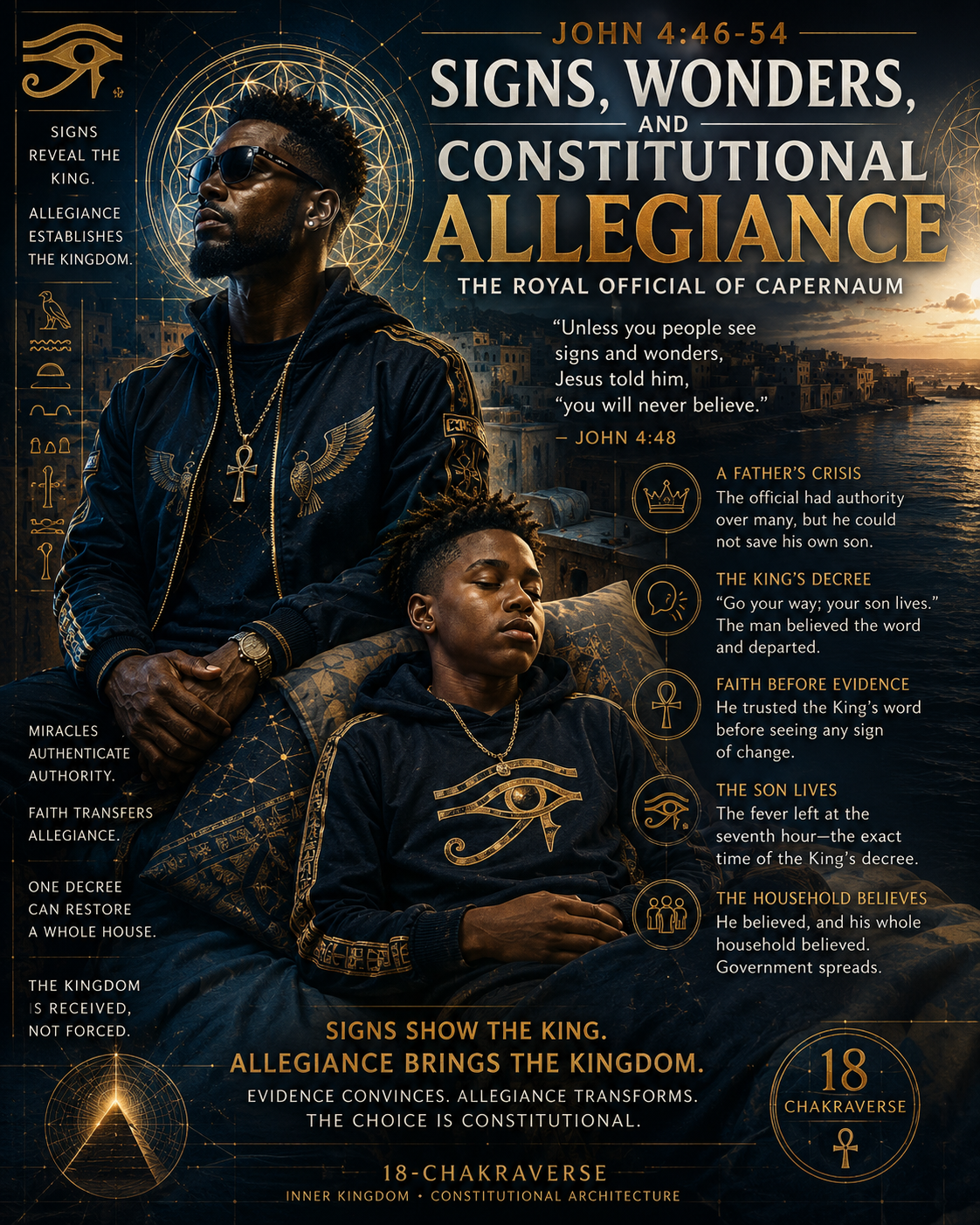
The Royal Official of Capernaum
Signs, Wonders, and Constitutional Allegiance: A Constitutional Decoding of John 4:46–54
By Alchemist Iris Chapman
“Unless you people see signs and wonders,” Jesus told him, “you will never believe.”
— John 4:48
At first glance, John 4:46–54 appears to be a simple healing story. A desperate father seeks Jesus. Jesus speaks. A dying son recovers. The family rejoices.
Yet John rarely records events merely because they happened. Throughout his Gospel, miracles function as signs—constitutional demonstrations that reveal the true nature of the Kingdom of God.
Within the 18-ChakraVerse, this miracle explores one of the most critical questions of constitutional maturity: What changes a person’s allegiance? Is it external evidence, or is it internal trust in the King’s government?
A Constitutional Crisis: The Royal Official as a Governing Persona
John introduces the man simply as a royal official. This detail is far more than a description of his occupation. Within the constitutional architecture of the 18-ChakraVerse, the official represents a governing persona—an aspect of Adam entrusted with stewardship, responsibility, and the administration of a particular constitutional district.
He possesses authority. He commands servants. He understands hierarchy, jurisdiction, and the exercise of delegated power.
From every outward appearance, he is successful. His governmental office is functioning. Others answer to him. Decisions are carried out at his command.
Yet the crisis John records exposes a constitutional reality that every Adam eventually encounters:
A constitutional office may appear strong externally while an internal jurisdiction quietly deteriorates.
There are areas of the Inner Kingdom that cannot be restored by education, influence, experience, wealth, or personal discipline alone. Human authority eventually reaches its constitutional limit.
Higher Adam immediately recognizes what the official himself cannot solve. Behind the father’s request lies a hidden governmental crisis.
The Constitutional District of Capernaum & The Earth Star Office
John intentionally tells us where this constitutional crisis unfolds: the son lies in Capernaum. This is far more than a geographical detail.
Within the 18-ChakraVerse, cities represent constitutional districts of the Inner Kingdom rather than permanently fixed chakra centers. The governing office emphasized depends upon the constitutional function under examination in the narrative.
In John 4:46–54, Capernaum primarily reflects the Earth Star Office. Its Hebrew name (Kaphar Nahum) strongly supports this reading:
- Kaphar: Speaks of a protective covering, a constitutional enclosure, the Mercy Seat, and the lawful boundaries that preserve life. It is the language of covenant protection and rightful placement.
- Nahum: Speaks of compassion, consolation, repentance, and comfort.
Together, they describe a district established to preserve life through lawful covenant exercised with mercy.
Yet this protected district contains a hidden constitutional breach. A royal official governs many servants, but he cannot preserve the life of his own son. His external government appears successful, while the future of his own household quietly deteriorates.
Within the constitutional architecture of the 18-ChakraVerse, this is the hallmark of an Earth Star crisis. The Earth Star Office governs covenant, lawful placement, inheritance, and constitutional continuity. It asks a foundational question:
Who ultimately governs this jurisdiction?
The Dying Son: Future Continuity of the Earth Star
The son represents more than a sick child—he represents the future continuity of lawful government:
- A son inherits.
- A son carries the father’s government into the next generation.
- A son embodies continuity, succession, and the future of the kingdom.
A dying son therefore symbolizes a governing function whose future has nearly collapsed. Hope itself is failing. The constitutional line appears ready to end.
The royal official has reached the absolute limit of his own authority. He can command servants. He can administer his office. But he cannot preserve the inheritance entrusted to him. Only Higher Adam can restore that which covenant alone can secure.
This is why Jesus never enters Capernaum physically in this passage. Instead, He issues a constitutional decree from a distance:
“Go your way; your son lives.”
The King’s spoken authority restores the district before the official ever sees the evidence. The miracle is therefore not merely the healing of a child; it is the restoration of a constitutional district whose covenant future was slipping away. Through the lawful decree of Higher Adam, the Earth Star Office is brought back under the Father’s covering, and the inheritance is preserved for another generation.
“Unless You See Signs and Wonders…”
Before healing the child, Jesus says something surprising:
“Unless you people see signs and wonders,” Jesus told him, “you will never believe.”
Many readers hear only criticism. But the remainder of the narrative reveals something far more subtle: Jesus is exposing how human beings typically approach government.
+---------------------------------------+---------------------------------------+
| Human Approach to Governance          | Constitutional Approach to Governance |
+---------------------------------------+---------------------------------------+
| Demands evidence before allegiance.   | Grants allegiance upon the King's word.|
| Wants sensory certainty before trust. | Trusts the decree before sight.       |
| Seeks demonstrations before submission.| Reorganizes inner government first.   |
+---------------------------------------+---------------------------------------+
Signs and wonders are not dismissed—they are acknowledged as effective tools that reveal the King’s authority. But they cannot complete the constitutional work by themselves.
The Official’s First Act of Faith: Why the Official Believes
The official pleads again: “Sir, come down before my child dies.”
Jesus refuses to travel physically. Instead, He simply issues a decree:
“Go your way; your son lives.”
This also explains why the official’s response is so significant.
When Jesus speaks these words, the official is being asked to entrust the future of his government to a higher constitutional authority. His own office has failed. His own authority has reached its limit. His servants cannot solve this crisis. Only the King’s decree can restore the inheritance.
John then records one of the most overlooked sentences in the Gospel:
“The man believed the word that Jesus spoke to him and departed.”
This is the miracle before the miracle. The miracle has already begun—not because the son has recovered, but because the father’s allegiance has shifted. He has acknowledged that there is a greater King than himself.
His constitutional allegiance shifts before his circumstances change. He begins walking home without physical evidence, no longer trusting what he can observe, but trusting the authority of the King’s word.
The Son Lives
While traveling home, servants meet him with astonishing news: his son is alive.
The official asks an illuminating question—he does not simply ask if the child recovered, but when.
“The fever left him yesterday at the seventh hour.”
Immediately, he recognizes the exact moment: the King’s decree and the son’s healing occurred simultaneously. Distance proved completely irrelevant.
The Father’s government is not limited by geography or physical space. Lawful authority operates constitutionally—wherever the King’s decree is received, restoration begins.
The Household Believes
John ends the story with another critical observation:
“He himself believed, and his whole household.”
This does not contradict the earlier statement that he believed Jesus’ word; instead, it reveals constitutional progression:
[1. Trust in King's Word] ---> [2. Visible Confirmation] ---> [3. Household Alignment]
Government spreads. Alignment within one constitutional office influences every connected jurisdiction. One person’s transfer of allegiance begins reorganizing an entire household.
Then Why Does Capernaum Fall?
This is where John’s story becomes astonishing. The very district in which this miracle occurs later receives one of Jesus’ strongest warnings:
“And you, Capernaum, will you be exalted to heaven? No, you shall descend to Hades…”
— Matthew 11:23
How can this happen? How can the city that witnessed so many miracles fail to enter constitutional alignment?
The answer lies in the fundamental difference between evidence and allegiance.
Evidence Is Powerful
Signs and wonders accomplish exactly what they are designed to accomplish:
- They authenticate the King’s authority.
- They expose competing, unlawful governments.
- They reveal that another Kingdom has entered the district.
Without signs, many would never recognize that Higher Adam governs differently from every earthly ruler. Miracles matter—John specifically calls them signs because a sign points beyond itself toward a destination.
Allegiance Changes Government
Capernaum witnessed miracle after miracle: the blind saw, the lame walked, demons fled, and storms obeyed. Yet many residents never reorganized their lives under the Father’s constitutional government. They accumulated evidence, but they failed to transfer allegiance.
The royal official did something entirely different: his allegiance shifted before the miracle became visible. That is why his story stands in such striking contrast to the city around him. He received more than physical healing—he received a new King.
Constitutional Government Cannot Be Forced
The Father’s government never operates through coercion. Miracles persuade, but they do not compel; truth invites, but it does not enslave.
The Kingdom of God must be received voluntarily. Every constitutional office remains free to decide which governing authority it will recognize. This is why signs alone cannot establish the Kingdom—they reveal the King, but only allegiance allows Him to reign.
The Constitutional Choice
John 4:46–54 asks a fundamental question: How much evidence is enough? How many signs are required before constitutional allegiance changes?
The royal official teaches that faith is not blind optimism. It is the willingness to organize one’s life around the King’s decree before visible circumstances confirm the outcome. His son was healed by the authority of Higher Adam, but the greater miracle occurred in the father’s heart when his allegiance shifted from confidence in his own authority to trust in the Father’s constitutional government.
Capernaum stands as the sobering counterpart to that transformation. An entire district witnessed extraordinary signs and wonders, yet many remained governed by familiar loyalties and inherited agreements. The official saw one miracle and found a King; Capernaum saw many miracles and largely continued under its old government.
Within the 18-ChakraVerse, this passage reveals that signs and wonders are indispensable constitutional witnesses. They authenticate the reality of the Kingdom and invite every district of the Inner Kingdom to realign. But the Kingdom itself is not established by miracles alone—it is established when Adam willingly transfers every constitutional office, every governing intention, and every allegiance to the Father’s Original Design. Only then does the King’s authority become the King’s active government within.