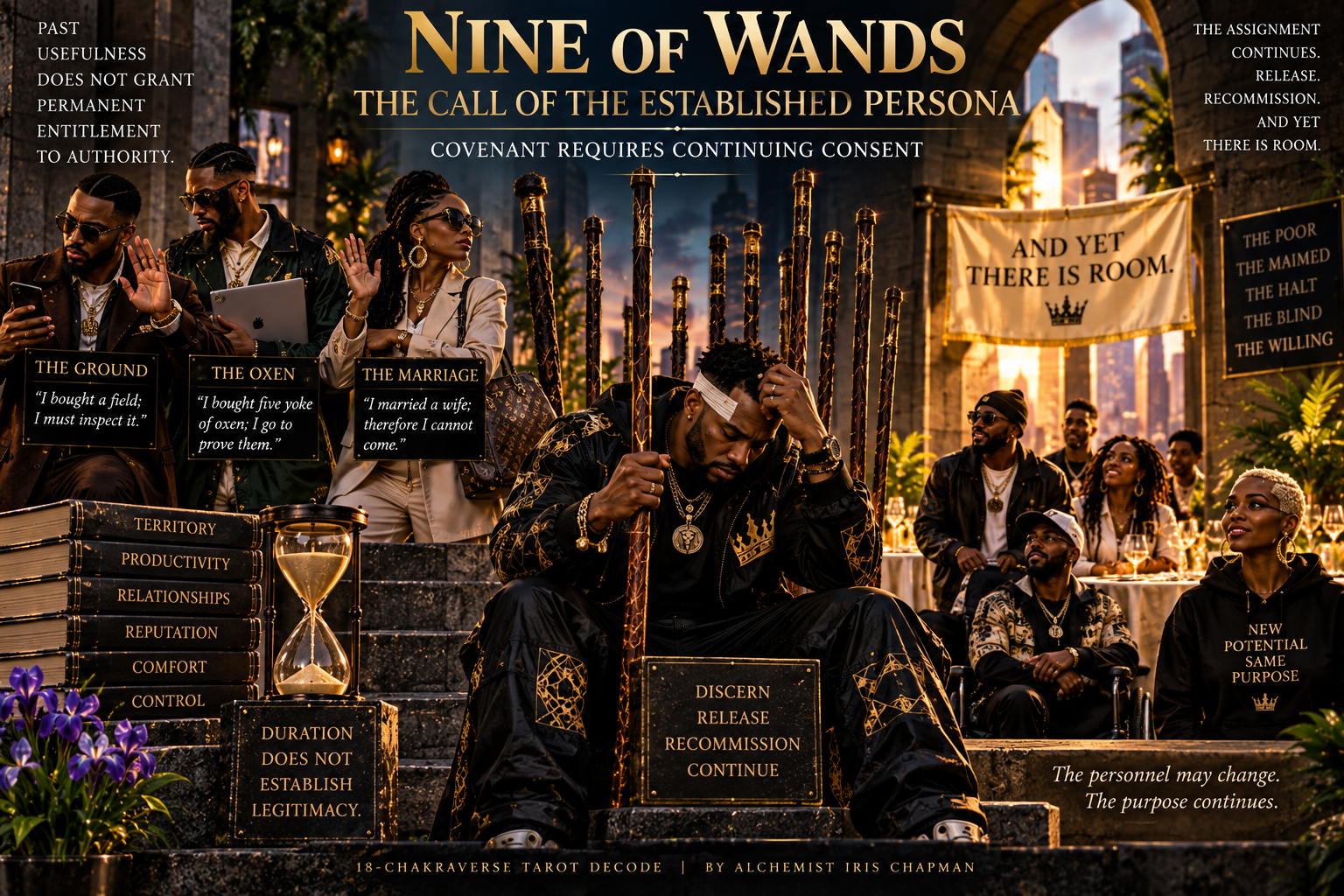
Covenant Requires Continuing Consent: When Yesterday’s Faithful Servant Refuses Today’s Divine Summons
By Alchemist Iris Chapman
There comes a point in human development when Divine Direction summons the very personas Adam believed he could rely upon indefinitely.
These are not rogue governments. They are not crude, trauma-induced survival mechanisms, nor are they obvious adversaries of Divine Purpose. They are often the most respectable, accomplished, disciplined, and proven members of Adam’s internal cabinet:
- They helped him survive his leanest years.
- They helped him construct enterprises and accumulate resources.
- They helped him raise children and maintain critical alliances.
- They established his professional credibility and public reputation.
- They helped him become the integrated man he is today.
Then Divine Direction announces: The next stage is prepared. Come.
And the established persona answers: I cannot.
This is the Nine of Wands: The Call of the Established Persona.
With the Covenant Chakra (Zebulun) fully integrated into the Wands progression, the constitutional crisis becomes unmistakable: Past faithfulness does not substitute for present consent. Covenant is not an ancient relic; it is living agreement. And living agreement must remain responsive to the One who issues the summons.
The Great Supper Is a Covenant Summons
Luke 14 provides the operational architecture:
“A certain man made a great supper, and bade many: And sent his servant at supper time to say to them that were bidden, Come; for all things are now ready.”
— Luke 14:16–17
The feast is prepared. The table is laden. The resources exist.
Notice the crucial status of those summoned: They were already bidden. These are not strangers wandering outside the gates. They possessed standing in the house, held relationship with the master, and were fully aware that an invitation existed.
Then the hour of execution strikes: Come.
“And they all with one consent began to make excuse.”
— Luke 14:18
This is not the rebellion of an outsider; it is the refusal of the established insider. That makes the Nine an acute Covenant crisis.
Covenant Must Remain Responsive
The Covenant Chakra governs constitutional integrity, stewardship, and demonstrated trustworthiness. Yet Covenant can never be distorted into an entitlement contract:
- It does not mean: I was obedient in the past, therefore my operational post is permanent.
- It does not mean: I fulfilled yesterday’s commission, therefore I dictate tomorrow’s strategy.
- It does not mean: God used this persona to build an empire, therefore this persona must govern the kingdom forever.
The governing inquiry of the Nine is severe: Can an established persona remain responsive when Divine Government alters its assignment?
Initial obedience is comparatively simple—the novice has nothing to lose. The veteran persona possesses a formidable résumé, accumulated honors, and invested equity. Surrender is far more costly for an established structure.
Yesterday’s Assignment Can Become Today’s Idol
The peril of the Nine is subtle because Adam is not clinging to overt wickedness. He is clinging to something God explicitly authorized in an earlier season:
- A past career or ministerial calling
- A proven creative formula or business method
- An established role within a family system
- A hard-won theological framework or intellectual reputation
All of these were legitimate in their appointed hour. Yet Covenant is never formed with the assignment itself; Covenant is made exclusively with the Government that issues the assignment. The servant must remain perpetually available for reassignment, retirement, or release.
The Three Excuses: Three Competing Treaties
Luke details three specific refusals:
[The Ground]   ──► "I have bought a piece of ground, and I must needs go and see it."
[The Oxen]     ──► "I have bought five yoke of oxen, and I go to prove them."
[The Marriage] ──► "I have married a wife, and therefore I cannot come."
None of these pursuits is inherently immoral. That is why the Nine demands deep discernment. The problem is not possession, labor, or relationship; the problem is priority of allegiance. Each legitimate structure has usurped veto power over Divine Direction.
1. The Ground: Covenant With Established Territory
The first persona bought a field. The field represents acquired territory—investments of time, capital, status, and identity. The Property Steward declares, “I cannot abandon this; I spent twenty years cultivating this soil.”
Covenant audits: Did Divine Government entrust you with the field, or did the field become your sovereign ruler? When conscious construction outranks the Architect, the structure has become an idol.
2. The Oxen: Covenant With Productivity
The second persona purchased five yoke of oxen and must test their pulling power. This is the Industrial Producer: operational competence, commercial output, and functional efficiency. It is often the most applauded persona in Adam’s cabinet.
Yet when the summons sounds, the Producer protests, “I am too busy producing results.” This breach is particularly dangerous because it masquerades as diligence. Adam can be passionately managing yesterday’s tasks while deaf to today’s command.
3. The Marriage: Covenant With Relational Identity
The third persona declares, “I have married a wife, and therefore I cannot come.”
The relationship is not condemned, but the deduction is fatal: “Therefore I cannot come.” A secondary, human covenant has assumed absolute veto authority over the primary Covenant with God. The Relational Caretaker balks at divine reassignment because human networks are accustomed to the old identity.
Legitimate Covenants Must Remain Constitutionally Ordered
The Covenant Chakra does not encourage reckless abandonment of duty. Vows matter. Family commitments, financial contracts, institutional obligations, and practical stewardship remain sacred.
Constitutional government requires ordered covenant:
Divine Will (Primary Covenant) > Human Commitments (Secondary Covenants)
A lower agreement cannot unilaterally cancel the Sovereign’s call, nor can Adam cite “divine leading” to evade ordinary accountability. Adam must use sharp Swords discernment to distinguish authentic divine redirection from spiritualized avoidance, boredom, or restlessness.
“They All With One Consent”
Then comes the systemic rupture:
“And they all with one consent began to make excuse.”
— Luke 14:18
Not an isolated mutiny—a unified strike across the entire established cabinet:
- The Provider says: “Too financially precarious.”
- The Scholar says: “This disrupts my published doctrine.”
- The Producer says: “My schedule cannot accommodate this.”
- The Caretaker says: “The family will never tolerate the disruption.”
- The Leader says: “I will lose my institutional standing.”
Adam looks across his polished boardroom and realizes: None of his proven personas are willing to take the next step.
The Bandaged Head: The Trauma of Failed Expectation
In classical tarot, the Nine of Wands depicts a weary, bandaged figure leaning upon a heavy staff. Behind him stands a palisade of eight firmly planted staves.
The bandage marks the acute shock of discovering that yesterday’s competence is not automatically transferable to tomorrow’s assignment.
[Eight Wands Behind] ──► Accumulated victories, integrated capacities, established tenure.
[The Bandaged Brow]  ──► Somatic & psychological grief over internal refusal.
[Ninth Wand in Hand] ──► Personal fidelity to the Covenant when the workforce quits.
The pain does not stem from external attack; it stems from internal friction. Adam confused past utility with permanent suitability.
Covenant Permits the Persona to Decline
Because Covenant requires voluntary consent, Divine Government does not force unregenerate compliance:
- The established persona states its limit: “I cannot go.”
- Adam does not manipulate or bully it into false obedience.
- Adam formally acknowledges: “Then your commission ends here.”
The persona is not destroyed; it is honorably retired from executive leadership.
The Wound Does Not Get the Throne
Grief over this internal retirement is entirely natural, but the boundary must hold: The wound is real, but the wound never gets the throne.
If Adam responds to this internal impasse with bitterness, he risks drafting a reactionary covenant:
- “No one can be trusted.”
- “I must do everything entirely alone.”
- “Every partnership eventually rots.”
When Adam harbors these thoughts, Eve—the Holy Spirit and generative Helpmeet—receives an unholy blueprint. The wound hardens into a fortress, giving birth to the Cynic, the Isolationist, and the Suspicious Warden.
Covenant establishes an immovable rule: Pain may inform you, but pain may never legislate for you.
The Master’s Anger: Transforming Disappointment Into Motion
Luke does not sanitize the master’s emotional response:
“Then the master of the house being angry said to his servant, Go out quickly into the streets and lanes of the city…”
— Luke 14:21
The master experiences real anger, yet notice its expression: He does not demolish the feast, burn down the estate, or pursue the guests to berate them.
The heat is converted instantly into redirected movement. This is pure Solar Plexus fire governed by Covenant: Disappointment is converted into reassignment without pausing for self-pity.
“Bring in Hither the Poor, the Maimed, the Halt, and the Blind”
Divine Government turns toward the overlooked sectors of Adam’s interior:
[The Poor]   ──► Neglected capacities (play, contemplative silence, raw creative intuition).
[The Maimed] ──► Wounded capacities carrying scar tissue, yet constitutionally viable.
[The Halt]   ──► Hesitant, unseasoned capacities lacking technical confidence, yet fully willing.
[The Blind]  ──► Untrained faculties that cannot foresee the outcome, but trust the Guidance.
Availability suddenly eclipses credentials.
The established personas had pedigree; the outcasts have willingness. The established personas had past victories; the outcasts have present consent.
Established Pedigree + Refusal = Disqualification
Untrained Capacity + Willing Consent = Kingdom Eligibility
Competence can be developed through training, but an unwilling heart cannot be utilized by the Spirit.
Tenure Is Not Ownership
The Nine strips away the illusion of internal entitlement. A persona may have served honorably for three decades—honor it for its service, but never surrender to it the keys of sovereign governance:
- The Provider carried you through poverty—bless it, but do not let financial fear veto a divine transition.
- The Intellectual dismantled religious confusion—honor it, but do not permit academic pride to reject fresh revelation.
The Government always retains the right of redistribution.
“And Yet There Is Room”
Once the outcasts assemble, the servant delivers an astonishing report:
“Lord, it is done as thou hast commanded, and yet there is room.”
— Luke 14:22
Adam is vastly larger than his active cabinet.
- His current résumé does not define the perimeter of his soul.
- His existing skills do not exhaust his divine capacity.
- His most celebrated persona is not his final iteration.
And yet there is room. The refusal of an established persona clears the table so previously uncultivated dimensions of Adam can finally sit down and dine.
The Ninth Wand: Holding the Line Under Fatigue
The figure in the card stands alone with his staff, weary yet watchful. He does not discard the staff because his companions departed.
The Ninth Wand represents perseverance in Covenant when the familiar workforce declines the call.
This posture must not be confused with cynicism:
- Cynicism: Hardens the heart, assumes betrayal is universal, and builds solitary walls.
- Discernment: Acknowledges specific refusals, maintains healthy boundaries, and remains receptive to new, willing participation.
External Adams May Decline Too
The parable of the Great Supper applies with equal force to external relationships. You may issue a clear, loving invitation to partners, friends, family members, or colleagues to step into a new dimension of aligned purpose.
They may decline.
Recall the previous jurisdictional laws:
- Eight of Wands: Recognition ≠ Jurisdiction.
- Nine of Wands: Invitation ≠ Ownership.
Another Adam’s refusal never licenses coercion. You cannot guilt, threaten, or spiritually manipulate another sovereign soul into joining your assignment.
“Who art thou that judgest another man’s servant? to his own master he standeth or falleth.”
— Romans 14:4
You bless their sovereignty, release them without bitterness, and keep the doors open for those whom the Father is actually sending.
Loving the Purpose More Than the Personnel
Here lies the definitive test of the Nine of Wands: Are you devoted to the Father’s Purpose, or are you devoted to executing that Purpose solely through the specific people and personas you expected to use?
"I will go if my business partner stays."
"I will go if my theological reputation remains safe."
"I will go if my spouse leads the charge."
"I will go if my old skills guarantee my comfort."
Divine Government answers with a single word: Come.
The assignment endures, but the personnel may be entirely reordered. The vehicle may be replaced, the tools may change, and the workforce may be radically reconstituted. Covenant anchors exclusively to the Sovereign.
The Fire Progression: Ace to Nine
- Ace of Wands (Kindle): Power entrusted to a prepared vessel.
- Two of Wands (Empower): The persona receives generative backing under agreement.
- Three of Wands (Guide): Daily coordinates received via continuing guidance.
- Four of Wands (Repurpose): Capacities rescued and stabilized under new management.
- Five of Wands (Confront): Competing survival rulers stripped of their crowns.
- Six of Wands (Recognize): Demonstrated fruit honored without persona inflation.
- Seven of Wands (Defend): Realignment defended against internal counterattack.
- Eight of Wands (Execute): Governed speed born of settled constitutional law.
- Nine of Wands (Recommission): Releasing yesterday’s faithful servant when it refuses today’s summons.
The fire has moved past the obvious enemy and the subtle crowd; it now tests Adam’s attachment to his own past success.
Quick Reference: Nine of Wands in the 18-ChakraVerse
| Element | Decode |
| The Great Supper | The next developmental phase of Divine Purpose ready for physical embodiment |
| Master of the House | Divine Sovereign Government issuing the operational call |
| Those Already Bidden | Established personas possessing tenure, competence, and past usefulness |
| The Ground | Unhealthy attachment to accumulated territory, capital, and past achievements |
| The Oxen | Entanglement with operational productivity and functional busyness |
| The Marriage | Elevating a human relational contract to a veto position over Divine Will |
| The Bandaged Brow | Somatic and emotional shock of discovering an internal persona’s refusal |
| Eight Wands Behind | Prior developmental milestones that cannot substitute for present obedience |
| Ninth Wand in Hand | Continuing personal fidelity to the assignment despite internal abandonment |
| The Outcasts | Latent, neglected, wounded, or untrained capacities ready for activation |
| “And Yet There Is Room” | Adam’s untapped constitutional potential exceeding his known identities |
| Covenant Chakra (Zebulun) | Enforces present-tense faithfulness, releases obsolete tenure, and reassigns duties |
| Primary Test | Can Adam remain faithful when trusted internal and external allies refuse to advance? |
| Core Movement | Summon → Receive Refusal → Grieve → Release → Recommission → Advance |
| Master Law | Past faithfulness earns honor, not permanent executive tenure. Covenant answers present commands. |
| Operational Formula | Established Refusal + Sovereign Release + Latent Capacity Awakened + Eve’s Empowerment = Unbroken Kingdom Progress |
Nine of Wands Declaration
I honor what carried me without crowning it as my god.
I honor yesterday’s faithful servants without granting them permanent executive tenure.
I do not confuse tenure with ownership.
I do not confuse operational productivity with Covenant obedience.
I do not elevate any human relationship into an unauthorized veto over the Father’s call.
I do not abandon legitimate covenants in the pursuit of novelty.
I weigh the summons with clean discernment.
When the Father speaks, I remain available for complete reassignment.
I permit an established persona to state its limit and say no.
I release it from active leadership without hatred or contempt.
I feel the sting of disappointment without drafting a treaty with my pain.
Suffering may inform me; it will never govern me.
I refuse to coerce other Adams to sit at my table.
I release their refusal without harboring bitterness.
I open the banquet doors to the poor, the maimed, the halt, and the blind.
I make room for capacities within myself that I have never yet met.
The Father issues the call.
Adam yields his consent.
Covenant remains living and responsive.
Eve empowers the willing vessel.
Personas serve according to present orders.
The personnel may change, but the purpose moves forward.
The table remains laden.
And yet there is room.