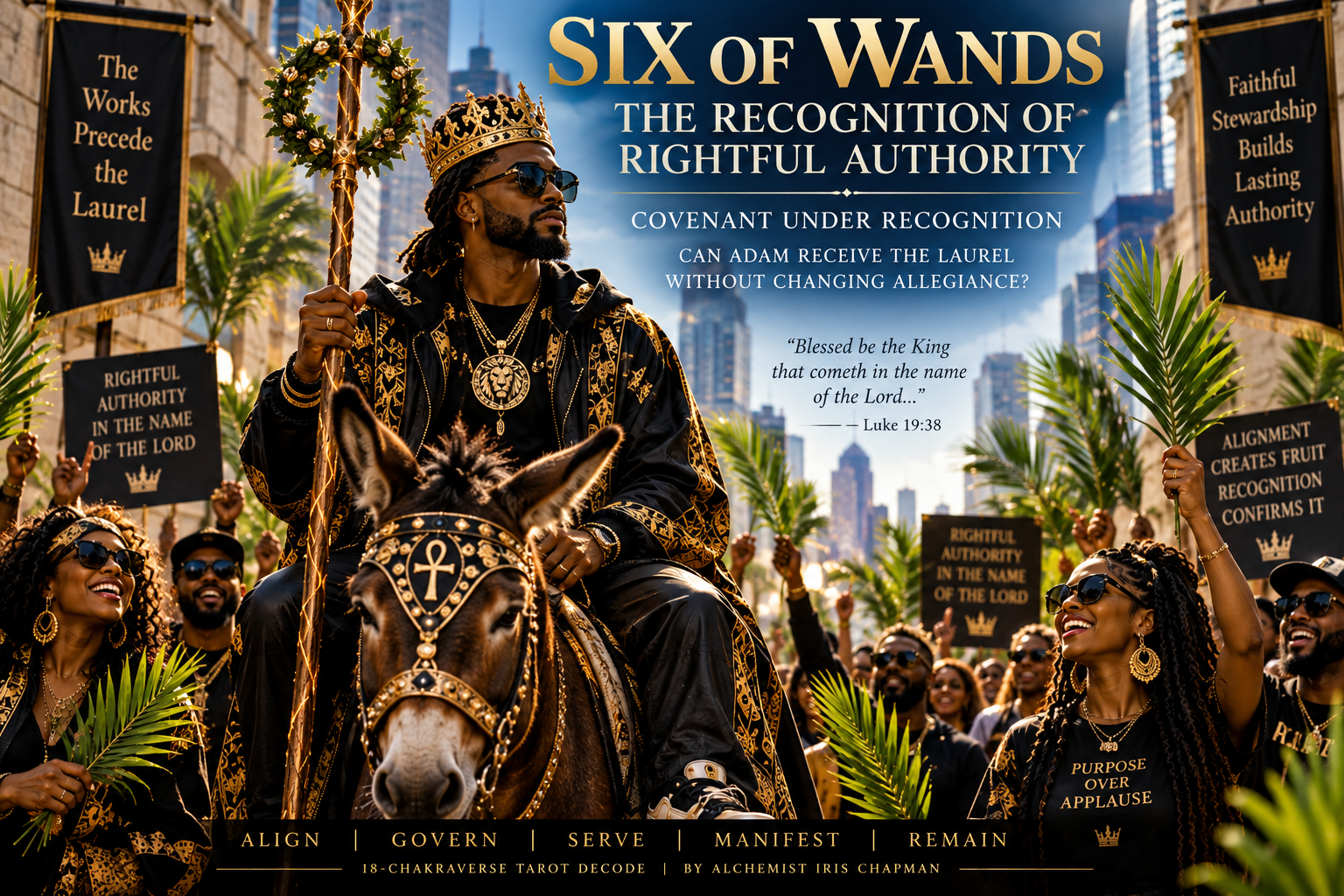
Covenant Under Recognition: Can Adam Receive the Laurel Without Changing Allegiance?
By Alchemist Iris Chapman
The internal civil war has reached its verdict.
In the Five of Wands, Divine Fire exposed the competing governments operating within Adam’s earth. Entrenched personas asserted their survival claims, ancient agreements surfaced, and theoretical knowledge was separated from actual submission. False crowns were struck down, and useful capacities were severed from unauthorized rule.
Now the smoke clears. The question of internal jurisdiction has been settled.
The King mounts his vehicle. The city turns its eyes toward him, and the crowd begins to shout.
This is the Six of Wands: The Recognition of Rightful Authority.
With the Covenant Chakra (Zebulun) active in the Wands progression, the Six is revealed as far more than a simple victory card. It is a severe constitutional examination. The Five asked: Will Adam remain faithful when his internal personas resist Divine Government?
The Six asks: Will Adam remain faithful when the world recognizes his authority?
Opposition tests Covenant, but applause tests it even more deeply.
The Crowd Does Not Make Jesus King
Luke records the architectural blueprint during the Triumphal Entry:
“The whole multitude of the disciples began to rejoice and praise God with a loud voice for all the mighty works that they had seen; Saying, Blessed be the King that cometh in the name of the Lord: peace in heaven, and glory in the highest.”
— Luke 19:37–38
A foundational truth must be established immediately: The crowd does not make Jesus King. They merely bear witness to an authority that was established long before they opened their mouths.
Before Jerusalem ever shouted “Blessed be the King,” Jesus had already:
- Endured forty days of desert testing.
- Rejected Satan’s offer of worldly kingdoms.
- Healed the broken and cast out illegitimate rulers.
- Confronted religious hypocrisy and taught with original authority.
- Obeyed the Father in total obscurity.
- Governed His own earth without compromise.
The crowd arrives after the fruit has matured. Divine Government establishes authority; fruit demonstrates it; recognition merely witnesses it.
Divine Design⟶Adam’s Agreement⟶Eve’s Empowerment⟶Embodied Fruit⟶Recognition
Recognition is strictly downstream from Covenant. Public opinion cannot create authority, nor can public rejection diminish it.
“Cometh in the Name of the Lord”
The multitude proclaims: “Blessed be the King that cometh in the name of the Lord.”
That single phrase holds the constitutional key. Jesus did not enter Jerusalem in His own name; He came bearing the legal seal of a higher Sovereign.
“I am come in my Father’s name, and ye receive me not: if another shall come in his own name, him ye will receive.”
— John 5:43
Here lies the holy paradox of the Six of Wands: Adam possesses genuine authority precisely because he refuses to claim self-originated sovereignty.
The mature Wand never announces, “Look how powerful I have become.” It declares, “Look at what faithful alignment under Divine Government has produced.”
The Six Tests Whether Recognition Alters the Contract
It is comparatively straightforward to maintain Covenant in obscurity. When no one is watching, the ego has little outside validation to feast upon. The real hazard ignites when the work becomes visible.
What happens when:
- Audiences applaud and quote your words?
- Seekers seek your counsel and institutions offer you payment?
- Communities celebrate your gifts and call you a master, teacher, or authority?
Does Adam’s internal agreement quietly morph? Does he begin optimizing his choices to preserve public approval? Does he become terrified of losing the laurel?
The moment recognition becomes the metric of safety, the crowd has dethroned God and assumed the governance of Adam’s life.
The Laurel Is Evidence, Not Identity
In classical tarot iconography, the horseman carries a staff crowned with a laurel wreath, while another rests upon his brow. In the Greco-Roman world, the laurel signified imperial conquest and public victory.
Covenant introduces an essential boundary: The laurel is evidence; it is not government.
Adam may receive honor. He may acknowledge a completed assignment and celebrate demonstrated fruit. But Adam cannot derive his identity from the wreath. When the laurel shifts from being an objective marker of completed work to the primary food that fuels Adam’s self-worth, the King has surrendered his throne to the crowd.
Recognition Can Resurrect the Performer
The Six of Wands directly retests the internal territory settled in the Five.
Recall the Performer persona—confronted in Matthew 23 for doing all works “to be seen of men.” In the Five, the Performer was stripped of its crown and reassigned. Its communication mastery, presence, and relational charisma were redeemed. Eve began empowering those assets for a legitimate commission.
Then public recognition arrives. Instantly, the old survival treaty whispers:
- “They are looking at you now.”
- “Keep them captivated.”
- “Filter the message so you don’t lose the applause.”
- “Protect the brand.”
The Covenant Chakra audits the scene: Has the Performer truly become a servant of the assignment, or was it merely biding its time until a larger stage appeared?
Recognition Is More Subtle Than Rejection
Rejection is an assault; recognition is a seduction. Rejection triggers vigilance, while recognition coaxes the defenses to sleep.
- The wilderness whispers: Prove yourself.
- The crowd whispers: You have proven yourself; now take the throne.
Both temptations aim to sever Adam from Divine Government.
Jesus survived both. He turned away Satan’s offer of global kingdoms in the desert, and later He entered Jerusalem amid waving palm branches without letting the public acclaim dictate His steps. Adam does not need to run from honor, but he must steadfastly refuse to worship the system providing it.
The Crowd Is Too Fickle to Serve as a Foundation
Human acclaim is fundamentally unstable. The same geographical territory that cries “Hosanna” on Sunday will scream “Crucify him” by Friday.
If Adam constructs his self-worth upon public affirmation, the first wave of criticism will shatter him. If the crowd has the internal authority to crown him, it holds equal power to execute him.
Covenant anchors the vessel to an immovable bedrock:
[The Fickle Multitude] ──► Hosanna (Sunday) ──► Crucify (Friday)  [UNSTABLE]
                                  vs.
[Covenant Alignment]   ──► Divine Will ──► Steady Government       [UNSHAKABLE]
Adam’s peace remains untouchable because public sentiment was never the source of his mandate.
The Donkey: The King Rides His Earth
The Triumphal Entry provides an extraordinary somatic symbol:
“Go your way into the village over against you; in the which at your entering ye shall find a colt tied, whereon yet never man sat: loose him, and bring him hither… The Lord hath need of him.”
— Luke 19:30–31
Within the 18-ChakraVerse, the earth is first Adam’s physical body, biological nervous system, and instinctual nature.
Notice what the King does: He does not destroy the beast; He rides it.
The King does not mortify or despise his biology. He governs it. The physical body becomes the consecrated vehicle that transports Divine Purpose into physical space.
Embodied Covenant: Calibrating the Nervous System
Covenant is not purely abstract; it must govern biology:
- Can Adam remain grounded when adrenaline surges?
- Can his nervous system stay regulated while a stadium cheers?
- Can he experience high-visibility success without developing a chemical addiction to dopamine and applause?
- Can he return to ordinary, mundane stewardship on Monday morning after extraordinary victory on the weekend?
This is embodied Covenant. The King rides the animal; the animal does not bolt toward the roar of the crowd.
“The Lord hath need of him.” The physical body, the nervous system, the personality, the intellect, and the repurposed personas all have legitimate functions within the Kingdom. None of them need to claim sovereignty to possess immense value. The beast of burden carries the King. That is its true glory.
The Developmental Assembly of the Six Wands
[Wand 1: Divine Fire] ────────► Power is entrusted to a prepared vessel.
         │
[Wand 2: Generative Union] ───► Adam & Eve enter operative agreement.
         │
[Wand 3: Divine Guidance] ────► Power receives real-time coordinates.
         │
[Wand 4: Repurposed Persona] ─► Recovered human capacity enters lawful service.
         │
[Wand 5: Loyal Submission] ───► Competing internal rulers surrender their crowns.
         │
[Wand 6: Recognized Authority] ► Integrated government becomes publicly visible.
The sixth Wand does not manufacture authority on the spot; it reveals the structural coherence generated across the prior five thresholds.
Covenant Transforms Coherence Into Dependability
The Covenant Chakra ensures that alignment is not a fleeting spiritual breakthrough, but enduring character:
- Can Adam produce aligned fruit consistently across seasons?
- Is his private life identical to his public presentation?
- Does his word remain binding when an agreement becomes costly?
- Does sudden wealth warp his ethics or visibility compromise his values?
The world recognizes genuine authority because Covenant has made that authority dependable.
The Root of Recognition: Demonstrated Fruit
The disciples praised God “for all the mighty works that they had seen.”
The works preceded the celebration. The Performer acts strictly to be seen; the aligned Adam executes the assignment because God commanded it, regardless of whether a single human eye witnesses the labor.
| Persona / State | Core Dynamic | Operational Objective |
|---|---|---|
| The Performer | Image-Driven | Performs to extract validation and manufacture status. |
| Aligned Authority | Assignment-Driven | Executes the mandate; recognition may or may not follow. |
| The Rogue Six | Acclaim-Addicted | Consumes praise, turning public applause into its governing god. |
Eve Manifests the Fruit, Not Persona Worship
Throughout the Wands journey, Eve—the Holy Spirit and Manifestor-in-Chief—supplies the generative current that brings the Word into physical reality.
When results materialize, Adam faces a subtle temptation: taking proprietary ownership of Eve’s manifestations.
- Early Stage: “The Lord did this through us.”
- Compromised Stage: “Look at what we built.”
- Rogue Stage: “I built this empire; this belongs to me.”
Covenant severs this slide into pride. Manifestation does not prove Adam is the Source; it proves that the divine circuit remained unbroken.
“For unto whomsoever much is given, of him shall be much required: and to whom men have committed much, of him they will ask the more.”
— Luke 12:48
Visibility does not lower the standard of stewardship; it radically increases accountability.
The Lowly King: Humility as Accurate Alignment
Zechariah prophesied the exact posture of legitimate power:
“Rejoice greatly, O daughter of Zion; shout, O daughter of Jerusalem: behold, thy King cometh unto thee: he is just, and having salvation; lowly, and riding upon an ass, and upon a colt the foal of an ass.”
— Zechariah 9:9
King and lowly. These terms are not contradictions:
- False Pride: I am the sovereign source of this power.
- False Humility: I have no authority or power at all.
- Covenant Alignment: I hold the exact authority entrusted to me by the Father, and I exercise it strictly within His jurisdiction.
When the Pharisees demanded that Jesus silence the celebrating crowds, He refused:
“I tell you that, if these should hold their peace, the stones would immediately cry out.”
— Luke 19:40
Jesus did not practice false modesty. He did not deny the reality of His office or pretend the fruit was invisible. True humility operates with precision in both directions: never grasp at an unauthorized throne, and never abdicate an assigned post.
The Stones Cry Out: Material Reality Testifies
Eventually, physical reality corroborates spiritual truth. Adam does not need to run continuous public relations campaigns to defend his standing.
Repeated alignment produces material proof:
- Consistent habits and integrated character tell the truth.
- Financial integrity and stable relationships tell the truth.
- Governed speech and mature fruit tell the truth.
The physical architecture of Adam’s life becomes an objective witness to the Government within.
The Dual Gauntlet: Five and Six
               [The Dual Gauntlet of Covenant]
                              │
     ┌────────────────────────┴────────────────────────┐
     ▼                                                 ▼
[Five of Wands]                                  [Six of Wands]
Covenant Under Resistance                        Covenant Under Recognition
"Will you stand when                             "Will you remain surrendered
the internal personas fight?"                     when the external world applauds?"
Opposition cannot destroy the aligned Adam, and acclaim cannot seduce him. Criticism does not strip his authority, and praise does not inflate his persona. His allegiance is anchored in the Father.
The Arc of Fire: Ace to Six
- Ace of Wands (Kindle): Can God trust Adam with fire?
- Two of Wands (Empower): Can the empowered persona remain within the agreement?
- Three of Wands (Guide): Can Adam yield to present coordinates?
- Four of Wands (Repurpose): Can recovered capacity serve its new Government?
- Five of Wands (Confront): Will competing internal personas surrender their crowns?
- Six of Wands (Recognize): Can Adam receive rightful recognition without changing allegiance?
The fire has journeyed from an internal spark to visible demonstration. Authority is now public knowledge.
Yet this visibility creates an entirely new operational challenge: Once authority is publicly established, it will be contested by external systems.
That looming siege marks the threshold of the Seven of Wands.
Quick Reference: Six of Wands in the 18-ChakraVerse
| Element | Decode |
|---|---|
| The King | Aligned Adam exercising legitimate stewardship under Divine Authority |
| The Crowd | External observers recognizing demonstrated fruit |
| Laurel Wreath | Lawful recognition that must never become identity or internal food |
| The Colt / Donkey | Adam’s physical body and biological nervous system brought under government |
| Riding the Colt | Embodied sovereignty; stewarding biological capacity without destroying it |
| “In the Name of the Lord” | Operating strictly under higher constitutional authorization |
| Mighty Works | Tangible, embodied evidence that precedes public honor |
| Stones Crying Out | Physical reality confirming repeated, sustained alignment |
| Covenant Chakra (Zebulun) | Preserves allegiance, humility, and dependability when visibility surges |
| The Rogue Six | Persona consuming praise, allowing the crowd to dictate policy and identity |
| Primary Test | Can Adam receive recognition without changing his sovereign allegiance? |
| Core Movement | Govern → Demonstrate → Emerge → Receive → Remain |
| Master Law | Recognition does not establish authority. Alignment produces fruit; recognition merely witnesses it. |
| Operational Formula | Alignment + Covenant Faithfulness + Governed Earth + Eve’s Power = Recognized Authority |
Six of Wands Declaration
I do not labor to be seen.
I allow faithful stewardship to become visible in its appointed season.
I do not mistake recognition for authorization.
I do not mistake applause for Daily Bread.
I refuse to let the crowd crown what God has not sanctioned.
I refuse to let criticism dethrone what God has established.
I receive the laurel without consuming it.
I govern my physical earth without despising its design.
I hold the authority entrusted to me without claiming to be its Source.
The Father establishes.
Adam agrees and governs.
Eve empowers.
The persona serves.
The body carries the commission.
Demonstrated fruit bears witness.
Covenant anchors my loyalty.
Whether Jerusalem shouts Hosanna or demands the cross, my government remains immovable in the Father.