
By Iris J Chapman
Before Adam Becomes Physical
Before the Point, there is the Monad.
Before Adam has a physical location, a body, a persona, an environment, or a curriculum, there is the mystery of Adam’s origin. This is where we must begin carefully.
Source gives us just enough information about the spiritual realm to recognize that it exists. Scripture speaks of Spirit, angels, visions, dreams, heavenly activity, revelation, and realities that extend beyond ordinary physical perception. But we are not given a detailed map of that realm. We are given glimpses—enough to know there is more, but not enough to pretend we understand it completely.
The Monad stands at the edge of that mystery.
What Is the Monad?
The word monad comes from the Greek monas, meaning one, unit, or alone. The term has been used in philosophy, mathematics, metaphysics, and various spiritual traditions in very different ways. I am not adopting all of those systems.
For this discussion, one characteristic is especially useful: The Monad is irreducible. Something irreducible cannot be broken down into simpler components and still remain what it is.
Within the 18-ChakraVerse, I use the Monad to describe the energetic spark from the Father that becomes Adam. That is all we need to establish at the beginning:
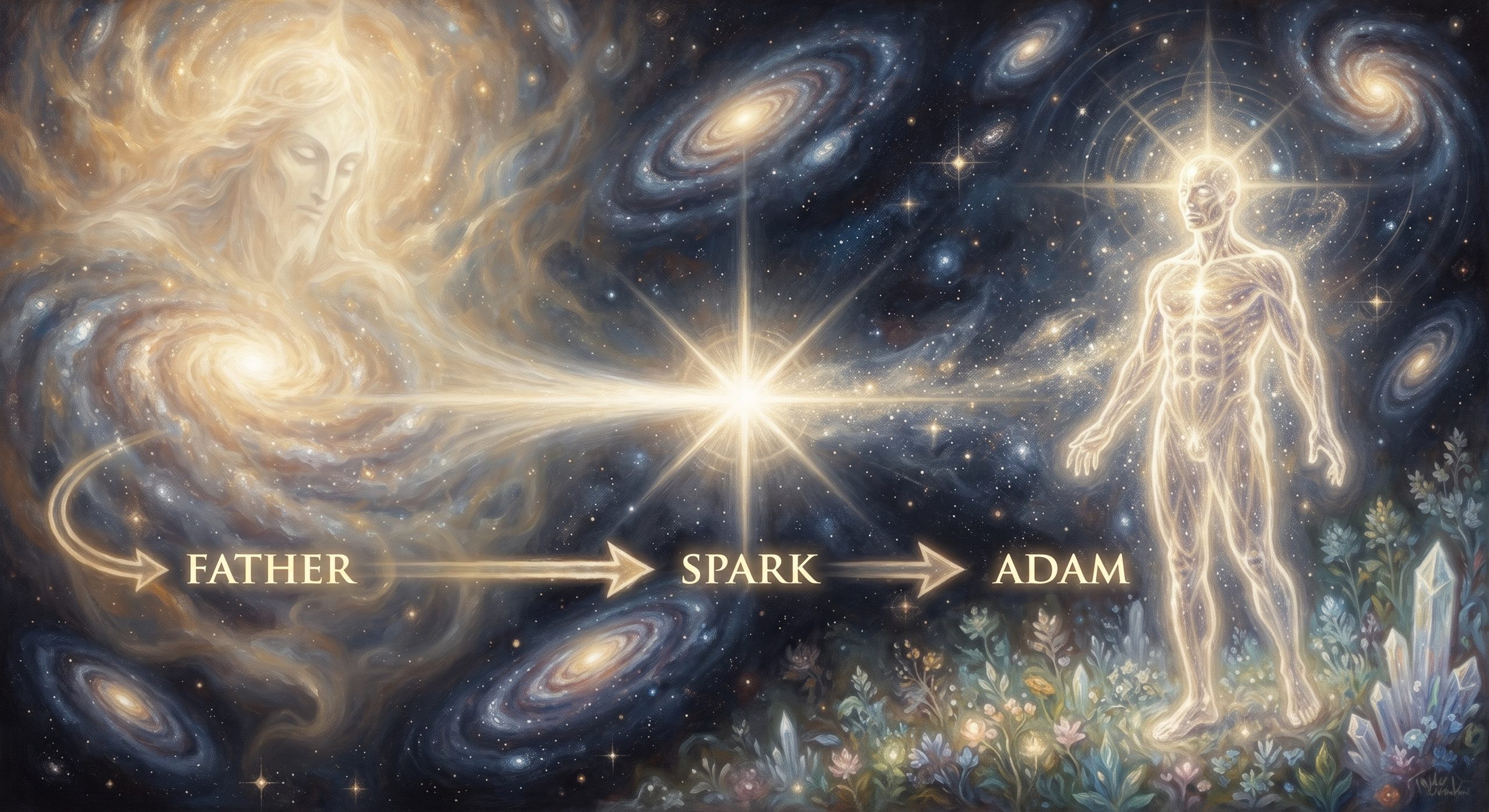
Before we examine what Adam does, we must first acknowledge that Adam is.
Energy Is Existence
When I use the word energy here, I am not using it in the scientific sense of measurable physical energy such as heat, electricity, motion, or radiation. I am using the word metaphysically.
In this framework, energy does not animate existence; energy is existence. Physical form provides an avatar through which that existence can operate and experience the material world.
This distinction matters. If energy merely animated Adam, we could imagine Adam as a physical object constructed first and then switched on by some external life force. That is not what I mean. Adam precedes the avatar. The spark from the Father becomes Adam. Physical expression comes later.
The Spark Comes From the Father
Adam does not originate himself. His origin is Source. The Monad therefore tells us something fundamental about Adam without requiring us to construct an elaborate theology of the spiritual realm: Adam comes from the Father.
However, coming from the Father does not mean Adam is the Father. That distinction must remain intact:
- The spark has an origin.
- The origin is Source.
- The spark becomes Adam.
- Adam is therefore related to Source without being identical to Source.
We do not have to understand the mechanics of that relationship to acknowledge it.
The Leaf Is Not the Tree
Creation gives us a useful way to think about this distinction. A leaf comes from a tree, but the leaf is not the tree, nor does it look like the enormous trunk from which it grew.
A seed is an even stronger example. Look at an acorn: nothing about its appearance adequately communicates the enormous oak it may someday become. The mature oak may stand for centuries—enduring wind, drought, freezing temperatures, scorching summers, disease, and changing seasons—while looking entirely different from its origin.
- Origin does not equal maturity.
- Potential does not equal development.
- Coming from something does not mean being identical to it.
So when I describe the Monad as the spark from the Father, I am not describing Adam as a miniature God. I am identifying Adam’s origin. What Adam becomes is a developmental question, and we are nowhere near that part of the story yet.
Adam Is Irreducible
The Monad also gives us a safeguard for everything that follows. Adam cannot ultimately be reduced to the things we observe about him:
- Adam is not merely his body.
- Adam is not his persona.
- Adam is not his childhood or environment.
- Adam is not his successes or failures.
- Adam is not his current level of development—nor even the curriculum he happens to be experiencing.
All of these things can tell us something about Adam, but none of them completely tells us what Adam is. There remains an irreducible Adam beneath what we can observe.
This irreducibility matters because we have a powerful human tendency to classify one another. We see behavior and believe we understand the person; we identify a developmental pattern and begin expecting everyone to follow it. But the map is never Adam.
The Architecture Is Structured; Adam Is Not Standardized
This principle becomes increasingly important as we move through the sacred geometry of the 18-ChakraVerse. There is structure, patterns, capacities, attributes, choices, consequences, and curriculum. But that does not mean every Adam follows an identical developmental path:
- One Adam may need courage; another may possess tremendous courage but lack restraint.
- One Adam may need to learn how to speak; another may need to learn when to stop speaking.
- One Adam may need greater stability; another may have become so rigid that development requires learning flexibility.
We can study the architecture without turning Adam into a machine. The architecture can be structured without Adam being standardized.
Creation Has Something to Teach
Eventually, Adam will encounter an extraordinary teacher: Creation itself.
We recognize this instinctively in our language—steady as an oak, brave as a lion, eyes like an eagle. The Bible uses this repeatedly, employing animals, plants, weather, land, water, seed, harvest, trees, mountains, and stars to communicate qualities and patterns.
- Adam can observe, imitate, develop, and learn what a characteristic looks like when expressed well and what happens when it becomes distorted.
- These characteristics can eventually contribute to the persona Adam develops, but the characteristics are not Adam.
Adam can become courageous without becoming a lion, and develop steadiness without becoming an oak. The Monad is the Adam encountering all of these possibilities.
The Monad Is Not the Persona
The Monad is Adam. The persona is something Adam develops and expresses.
While personas, characteristics, beliefs, behavior, and understanding can change, and Adam’s relationship with Source can mature, we must remember that there is an Adam doing the wearing, learning, constructing, and expressing. The Monad gives us that foundational Adam.
What We Do Not Know
This may be one of the most important sections of the Monad: There is much we do not know.
- What exactly is the spark?
- What does spiritual existence look like?
- Does Adam possess memory or personality before physical expression?
- What exactly occurs when spiritual existence becomes physical expression?
I do not know. And I do not think we have been given enough information to pretend that we know.
This is where spiritual investigation requires restraint. Mystery is not an intellectual failure; sometimes mystery is simply the boundary of available information. We should respect that boundary rather than filling informational gaps with elaborate, unverified systems.
For the Monad, we know enough:
- Source exists.
- There is a spiritual reality.
- Adam originates from Source.
- The spark from the Father becomes Adam.
Beyond that, we proceed cautiously.
The Monad Is Not the Point
This requires a correction to my earlier understanding of sacred geometry. I previously identified the Monad with the Point. I no longer think they should be treated as the same thing.
The Monad belongs to the spiritual/energetic mystery of Adam’s origin. The Point belongs to physical existence. So the architecture does not begin as a pairing
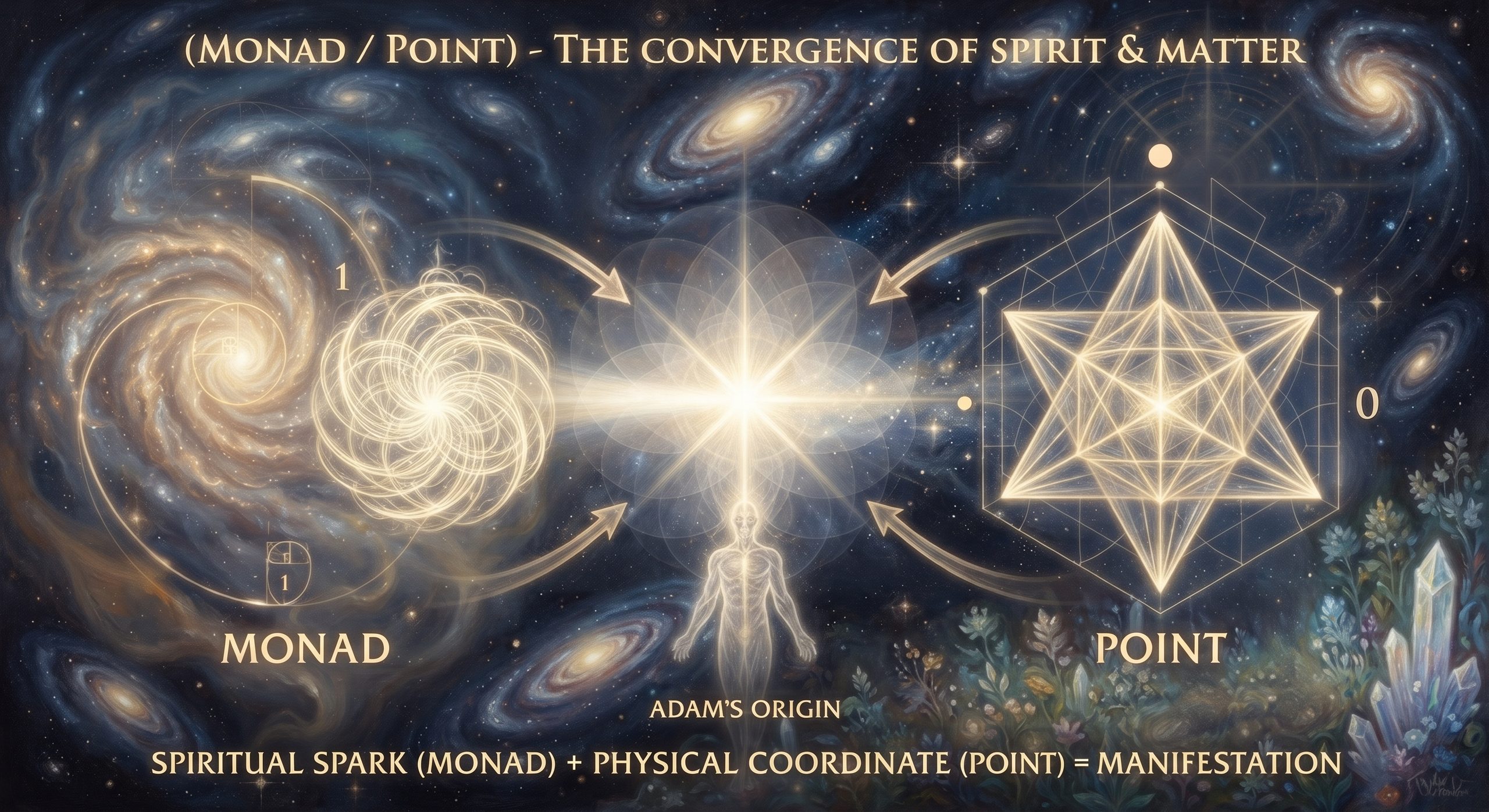
but as a progression:
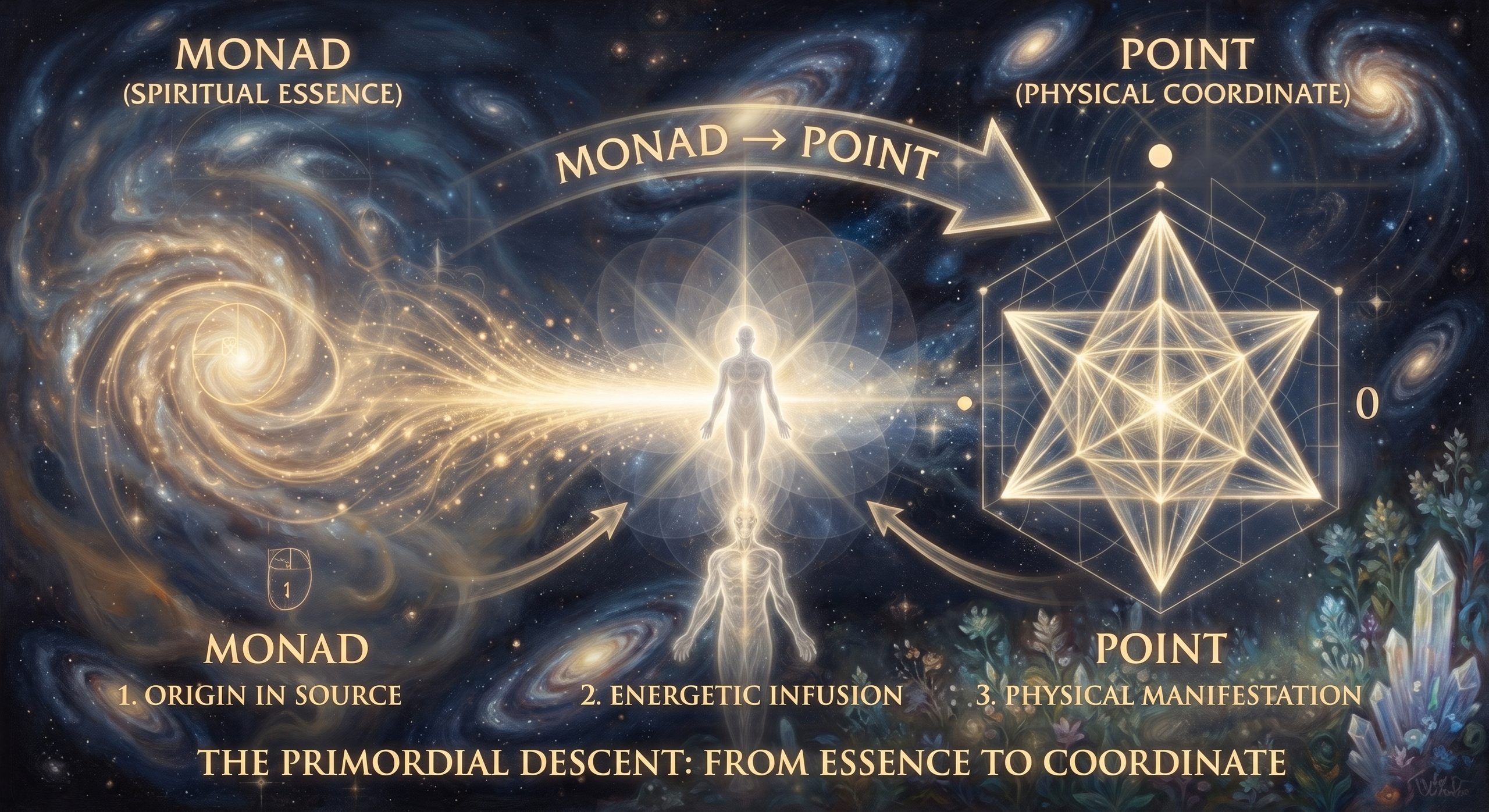
The Monad precedes the body, the Garden curriculum, the eating, and everything else we will eventually examine. Before Adam can eat, choose, build, speak, or mature, Adam must first exist. That is the Monad.
The Cube Does Not Create Adam
This distinction will eventually help us understand the material world itself. Adam does not exist because the Cube needs Adam; the Cube exists for Adam.
The classroom does not create the student. The student enters the classroom because there is something to experience, encounter, and learn. Adam precedes the curriculum, and the Monad precedes the Cube.
At the Edge of Mystery
The Monad therefore requires surprisingly little explanation. Perhaps that is appropriate. We have reached the edge of what has been disclosed.
We can look backward and acknowledge Source, the spiritual realm, the spark, and Adam. But we cannot confidently draw the landscape behind him—and we do not need to.
The sacred geometry is about to move in a direction we can begin to recognize. The spark from the Father has become Adam. Adam exists. But Adam has not yet entered physical expression.
That is the boundary. Behind it lies a spiritual reality we can acknowledge but do not deeply understand. Ahead lies embodiment, matter, location, Creation, experience, development, and eventually curriculum.
The Monad brings us to the threshold. The next movement crosses it. The Monad is spiritual. The Point is physical. And with the Point, Adam enters the material world.
I just read your post about Adam and Monad. I felt like I was coming in the middle of a teaching about something you would consider far deeper. I may need to read other posts on your site to see where you are coming from.
I read about Adam from a Christian perspective. What I learn about him and Eve is from what I see in the historical account given to us in Scripture. The ‘eating’ was a direct violation of God’s instruction. God said, “On the day you eat, you will surely die.” Adam and Eve did die spiritually the moment they took the fruit and ate it. They were separated spiritually from the holy God. They also began to die physically. If he had not sinned, he would have lived forever. HIs body was perfect, but the fallen world began to take its toll on the fallen body. Yes he lived 930 years, but we see the trend is shorter life span throughout the following generations (with a few notable exceptions).
How are you able to come up with all that you teach about Adam here? What is your source of truth?
– Scott
One of the foundational conclusions of my research is that certain narratives in Scripture function not only as historical accounts, but also as what I would call architectural texts. They reveal the underlying design of humanity and God’s pattern of creation. I believe the account of Adam and Eve is one of those narratives.
For much of Christian history, the emphasis has understandably been placed on Adam and Eve as the first man and woman standing at the beginning of human history. I do not reject that reading. Rather, I believe the narrative also operates on another level. It describes the architecture of human existence itself.
In this reading, Adam and Eve are not merely individuals in the distant past. They become enduring realities that reveal how every human being is designed to relate to God, to creation, and to themselves.
Within the 18-ChakraVerse framework, Adam represents humanity itself—the soul-bearing vessel of mankind, both male and female, carrying awareness, will, responsibility, and the capacity to govern. This understanding is rooted in Genesis 5:2, where God “called their name Adam,” indicating that “Adam” is more than the personal name of a single male; it is the collective identity of humanity.
Eve represents what I describe as the living creative field through which life is expressed. I use the symbol of the Flower of Life to describe this principle because it conveys generation, multiplication, relationship, and manifestation. Eve is the matrix through which identity, experience, and the many expressions of human life unfold.
Together, Adam and Eve reveal a divine partnership. Their union is not presented merely as the origin of marriage, but as the pattern through which spirit and manifestation work together. It is an architecture of creation that extends throughout Scripture and, I believe, reaches its fulfillment in the restoration of the inner kingdom and the reconciliation of heaven and earth.
This conclusion does not come from setting Scripture aside. It comes from reading Scripture as a unified work that communicates through history, symbolism, recurring patterns, and prophetic architecture. The 18-ChakraVerse is my attempt to map those patterns into a coherent framework that can be examined, tested, and, where necessary, challenged against the biblical text itself.
I really appreciated your framing of the eating as the moment Adam becomes a “point of self-aware responsibility” rather than just a moral failure. It made me think about the timeline though, since Adam lived for over 900 years after that day, even though Genesis 2:17 warns he would surely die on the very day he ate. Before the eating, he walked openly with the Lord, but afterward, he hides in shame while still physically thriving for centuries.
How do you usually reconcile that long lifespan with the idea of immediate spiritual separation, and do you see his later years as part of that slow journey back toward integration?
Thank you, Ropata. I appreciate the thoughtful question because it gets to the heart of how I understand Adam’s journey within the 18-ChakraVerse.
For me, the warning in Genesis 2:17 is not contradicted by Adam living another 930 years. The “death” that occurs on the day of the eating is the end of one mode of existence and the beginning of another. Adam immediately steps out of direct dependence upon God’s sovereignty and into the experiment of self-sovereignty. The separation is immediate, even though the physical body continues to live.
What has become especially meaningful to me is viewing Adam’s 930 years against the pattern established in the opening chapter of Genesis. Before Adam’s lifespan is ever mentioned, God reveals a pattern of completed creation days. Within my framework, a symbolic day represents a complete cycle of divine formation. Adam lives 930 years—not a full symbolic thousand. To me, that suggests his first incarnation outside Eden did not complete the full creation assignment. The curriculum was still unfinished.
What makes that first incarnation unique is that Adam still remembered Eden. He remembered walking openly with God. Even with that living memory, he could not fully mature into self-governance within a single lifetime. That is why I see the rest of the biblical narrative not as unrelated stories about different people, but as the continuing journey of Adam through successive incarnations, gradually learning what true self-sovereignty under God actually requires.
So I would say that Adam’s later years were certainly part of the journey toward integration, but not its completion. They represent the beginning of a much longer curriculum. The Bible, as I understand it, records the ongoing process until Adam finally reaches the maturity envisioned from the very beginning.
Thank you for raising such a thoughtful point. Questions like yours help bring these deeper patterns into clearer focus.
Thank you for sharing such a thoughtful breakdown of Adam’s journey through the 18-ChakraVerse framework. I really appreciate how you connected his 930-year lifespan to an incomplete symbolic day, framing it as a long curriculum of learning self-sovereignty under God. While that perspective offers a fascinating lens on spiritual maturation, I’ve always understood the “death” God warned about in Genesis 2:17 as the immediate severing of Adam’s direct communion with the Holy Spirit. Scripture consistently points to the Spirit as the very breath of divine life and connection (Romans 8:9-11), and when Adam chose his own path, that intimate indwelling presence was withdrawn, leaving humanity spiritually dead even while physically alive. This is exactly why Jesus’s mission was so crucial; He didn’t just come to teach us better self-governance, but to restore that lost relationship by sending the Holy Spirit back to dwell within believers (John 14:16-17, Acts 2:38). In that light, the biblical narrative feels less like a series of successive incarnations and more like a single, continuous rescue plan to bring humanity back into the Spirit-led maturity God originally intended. I’d love to hear how you see the Holy Spirit’s role fitting into your framework, especially when it comes to that final integration Adam is working toward.
There is no forgiveness for blaspheming the Holy Spirit: Matthew 12:31-32, Mark 3:28-29, and Luke 12:10. Jesus cannot overrule diving law. Adam does not need rescuing as if he were a toddler. He is not a child. He is an adult often acting out of childlike ignorance. He ate from the tree to make a lawful freewill decision/claim to learn self-sovereignty and gain maturity on his own. God made this path for Adams who wanted it. For those who wanted to stay in heaven under God’s house. They are able to do that. The prodigal son gives the example. I wrote a blog post today on Eve. The link is here. https://chakraandenergyhealing.com/who-is-eve/
I found this an interesting reflection on responsibility and self-awareness, especially the way you frame the turning point as the moment Adam becomes conscious of consequence rather than simply becoming “bad.” The idea that awareness without integration can lead to hiding or shame lends the piece a more psychological angle, and that part feels broadly relatable even to readers outside the spiritual framework.
I also think the strongest part is the distinction between self-awareness and self-governance, because many people recognize themselves in it. The article suggests that insight alone is not enough, and that feels like a meaningful discussion point, whether someone reads this symbolically, spiritually, or as a lens for personal growth.
Hi Aly,
Thank you for another thoughtful reflection. I’m especially glad the distinction between self-awareness and self-governance stood out to you because that is one of the foundational ideas behind the 18-ChakraVerse.
In my view, Adam’s eating was not simply the beginning of wrongdoing but the beginning of responsibility. Awareness opened the door, but awareness alone did not produce wisdom, maturity, or inner order. Those qualities had to be cultivated through experience.
That’s why I see shame, hiding, and blame not as the destination of the story but as the first signs that Adam had become conscious without yet knowing how to govern what he had discovered within himself. Many of us experience the same pattern today. We become aware of our fears, habits, or emotional reactions, but awareness by itself does not transform them. Transformation begins when we learn to govern them intentionally.
I also appreciate your point that this can be meaningful from different perspectives. While I’m writing from the lens of the 18-ChakraVerse, I hope readers can still find principles that encourage deeper reflection on their own journey toward greater self-governance and inner harmony.
Thank you again for your thoughtful engagement. Your questions and observations consistently add depth to the conversation, and I truly appreciate you taking the time to share them.
Hi,
This is such a thoughtful exploration of Adam’s awakening. I really like the way you framed the Monad as the moment where awareness becomes responsibility. The way you described the shift from divine placement to self‑directed consciousness. I also liked the idea that awareness alone isn’t sovereignty. It really made me think about how often we stop at insight without moving into integration. I’m curious about the next stage. This article is a interesting read throughout and you have made it like without boring.
Hi Shafna,
Thank you so much for your thoughtful comment. I’m glad the idea of the Monad as “awareness becoming responsibility” resonated with you, because that is really the heart of this stage.
Insight is powerful, but insight alone is not the same as sovereignty. Adam’s awakening after the eating is not just about realizing something has changed; it is about learning how to carry that awareness without blaming, hiding, or collapsing under it. That is where integration begins.
The next stage moves from simply becoming aware to learning what that awareness requires. Once Adam knows himself differently, he must begin to understand consequence, choice, placement, and self-governance. In other words, the soul must learn how to live from consciousness, not just experience it for a moment.
I truly appreciate your reflection, and I’m glad the article held your interest throughout. Thank you for reading with such care. For more on this, you will find it here: https://chakraandenergyhealing… The links on the page will take you to the different blog posts.