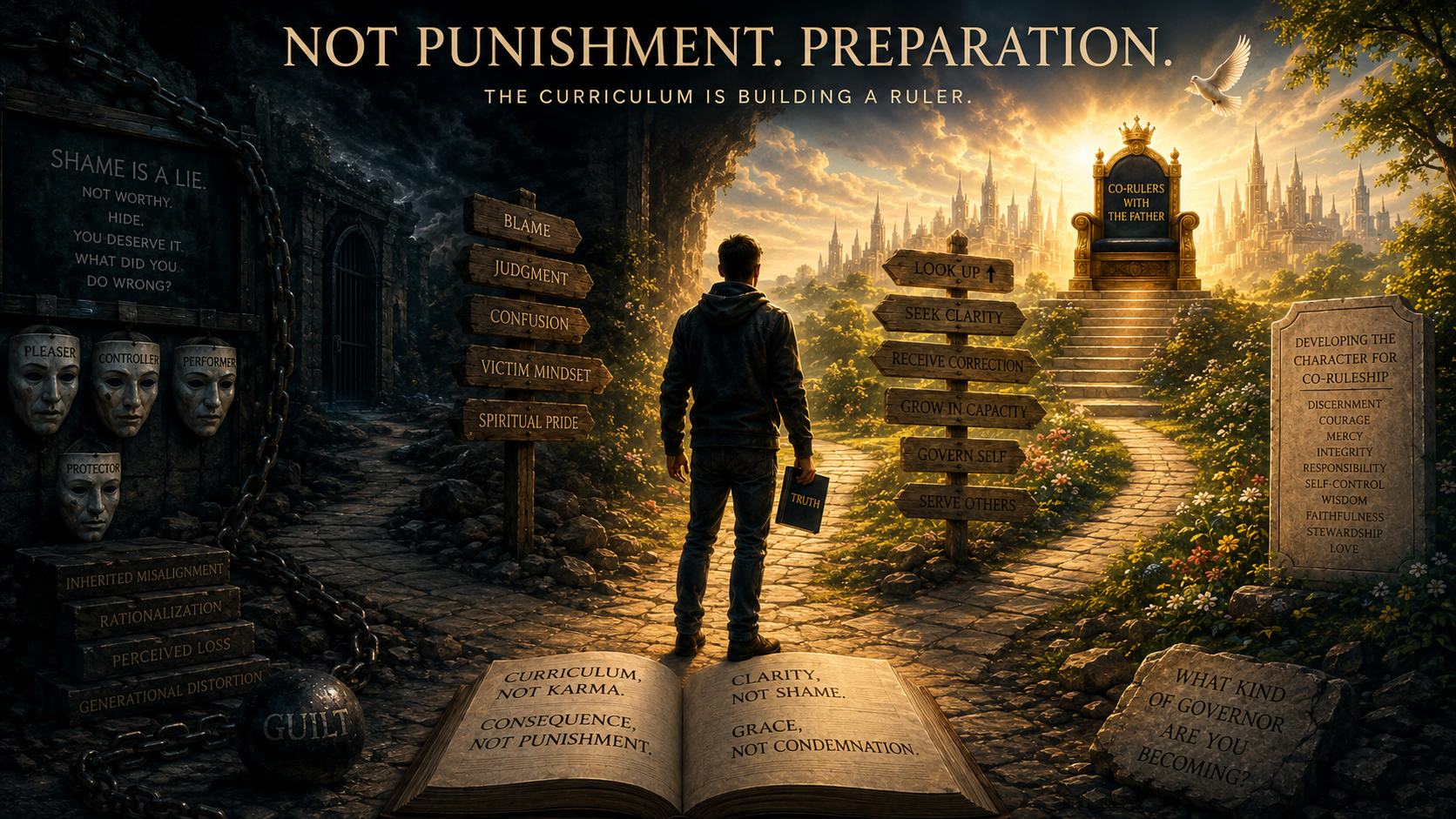
The Hidden Curriculum Preparing You to Rule
By Alchemist Iris Chapman
What if some of the experiences you have interpreted as punishment were never punishment at all?
What if the difficulties, consequences, corrections, unanswered questions, unexpected circumstances, and even failures of your life belong to something much larger?
A curriculum.
For much of my life, I understood consequence through the language of punishment and shame. Something went wrong, therefore I must have done something wrong. Something painful happened, therefore perhaps God was displeased. I failed, therefore something must be inherently wrong with me.
This mindset embeds a destructive equation directly into our theology:
Misalignment ➡ Punishment ➡ Shame
The biblical journey of Adam is not primarily the story of a criminal being sentenced. It is the story of a ruler being trained. The curriculum is not designed to punish Adam for being an imperfect student; it is designed to develop an Adam whom God can trust as a co-ruler.
The Higher Agenda Is Co-Rulership
The purpose of Adam’s journey is not merely to learn how to behave. Adam is learning how to govern. That distinction changes everything.
If the ultimate objective were simply passive obedience, God could provide a rigid list of rules and reward compliance. But Scripture concludes somewhere far more expansive: it ends with rulership.
“To him that overcometh will I grant to sit with me in my throne.”
— Revelation 3:21
“And they shall reign for ever and ever.”
— Revelation 22:5
The student does not remain a student forever. There is an ultimate graduation—a throne, a government, and genuine responsibility. The curriculum has a definitive destination: Adam is being prepared for co-rulership.
Self-Sovereignty Is Part of the Training
Self-sovereignty is not merely Adam declaring, “Nobody tells me what to do.” That is freedom without government. True sovereignty requires rigorous internal alignment:
- Can Adam govern desire rather than be ruled by it?
- Can Adam exercise power without being corrupted by power?
- Can Adam distinguish the authentic Self from a protective persona?
- Can Adam recognize an inherited distortion even when everyone around calls it righteous?
- Can Adam receive correction without collapsing into self-condemnation?
- Can Adam create and accept total responsibility for what that creation produces?
- Can Adam exercise mercy without abandoning discernment?
- Can Adam encounter truth that costs something and still choose alignment?
Self-sovereignty is the testing ground where Adam discovers what internal governance actually demands.
The Curriculum Is Not Karma
The curriculum is not a simplistic karmic ledger where every hardship is a direct retribution for a past misdeed. That is merely punishment theology wrapped in alternative vocabulary:
| System | Diagnostic Assumption | Underlying Error |
| Punitive Theology | “You are suffering because you sinned.” | Diagnoses spiritual standing purely from external circumstance. |
| Karmic / Past-Life | “You must have done something wrong in a past life.” | Fills an information gap with speculative guilt. |
| The Divine Curriculum | “What capacity must Adam develop to govern?” | Views circumstance through developmental growth and lawful feedback. |
The core question is not, “What does Adam owe because of yesterday?” The larger developmental question is: What must Adam know, integrate, and become capable of governing to fulfill original design?
Sowing and reaping remain lawful realities. Actions have consequences. But consequence is not the only explanation for circumstance, and circumstance alone never reveals another person’s complete transcript.
Consequence Is Information, Not Retribution
Consequence is not necessarily punishment—it is information.
When Adam makes a choice, that choice produces a creation. Adam experiences the result, and that experience delivers immediate feedback regarding the internal government that produced it.
Choice ➡ Creation ➡ Consequence ➡ Information ➡ Correction ➡ Greater Capacity
If God continually shielded Adam from the lawful results of his own government, Adam could never understand how creation operates. A future co-ruler requires dependable laws. Rigidity of law is not the absence of grace; very often, grace is the clarity delivered directly through the consequence.
Nebuchadnezzar Looked Up
King Nebuchadnezzar provides a clear case study in Daniel 4. He held massive external authority, yet his internal government collapsed into hubris:
“Is not this great Babylon, that I have built… by the might of my power, and for the honour of my majesty?”
— Daniel 4:30
The persona of the monarch usurped the throne of his true identity. Because he was governed by the consciousness of his own power, he descended into a degraded, beast-like state. Yet the turning point arrived within that very condition:
“I Nebuchadnezzar lifted up mine eyes unto heaven, and mine understanding returned unto me.”
— Daniel 4:34
Nebuchadnezzar did not fix his circumstances first. He did not prove his worthiness or escape the consequence before approaching God. He looked up while still inside the lesson—and understanding returned.
       [ CONFLICT / COLLAPSE ]
                  │
        ┌─────────┴─────────┐
        ▼                   ▼
    LOOKING IN          LOOKING UP
 (Shame & Concealment)  (Alignment & Clarity)
        │                   │
  Identity Verdict     Understanding Returns
        │                   │
   Persona Rule        Sound Governance
Shame Tells Adam Not to Look Up
Shame corrupts the educational sequence. Instead of moving from observation to correction, shame inserts concealment:
Choice ➡ Consequence ➡ Shame ➡ Concealment ➡ Avoidance
Adam stops asking, “What does this teach me?” and begins asking, “What does this prove is broken in me?” To survive the perceived verdict, protective internal personas take over governance:
- The Pleaser: “Keep everyone appeased so we remain safe.”
- The Controller: “Micromanage all variables so nothing catches us off guard.”
- The Performer: “Remain impressive so no one sees our flaws.”
- The Protector: “Build walls so no one gets close enough to wound us.”
These personas are not evil; they were internal citizens commissioned during a past crisis. The problem is that no one ever notified them that the emergency has passed.
A persona is an instrument, not the Self. The objective is not to destroy these personas, but to restore proper order. The Self must govern the persona—the persona must never govern the Self.
When reassigned under sound governance, the Protector becomes a guardian of healthy boundaries, the Controller becomes discernment, the Pleaser matures into diplomacy, and the Performer becomes a clear communicator.
Job’s Friends and Circumstantial Judgments
When consequence provides feedback, we risk assuming every hardship is a direct consequence of error. Scripture explicitly forbids this.
In Job 1:6, a dialogue occurs in the heavenly realm outside of Job’s awareness. When devastation strikes, his friends observe his outer ruins and reason backward: Job is suffering, therefore Job must harbor secret sin. They manufactured guilt to explain a mystery they could not comprehend.
Jesus confronted this exact error in John 9:2 when His disciples asked whether a man’s blindness was caused by his own sin or his parents’. Jesus rejected the premises entirely, just as He did in Luke 13 regarding the Galileans who suffered untimely deaths. Circumstances do not disclose their own spiritual root.
The Inner Circle and the Transmitted Knot
Every individual’s complete curriculum is held securely in the Inner Circle between them and God. Others can see external behavior, outcomes, and disruption, but they do not possess the case file.
┌───────────────────────────────────────────────┐
│              THE INNER CIRCLE                 │
│                                               │
│   • Original Self         • Intentions & Fear │
│   • Active Personas       • Available Data    │
│   • Learned Capacities    • The Lesson Plan   │
│                                               │
│         [ KNOWN ONLY TO GOD & THE SELF ]      │
└───────────────────────────────────────────────┘
A failed exam demonstrates an outcome, but never the inner reason for the failure. Decades ago, I saw a struggling classmate’s test paper filled with cartoon names and nonsense. That visual gave me additional data, but it never gave me access to her Inner Circle. I could see the failure, but not the complex knot of fear, exhaustion, or resistance behind it.
Furthermore, many distortions are inherited across generations. When a misalignment is passed down through family systems, cultures, or institutions, it is frequently defended not as malice, but as moral righteousness:
Inherited Distortion ➡ Perceived Benefit ➡ Threatened Loss ➡Moral Justification ➡ Transmission
When an individual decides to break that chain and refuse cooperation with the inherited distortion, their life often undergoes immense disruption. An outside observer might judge the upheaval as failure, when in reality, the disruption is the natural friction of breaking a multi-generational knot.
From Unconscious Construction to Conscious Governance
Knowledge of this curriculum is meant for internal navigation, never external prosecution. Grace does not eliminate discipline; grace governs discernment so that correction can take place without condemnation.
UNCONSCIOUS CONSTRUCTION
Create ──► Experience ──► Discover ──► Correct ──► Develop Capacity

CONSCIOUS CONSTRUCTION
Understand ──► Choose ──► Create ──► Govern ──► Maintain Alignment
The classroom is real, the laws are dependable, and the stakes matter. God is not producing an Adam terrified of making an error; He is raising a co-ruler equipped with the discernment, wisdom, and capacity required to govern.
When the lesson feels obscure and your vantage point is limited, do not manufacture guilt or look to the opinions of fellow students.
Acknowledge the mystery, receive the information, and look up.
Music Video: Curriculum: “Curriculum” explores a different possibility: consequence can be information, failure is not always refusal, and circumstance does not automatically reveal why an experience has entered your life. Lyrics by Achemist Iris Chapman.
You have presented a perspective that I was not familiar with (and one that is not discussed very often). I have never thought about my life as “curriculum”. This approach is definitely healthier vs. looking at bad things that have happened to me as punishment. I know I have played victim to my circumstances and it kept me down for a long time. I can definitely see the benefits of knowing and applying the concept that “Consequences are information and not retribution” as you stated. I read some of your other articles as well and bookmarked your site! You have information on here that I have not seen anywhere else!
Thank you so much, Misty. I appreciate not only your kind words about the site, but also your willingness to reflect so openly on your own experiences.
The distinction you highlighted—“Consequences are information, not retribution”—is really at the heart of what I am exploring.
When I began looking at life as curriculum, it changed the questions I could ask. Instead of only asking, “Why is this happening to me?” or “What did I do to deserve this?” I could also ask, “What can I learn here? What can I govern? What can I do differently with what I know now?”
And I think there is an important distinction between recognizing that we have sometimes occupied the position of victim and blaming ourselves for circumstances in which we genuinely were victimized. We do not control everything that happens to us, and other people’s choices can have very real consequences in our lives. Self-sovereignty does not require us to deny that reality.
What it can give us is a way forward.
Even when I did not choose what happened, I can begin examining what belongs to my jurisdiction now—my interpretation, my decisions, my boundaries, my response, and eventually the direction I choose to take.
That is why I use the word curriculum. A classroom is a place where we are expected not to know everything yet. We encounter something, learn, practice, make mistakes, receive feedback, correct, and develop greater capacity. Seen through that lens, correction does not have to mean condemnation.
And perhaps one of the most liberating realizations is this: I can acknowledge what happened to me without allowing what happened to become the permanent definition of who I am.
Thank you for reading some of the other articles as well, and especially for bookmarking the site. I hope you continue finding ideas here that give you new questions to explore.
Since you mentioned that this way of thinking about life as curriculum was new to you, I’d be curious to hear whether there is a particular experience or pattern in your life that looks different when you view it through that lens. No need to share anything too personal, of course—but I’d love to hear what the idea brings up for you.
Iris, this reframing of the Adam narrative from a criminal sentence to a ruler’s training ground completely disrupts how we process personal failure. That line about moving away from the destructive equation of misalignment leading to punishment and shame hit home.
If we truly view life’s friction as a curriculum designed to develop self-sovereignty, such as learning to govern desire, handle power without corruption, and receive correction without collapsing into self-condemnation, it radically changes how we engage with our mistakes.
I’m curious how you distinguish, in a practical sense, between a consequence that is meant to be a developmental correction versus a situation where we are simply repeating an unhealed cycle. When we hit those heavy roadblocks, how do you suggest we discern whether we are being “trained to rule” or just missing the lesson entirely? Would love to hear your thoughts on navigating that line.
Thank you, Eric. That is an excellent question because I don’t necessarily see “being trained to rule” and “repeating an unhealed cycle” as opposites. The repeated cycle may be the training.
For me, the distinction becomes clearer when I look at what the experience is revealing rather than simply whether the experience keeps happening.
If I repeatedly encounter the same pattern—different relationship, same conflict; different job, same frustration; different circumstance, same reaction—I begin asking: What remains unchanged when everything around me changes? That question turns my attention toward the part of the pattern I actually govern.
Then I look for three things: awareness, choice, and response. Can I see the pattern more clearly than I could before? Do I recognize where I have a genuine choice? Am I responding differently with the understanding I now possess?
If the answer is yes, I may still be encountering similar circumstances, but I am not necessarily repeating the same lesson. I may be encountering it at another level of development. The external situation can look remarkably similar while the ruler within it has changed.
If, however, I keep producing the same response while expecting the environment, another person, or even God to change the outcome for me, that tells me there may still be something in the pattern I have not recognized or learned to govern.
This is also why I hesitate to label every roadblock as a divine message with one predetermined meaning. Sometimes a closed door is correction. Sometimes it is protection. Sometimes it is timing. Sometimes another person simply made a decision we cannot control. And sometimes life is giving us the consequences of choices already made.
So rather than trying to determine immediately, “What is God doing to me?” I prefer the question: “What is this revealing to me, and what is mine to govern here?”
That keeps the focus on development without turning every painful experience into either punishment or personal failure.
Perhaps that is what “training to rule” ultimately requires. The mature ruler does not need every circumstance explained before responding wisely. Adam learns to observe, discern, act, evaluate the result, make corrections, and try again.
And if the lesson has to return? Then the classroom is still open.
Thank you for asking this. You gave me an opportunity to articulate an important distinction within this framework.
This is a thought-provoking perspective, especially the idea of looking at life as something other than a form of punishment. Sometimes the way we interpret difficult experiences can have a big influence on how we respond to them and what we learn from them. I like how this topic encourages readers to question the stories they may have created about their own struggles. It also raises an interesting discussion: can changing the way we view difficult experiences help us find meaning, growth, or a new direction in life? I’d be interested to hear how others interpret this idea.
Thank you, Mala. I do believe changing the way we interpret difficult experiences can change what becomes possible afterward.
If I interpret every hardship as punishment, I may approach it primarily through fear, shame, or the question, “What did I do to deserve this?” But if I allow myself to ask whether the experience contains information, a different set of questions becomes available: “What can I learn here? What needs my attention? Is there something I can change? Is there something I need to accept? What is my wisest next step?”
Importantly, that does not mean every difficult experience was caused by something we did wrong. Loss, illness, other people’s decisions, economic circumstances, and countless uncertainties are part of human experience. We should be especially cautious about looking at another person’s hardship and assigning spiritual meaning to it from the outside.
The shift I am exploring is therefore not from “punishment” to “everything happens because you manifested it.” It is from condemnation to conscious evaluation.
Whatever brought me to this moment, I can still ask what this moment is showing me and how I want to respond to it. Sometimes growth may mean changing direction. Sometimes it may mean developing greater wisdom, boundaries, compassion, patience, or resilience. And sometimes the lesson may simply be learning how to walk through something difficult without turning the experience into a verdict against ourselves.
Thank you for raising the question. I would also be interested in hearing how other readers distinguish between finding meaning in an experience and assuming that every experience must have been caused by us.
Iris, separating consequence from personal condemnation can give people a far healthier way to respond when life becomes difficult. Looking at outcomes as information creates room to pause, learn, ask for support, and choose a different next step, rather than letting shame turn one setback into a fixed verdict about someone’s worth.
I appreciate the distinction between self-reflection and judging another person’s hidden story. We can be accountable for our choices while still recognizing that illness, loss, family patterns, economic pressure, and plain uncertainty shape people’s lives in ways outsiders cannot fully see.
Thank you, Aly. I especially appreciate your point that accountability and compassion do not have to oppose one another. That distinction is central to what I am exploring. Consequences can give us information about our choices, patterns, and internal government without becoming a declaration about our worth.
I also agree that we have to be very careful about interpreting another person’s circumstances. We rarely know the full curriculum another person is navigating. Illness, loss, family history, economic pressure, and circumstances outside an individual’s control make it impossible to look at someone’s life from the outside and confidently declare what their experience “means.”
For me, that is where self-reflection becomes different from judgment. I can ask, “What is this experience showing me? Is there anything here for me to understand, change, strengthen, or govern differently?” But I cannot automatically answer those questions for someone else.
Perhaps that is one of the most important shifts: consequence can be information without becoming condemnation, and difficulty can invite examination without becoming evidence of guilt.
Thank you for adding such a thoughtful perspective to the discussion.
This is a thought-provoking perspective on the difference between punishment and growth. I especially appreciate the idea that consequences can provide information rather than simply serving as condemnation. That shift encourages self-reflection, accountability, and learning instead of allowing shame to define our identity. The connection between internal governance and effective communication is also interesting when we understand ourselves and respond to correction with greater clarity, we become better equipped to communicate with wisdom, empathy, and discernment.
Hi Kavitha,
Thank you for such a thoughtful response. You captured an important distinction I hoped to communicate: consequence does not have to mean condemnation. Consequence can be information. It can show us what a particular choice, belief, pattern, or internal structure is producing so that we have an opportunity to evaluate it and make a different choice.
I especially appreciate your connection between internal governance and communication. When correction is interpreted primarily through shame, we often become defensive, fearful, or unwilling to examine what happened. But when correction is understood as part of growth, we can ask better questions: What is this experience showing me? What needs greater alignment? What can I learn from it?
That is a major principle within the 18-ChakraVerse. The goal is not perfection or the avoidance of every difficult consequence. It is developing the capacity to govern ourselves consciously—to receive information, exercise discernment, make corrections, and continue growing without allowing the experience to become our identity.
Thank you for adding this dimension to the discussion. Your observation about wisdom, empathy, and discernment fits beautifully with the idea that effective outer communication begins with clearer inner government.
Alchemist Iris