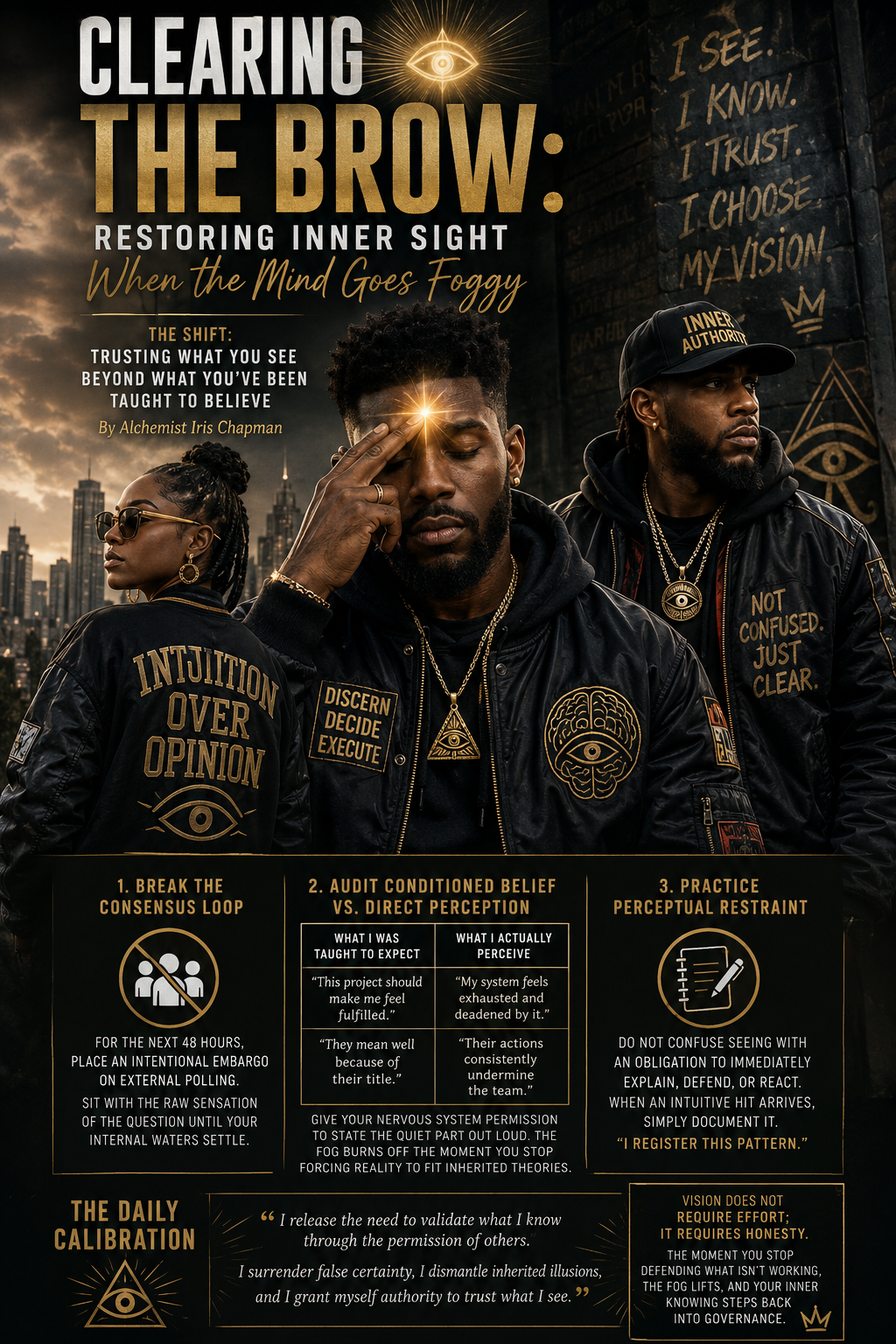
Third-Eye Remedy: The Shift — Trusting What You See Beyond What You’ve Been Taught to Believe
By Alchemist Iris Chapman
Mental fog is rarely just a failure to think harder. Sometimes the problem is not that you cannot see. The problem is that what you perceive conflicts with the rules, conditioning, assumptions, or expectations you have already accepted.
Scripture contains its own language for this kind of inner sight.
Paul prayed that “the eyes of your understanding” would be enlightened (Ephesians 1:18). The language is significant. Understanding has eyes. Something within Adam can perceive, and those eyes can become illuminated.
Romans 12:2 connects that illumination with the renewal of the mind:
“Be not conformed to this world: but be ye transformed by the renewing of your mind…”
The renewed mind becomes capable of discerning what is good, acceptable, and aligned with the will of God.
That means transformation sometimes requires allowing what you actually perceive to challenge what you have been conditioned to believe.
When the Third Eye is clouded, you do not necessarily lose your vision. Instead, the analytical mind may step in and aggressively censor what has already registered because acknowledging it would disrupt an established certainty.
The fog can be the friction between perception and permission.
You saw it.
Then you asked whether you were allowed to see it.
The Anatomy of the Block
The brow center operates as an internal lens of strategic insight, pattern recognition, and uncompromised sight. When this center falls out of equilibrium, the friction can register somatically and mentally.
The Symptom: Chronic second-guessing, feeling ungrounded in your decisions, ambient pressure between the brows, and waiting for external consensus before honoring an internal perception.
The Underlying Conflict: You saw something clearly—a red flag, an expired dynamic, an emerging trajectory, an inconsistency—but your rational mind immediately asked:
“Is it socially safe for me to know this?”
The Distortion: Relegating your deepest impressions to coincidence, anxiety, wishful thinking, or imagination simply because what you perceive contradicts an inherited explanation.
But Scripture does not tell Adam to surrender discernment to consensus.
Solomon asked God:
“Give therefore thy servant an understanding heart… that I may discern between good and bad.”
— 1 Kings 3:9
Discernment is part of governance.
And Hebrews 5:14 describes mature people as those who have their perceptive faculties exercised through use to “discern both good and evil.”
Sight develops through practice.
But there is an equally important safeguard:
“Prove all things; hold fast that which is good.”
— 1 Thessalonians 5:21
This is the balance.
Inner sight is not permission to believe every impression.
You do not have to dismiss what you perceive because someone else does not validate it. But neither do you have to immediately declare every perception true.
You can see it.
You can document it.
You can test it.
You can watch its fruit.
You can allow additional evidence to reveal whether the perception holds.
See. Test. Hold fast.
That is disciplined sight.
The Remedy Protocol: Returning to Clear Sight
To dissolve mental fog, stop fighting to force answers. Clear vision returns when you create enough internal stillness to allow what you perceive to register before commentary, fear, conditioning, or consensus rewrites it.
1. Break the Consensus Loop
When uncertainty strikes, the reflex may be to ask three different people for advice, search for another opinion, or consume more information.
Sometimes that multiplies the static.
For the next 48 hours, consider placing an intentional embargo on external polling. Sit with the raw question long enough for your internal waters to settle.
This does not mean rejecting counsel.
It means learning the difference between seeking information and seeking permission to know what you already perceive.
Proverbs 20:27 says:
“The spirit of man is the candle of the LORD, searching all the inward parts…”
There is an inward search.
Before asking everyone outside you what they see, become quiet enough to identify what has already registered inside you.
2. Audit Conditioned Belief vs. Direct Perception
Romans 12:2 warns against conformity and immediately connects renewal of the mind with discernment.
So examine the difference between the inherited model and the observed evidence.
| What I Was Taught to Expect | What I Actually Perceive |
|---|---|
| “This project should make me feel fulfilled.” | “My system feels exhausted and deadened by it.” |
| “They mean well because of their title.” | “Their actions consistently undermine the team.” |
| “This is supposed to work.” | “The fruit consistently tells me that it isn’t working.” |
Do not force observation to conform to theory.
Write down what you actually see.
Then test it.
That last step matters.
1 Thessalonians 5:21 does not say reject everything. It does not say accept everything. It says test everything and hold fast to what proves good.
This is how perception becomes discernment.
3. Practice Perceptual Restraint
Seeing something does not create an obligation to immediately explain it, defend it, announce it, or act upon it.
When an intuitive hit arrives, simply document it:
“I register this pattern.”
Then allow it to remain under observation.
This is where Hebrews 5:14 becomes practical. Discernment develops through use. You learn the difference between fear, assumption, conditioning, projection, intuition, and demonstrated pattern by testing what you perceive against what subsequently manifests.
Perceptual restraint removes panic from the brow.
You do not have to turn sight immediately into decree.
See first.
Test second.
Act when warranted.
4. Take the Thought Captive Without Blinding the Eye
Second Corinthians 10:5 speaks of “bringing into captivity every thought.”
That is governance.
But governing thought does not mean suppressing perception.
A thought can be examined without being obeyed.
An impression can be registered without becoming doctrine.
An inherited belief can be questioned without immediately replacing it with another certainty.
The governing Adam can ask:
What did I actually observe?
What interpretation did I add afterward?
What evidence supports the interpretation?
What fruit has this pattern produced?
What remains unknown?
Now the analytical mind becomes a servant of discernment rather than a censor of sight.
The Eye Full of Light
Jesus gives another striking image:
“The light of the body is the eye…”
— Luke 11:34
He continues by describing the person becoming “full of light” when the eye is functioning properly.
Within the language of the Third Eye, this gives us a useful architectural picture.
The objective is not to manufacture visions.
It is to clear the lens.
Not to force certainty.
Not to outsource perception.
Not to automatically believe every internal impression.
Not to automatically disbelieve it either.
Clear the lens enough to see what is there.
Then discern.
Then test.
Then govern.
The Daily Calibration
Place your fingertips gently at the center of your forehead, take a slow breath into the back of your skull, and release this decree:
“I release the need to validate what I perceive through the permission of others. I surrender false certainty and dismantle inherited illusions. May the eyes of my understanding be enlightened. I grant myself permission to see clearly, discipline to test what I see, patience to observe its fruit, and wisdom to hold fast to what proves true and good.”
Vision does not require force.
It requires honesty.
And discernment does not require blind trust in either yourself or someone else.
It requires testing.
See. Test. Hold fast.
The moment you stop forcing reality to fit inherited theories, the fog can begin to lift. The eye becomes clearer. The renewed mind evaluates what the eye perceives.
And inner sight returns to its proper place in governance.