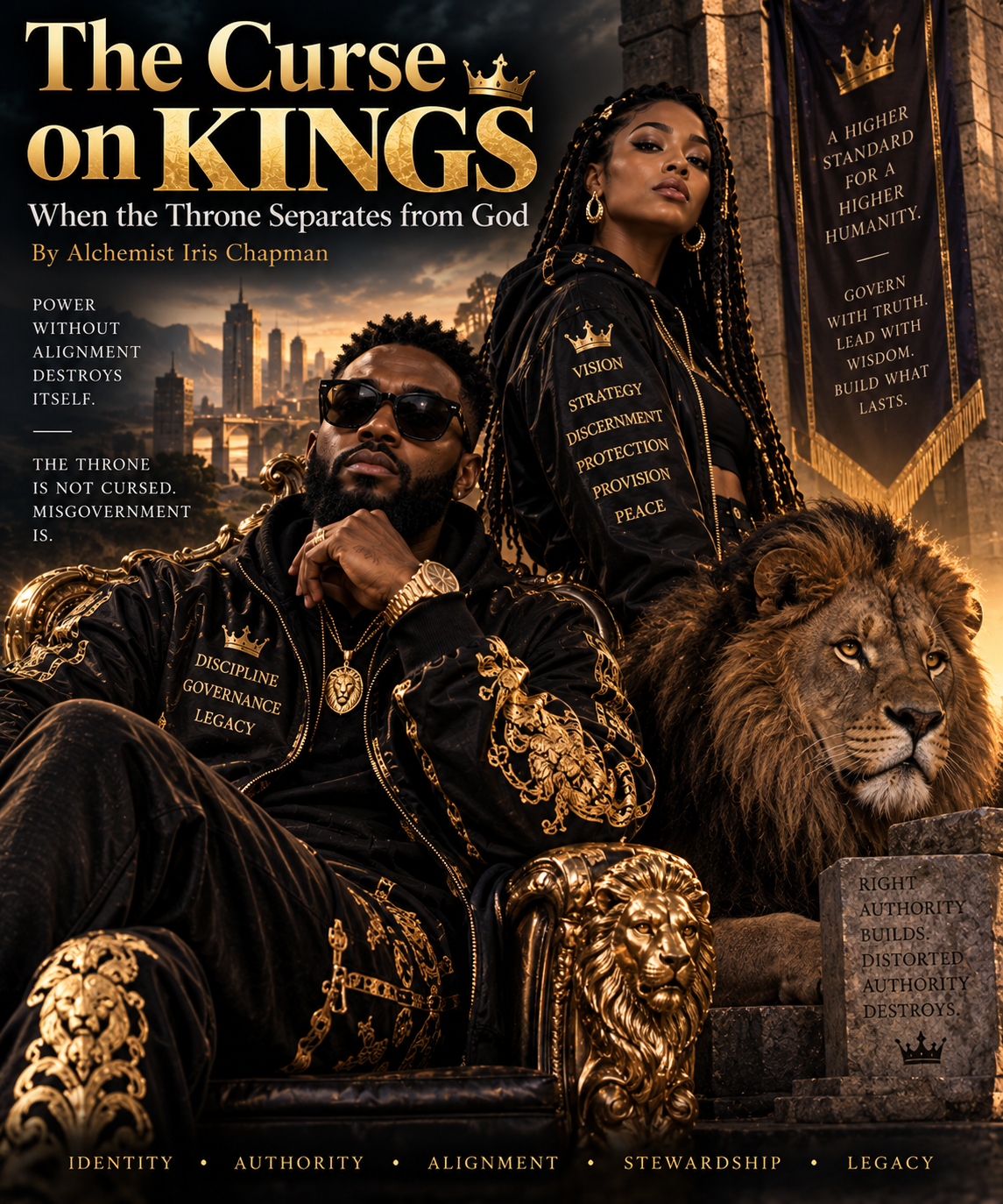
By Alchemist Iris Chapman
A repeating cycle runs through the historical books of Scripture:
- A king is chosen.
- Authority is bestowed.
- Armies march, borders expand, and temples or palaces are built.
- Then, the sovereign begins treating the authority entrusted to him as though its Source no longer matters.
The result is structural collapse. Saul clutches his physical crown long after the kingdom has been ripped from his spiritual hands. Ahab degrades royal authority into an apparatus for personal consumption and petty land-theft. Jeconiah incurs a divine embargo on his bloodline so severe that royal succession itself hits an apparent wall.
These accounts are routinely flattened into Sunday school morality lessons about bad rulers. Within the 18-ChakraVerse, they provide a diagnostic cross-section of internal statecraft:
The throne is not the curse. Power is not the curse. Authority is not the curse.
The curse is the systemic collapse that occurs when authority severs from the Divine Government
that establishes its lawful jurisdiction.
Every Adam possesses an internal kingdom, and every Adam sits upon an internal throne.
The Solar Plexus and the Seat of Jurisdiction
Within the 18-ChakraVerse, kingship belongs to the Solar Plexus Chakra (Center 3). This center governs will, personal agency, identity, boundary enforcement, executive decision, and jurisdiction.
The Solar Plexus asks the baseline operational question:
“Who has authority here?”
An aligned king does not lack power. An aligned king understands what power is for. A distorted king confuses the possession of raw capacity with the divine authorization to deploy it however he pleases.
This returns us to the foundational axiom of the Curse Series:
Possession is not access. Capacity is not authorization.
An individual may possess formidable reserves of will:
- Intellectual dominance
- Charismatic persuasion
- Financial leverage
- Physical or sexual magnetism
- Institutional status
- Esoteric knowledge
- Creative execution
None of these endowments automatically confers lawful jurisdiction. Raw capacity answers the lower question: “Can I force this to happen?” True government must answer the higher question: “Am I authorized to build this?”
Discernment must then apply the ultimate gate audit: “Is it true according to Divine Design?”
The Constitutional Sequence: A King Must First Be Governed
Human sovereignty is delegated stewardship. The king is not Source. The throne is not Source. The crown is not Source. God alone remains Source.
The lawful constitutional sequence flows downward:
Divine Design (God) ➡ Conscious Government (Adam) ➡ Jurisdiction ➡ Eve (Manifestation) ➡ Aligned Fruit
When the sovereign will disconnects from divine alignment, authority begins operating as if it were self-originating. The sequence inverts:
[ THE CAPTURED THRONE ]
Persona / Appetite / Fear ──► Sovereign Will (Adam) ──► Usurped Authority ──► Manifested Distortion
The throne has been hijacked—not by an invading demon, but by Adam’s unvetted survival agreements.
The King as Steward of Jurisdiction
Power and jurisdiction are two fundamentally different currencies:
| Dimension | Raw Power (Distorted King) | Lawful Jurisdiction (Aligned King) |
| Operational Query | “Can I make this happen?” | “Is this territory mine to govern?” |
| Response to Desire | “I want it; therefore, I am entitled to take it.” | “Desire is not authorization.” |
| Response to Fear | “I must control every variable to ensure survival.” | “What does constitutional law require here?” |
| View of Boundaries | Obstacles, threats, or personal insults | Sacred parameters and diagnostic data |
Kingship serves as a high-voltage laboratory for Conscious Construction because the throne amplifies the seed.
When an ordinary Adam constructs through unexamined fear, the fallout damages a marriage, a household, or a personal health baseline. When a king constructs through unexamined fear, that exact same seed metastasizes into foreign wars, domestic surveillance, crushing taxation, generational trauma, and systemic collapse.
Saul: When Fear Usurps the Throne
King Saul provides Scripture’s premier case study in the pathology of the captured throne.
Saul’s downfall is not an isolated tactical error; it is a progressive systemic drift. Fear steadily usurps internal government:
- He fears public opinion, so he rushes the offering instead of waiting for Samuel.
- He fears losing stature, so he rationalizes direct disobedience regarding the spoils of Amalek.
- He fears David’s rising favor, so his primary executive focus shifts from governing a nation to hunting down a loyal musician.
Saul adopts a single, unexamined operating agreement:
“I must preserve my crown at all costs.”
Once that survival premise is ratified, every atrocity becomes justifiable: paranoia, medium consultations, manipulation, targeted assassinations, and civil war.
The king who fears losing his throne is no longer a king; he has become the terrified servant of the crown.
       [ Fear of Exposure / Loss ]
                    │
                    ▼
     [ "I must preserve my crown" ]
                    │
                    ▼
 [ Defensive Violence & Manipulation ]
                    │
                    ▼
 [ The King Enslaved by His Defense ]
The Crown Remains Visible After Authority Has Departed
When Samuel confronts Saul, he delivers a definitive constitutional verdict:
“The LORD hath rent the kingdom of Israel from thee this day, and hath given it to a neighbour of thine, that is better than thou.” — 1 Samuel 15:28
Notice the operational timing: Saul does not physically lose the crown that afternoon.
He continues to occupy the palace. He wears royal robes. He issues executive decrees. Generals snap to attention. Servants bow. He looks like a king to every external observer.
Yet underneath the visible costume, the spiritual authorization has evaporated.
Position is not proof of alignment.
The successful exercise of power is not proof of lawful authority.
Saul can still muster troops and throw spears, proving once again: Effective Construction $\neq$ Lawful Construction. The office remains visible while the internal government underneath it has rotted into exile.
Ahab: When Appetite Captures the Executive Branch
If Saul illustrates the throne captured by fear, King Ahab illustrates the throne captured by appetite, passivity, and acquisition.
The tragedy of Naboth’s vineyard (1 Kings 21) is a masterclass in jurisdictional violation:
- Ahab looks across his border and spots Naboth’s ancestral vineyard.
- Ahab wants it for an herb garden.
- Naboth cites Torah covenant and refuses to sell his ancestral inheritance.
That refusal should have concluded the matter. Desire met a lawful boundary. As established in the Curse of Sexual Misconduct:
Desire is not authorization.
Ahab pouts on his bed, but his royal system—engineered through Jezebel—converts royal power into criminal predation. Naboth is framed through perjury, stoned to death, and Ahab walks down to take possession of the land.
The construction works. Ahab wanted the vineyard; Ahab got the vineyard.
The manifestation materialized in physical dirt, but the ground was cursed by murder. The success of an acquisition does not validate the spirit that engineered it.
[ Sensory Appetite ] ──► [ Overrides Boundary ] ──► [ Predatory Acquisition ] ──► [ Rot in the House ]
The Jurisdiction Test: Power Does Not Equal Title
The root sin in Naboth’s vineyard is a failure of jurisdiction.
Ahab’s crown gave him vast national authority, but it did not grant him title to Naboth’s family soil.
Power does not create jurisdiction.
This applies directly to the internal kingdom: Adam cannot lawfully govern another Adam’s personal world.
You do not possess the right to override another soul’s agency simply because you possess:
- Stronger emotional leverage
- Superior intellectual articulation
- Greater financial resources
- Higher institutional rank
- Senior spiritual or metaphysical knowledge
The diagnostic query must stand at every threshold: Is this territory mine to govern? Ahab treated capacity as entitlement, turning royal stewardship into outright theft.
The Conqueror Persona on the Throne
Within the 18-ChakraVerse persona taxonomy, Ahab’s fall exposes the danger of elevating The Conqueror to executive government:
| Capacity | Aligned Stewardship (True King) | Distorted Overreach (The Conqueror) |
| Strategy | Aligned long-term planning | Underhanded political manipulation |
| Territorial Instinct | Clean boundary defense | Ruthless expansion and acquisition |
| Physical Strength | Protection of the vulnerable | Coercive domination |
| Decisiveness | Clear, righteous execution | Entitled, unvetted action |
| Courage | Facing personal audits | Predatory aggression |
The Conqueror does not need to be slaughtered. The Conqueror must be dethroned, disarmed of policy-making power, and reassigned to the perimeter as an aligned officer of defense.
Jeconiah: Can Inherited Distortion Hold Permanent Jurisdiction?
The crisis of biblical succession peaks in the book of Jeremiah with the divine decree against King Jeconiah (Coniah):
“Thus saith the LORD, Write ye this man childless, a man that shall not prosper in his days: for no man of his seed shall prosper, sitting upon the throne of David, and ruling any more in Judah.” — Jeremiah 22:30
This decree strikes at the heart of the Davidic covenant. God promised David an enduring throne, yet here a Davidic king’s biological lineage is barred from ever prospering on the throne of Judah.
Traditional theology often twists itself into knots trying to explain this, especially since Matthew 1:11–12 explicitly includes Jeconiah in the genealogy of Jesus Christ.
The question is not how to erase Jeconiah from the record. The constitutional question is:
Can an inherited distortion possess permanent jurisdiction over Divine Purpose?
Within the 18-ChakraVerse, the answer is an absolute no.
Inheritance Establishes Conditions, Not Ultimate Authority
Adam arrives into physical embodiment carrying deep generational scripts:
- Ancestral trauma loops
- Cultural prejudices and biases
- Dysfunctional family communication models
- Economic scarcity frameworks
- Institutional religious conditioning
- Entrenched survival persona templates
These inherited patterns form the historical field into which Adam awakens. But an inheritance does not possess sovereign, eternal authority.
Influence is not authority. Inheritance is not destiny.
A construction can be centuries old without being true. It can be an ancestral tradition without being Divine Design. It can govern five generations of a family without possessing the legal right to rule the sixth.
Every inherited template must stand before the exact same blade: Is it true according to Divine Design?
The Virgin Birth: Identity Originating in Source, Not Bloodline
This perspective reveals the metaphysical depth of the Virgin Birth.
The Virgin Birth is not merely a biological anomaly designed to slip past Jeconiah’s curse on a technicality. It is an architectural demonstration of a higher spiritual law:
Divine Purpose does not have to reproduce the distortions of the human lineage
simply because those distortions came first.
[ Human Lineage / Generational Curse ]  Compromised Seed ──► Repeats Ancestral Pattern
                                                                      ▲
                                                                      │ (The Divine Interruption)
                                                                      ▼
[ The Virgin Birth Architecture ]      Divine Source    ──► Holy Spirit / Eve ──► Uncorrupted Son
- God: Source and Original Design
- The Holy Spirit / Eve: The uncorrupted generative field, Helpmeet, and Manifestor
- The Manifested Christ: The new, uncompromised Adamic identity
The Virgin Birth proves that when the conscious governor steps out of agreement with ancestral survival scripts, the Holy Spirit can birth a fresh, uncorrupted reality directly into the physical world. The old lineage loses its reproductive monopoly.
Eve Does Not Manufacture the Corrupt King
We must continually defend the functional role of the feminine manifestor: Eve does not manufacture the corrupt king.
Eve is not sitting in the subconscious plotting Saul’s paranoia or Ahab’s greed. Eve operates as the impartial, geometric mirror of manifestation.
- Adam supplies the seed: the unvetted fear, the entitlement, the rationalization.
- Eve weaves the field: she materializes the physical circumstances that mirror the seed Adam authorized.
Capacity (God) ➡ (Configuration (Adam) ➡ Manifestation (Eve) ➡ Audit)
Saul cannot blame his crown. Ahab cannot blame Jezebel. The individual cannot blame his environment or his trauma. The audit returns directly to the governing will of Adam.
David and Shimei: Power That Withholds Retaliation
David’s flight from Jerusalem during Absalom’s rebellion reveals what governed power looks like under intense provocation (2 Samuel 16).
As David walks along the hillside, Shimei runs parallel to him, throwing rocks, kicking up dust, and screaming: “Come out, come out, thou bloody man, and thou man of Belial!”
David’s general, Abishai, immediately reaches for his sword: “Why should this dead dog curse my lord the king? let me go over, I pray thee, and take off his head.”
David possesses the physical military power to execute Shimei in thirty seconds. Instead, the king halts his men:
“So let him curse, because the LORD hath said unto him, Curse David. Who shall then say, Wherefore hast thou done so?… let him alone, and let him curse; for the LORD hath bidden him. It may be that the LORD will look on mine affliction…” — 2 Samuel 16:10–12
David does not allow wounded pride to hijack the executive branch. He can endure an insult without needing an immediate blood-sacrifice to prove he is still king:
- The insult is received: Reception is not consent.
- The fury flares: Influence is not authority.
- The urge to kill rises: Desire is not authorization.
David holds the response at the gate. He does not turn his royal power into an instrument of personal defensiveness. His throne remains governed by God.
Two Modes of Kingship: Saul vs. David
[ SAUL: The Ungoverned King ]
Threat / Provocation ──► Fear Fires ──► Fear Crowned King ──► Power Weaponized ──► Paranoia & Murder
                                                                                       │
                                                                                       ▼
                                                                           [ Systemic Collapse ]

[ DAVID: The Governed King ]
Threat / Provocation ──► Ego Flared ──► Held at Gate ──► Audited Against Truth ──► Restraint Exercised
                                                                                       │
                                                                                       ▼
                                                                           [ Throne Preserved ]
The distinction is clear: The aligned king can experience threat without making the threat king.
Solar Plexus Government: From Will-to-Power to Will-to-Align
Within the 18-ChakraVerse, the Solar Plexus (Center 3) must mature from an ego-driven engine into an altar of sacred stewardship:
| Developmental Level | Operating Posture | Defining Axiom |
| Immature Solar Plexus | Hoards power; uses dominance to quell fear; views boundaries as insults | “I can, therefore I may.” |
| Distorted Solar Plexus | Weaponizes authority to extract resources; builds empires to medicate exile | “My power gives me entitlement.” |
| Mature Solar Plexus | Stewards jurisdiction; exercises restraint; submits power to Divine Law | “What am I authorized to govern?” |
The crown does not make the king. Titles, credentials, corporate promotions, ordination papers, and massive followings are merely costumes.
Divine Law looks past the royal robes and audits the seed sitting on the internal throne.
The Sovereign Internal Audit
Every Adam must sit before the diagnostic mirror of his own government:
- What seed commissioned my last three major decisions? Was it divine assignment, or was it the panic of a threatened ego?
- What persona is currently sitting on my council? Is the Sentry standing at the gate, or has Cain taken the throne?
- What territory am I attempting to control that was never mine to govern? Am I violating the borders of another Adam?
- Am I leading, or am I consuming? Am I protecting the realm, or am I building a city to medicate an internal exile?
- Is my construction true according to Divine Design?
The Restoration of Kingship
The restoration of the inner kingdom does not require Adam to become passive, castrated, or weak:
One Government. Many Capacities. Lawful Jurisdiction.
- The Conqueror’s raw drive is reclaimed as uncompromising courage.
- The Strategist’s leverage is reclaimed as consecrated stewardship.
- The Sentry’s vigilance is reclaimed as sharp boundary discernment.
- The Performer’s energy is reclaimed as master craftsmanship.
The king does not butcher his inner army; he relieves the mutinous generals of command and places every capacity under the direction of the High Heart.
                 [ The High Heart / Eden (Center 8) ]
                                  │
                                  ▼
                [ Aligned Solar Plexus / The King (Center 3) ]
                                  │
         ┌────────────────────────┴────────────────────────┐
         ▼                                                 ▼
[ The Sentry (Gate) ]                            [ The Builder (Form) ]
 Boundary & Defense                                Material Stewardship
The Curse on Kings was never a divine decree that leadership must end in ruin. It is the predictable consequence of power severed from Source.
When the throne separates from God, power consumes the kingdom it was meant to steward. When the throne submits to God, power becomes service, authority becomes stewardship, and the crown rests upon a ruler who has finally learned to govern himself.