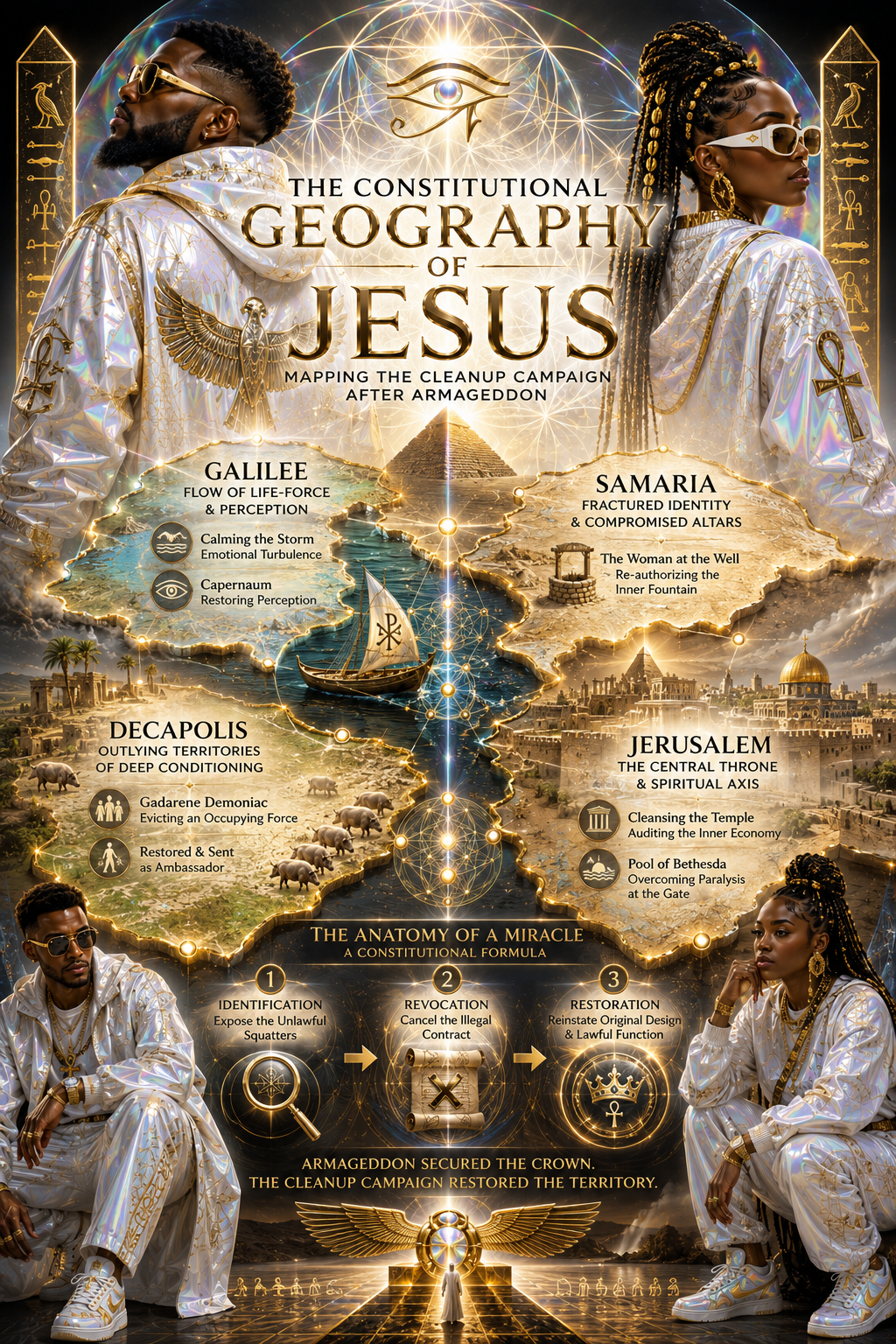
Mapping the Cleanup Campaign After Armageddon
By Alchemist Iris Chapman
In the previous article, we uncovered how the War of Armageddon was decisively won not on a physical battlefield at the end of time, but within the wilderness of consciousness during Jesus’ forty-day fast. By withdrawing constitutional funding from the competing governments of appetite, false identity, and self-sovereignty, the supreme authority of the Father’s Original Design was lawfully established.
Yet, winning the central war does not automatically mean every territory immediately surrenders.
When a central government shifts, outlying provinces often remain occupied by entrenched, unauthorized administrations. What follows the decisive victory is a strategic Cleanup Campaign—a systematic reclaiming of local jurisdictions, infrastructure, and trade routes. As Peter summarized, Jesus “went about doing good and healing all who were oppressed by the devil, for God was with Him” (Acts 10:38).
When we map the geography, miracles, and encounters of Jesus’ ministry through the framework of the 18-ChakraVerse, a startling pattern emerges: Jesus was not performing random acts of benevolence. He was conducting a precise, territorial restoration of Adam’s Inner Kingdom.
The Map of Adam’s Inner Kingdom
Within the 18-ChakraVerse, the physical landscape of First-Century Judea, Galilee, and Decapolis acts as a macro-constitutional blueprint of humanity’s internal architecture.
+-------------------------------------------------------------------+
|               THE CONSTITUTIONAL MAP OF THE INNER KINGDOM          |
|                                                                   |
|   [ Sea of Galilee ]  <--->  Flow of Life-Force & Perception       |
|   [ Decapolis ]       <--->  Gentile/Foreign Conditioned Territories|
|   [ Samaria ]         <--->  Fractured Identity & Compromised Altars|
|   [ Jerusalem ]       <--->  The Central Throne & Spiritual Axis   |
+-------------------------------------------------------------------+
Each province, city, and body of water represents a distinct jurisdiction within Adam’s consciousness:
- Galilee: The seat of daily operational life, perceptual processing, and vital energy exchange. As prophesied, “the land of Zebulun and the land of Naphtali, by the way of the sea… Galilee of the Gentiles: the people who sat in darkness have seen a great light” (Isaiah 9:1–2; Matthew 4:15–16).
- Samaria: The fractured borderlands of identity, where divine truth became mixed with inherited human traditions.
- Decapolis: The outlying, unrefined regions governed by foreign, heathen personas and deep-seated animalistic programming.
- Jerusalem: The central capital and governing crown, housing the Temple economy and the ultimate throne of authority.
When Jesus traveled between these regions, He was executing a territorial reclamation project.
Galilee: Restoring the Flow of Life-Force and Perception
Jesus establishes His operational base in Galilee, specifically around the Sea of Galilee. In the architecture of the Inner Kingdom, water represents consciousness and the movement of life-force.
1. The Storm on the Sea: Calming Environmental Turbulence
When Jesus rebukes the storm on the Sea of Galilee (Mark 4:39), He is not merely managing the weather. The sea represents the emotional and instinctual waters of Adam’s lower nature. An uncontrolled storm signifies emotional chaos destabilizing the kingdom’s interior environment. By commanding stillness, Jesus manifests the sovereign pattern of Psalm 107:29–30: “He calms the storm, so that its waves are still. Then they are glad because they are quiet; so He guides them to their desired haven.” External turbulence must yield to internal constitutional order.
2. Capernaum: The Jurisdiction of Perceptual Order
Capernaum, Jesus’ “own city,” serves as the hub for clearing sensory distortions, directly fulfilling the ancient blueprint of Isaiah 35:5–6: “Then the eyes of the blind shall be opened, and the ears of the deaf shall be unstopped.”
- Opening the Eyes of the Blind: The restoration of true perceptual alignment. Distorted vision creates false realities; restoring sight ensures that the Inner Kingdom evaluates reality through the Father’s lens rather than conditioned fear.
- Unstopping the Ears of the Deaf: Re-establishing the capacity to hear the divine voice above the clamor of competing internal narratives.
Samaria: Reclaiming Fractured Identity and Compromised Altars
To travel from Galilee to Judea, traditional religious mindset dictated bypassing Samaria. Yet Scripture notes that Jesus “had to pass through Samaria” (John 4:4). This was not a logistical necessity; it was a constitutional imperative.
Samaria represents the region of fractured identity—where the worship of God had been mixed with pagan influences, resulting in an altar that was half-lawful and half-compromised.
The Woman at the Well: Re-authorizing the Inner Fountain
At Jacob’s well, Jesus meets a woman who had five husbands, and the man she was currently with was not her husband.
+-------------------------------------------------------------------+
|                       THE SAMARITAN TRANSFORMATION                |
|                                                                   |
|   5 Previous Husbands  ---> Five Unlawful Governing Authorities    |
|   Current Partner      ---> Uncommitted, Illegal Agreement        |
|   Living Water         ---> Re-establishment of True Worship      |
+-------------------------------------------------------------------+
In the 18-ChakraVerse, husbands represent governing covenants or agreements that exercise authority over a territory. The woman’s history directly reflects Samaria’s judicial past: the king of Assyria settled five foreign nations—Babylon, Cuthah, Ava, Hamath, and Sepharvaim—into the cities of Samaria, so that the inhabitants “feared the Lord, yet served their own gods” (2 Kings 17:24, 33).
By offering her Living Water, Jesus:
- Audits her history of unlawful covenants.
- Dissolves her reliance on broken, inherited systems of identity.
- Restores true worship “in spirit and in truth” (John 4:23–24)—re-centering the altar of Samaria back into unmediated alignment with Original Design.
Decapolis: Liberating the Territory of Deep Conditioning
The Decapolis (“Ten Cities”) was a predominantly Gentile region across the Jordan River. It represents the deeply ingrained, wild, and unrefined territories of Adam’s consciousness—zones ruled by instinctual survival mechanisms, shadow personas, and heavy ancestral bondage.
The Gadarene Demoniac (Legion): Evicting an Occupying Force
Upon stepping foot in the country of the Gadarenes, Jesus is met by a man who precisely mirrors Isaiah 65:4: one who “sits among the graves, and spends the night in the tombs; who eats swine’s flesh.”
| Element of the Miracle | Constitutional Signifier within Adam |
| The Tombs | Attachment to dead, obsolete narratives and past traumas. |
| Legion (Army Unit) | Highly structured, militarized network of unlawful, false personas. |
| The Swine | Lower, animalistic appetites unfit to house divine life-force. |
| Sitting, Clothed, Right Mind | Complete restoration of lawful sovereignty and internal peace (Mark 5:15). |
This encounter is one of the most aggressive cleanup actions in the Gospels. Jesus does not merely cast out a spirit; He completely clears a massive, militarized stronghold occupying a vital province of Adam’s consciousness.
Once restored, Jesus gives him a judicial mandate: “Go home to your friends, and tell them what great things the Lord has done for you” (Mark 5:19). The man departs to preach throughout the Decapolis (Mark 5:20), converting a formerly occupied territory into a garrison of the Father’s government.
Jerusalem: Dismantling Corruption at the Central Axis
Jerusalem is the capital of the realm, representing the highest centers of governance, spiritual authority, and authority allocation within the Inner Kingdom.
Because Jerusalem sits at the center, the unlawful holdouts here are the most entrenched, institutionalized, and disguised as righteousness.
1. The Cleansing of the Temple: Auditing the Inner Economy
Jesus entering the Temple and overturning the tables of the money changers is an act of economic purification. As established in the wilderness fast, commerce within the Inner Kingdom represents the exchange of attention and life-force. The merchants had turned the core sanctuary into what Jeremiah and Jesus declared a “den of thieves” (Jeremiah 7:11; Matthew 21:13).
By driving out the merchants, Jesus fulfills the legal standard that “there shall no longer be a Canaanite [trafficker] in the house of the Lord” (Zechariah 14:21). The central altar of Adam’s consciousness cannot be commercialized. Divine life-force cannot be bought, sold, or traded through fear-based transactionalism.
2. The Pool of Bethesda: Overcoming Paralysis at the Gate
At the Sheep Gate in Jerusalem lay a man who had been paralyzed for 38 years, waiting passively for the stirring of the water.
Paralysis represents total stasis—a jurisdiction where authority exists in potential but lacks the functional vitality to act. By commanding him, “Rise, take up your bed and walk” (John 5:8–9), Jesus reinstates the law of conscious movement, freeing the executive functions of the Inner Kingdom from decades of learned helplessness.
The Anatomy of a Miracle: A Constitutional Formula
When viewed through this territorial lens, every miracle follows a precise three-part legal sequence that reflects the judicial victory of the cross:
- Identification of Unlawful Squatters: Exposing where fear, disease, lack, or false authority has taken root (e.g., blindness, paralysis, possession).
- Revocation of Unlawful Title: Canceling the illegal contract through truth, forgiveness, or judicial command—“having wiped out the handwriting of requirements that was against us… having disarmed principalities and powers” (Colossians 2:14–15).
- Re-installation of Original Design: Restoring functional wholeness and returning the jurisdiction back to the Father’s governance (“Stretch out your hand” / “Go home to your people”).
Concluding the Cleanup Campaign
The ministry of Jesus was not a series of disconnected, miraculous events intended merely to impress onlookers. It was a methodical, geographic sweep designed to reclaim every jurisdiction of Adam’s Inner Kingdom following the victory at Armageddon.
From the emotional waters of Galilee to the fractured altars of Samaria, the wild frontiers of Decapolis, and the central thrones of Jerusalem, Jesus systematically restored what had been lost.
The message He carried throughout this cleanup campaign remains the defining reality of the Inner Kingdom:
“If I drive out demons by the finger of God, then the kingdom of God has come upon you.” — Luke 11:20
Armageddon secured the crown; the cleanup campaign restored the territory. The invitation left for Adam today is to walk through his own consciousness, applying the same constitutional authority to every remaining holdout until the entire Inner Kingdom reflects the full, undivided glory of Original Design.