

Using Blue Salt In Cleaning Rituals For Home And Body
Blue salt stands out as an eye-catching yet easy addition for anyone wanting simple tools with a bit of a twist for home and personal care routines. Known for its striking color and its connection to mindfulness rituals, blue salt brings curiosity that’s more than just about its visual appeal. A lot of people are interested in how to put this unusual salt to work for both space and body cleansing, especially since not all salts have the same uses. In this guide, I’ll break down what blue salt is, why people tap into it for ritual cleaning, and give you clear ways to try it in your own life, without any confusion.
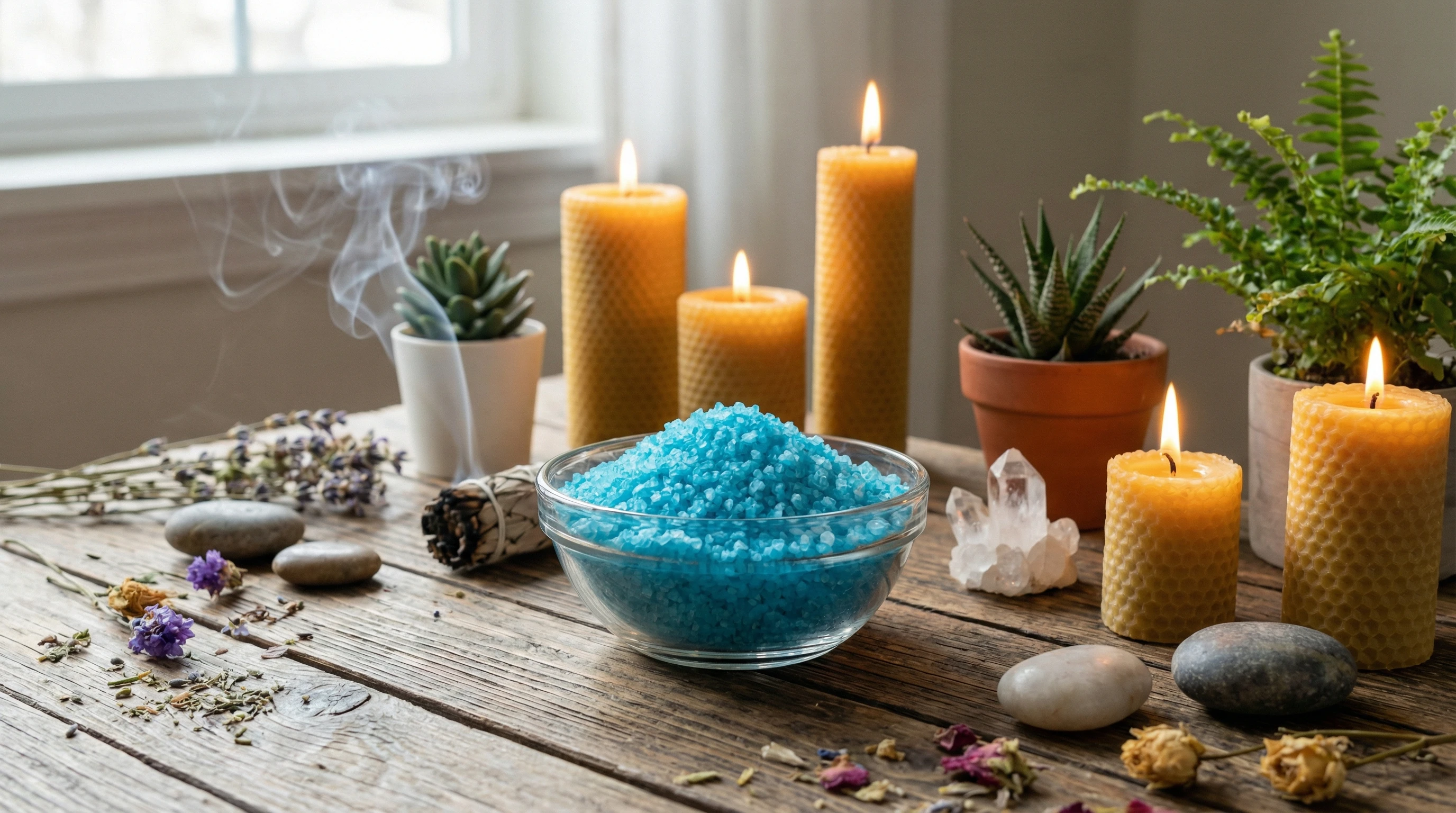
What Is Blue Salt and Why Is It Used?
Blue salt is usually made by adding either color or trace minerals to everyday salt. Some types use dye that’s safe for home or body rituals, while others naturally get their tint from minerals, like the rare Persian blue salt. The blue shade gives it a bit of extra meaning in cleansing rituals because blue is often tied to peace, protection, and clarity.
In my experience, blue salt is valued for the calm feeling it brings and how it draws the eye. Blue is a popular color for calmness and spiritual clarity. For lots of people, this makes blue salt perfect for rituals meant to sweep away heavy feelings or offer a fresh start, whether for your home or your own care routines.
If you’re curious about using blue salt in any ritual, always check if it’s cosmetic grade or food grade. Some versions exist only for decorative or spiritual use and shouldn’t be eaten or put directly on skin.
How Blue Salt Can Give a Boost to Home Cleansing Routines
Bringing blue salt into cleaning routines adds a mindful and symbolic step that elevates any regular ritual. Whether I want to shake off stagnant energy or just create a peaceful mood at home, these practices are easy for anyone, especially if you’re after non-religious, mindfulness-based routines. Here are my favorite ways to put blue salt to use around the house:
- Protective Bowls: Setting a small bowl of blue salt near main doors, on window sills, or in the corners of rooms can help “soak up” heavy energy or tension. I refresh the salt every couple of weeks, or more often if the room feels stuffy.
- Floor Wash: A sprinkle of blue salt in a bucket of warm water adds a ritual twist to mopping floors, especially by entryways. While scrubbing, I keep my attention on tossing out the day’s worries and welcoming a sense of calm.
- Smoke-Free Reset: Not everyone wants or can use incense so blue salt makes a gentle, scentfree substitute. A simple bowl tucked onto a shelf or desk gives me a quick visual reminder to take little moments of calm during the day.
- Nighttime Reset: Using blue salt in the bedroom became a go-to during stressful nights. I put out a small bowl before bed and dump the contents in the morning to symbolize letting go of emotional heaviness picked up in sleep.
Trying Blue Salt for Body and Personal Cleansing
Blue salt isn’t just for rooms. Adding it to personal care routines brings a mindful edge—just make sure your salt is meant to touch skin. Here are a few ways I get the most out of it for body-oriented rituals:
- Bath Soak: When I’m feeling emotionally wiped or tense, dissolving a tablespoon or two of blue salt into a hot bath does the trick. This is all about intention and letting go. The quiet, warm water and slow breathing always help me reset.
- Foot Soak: For days when a full bath isn’t realistic, I opt for a foot soak. Just a pinch of blue salt in a basin of warm water while I write in my journal or sit quietly packs a calming punch.
- Shower Ritual (Indirect): Even if I’m just grabbing a quick shower, I keep a tiny bowl of blue salt nearby to touch or hold before washing up. That moment feels like a mindful pause before getting on with my day or night.
Making Blue Salt Part of Emotional and Mindfulness Rituals
Blue salt also fits nicely into emotional and mindfulness routines thanks to its grounding qualities and soothing color. If you want ritual ways to let go of worries or mark boundaries, here are a couple routines that work well:
- Meditation Anchor: Placing a little dish of blue salt near me sets the space as focused and protected. Sometimes I’ll just rest my hands near it or hold it as I set intentions before meditating.
- Release Ritual: When it’s time to drop some old worries or stories, I write them down, top with a sprinkle of blue salt, and toss the paper or tear it up. This ritual never fails to leave me feeling more in control and able to move on.
Practical Tips for Using Blue Salt Rituals at Home
Jumping into blue salt is easy but a few smart steps make it more impactful. Here are ways that have helped me and others keep things simple and satisfying:
- Pick the Right Salt: Know if your blue salt is food-grade, cosmetic-grade, or only decorative. Only some colored salts are safe for bathing or touching skin.
- Start Small: Add blue salt to just one part of your routine first, like a nightly bowl or a weekend foot soak. When you’re comfortable, you can experiment with more spaces or rituals.
- Set a Clear Intention: Whether cleaning, meditating, or relaxing in the tub, take a second to decide on a wish or goal. Saying it out loud, even quietly, can help set the stage.
- Refresh Regularly: Unlike typical cleaning supplies, ritual salt bowls work best when replaced every week or so—whenever they seem stale or heavy.
- Don’t Eat Decorative Salt: Always double check labels so you’re never using a product for the wrong purpose—especially in homes with children or pets around.
How Others Use Blue Salt for Cleansing: Real-Life Experiences
Lots of what I do with blue salt came from my own experiments and stories from others. For instance, a friend keeps a blue salt bowl by her front door, switching it every Sunday to keep the energy in her house light and open. Another friend uses blue salt in a ceramic dish in her meditation area, as a boundary setter and protection boost.
Online, I’ve seen people stash blue salt in desk drawers at work for stress relief, and some use it to help kids create calming corners during anxious moments. The beauty of blue salt rituals is how easy it is to tailor them to your own needs and style.
Common Questions About Blue Salt in Cleansing Rituals
Since no two people do ritual work quite the same, there are always questions. Here are a few of the most common ones, with straight answers from my own experience and research:
Is blue salt the same as regular salt?
Blue salt has pigments or minerals added. Check the label to know what’s safe for your needs.
Are the effects real or more symbolic?
This is mostly about symbolism. People usually feel calmer or clearer because of their ritual and focus, not from properties unique to blue salt itself.
What should I do with used blue salt?
Bag it up and throw it in the trash, or dissolve it and pour it down the drain if it’s safe. Avoid dumping outdoors unless you know it’s harmless to plants.
Can blue salt help with allergies or germs?
It isn’t meant to replace cleaning supplies or medicine. Use it for mindful rituals, not as a disinfectant.
Things to Keep in Mind With Blue Salt
- Always make sure your blue salt is the right type before putting it in a bath, on your skin, or anywhere kids or pets may get to it.
- Store your salt somewhere dry where it won’t spill or soak up moisture.
- Blue salt works best as a complement—not a substitute—for regular cleaning and care routines.
Trying these blue salt rituals has helped me appreciate the small moments that mark everyday changes—coming home, winding down, or getting ready for a new chapter. No matter your reason, blue salt makes it easy to carve out a peaceful space or ground yourself at the end of a busy day. If you’re looking for a simple, affordable entry into ritual practice, it’s a next-level cool way to start.




I really appreciate how you framed blue salt rituals as mindful practices rather than magical fixes. ???? The idea of using a simple bowl of blue salt for a nightly reset or adding it to a bath soak feels like an accessible way to bring intention into everyday routines without overcomplicating things. I’ve experimented with different types of ritual salt before, and I agree that choosing cosmetic-grade or food-grade options and setting a clear intention makes the whole experience feel more grounded and meaningful ????
Aly, I really appreciate the way you articulated that — “mindful practice, not magical fix” is exactly the distinction I try to make.
For me, blue salt is less about superstition and more about nervous system signaling. When I place a bowl near the bed or add it to a bath, I’m not trying to force an energetic outcome — I’m cueing my body that it’s safe to soften. The color blue itself speaks to the throat and parasympathetic response: calm, clarity, release. Salt adds the tactile element — something mineral, grounding, physical. Together, they create a sensory ritual that tells the body, the day is complete; you can let go now.
I also love that you mentioned intention and quality. Cosmetic-grade or food-grade salt matters because the ritual should respect the body, not bypass it. And intention matters because the brain responds to meaning. When we deliberately mark a reset moment, we interrupt stress loops and reestablish coherence. That’s not magic — that’s embodied awareness.
Have you noticed a difference in how your body feels when you use blue versus other colors? I find blue shifts me into clarity, while warmer tones tend to feel more activating.
Thank you for such a rich and carefully structured exploration of blue salt rituals. From a communication standpoint, you make abstract, spiritual concepts approachable by pairing symbolism with clear instructions, safety notes, and everyday language your readers can confidently follow.
I especially value how you manage expectations explaining what is experiential versus practical which builds trust and credibility. That balance between inspiration and clarity is a hallmark of effective, responsible communication.
Thank you so much for taking the time to share this, Kavitha. I really appreciate the way you noticed how the information was communicated, not just what was shared.
One of my intentions with these ritual posts is to make sure spiritual and energetic practices feel grounded and accessible rather than mysterious or intimidating. Pairing symbolism with clear steps and safety notes helps people decide what resonates with them without feeling pressured to “believe” or perform anything a certain way.
I’m especially glad the distinction between experiential and practical elements stood out to you. For me, that transparency is important—ritual can be deeply personal, but it should never blur into confusion or unrealistic expectations.
Out of curiosity, when you explore ritual or spiritual practices yourself, do you tend to lean more toward the symbolic experience, or the practical, everyday application?
I like the way you keep this simple and grounded. It reads less like “magic” and more like a mindfulness tool that helps the mind and body switch into calm. I’ve done the same kind of thing with plain salt and water in stressful seasons, not because I thought the salt had powers, but because the small ritual gave my nervous system a clear signal: reset time.
The practical cautions matter too. The “cosmetic grade or food grade” reminder is the part people skip, then they blame the practice instead of the product.
One thought to add to the discussion: I think blue salt works best when people treat it like a cue for attention and release, not a substitute for basic cleaning or medical care. The bowl by the door, the mop water, the foot soak, those are simple anchors that can turn routine into rest.
Do you prefer mineral blue salt like Persian blue salt, or dyed blue salt for ritual use, and why? And what is your safest “starter ritual” for someone with sensitive skin who still wants the calming effect?
John
Hi John — thank you for such a thoughtful and grounded reflection. I really appreciate the way you framed ritual as a nervous-system cue rather than something mystical or performative. That distinction matters, and you articulated it beautifully.
You’re absolutely right: when practices like this are approached as anchors for attention and release, they tend to work with the body instead of bypassing it. Salt doesn’t need to be imbued with “powers” for the ritual to be effective — the body responds to rhythm, intention, and repetition. That’s often enough to signal safety and reset.
I also appreciate you highlighting the safety piece. Product quality gets overlooked far too often, and then the practice gets blamed instead of the materials. Cosmetic-grade or food-grade really is non-negotiable, especially when skin or respiratory sensitivity is involved.
To your questions:
Mineral blue salt vs. dyed blue salt
I personally lean toward natural mineral blue salts (like Persian blue salt) when they’re available and affordable, simply because they carry fewer unknowns — no added dyes, no stabilizers, and no surprises for sensitive systems. That said, I don’t think dyed blue salt is “wrong” for ritual use if it’s clearly labeled cosmetic-grade and used externally (bowls, floor washes, symbolic placements). The body tends to relax more readily when it doesn’t have to process ambiguity.
Safest starter ritual for sensitive skin
For someone with reactive skin, I usually suggest starting without direct contact:
A small bowl of blue salt and water near the bed or doorway
A floor or surface wipe (not a soak) using a very dilute solution
Or even a visual ritual — dissolving a pinch of salt in water, taking a few slow breaths, and pouring it down the drain with the intention of release
If skin contact is desired, a foot soak with a very low concentration and a short duration (5–7 minutes) tends to be the gentlest entry point, followed by a clear water rinse. The ritual works even at minimal exposure — the nervous system doesn’t require intensity to register calm.
I really value how you emphasized that these practices are complements, not substitutes, for cleaning, care, or medical support. Turning routine into rest — as you said — is where the real power lives.
Thank you for adding such a balanced, embodied perspective to the conversation. It deepens the discussion in exactly the way this space is meant to hold.
This is such a fascinating and thorough exploration of blue salt beyond its physical uses. I appreciated how you connected the color’s properties (calm, communication) with the practical and ritualistic actions of cleaning—it makes the entire process feel more intentional and mindful. Your step-by-step guides for both home and personal space feel accessible even for someone new to energy work.
A quick question from a curious beginner: For someone wanting to try just one simple ritual first, would you recommend starting with the personal aura spray or the room-clearing method? Also, in your experience, is there a noticeable difference in the “feel” of a space when using blue salt versus more common white salt for cleansing?
Thanks for sharing such a unique and practical blend of household tips and energetic hygiene!
Thank you so much for this thoughtful reflection, Cian — I really appreciate how closely you picked up on the intentionality behind combining color, ritual, and everyday cleaning. That mindful bridge between the practical and the energetic is exactly what I hope people feel when they try these practices.
For a first step, I usually suggest starting with the personal aura spray. It’s gentle, very intuitive, and helps you tune into your own sensitivity before working with the energy of a room. Many people notice subtle shifts in calmness, clarity, or breath awareness almost immediately. Once that personal awareness is established, the room-clearing method tends to feel more powerful and easier to “read,” because you’re already attuned to how energy shifts feel in your body.
As for blue salt versus white salt, there is a noticeable difference for many people. White salt often feels more neutral and grounding — like a reset or clearing to baseline. Blue salt tends to feel softer, more communicative, and calming, especially in spaces where there’s been tension, overstimulation, or a lot of mental activity. I think of blue salt less as “scrubbing” a space and more as harmonizing it. Both are effective — it really comes down to the intention and the quality of energy you want to invite back in after cleansing.
Thank you again for such a beautiful, curious engagement with the work. Questions like yours help keep these practices approachable and alive.
This is such a fascinating and practical guide—thank you for sharing! ???? I love how blue salt is highlighted not just for its beauty, but for the mindful and symbolic ways it can be incorporated into daily routines. From creating protective bowls at home to using them in baths or foot soaks, it’s inspiring to see something so simple turned into a meaningful ritual for both home and body.
I appreciate the clear tips on safety, intention-setting, and starting small—it makes these practices feel approachable for anyone, whether they’re new to mindfulness or already exploring rituals. I can definitely see how having a small blue salt bowl by the door or using it in meditation could bring a sense of calm and clarity to everyday life. This guide makes me excited to try some of these ideas and carve out more intentional, grounding moments in my own routine. ✨
Thank you so much for this thoughtful and encouraging reflection, Monica
I love that you picked up on the simplicity of blue salt as part of its power. That’s exactly what I hoped to convey—that ritual doesn’t have to be elaborate or intimidating to be meaningful. When we work with something as gentle and symbolic as blue salt, the real transformation often comes from the intention we bring to it, whether that’s placing a small bowl by the door as an energetic reset or using it mindfully in a bath or foot soak to release the day.
I’m especially glad the safety tips and “start small” approach resonated with you. Grounding practices tend to be the most sustainable when they feel natural and supportive rather than overwhelming. Even a quiet moment with blue salt during meditation or daily cleaning can become a steady anchor for calm, clarity, and presence. Thank you again for sharing your experience and openness—it’s beautiful to hear how these ideas are already weaving into your routine