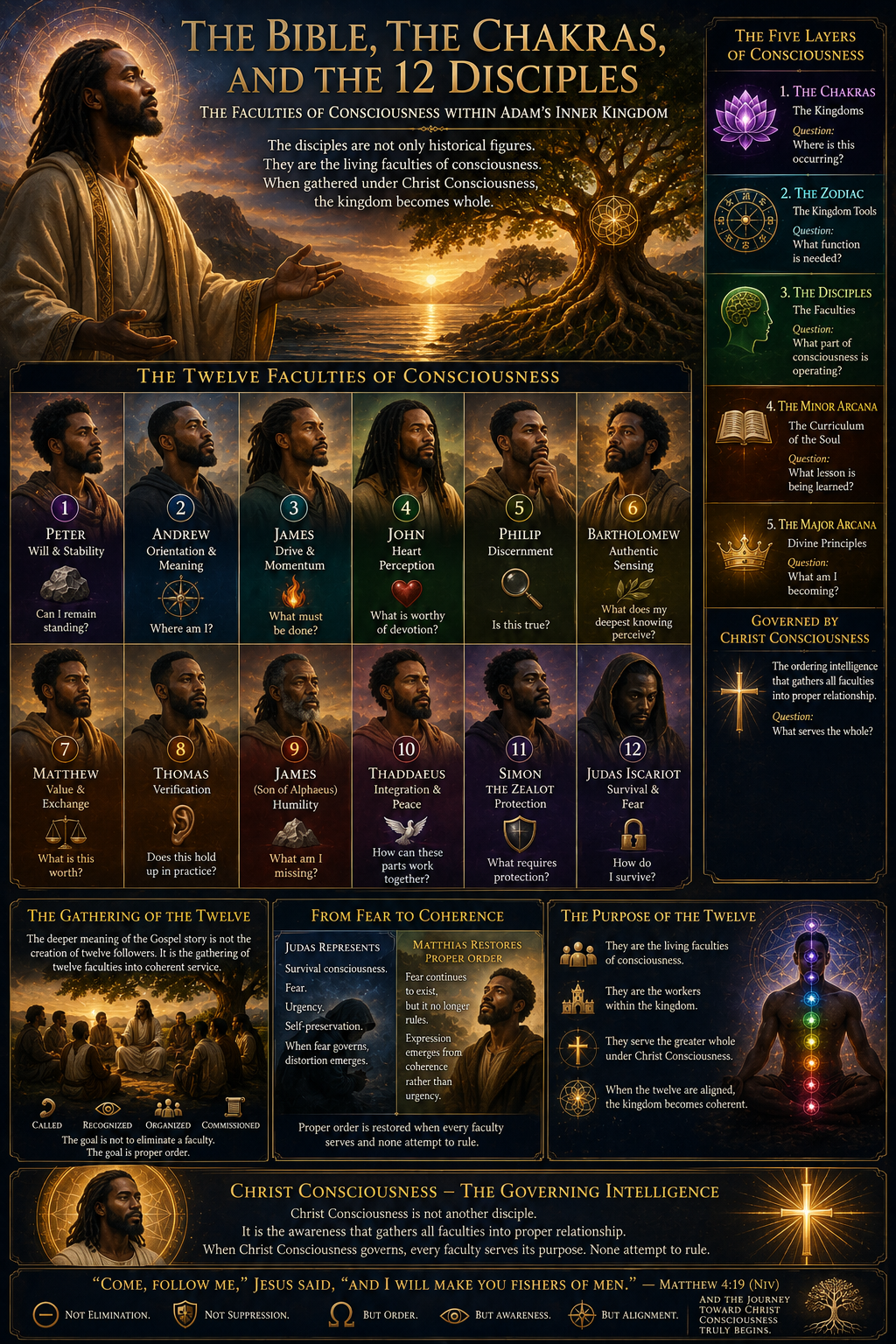
The Bible, The Chakras, and The 12 Disciples
The Faculties of Consciousness Within Adam’s Inner Kingdom
Many spiritual systems attempt to explain consciousness.
The Bible speaks through stories.
The chakra system speaks through energy centers.
The Tarot speaks through archetypes.
The zodiac speaks through symbolic tools.
The 18-ChakraVerse approaches these systems differently.
Rather than treating them as competing explanations, it views them as different layers of the same kingdom.
The chakras reveal the kingdoms.
The zodiac reveals the tools.
The Tarot reveals the lessons.
The disciples reveal the faculties.
Together they form a map of consciousness.
This article explores the role of the twelve disciples within that map.
The Disciples Are Not Historical Characters Alone
Within the 18-ChakraVerse, the disciples are more than historical individuals.
They are living faculties operating within consciousness itself.
Every day Adam sees.
Feels.
Speaks.
Discerns.
Acts.
Protects.
Questions.
Remembers.
These capacities are represented by the disciples.
The disciples are not separate from consciousness.
They are functions within consciousness.
Just as a kingdom requires different departments to operate effectively, consciousness requires different faculties to navigate reality.
The disciples represent those faculties.
The Difference Between Kingdoms, Tools, Lessons, and Faculties
One of the greatest sources of confusion in symbolic systems occurs when everything attempts to occupy the same role.
In the 18-ChakraVerse, each system has a distinct responsibility.
The Chakras
Reveal the kingdoms.
Question:
Where is this occurring?
The Zodiac
Reveal the Kingdom Tools.
Question:
What function is needed?
The Minor Arcana
Reveal the soul’s curriculum.
Question:
What lesson is being learned?
The Major Arcana
Reveal divine principles.
Question:
What am I becoming?
The Disciples
Reveal the faculties.
Question:
What part of consciousness is operating?
The disciples are not tools.
They are not lessons.
They are not archetypes.
They are the inner capacities that carry out the work of the kingdom.
The Twelve Faculties of Consciousness
Peter — Will and Stability
Peter represents the faculty of stability.
He holds position.
Maintains commitment.
Provides endurance.
Peter asks:
Can I remain standing?
Without Peter, the kingdom lacks strength.
Andrew — Orientation and Meaning
Andrew represents the faculty of orientation.
He helps consciousness locate itself.
Interpret experience.
Find meaning.
Andrew asks:
Where am I?
Without Andrew, confusion emerges.
James (Son of Zebedee) — Drive and Momentum
James represents movement.
Initiation.
Forward progress.
Action.
James asks:
What must be done?
Without James, nothing moves.
John — Heart Perception
John represents the heart’s ability to perceive.
Love.
Connection.
Safety.
Belonging.
John asks:
What is worthy of devotion?
Without John, the kingdom becomes cold.
Philip — Discernment
Philip tests.
Evaluates.
Questions.
Examines.
Philip asks:
Is this true?
Without Philip, deception flourishes.
Bartholomew — Authentic Sensing
Bartholomew represents instinctive knowing.
Direct sensing.
Inner recognition.
Bartholomew asks:
What does my deepest knowing perceive?
Without Bartholomew, intuition becomes muted.
Matthew — Value and Exchange
Matthew governs relationship through value.
Giving.
Receiving.
Reciprocity.
Exchange.
Matthew asks:
What is this worth?
Without Matthew, imbalance develops.
Thomas — Verification
Thomas verifies.
Grounds.
Tests reality through experience.
Thomas asks:
Does this hold up in practice?
Without Thomas, fantasy replaces wisdom.
James (Son of Alphaeus) — Humility
James represents proportion.
Perspective.
Regulation.
Humility.
James asks:
What am I missing?
Without James, pride emerges.
Thaddaeus — Integration and Peace
Thaddaeus harmonizes.
Connects.
Softens.
Integrates.
Thaddaeus asks:
How can these parts work together?
Without Thaddaeus, fragmentation increases.
Simon the Zealot — Protection
Simon guards boundaries.
Protects convictions.
Maintains integrity.
Simon asks:
What requires protection?
Without Simon, the kingdom becomes vulnerable.
Judas Iscariot — Survival and Fear
Judas represents survival consciousness.
Not evil.
Not corruption.
Protection.
Fear.
Urgency.
Self-preservation.
Judas asks:
How do I survive?
The problem is not Judas.
The problem occurs when Judas occupies the throne.
Matthias and Restored Order
When fear governs consciousness, distortion emerges.
Speech changes.
Perception narrows.
Reaction replaces wisdom.
The replacement of Judas by Matthias symbolizes the restoration of proper order.
Matthias is not a new faculty.
He represents a new relationship to fear.
Fear continues to exist.
But it no longer rules.
Matthias asks:
Can expression emerge from coherence rather than urgency?
This is the beginning of integration.
Christ Consciousness
The disciples are not the highest principle.
They are not the ruler.
They are the servants.
Christ Consciousness is the governing intelligence that orders them.
Within the 18-ChakraVerse:
Christ Consciousness is not another disciple.
It is not another faculty.
It is not another voice competing for attention.
It is the awareness that gathers all faculties into proper relationship.
When Christ Consciousness governs:
Peter provides stability.
Andrew provides orientation.
Philip provides discernment.
Simon provides protection.
John provides love.
Thomas provides verification.
Every faculty serves its purpose.
None attempt to rule.
The Gathering of the Twelve
The deeper meaning of the Gospel story is not the creation of twelve followers.
It is the gathering of twelve faculties into coherent service.
The disciples are called.
Recognized.
Organized.
Commissioned.
The same process occurs within consciousness.
The goal is not to eliminate fear.
Eliminate doubt.
Eliminate desire.
Or eliminate protection.
The goal is proper order.
Every faculty belongs.
Every faculty serves.
Every faculty participates.
The kingdom becomes healthy when no single faculty attempts to govern the whole.
The Purpose of the Twelve
The disciples answer a question no other system answers.
The chakras reveal where the work occurs.
The zodiac reveals what function is needed.
The Tarot reveals what lesson is being learned.
The disciples reveal who carries out the work.
They are the living faculties of consciousness.
The workers within the kingdom.
The servants of the greater whole.
And when gathered under Christ Consciousness, they transform fragmentation into coherence.
Not through force.
Not through suppression.
Through order.
Through awareness.
Through alignment.
Final Reflection
The Bible presents the disciples as companions of Christ.
The 18-ChakraVerse presents them as companions of consciousness.
Every disciple lives within Adam.
Every faculty seeks expression.
Every faculty has wisdom to offer.
The work is not removing them.
The work is gathering them.
When the twelve are aligned:
The kingdom becomes coherent.
The nervous system becomes ordered.
The heart becomes peaceful.
Consciousness becomes whole.
And the journey toward Christ Consciousness truly begins.



Wow, this is such a good-looking website… I love it, and I know my partner will love it even more. How long have you been in the Chakra and Energy space for?
I know firsthand what a difference your mindset can make and how it affects others. Learning to control your own energy takes practise, but well worth the rewards 🙂
Thanks for the read…
Luke, I really appreciate that—thank you. It means a lot that the site resonated with you, and I love that you’re already thinking about sharing it with your partner.
I’ve been immersed in the chakra and energy space for more than 40 years now, but more importantly, it’s been a lived practice—not just study. What you’re seeing on the site is the result of that ongoing integration: taking spiritual principles, testing them in real life (in mindset, relationships, business, and health), and then refining them into something that people can actually use.
You said something key—learning to control your own energy takes practice. That’s exactly the foundation of everything I teach here. Most people think of energy work as something abstract, but in reality, it’s about becoming aware of the patterns running through you and then consciously shifting them. That’s where the real transformation happens.
And you’re absolutely right—the ripple effect is real. When your internal state shifts, it naturally begins to influence the people around you, often without you needing to say a word.
I’m glad the message landed with you, and I’d love to hear what you and your partner resonate with most as you explore more.
This was such a beautifully written and deeply integrative piece. I really appreciate how you bridged spiritual language with nervous system awareness in a way that feels both mystical and practical. The mapping of the disciples to inner faculties was especially powerful — it made the whole concept of healing feel more embodied and compassionate instead of abstract. I also loved the reminder that integration isn’t about suppressing any part of ourselves, but bringing everything back into order with gentleness. This was such a thoughtful and expansive read.
Kiersti, I really appreciate the depth of what you reflected back here. You touched on something essential—the moment spiritual language actually lands in the body, it stops being philosophy and starts becoming integration. That bridge between nervous system awareness and what I call Christ Consciousness is where the work becomes real. It’s no longer about reaching upward or escaping, but about organizing what’s already within us into coherence. That’s why the mapping of the disciples matters so much to me—it reframes healing as a relational process inside the self, where each “part” has a role, a voice, and a place in the whole.
And I’m especially glad the piece conveyed gentleness, because that’s the part often missing in both spiritual and healing spaces. True integration isn’t force, discipline, or suppression—it’s right order through awareness. When the system feels safe enough, it naturally reorganizes. What we often call “healing” is really the return of internal harmony, where nothing is exiled and nothing has to fight to be seen. You captured that beautifully.
This was a very interesting article because it explores the connection between spirituality, consciousness, and the nervous system in a way that encourages deeper reflection. The idea of “neural integration” presented in the post suggests that healing occurs when different parts of the mind and body begin to work together in balance rather than operating in conflict. The article uses spiritual language such as Christ consciousness and the symbolism of the twelve disciples to describe how different faculties of awareness can become aligned under a single, calm center of consciousness.
The discussion about internal fragmentation is particularly thought-provoking. Many people experience stress, anxiety, or emotional overwhelm as if different parts of their mind are pulling in different directions. The article frames healing as a process of restoring order in the nervous system, where fear or survival responses no longer dominate awareness and the body returns to a more regulated state.
I also found the concept of expanding the traditional chakra system to an 18-chakra model interesting. Whether someone approaches this idea from a spiritual, symbolic, or psychological perspective, it encourages people to pay attention to how emotions, physical sensations, and awareness interact throughout the body. Overall, the article provides an intriguing perspective on how spiritual symbolism and ideas about nervous system regulation can overlap when discussing personal healing and inner balance.
Anthony, thank you for such a thoughtful reflection on the article. I’m especially glad the idea of neural integration resonated with you. One of the central intentions behind the piece was exactly what you described—showing how spiritual language and nervous system regulation are often pointing to the same inner process. When the mind, body, and emotional centers begin cooperating instead of competing, a calmer and more coherent state of awareness naturally emerges. In many ways, what spiritual traditions call Christ consciousness can be understood as that centered state where our inner faculties are no longer fragmented but unified.
I also appreciate your openness to the 18-chakra model as a symbolic map for exploring that integration. Whether someone approaches it spiritually, psychologically, or energetically, the goal is the same: greater awareness of how our thoughts, emotions, and bodily signals interact. When we start listening to those signals instead of suppressing them, healing becomes less about “fixing” ourselves and more about restoring harmony within the system. Your insight about inner balance captures that beautifully, and I’m grateful you took the time to share your perspective.
This is a very interesting article. If I have understood this correctly, this is a deep experience that connects the awareness of our nervous system to a recognition of our spirituality. It is a unique healing and self-regulation with much clarity. It is also interesting to notice that each particular disciple “possessed” the unique functions for your chakras. This “path” is recognizing and remembering our INNER self. Thank you for a very educational article.
Best wishes,
Kent
Kent, I really appreciate how clearly you reflected the core of the article back. Yes — what you described is exactly the bridge I was pointing to: neural integration as the physiological doorway, and Christ Consciousness as the organizing spiritual intelligence. When the nervous system is fragmented, our perception of self fragments with it. When the system integrates, clarity increases — not because something mystical was “added,” but because interference was reduced. Self-regulation and spiritual awareness are not separate tracks; they are layered expressions of the same alignment.
And I love that you noticed the disciples representing unique functions. That symbolism is intentional. Each disciple mirrors a distinct neural pathway, energetic quality, and archetypal capacity within us. The “sending out in pairs” reflects bilateral integration. The calling of each one represents conscious recruitment of dormant inner functions. The path is not about acquiring something new — it is about remembering and coordinating what has always been present. That remembering is the return to the INNER self you described so well. Thank you for engaging the work with such depth.
A deeply integrative and carefully articulated framework that bridges contemplative spirituality with embodied nervous system awareness. I appreciate how you translate symbolic language into lived, physiological experience without losing nuance or reverence. The step-by-step movement from recognition to unification offers readers a practical path rather than abstract philosophy. Thought-provoking, grounded, and likely to resonate with anyone exploring healing through coherence and self-regulation.
Vitha, thank you — I genuinely receive this.
What means the most to me in your reflection is that you felt the bridge. That’s always the intention. I never want spiritual language to float above the body, and I never want physiology to be reduced to mechanics. If Christ Consciousness cannot be felt in the nervous system, then it remains theory. And if nervous system regulation is not connected to meaning, it can become purely technical. Healing lives in the integration.
You named something important when you mentioned the movement from recognition to unification. That progression mirrors how the body actually stabilizes. First we notice dysregulation. Then we create safety. Then coherence begins to form. And only after coherence stabilizes does unification feel natural rather than forced. The 18-chakra covenant framework is built around that sequencing on purpose.
I’m curious — when you read about neural integration and coherence, did any particular part resonate in your own lived experience? Was it the recognition phase, the recalibration of the nervous system, or the sense of embodied unity afterward?
I deeply appreciate your attentiveness to nuance and reverence. That tells me you’re not just reading the material — you’re engaging it somatically. And that, to me, is where real healing begins.
This was really interesting to read and it was also fascinating to see that each disciple had their own functions when it comes to balancing your chakras. It looks quite complex and I think is overwhelming to someone studying this for the first time, but you have set this out in such an easy to understand fashion.
Does practicing mindfulness, prayer, and deep breathing help one to understand all these chakras a bit better and tune into them? Is it better to go to a practitioner who can work out which chakras are blocked and help you to unblock them?
Hi Michel, thank you so much for reading so thoughtfully and for sharing your reflections. I really appreciate you naming both the depth and the potential overwhelm—that’s very honest, and it’s something I’m always mindful of when writing about the 18-chakra system.
To your first question: yes, practices like mindfulness, prayer, and deep breathing are some of the most effective ways to begin understanding the chakras. They gently slow the nervous system and bring awareness back into the body, which is where chakra information is actually perceived—not intellectually, but through sensation, emotion, and subtle shifts. Over time, these practices help you notice patterns: where tension gathers, where energy feels open, where emotions repeat. That awareness alone is already a form of integration.
As for whether it’s better to work with a practitioner—there’s no single “right” answer. Many people benefit from starting on their own with simple daily practices, especially when the goal is self-awareness rather than fixing something. A skilled practitioner can be helpful if you feel stuck, disconnected from your body, or want guidance in interpreting what you’re experiencing. Ideally, though, a practitioner doesn’t override your intuition—they help you learn how to listen to it more clearly.
The way I frame the 18-chakra covenant is not as something you have to master all at once, but as a living map. You don’t study the whole map at the beginning of a journey—you walk one path, notice what arises, and let understanding unfold naturally. The practices you mentioned are already doing more work than most people realize.
That said, I’m curious—when you think about tuning in more deeply, do you feel drawn toward inner, self-guided practices, or does having an external guide feel more supportive for you right now?
I like what you’re doing here, because it treats spirituality and the nervous system as one human story, not two rival worlds. The “inner disciples” idea makes sense to me. When fear takes the wheel, everything inside gets noisy. When calm returns, the parts start cooperating again.
I also appreciated how you handled Judas as “survival voice” instead of a cartoon villain. Survival has a job, but it becomes destructive when it stays in leadership after the danger is gone.
Question: is your disciple-to-cranial-nerve mapping meant as a symbolic teaching tool, or are you saying it is a direct biological link? And for someone who feels fragmented today, what is one simple practice you’d suggest to feel integration in the body, not just understand it in the mind?
John
John, thank you for such a thoughtful and precise reflection. I really appreciate the way you named this as one human story, not a tug-of-war between spirituality and biology. That’s exactly the bridge I’m trying to walk.
On your first question: the disciple-to-cranial-nerve mapping is not meant as a literal one-to-one anatomical claim, but it’s also more than a loose metaphor. I see it as a functional correspondence. In other words, the disciples represent roles of perception, communication, regulation, and response that the nervous system actually performs. The biblical language gives us a symbolic map of how consciousness organizes itself, while the cranial nerves show us how that organization is carried out in the body. They’re describing the same coordination from two different angles—inner narrative and biological process—without collapsing one into the other.
Your insight about Judas as a survival voice is right on point. Survival has a legitimate job. Trouble starts when it stays in leadership after the threat has passed. That’s not evil—it’s dysregulated protection. Scripture is surprisingly compassionate when read at that level.
For someone feeling fragmented today, here’s one simple, embodied practice I often return to myself:
Integration Practice (2–3 minutes):
I place one hand gently on my chest and one on my lower abdomen. I slow my breath and let the exhale be slightly longer than the inhale. As I breathe, I quietly name what’s present without fixing it: “fear is here,” “tension is here,” “breath is here.” Nothing gets pushed out; nothing gets crowned as leader. I’m signaling safety to the nervous system and inviting the parts back into cooperation.
What matters is not insight, but signal. Calm tells the system it’s safe to integrate. Understanding can follow later.
I’m grateful for the way you’re engaging with this—curious, grounded, and humane. Conversations like this are exactly where integration becomes real, not theoretical.
Beautifully woven perspective. I really appreciate how you translate mystical language into lived, embodied experience rather than abstract belief. The framing of the cranial nerves as “inner disciples” is especially compelling because it invites self-observation instead of self judgment; every response pattern becomes information, not failure. Your emphasis on fear as a protector that simply shouldn’t lead feels both compassionate and neurologically sound. I also resonate with the idea that healing is less about adding something new and more about restoring communication and rhythm within systems that already know how to regulate. The integration of breath, vagal tone, and subtle awareness practices gives readers practical entry points, which is often what spiritual discussions lack. Whether someone relates through faith, neuroscience, or somatic work, this model offers a unifying map that honors complexity without losing groundedness. Thank you for sharing such an integrative and framework.
Andrejs, thank you for this—your reflection tells me you felt the work, not just read it. I really appreciate how you named the shift from belief to embodied observation, because that’s exactly where real healing begins. When response patterns become information instead of failure, the nervous system can finally soften enough to listen. That’s the doorway I’m always hoping readers will walk through.
I’m especially glad the framing of fear as a protector that shouldn’t lead resonated with you. So much spiritual harm comes from trying to exile fear rather than reassign it. When fear is honored but no longer governing, rhythm and communication naturally return—neurologically and energetically. Your point about restoring communication rather than “adding” something new is beautifully said and very much at the heart of the 18-chakra model.
Out of curiosity, which entry point spoke to you most—the cranial nerves as inner disciples, the breath/vagal lens, or the idea of rhythm as the true healer? And do you tend to approach this work more from a somatic, contemplative, or integrative neuroscience angle in your own practice?
This is a profound and practical synthesis of spiritual symbolism and nervous system science. I appreciate how the ‘12 disciples’ are reframed as internal faculties rather than external figures, making the teaching deeply relatable to daily healing work.
The connection between Christ Consciousness and neural integration especially resonates—when the nervous system is ordered, the experience of peace feels less like a ‘spiritual event’ and more like a natural state of coherence. The way you describe fear (Judas) as a necessary but misled part is particularly insightful, because it shifts healing from ‘elimination’ to ‘reordering.’
I also found the 18-chakra map helpful in offering more nuanced checkpoints for self-awareness. It feels like a bridge between traditional chakra wisdom and modern understanding of trauma, regulation, and embodied presence.
A question for readers: what part of this mapping do you feel most strongly in your body right now—fear, will, heart, or something else—and what practice helps you return it to balance?
Thank you so much for this thoughtful reflection, Monica. I really appreciate how clearly you articulated the heart of the work—especially the idea that coherence in the nervous system makes peace feel less like something we reach for and more like something we remember. That distinction is so important. When Christ Consciousness is understood as integration rather than transcendence, healing naturally shifts from fighting parts of ourselves to listening, ordering, and restoring right relationship within the whole system.
I also love how you highlighted fear (Judas) as “necessary but misled.” That reframing is central to this map. Fear isn’t the enemy—it’s an early-warning intelligence that simply needs to be brought back into alignment with heart, breath, and higher will. The 18-chakra framework exists for that very reason: to give us more precise checkpoints in the body where regulation, compassion, and conscious choice can meet. Your closing question is beautiful, too—it invites embodiment rather than theory, which is exactly where real healing begins.
This is a truly thought-provoking piece. What resonates most is the framing of this expansion not as an acquisition of something external, but as an integration and remembrance of a divine architecture within. The emphasis on moving from intellectual understanding to embodied experience—’neural integration’—feels like the crucial next step beyond theory. It invites deep personal contemplation on what true healing and consciousness mean. Thank you for this insightful contribution!
Thank you so much for this thoughtful reflection, Cian. I really appreciate how clearly you picked up on the heart of the work—that this path isn’t about adding something new, but about remembering and reintegrating what has always been within us. For me, neural integration is where spiritual insight moves out of abstraction and into lived reality, where the body, mind, and spirit begin to speak the same language again. That shift from understanding to embodiment is exactly where true healing unfolds. I’m grateful you felt that invitation, and I’m honored this piece sparked deeper contemplation for you.