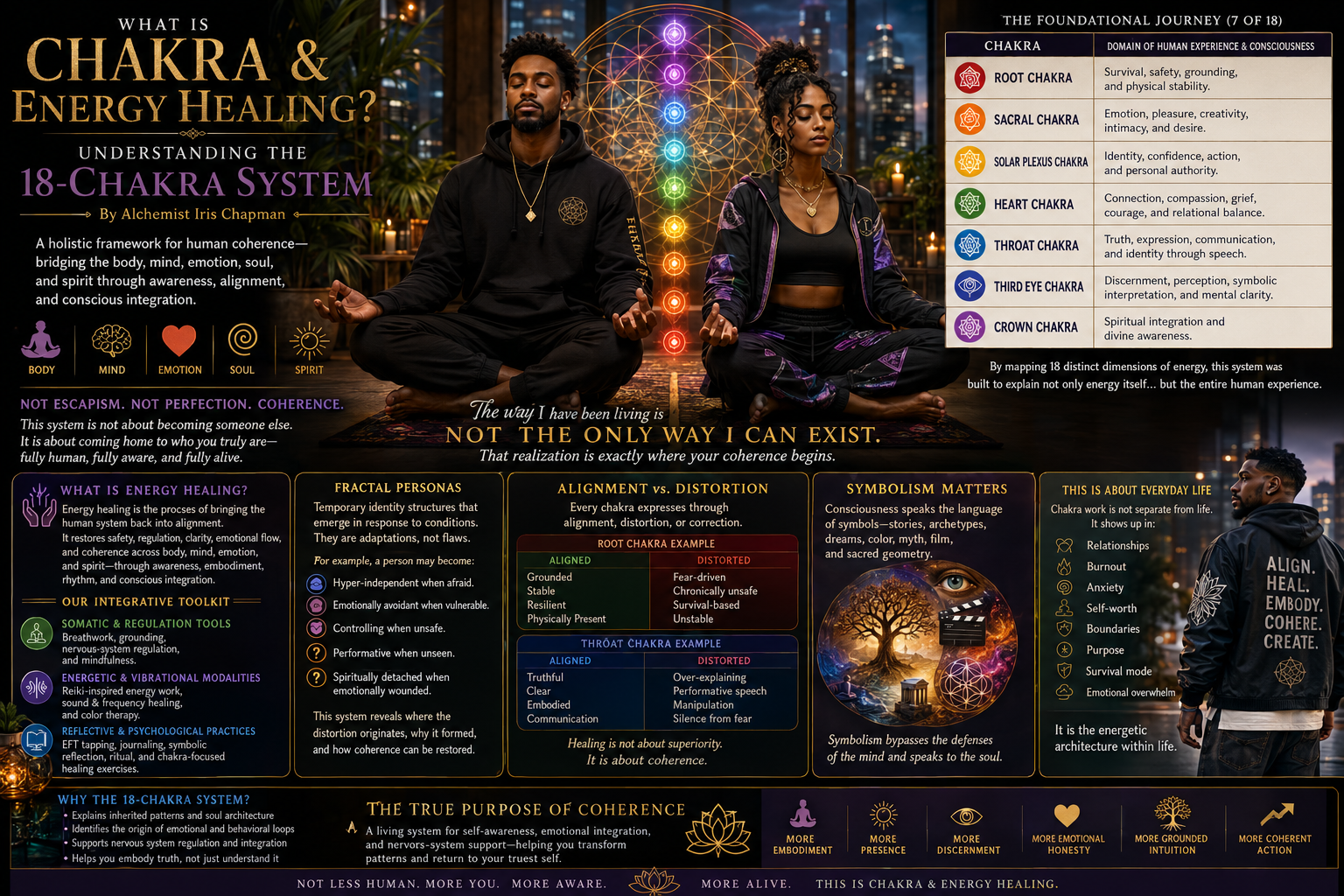
Understanding the 18-Chakra System
By Alchemist Iris Chapman
“And the kingdom of God cometh not with observation… for, behold, the kingdom of God is within you.”
— Luke 17:20–21
For many people, the words chakra and energy healing immediately bring to mind spinning wheels of color, ambient meditation tracks, wafting incense, or vague, floating spiritual ideas disconnected from daily life.
At Chakra & Energy Healing, we approach energy work through a radically different lens.
This is not a system built around escapism, performance spirituality, or the rejection of the material world. It is, fundamentally, an administrative and constitutional map of human coherence—an exploration of the sacred geography of Adam’s Inner Kingdom.
Jesus’ declaration that “the kingdom of God is within you” provides an indispensable key for this exploration. If there is a kingdom within, then questions of government, jurisdiction, authority, boundaries, communication, alignment, and internal order become legitimate spiritual inquiries.
Scripture repeatedly relies on this exact governmental architecture when detailing the inner human condition. Proverbs 25:28 declares:
“He that hath no rule over his own spirit is like a city that is broken down, and without walls.”
Notice the precise architecture of the metaphor: Spirit. Rule. City. Walls. The condition of the inner person is directly compared to the condition of a governed territory.
This is the territory the 18-ChakraVerse investigates.
A Framework for Understanding the Human Experience
The 18-ChakraVerse is a metaphysical architecture of consciousness. It is a lens that examines the profound, intricate relationship between the body, identity, behavior, perception, emotion, survival, intuition, speech, power, soul expression, and divine integration.
- It is both symbolic and practical.
- Ancient and modern.
- Biblical and psychological.
- Mystical and deeply human.
Rather than sweeping life’s complexities under a rug of spiritual platitudes, this framework provides a practical blueprint for understanding:
- Why we repeat the same painful emotional patterns across decades.
- Why certain fears dominate entire lifetimes.
- Why identity fractures under sudden pressure.
- Why some environments strengthen us while others slowly dissolve our vitality.
- Why the body, mind, emotions, and spirit cannot truly be separated.
- How genuine restoration occurs when a person becomes internally aligned with Original Design.
This emphasis on rigorous self-examination is deeply rooted in biblical tradition. Paul instructed in 2 Corinthians 13:5 to “Examine yourselves…” Likewise, Lamentations 3:40 urges:
“Let us search and try our ways, and turn again to the LORD.”
The objective is never condemnation; the objective is accurate evaluation.
- Where am I aligned?
- Where am I divided?
- What is governing my decisions?
- What pattern keeps repeating?
- What requires correction?
- And what would true restoration look like?
What Are Chakras? Jurisdictions of the Inner Kingdom
In traditional esoteric models, a chakra is often described merely as a subtle energetic vortex. In the 18-ChakraVerse, we shift the emphasis entirely:
A chakra is fundamentally a governing jurisdiction within Adam’s constitutional kingdom.
Just as an earthly nation requires distinct cities, borders, offices, and administrative centers to function lawfully, Adam is not merely a physical body—he is a living constitutional kingdom containing eighteen distinct governing offices.
The biblical metaphor of the human being as sacred architecture provides a direct parallel:
“Know ye not that your body is the temple of the Holy Ghost which is in you…?”
— 1 Corinthians 6:19
“Know ye not that ye are the temple of God, and that the Spirit of God dwelleth in you?”
— 1 Corinthians 3:16
The body is not treated biblically as spiritually irrelevant matter. It is a dwelling place. It has architecture. It has members. It has functions. It has boundaries. And it requires lawful government.
Each chakra office within the 18-ChakraVerse possesses:
- A constitutional purpose and lawful authority.
- Defined boundaries and gates regulating incoming and outgoing exchange.
- Resident personas and citizens serving within that jurisdiction.
- Neighboring offices with which it must maintain clear communication.
- Differentiated responsibilities that cannot simply be transferred elsewhere.
Paul outlines this principle of differentiated responsibility in 1 Corinthians 12:14, 18:
“For the body is not one member, but many… But now hath God set the members every one of them in the body, as it hath pleased him.”
The hand cannot become the eye simply because it prefers the eye’s assignment. The ear cannot abandon hearing because another member appears more prominent. Different members carry different assignments while remaining part of one integrated organism.
The 18-ChakraVerse applies this same principle constitutionally: differentiation does not require fragmentation. Healthy internal governance requires distinct offices that can perform their proper functions while remaining in communication with the whole.
The Complete 18-Chakra Jurisdictions: The Arc of Remembrance
Traditional systems stop at seven chakras, often presenting an incomplete map that leaves ancestral roots and higher legislative authorities floating in abstraction. The 18-ChakraVerse extends from the subterranean bedrock beneath our feet to the cosmic legislative courts of the Logos.
In this architecture, energetic distortion is rarely active rebellion—it is amnesia. When an administrative office forgets its constitutional assignment, a survival persona steps in to manage the void. Restoration occurs as each office transitions from the amnesia of survival back into the remembrance of its Original Design.
Subterranean & Somatic Foundations
- Earth Star Chakra
- Constitutional Jurisdiction: Lineage Bedrock, Generational Anchoring, and Ancestral Memory.
- The Amnesia: “I Forgot Where I Came From.” Displaced from origin, lineage severed, floating without grounding.
- The Law Restored: Unshakable physical and ancestral anchoring into the earth.
- Root Chakra
- Constitutional Jurisdiction: Survival, Safety, Boundary Security, and Physical Stability.
- The Amnesia: “I Forgot That I Was Fire.” Frozen in cold defense, hyper-vigilant survival panic, paralysis.
- The Law Restored: Primal vitality, embodied security, and the foundational spark of life.
- Sacral Chakra
- Constitutional Jurisdiction: Emotion, Fluidity, Pleasure, Intimacy, and Desire.
- The Amnesia: “I Forgot How to Feel.” Numbness, dissociation, mechanical survival stripped of life movement.
- The Law Restored: Creative fertility, healthy emotional circulation, and genuine feeling.
- Navel Chakra
- Constitutional Jurisdiction: Visceral Center, Somatic Instinct, and Internal Equilibrium.
- The Amnesia: “I Forgot My Center.” Internal drift, somatic instability, yielding core gravity to external forces.
- The Law Restored: Gut discernment, centered stillness, and somatic stability.
- Sentinel Chakra
- Constitutional Jurisdiction: Perimeter Defense, Watchtower Discernment, and Environmental Listening.
- The Amnesia: “I Forgot How to Listen.” Reactive paranoia, false alarms, and misinterpreting ambient signals.
- The Law Restored: Lawful vigilance, objective perimeter defense, and intuitive listening.
The Executive & Relational Sanctuary
- Solar Plexus Chakra
- Constitutional Jurisdiction: Personal Agency, Executive Authority, Confidence, and Action.
- The Amnesia: “I Forgot My Power.” Victim consciousness, abdication of will, or compensatory aggression.
- The Law Restored: Rightful executive governance, disciplined power, and sovereign agency.
- Heart Chakra
- Constitutional Jurisdiction: Central Sanctuary, Relational Balance, Courage, and Grief.
- The Amnesia: “I Forgot How to Love.” Armored walls, bitter withdrawal, fear of vulnerability, unmourned grief.
- The Law Restored: Open covenant exchange, unconditional compassion, and central balance.
- High Heart Chakra
- Constitutional Jurisdiction: Sovereign Devotion, Christic Stewardship, and Sacred Purpose.
- The Amnesia: “I Forgot How to Serve Without Losing Myself.” Codependency, martyr identity, depleting self-sacrifice.
- The Law Restored: Sustainable service, divine stewardship, and consecrated integrity.
The Perceptual & Legislative Gates
- Veil Chakra
- Constitutional Jurisdiction: Dimensional Permeability and Spiritual Insight.
- The Amnesia: “I Forgot What I Could See Beyond the Veil.” Trapped in literalism, believing surface appearance is the only reality.
- The Law Restored: Piercing the material illusion and perceiving underlying dimensional laws.
- Throat Chakra
- Constitutional Jurisdiction: Prophetic Decree, Truth, Boundary Proclamation, and Legislative Identity.
- The Amnesia: “I Forgot How to Speak My Truth.” Swallowed voice, fear-driven silence, performative speech.
- The Law Restored: Legislative integrity, boundary proclamation, and spoken authority (Proverbs 18:21; James 3:4).
- High Throat Chakra
- Constitutional Jurisdiction: Harmonic Resonance, Soul Frequency, and Tone.
- The Amnesia: “I Forgot the Song Within My Words.” Flat, lifeless speech; speaking without resonance or vibrational power.
- The Law Restored: Harmonic truth, melodic alignment, and soulful resonance.
- Third Eye Chakra
- Constitutional Jurisdiction: Oversight, Symbolic Cartography, Vision, and Discernment.
- The Amnesia: “I Forgot How to See.” Blindness to patterns, intellectual confusion, susceptibility to deception.
- The Law Restored: Clear vision, archetypal discernment, and enlightened understanding (Ephesians 1:18; Hebrews 5:14).
The Cosmic & Divine Transpersonal Interfaces
- Crown Chakra
- Constitutional Jurisdiction: Divine Communion, Summit Interface, and Receptivity.
- The Amnesia: “I Forgot How to Receive.” Orphan consciousness, absolute self-reliance, blocked divine flow.
- The Law Restored: Open summit communion, direct heavenly interface, and grace reception.
- Causal Chakra
- Constitutional Jurisdiction: First-Cause Origin, Seed Patterns, and Generational Blueprints.
- The Amnesia: “I Forgot the Cause Behind the Pattern.” Chasing superficial symptoms while ignoring root origins.
- The Law Restored: First-cause diagnostic clarity and the dissolution of generational cycles.
- Soul Star Chakra
- Constitutional Jurisdiction: Pre-Incarnate Identity, Soul Blueprint, and Divine Assignment.
- The Amnesia: “I Forgot Who I Was Before I Arrived.” Identity amnesia, reducing the self entirely to mortal history.
- The Law Restored: Memory of the pre-incarnate blueprint and higher soul appointment.
- Stellar Gateway Chakra
- Constitutional Jurisdiction: Multidimensional Resonance and Firmament Integration.
- The Amnesia: “I Forgot That the Universe Could Hear Me.” Feeling isolated, cosmic insignificance, perceived cosmic silence.
- The Law Restored: Multidimensional communion and alignment with the wider cosmos.
- Covenant Chakra
- Constitutional Jurisdiction: Sacred Oaths, Divine Contract, and Sovereign Mandate.
- The Amnesia: “I Forgot What I Promised.” Broken vows, aimless drift, operating out of alignment with Source.
- The Law Restored: Reactivation of sacred oaths and execution of divine mandate.
- Logos Chakra
- Constitutional Jurisdiction: Divine Fiat, Creative Architecture, and Sovereign Reality Construction.
- The Amnesia: “I Forgot That My Word Creates Worlds.” Careless speech, treating sound as powerless.
- The Law Restored: Creative fiat, authoritative alignment, and the embodiment of the Word made flesh (John 1:1, 14).
Why the 18-Chakra System Was Created
Traditional chakra systems often describe energy in abstract or overly generalized ways. Yet people find themselves struggling with deeply grounded questions:
- Why do I keep repeating the same emotional patterns and self-sabotaging?
- Why do I constantly live in survival mode and feel emotionally overwhelmed?
- Why do I struggle to trust myself, or become a completely different person under stress?
The 18-ChakraVerse was developed to investigate those questions with constitutional precision. It recognizes that human beings are layered, complex, adaptive, and constantly shifting between different states of internal governance.
Jesus gives us an absolute governing principle in Mark 3:24–25:
“And if a kingdom be divided against itself, that kingdom cannot stand. And if a house be divided against itself, that house cannot stand.”
This principle operates at every scale. A nation divided against itself becomes unstable. A household divided against itself collapses. And an individual whose internal offices continually fight one another experiences that division as chronic instability:
- One part wants intimacy while another expects betrayal.
- One part wants visibility while another fears judgment.
- One part wants rest while another believes safety depends upon constant productivity.
- One part knows what needs to be said while another fears the consequences of speaking.
The problem is not that one part is “evil.” The problem is that the kingdom is divided.
Fractal Personas and Energetic Adaptations
To address these patterns, our system introduces the concept of Fractal Personas.
These are temporary identity structures—resident personas or citizens within specific jurisdictions—that emerge automatically in response to emotional, environmental, relational, psychological, or spiritual stress.
- An individual may become hyper-independent when the Root boundary feels threatened.
- One may become emotionally avoidant when the Sacral office is overwhelmed.
- One may become controlling when Solar Plexus authority is compromised.
- One may become performative when Heart connection goes unseen.
- One may become spiritually detached when lower offices suffer unaddressed trauma.
These are not evidence of permanent character defects. They are adaptations. But an adaptation created to solve yesterday’s problem can become tomorrow’s unlawful governor.
Paul addresses this danger in Romans 6:12:
“Let not sin therefore reign in your mortal body, that ye should obey it in the lusts thereof.”
The operative word is reign. Something can occupy the body and begin exercising governing influence without possessing the rightful authority to rule the entire person. Paul continues in verse 16: “Know ye not, that to whom ye yield yourselves servants to obey, his servants ye are to whom ye obey…?”
This raises one of the central questions of chakra-office examination:
Who—or what—is governing this jurisdiction right now?
Fear? Shame? Rejection? Anger? Performance? Control? Survival? Or conscious, lawful intention?
The 18-Chakra System seeks to reveal where a distortion originates, why it formed, what purpose it originally served, and how lawful coherence can be restored to that office.
Personality, Persona, and the Temporary Self
To understand the 18-ChakraVerse, it is important to distinguish between personality and the deeper constitutional identity of the individual.
Metaphysically, personality is not viewed as our permanent essence. Rather, it is a temporary psychological construct—a persona—developed by the mind, body, emotions, and ego to navigate life within the material world. The word persona itself comes from the Latin term associated with the theatrical mask worn by actors to portray a particular character.
Human beings develop numerous personas throughout life. Some emerge in childhood to seek safety. Others arise to earn approval, avoid rejection, gain control, protect vulnerability, or survive difficult environments.
Although these personas may serve important functions for a season, they are adaptive roles rather than the deepest expression of who we are. Scripture repeatedly recognizes the possibility that established patterns of identity and behavior can be changed:
- Ephesians 4:22–24 describes putting off the old man, being “renewed in the spirit of your mind,” and putting on the new man.
- Colossians 3:9–10 speaks of putting off the old man and putting on the new, “which is renewed in knowledge.”
- Romans 12:2 commands: “Be ye transformed by the renewing of your mind…”
Transformation means that the pattern you have practiced is not the limit of who you can become. Within the 18-ChakraVerse, resident personas may temporarily assume administrative control when a particular office experiences fear, trauma, imbalance, or distortion. A persona may become highly practiced—even feeling like “who I am”—yet remain a temporary governor rather than the constitutional ruler of the kingdom.
Healing, therefore, does not require the destruction of personality. It requires the restoration of rightful governance.
What Is Energy Healing? Restoring Constitutional Coherence
Energy healing, in this system, is not about becoming “perfect” or ascending away from your earthly assignment. It is about restoring internal coherence and lawful alignment.
True healing occurs as the nervous system becomes regulated, the body experiences greater safety within its boundaries, perception clears, emotions move instead of stagnating, identity becomes less fragmented under pressure, and a person reconnects to truth rather than distortion.
Awareness ──> Embodiment ──> Discernment ──> Constitutional Coherence
Biblical correction consistently begins with examination. David prays in Psalm 139:23–24:
“Search me, O God, and know my heart: try me, and know my thoughts: And see if there be any wicked way in me, and lead me in the way everlasting.”
Notice the sequence: Search. Identify. Evaluate. Redirect. Correction is not a declaration of guilt; it is information that makes restoration possible. Hebrews 12:11 similarly acknowledges that correction may initially be uncomfortable, but afterward it yields “the peaceable fruit of righteousness.”
To facilitate this order, we integrate a comprehensive toolkit of practical modalities:
- Somatic & Regulation Tools: Breathwork, grounding, nervous-system regulation, and bodily presence.
- Energetic & Vibrational Modalities: Sound and frequency alignment, color therapy, and biofield balancing.
- Reflective & Psychological Practices: EFT tapping, journaling, symbolic reflection, and targeted chakra-office integration.
These modalities function as instruments for restoring communication across body, mind, emotion, soul, and behavior.
Gates, Boundaries, and the Inner Kingdom
No functioning kingdom leaves every gate open all the time. Boundaries are not merely defensive structures; they regulate lawful exchange.
- What enters?
- What leaves?
- Who receives access?
- What information is trusted?
- What belongs here, and what does not?
Proverbs 4:23 commands:
“Keep thy heart with all diligence; for out of it are the issues of life.”
The instruction is not to destroy the heart or isolate it from life, but to guard it. A permanently closed gate produces isolation; a permanently open gate produces vulnerability. Governance determines when the gate opens, why it opens, what crosses it, and when it closes again.
The Sacred Cartography of Everyday Life
The condition of the Inner Kingdom is not an abstract theory—it is visible across everyday human life:
| Everyday Pattern | Jurisdictional & Energetic Root |
|---|---|
| Constant Survival Mode | Root & Earth Star amnesia; living detached from ground and safety. |
| Mental Exhaustion in Perceptive People | High Third Eye/Veil activity without Navel and Sentinel anchoring. |
| Unprotected Gates (Over-Sharing) | Throat Chakra dysregulation; speaking without boundary discernment. |
| Compulsive Overworking | Solar Plexus disconnected from High Heart; worth tied to raw output. |
| Chronic Inability to Rest | Nervous system conditioned to equate stillness with threat. |
| Energetically Draining Relationships | Sacral/Heart boundaries lacking lawful gating and discernment. |
Daily life is where the condition of the Inner Kingdom becomes visible.
Alignment, Distortion, and Correction
Every governing office can express itself through alignment, distortion, or correction. Individuals are never reduced to simplistic labels of “good” and “bad.” Behaviors are evaluated through the clarity of their governance:
The Root Jurisdiction
- Aligned: Grounded, stable, resilient, physically present, and securely anchored.
- Distorted: Fear-driven, chronically unsafe, living in perpetual survival mode, or unable to establish appropriate boundaries.
The Throat Jurisdiction
- Aligned: Truthful, clear, embodied communication, and prophetic integrity.
- Distorted: Over-explaining, performative speech, manipulation, or fear-induced silence.
Correction provides actionable feedback: something in this jurisdiction is not producing the intended result. The response does not have to be shame. It can be investigation, structural adjustment, and restoration.
Symbolism as the Language of Consciousness
The 18-ChakraVerse recognizes that human beings communicate deeply through symbolism long before the analytical mind formulates words. Consciousness speaks through story, archetype, biblical narrative, dreams, music, color, myth, and body language.
Symbolic communication is deeply embedded within Scripture itself:
- “If there be a prophet among you, I the LORD will make myself known unto him in a vision, and will speak unto him in a dream.” (Numbers 12:6)
- “I have also spoken by the prophets, and I have multiplied visions, and used similitudes, by the ministry of the prophets.” (Hosea 12:10)
Similitudes are representations, correspondences, and images through which one thing communicates information about another. Jesus taught through parables, and biblical literature is filled with trees, mountains, rivers, beasts, cities, temples, lamps, seeds, bread, wine, brides, kingdoms, stars, numbers, dreams, and architectural patterns.
The 18-ChakraVerse incorporates:
- Archetypal decoding
- Sacred geometry and fractal patterns
- Biblical exegesis and constitutional geography
- Cinematic and narrative analysis
- Color psychology and energetic storytelling
The question is never merely: What does the symbol look like?
The deeper question is: What information is the symbol carrying?
Embodiment: The True Purpose of Coherence
If there is one core principle to retain from this framework, it is this:
Spirituality must increase embodiment, not remove you from reality.
True healing does not disconnect you from your physical form; it increases your ability to inhabit your life consciously. Paul writes in Romans 12:1 to “Present your bodies a living sacrifice,” and in 1 Corinthians 6:20 to “Glorify God in your body.”
The ultimate biblical statement of embodiment appears in John 1:14:
“And the Word was made flesh, and dwelt among us…”
The movement is not from flesh into abstraction. The Word becomes embodied. Truth becomes lived. Principle becomes action. Law becomes character. Understanding becomes behavior. The objective is not to escape humanity, but to govern human experience according to Original Design.
The Strong Man and the Palace
Jesus provides a striking governmental image in Luke 11:21:
“When a strong man armed keepeth his palace, his goods are in peace…”
The metaphor contains a complete architecture: a palace, a guardian, possessions, security, and authority. In the following verse, a stronger authority can enter, overcome the existing ruler, remove what that ruler trusted in, and redistribute what had been under his control.
Within the 18-ChakraVerse, this raises a profound question:
Who is keeping the palace?
A survival persona may be strong. A controlling persona may be strong. A fear-based identity may have defended its jurisdiction for decades. Its strength does not automatically establish its constitutional legitimacy. Some internal governors became powerful because at one point they were needed; healing asks whether they are still authorized to rule.
Constitutional Restoration
The biblical principles form a recognizable pattern:
- The Kingdom is within (Luke 17:20–21).
- The inner person requires government (Proverbs 25:28).
- The human being is sacred architecture (1 Corinthians 3:16; 6:19).
- Different members possess different functions (1 Corinthians 12:14–25).
- A divided kingdom becomes unstable (Mark 3:24–25).
- Something can improperly reign within the body (Romans 6:12).
- Patterns can be transformed through renewed consciousness (Romans 12:2).
- The heart must be guarded (Proverbs 4:23).
- Discernment must be exercised (Hebrews 5:14).
- Symbolic information can be communicated through visions and similitudes (Numbers 12:6; Hosea 12:10).
- And truth ultimately requires embodiment (John 1:14; Romans 12:1).
The 18-ChakraVerse takes these principles seriously and asks:
- What if instead of simply condemning a behavior, we located the jurisdiction producing it?
- What if instead of hating a persona, we asked why it was appointed?
- What if instead of treating fear as an identity, we examined the office where fear acquired authority?
- What if instead of trying to escape the body, we learned how to govern from within it?
- What if healing is not the annihilation of the self, but the restoration of lawful relationship among its parts?
Healing unfolds gradually: pattern by pattern, office by office, boundary by boundary, choice by choice. It begins with one quiet realization:
“The way I have been living is not the only way I can exist.”
That realization changes the question. Instead of asking, “What is wrong with me?” Adam can begin asking:
- “What is happening within my kingdom?”
- “Which office is speaking?”
- “What is it trying to accomplish?”
- “Is it operating within its lawful jurisdiction?”
- “And what would Original Design look like here?”
That is where awareness becomes government. That is where correction becomes restoration. And that is where constitutional coherence begins.
Music Video: Manifested in the Flesh: Let this song bring home the essence of this blog post musically. Lyrics by Alchemist Iris Chapman
I found the distinction between personality and a deeper, more enduring sense of identity particularly thought-provoking. We often become so accustomed to behaviors developed for protection, approval, or coping that we eventually assume those behaviors are simply “who we are.”
How can someone tell the difference between an authentic part of their identity and an adaptive persona they developed in response to past experiences?
Don, this is an excellent question because the line between identity and adaptation can become very difficult to see.
Within the 18-ChakraVerse, I distinguish between individuality and persona. Individuality is the deeper, enduring Self. A persona is a temporary mask or strategy we develop to navigate particular environments and experiences. Personas are not necessarily bad; many were intelligent responses to what we needed at the time. The problem begins when we forget that we are wearing them.
One way to recognize the difference is to ask: “Does this response feel chosen, or does it feel automatic?”
An adaptive persona often operates through reflex: I have to please. I have to prove myself. I have to stay quiet. I have to remain in control. I cannot let anyone get too close. The deeper Self has greater capacity for conscious choice. It can examine a situation and decide what response is appropriate now rather than automatically repeating what worked in the past.
This is one reason chakra work within the 18-ChakraVerse is about more than balancing energy. Each chakra becomes a place of inquiry. We can ask: What am I protecting here? What did I learn here? What belongs to my authentic individuality, and what did I construct simply to survive, belong, receive love, or remain safe?
The goal is not to destroy the persona. It is to understand its purpose, thank it for what it taught us, and restore it to its proper role. The persona should serve the Self; the Self should not become imprisoned by the persona.
Thank you for raising such a thoughtful question. It goes directly to the heart of moving from unconscious construction to conscious construction.
I found this article very interesting, especially the idea of looking at chakra and energy healing as a way of understanding the connection between our body, emotions, thoughts, and spiritual life. I particularly liked the focus on grounding and becoming more aware of our everyday experiences rather than using spirituality as an escape from reality. I’ve found that practices such as quiet reflection, breathing, and taking time to understand my emotions can help me feel more centered and focused. The 18-Chakra System gives an interesting perspective on personal growth and self-awareness. Thank you for sharing this unique approach!
Thank you so much, Mala. I really appreciate your thoughtful comment.
You highlighted something that is very important to the 18-Chakra System: spirituality should help us become more present in our lives, not less present. Grounding, reflection, conscious breathing, and understanding our emotional responses can all become ways of paying closer attention to what is happening within us and how we are responding to the world around us.
I see the chakras as more than energy centers—they can also serve as decoding keys that help us examine the relationship between the physical, emotional, mental, and spiritual dimensions of our experience. The goal is not to escape ordinary life, but to become more conscious participants in it.
I’m glad the 18-Chakra System gave you a new perspective on personal growth and self-awareness. Thank you for taking the time to read the article and share your experience.
— Alchemist Iris Chapman
The article presents a thoughtful and well-structured framework for exploring personal growth by connecting emotional patterns, identity, communication, and self-awareness into a unified model. I particularly appreciate its emphasis on practical application, encouraging readers to reflect on their behaviors and develop greater self-understanding rather than seeking quick fixes. Regardless of one’s perspective on the underlying framework, the focus on intentional self-reflection, emotional awareness, and authentic communication offers valuable insights for personal development.
Thank you, Kavitha. I appreciate your thoughtful reading of the article and your recognition of its practical purpose.
For me, chakra and energy healing are not about quick fixes or escaping the realities of daily life. They provide a structured way to observe how emotional wounds, repeated behaviors, communication patterns, and protective personas influence the way we govern ourselves.
Self-awareness allows us to pause and ask deeper questions: Is this response coming from my authentic nature, or from fear? Is this pattern still serving a lawful purpose, or has it begun governing areas of my life where it no longer belongs? Which inner jurisdiction needs attention, healing, or stronger boundaries?
The goal is not to judge every difficult reaction as a flaw. Many patterns began as intelligent adaptations that helped us survive. Healing involves understanding why they formed, appreciating the protection they once provided, and consciously deciding whether they should retain authority.
Thank you for highlighting the article’s emphasis on reflection, emotional awareness, and authentic communication. Those practices help move us from unconscious construction to conscious construction—and that is the heart of this work.
The idea of “Fractal Personas” appearing in response to stress really made me think about how difficult it can be to recognize these patterns in ourselves. For example, someone may see their hyper-independence as simply part of their personality, especially if it has helped them survive difficult situations for many years. From the inside, an adaptation can feel completely normal rather than like a temporary identity taking control. How can a person tell the difference between an authentic personality trait and a protective persona created by fear or emotional pressure? Are there particular reactions, body sensations, or repeated situations that usually reveal which chakra jurisdiction the pattern is coming from?
Thank you, Hanna. That observation gets to the heart of why I introduced the concept of Fractal Personas.
One of the reasons these patterns are so difficult to recognize is because they often develop as intelligent survival adaptations. If a persona has protected us for years—or even decades—it can begin to feel like our “real” personality rather than a temporary way of navigating life.
Within the 18-ChakraVerse, I don’t see personality as something fixed. Instead, I see resident personas that emerge within different chakra jurisdictions depending on what the nervous system believes is needed in a given moment. The question becomes less, “Who am I?” and more, “Who is governing this office right now?”
There are a few clues that a protective persona has taken the lead. The reaction tends to feel automatic rather than intentional. The body often signals it first through tension, contraction, shallow breathing, numbness, or an urge to fight, flee, freeze, or overcompensate. You’ll also notice recurring situations where you respond in nearly the same way, even when the circumstances are different. Repetition is often a sign that a particular jurisdiction is asking for attention.
For example, chronic hyper-independence may point toward a Root jurisdiction that learned, “I can only be safe if I rely on myself.” Someone who consistently over-explains may be operating from a distressed Throat jurisdiction, while people who constantly seek approval may be revealing a Heart office trying to secure connection through performance. The behavior itself isn’t the problem—it’s often a clue pointing to the office that is temporarily governing from a place of protection instead of coherence.
The goal of this framework is never to judge these personas. They helped us survive. Healing begins when we recognize them with compassion, understand why they appeared, and gradually restore lawful governance so they no longer have to carry responsibilities they were never designed to hold.
Thank you for such a thoughtful question. It’s exactly this kind of self-observation that transforms chakra work from an abstract idea into a practical map for understanding everyday life.
Hi Iris, this framework gives chakra language a much more grounded shape, especially the way you connect stress responses, identity shifts, and nervous system regulation into a single map.
The fractal personas idea stands out because it turns “personality problems” into patterned adaptations, which feels a lot more useful than vague spiritual talk. I’d be curious to hear how you see someone begin to identify which jurisdiction is most active in daily life without overthinking it. thanks!
Thank you, Aly! I’m glad that aspect resonated with you. One of my goals with the 18-ChakraVerse is to make chakra work practical rather than abstract by connecting it to patterns we can actually observe in everyday life.
I encourage people not to begin by asking, “Which chakra am I in?” Instead, start with a much simpler question: “What pattern keeps repeating?” Our recurring reactions usually reveal the jurisdiction that’s asking for attention.
For example, if you repeatedly feel unsafe, overwork to stay secure, or struggle with boundaries, the Root jurisdiction may be calling for restoration. If the same conflicts revolve around communication, withholding your voice, or feeling misunderstood, the Throat jurisdiction may be more active. If the pattern centers on people-pleasing, grief, resentment, or difficulty giving and receiving love, the Heart office may be signaling an imbalance.
The body is often the first messenger. Notice where you consistently feel tension, contraction, fatigue, or emotional intensity during stressful situations. Then ask, “What is this part of me trying to protect?” That question often reveals the protective persona operating beneath the surface.
The key is observation without judgment. We don’t have to diagnose ourselves every moment or force everything into a category. Over time, repeated themes naturally emerge, and those themes become a map of the Inner Kingdom. The objective isn’t to label ourselves—it’s to understand how our internal government is functioning so we can restore greater coherence, one jurisdiction at a time.
Thank you for such an insightful question. It’s exactly the kind of curiosity that helps transform self-awareness into lasting growth.