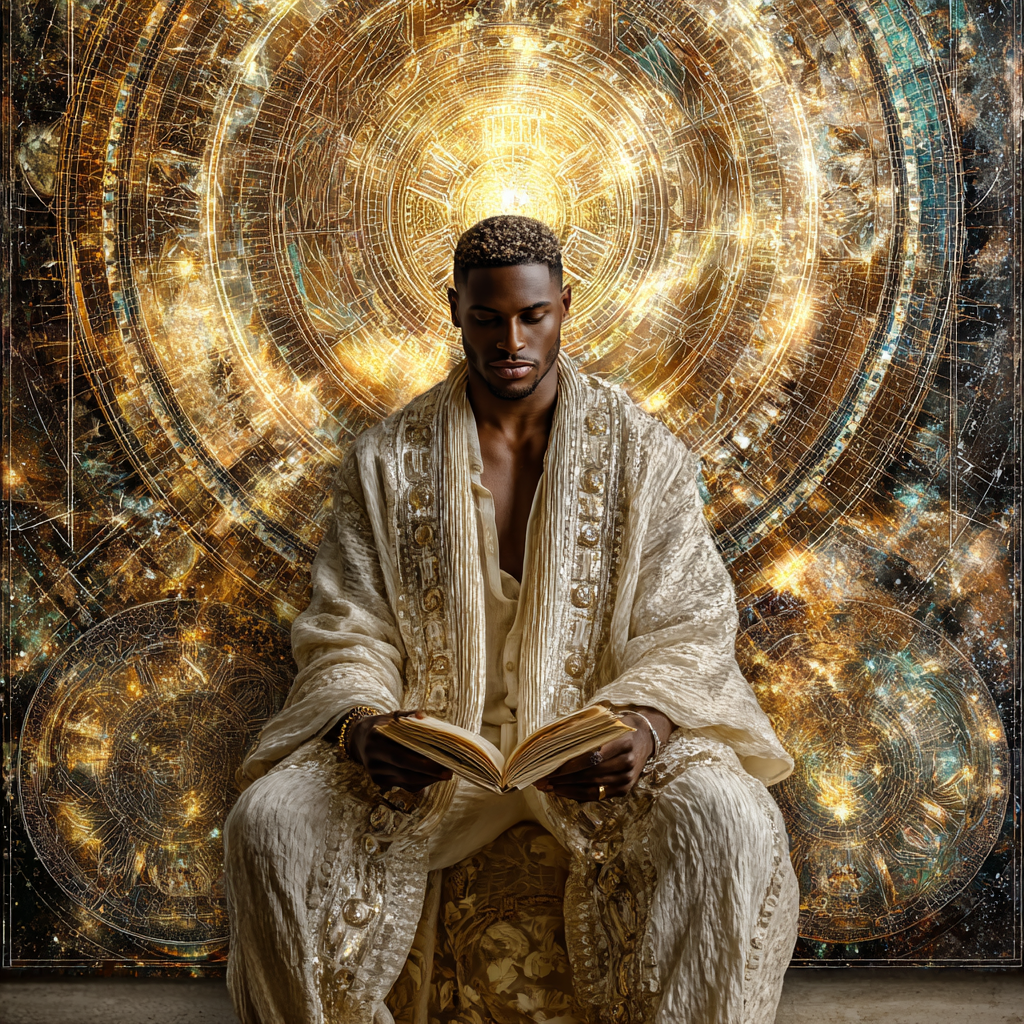
Tarot Decode: The Journey from Self-Sovereignty to Co-Rulership
By Alchemist Iris Chapman
The Logos Chakra occupies a profoundly unique position within the 18-Chakra System. It is the threshold where the architecture of the self meets the architecture of the Divine.
To understand the Logos, we must first look back. From the Earth Star Chakra through the Crown Chakra, Adam learns how to construct the inner kingdom. Each chakra within this physical vessel is associated with a specific zodiac archetype, serving as a teacher of balance, order, and mastery within a distinct jurisdiction of consciousness.
Beyond the Crown, the journey enters an entirely new phase. The transpersonal energy centers—the Causal Chakra, Soul Star Chakra, Stellar Gateway Chakra, and Covenant Chakra—are governed by the four suits of the Tarot. Here, Adam learns the higher frequencies of truth, remembrance, divine law, and authority. These are no longer the rudimentary lessons of personality development; they are advanced lessons of spiritual governance.
And then comes the Logos.
The Nature of the Logos Chakra
The Logos Chakra is fundamentally different from everything that precedes it. In this space, there is no misalignment. There is no Shadow in Service. There is only pure, unadulterated alignment.
Why? Because the Logos is not about learning how to govern oneself. The Logos is about learning how to govern with God.
Scripture introduces this principle in the cosmic prologue of John:
“In the beginning was the Word [Logos], and the Word was with God, and the Word was God… Through him all things were made.”
— John 1:1, 3
The Logos is not passive instruction; it is the generative, architectural authority of creation itself. While the Earth Star through the Covenant Chakras teach the arduous path of self-governance, the Logos introduces the ultimate paradigm shift: co-rulership. Paul points directly to this legal and spiritual inheritance:
“Now if we are children, then we are heirs—heirs of God and co-heirs with Christ, if indeed we share in his sufferings in order that we may also share in his glory.”
— Romans 8:17
This transition raises an important question for the evolving soul: What must Adam learn after choosing sovereignty?
The answer to this question may be hidden in plain sight, woven into the fabric of the Major Arcana. When we look at these cards—not as a system of fortune-telling or a collection of random symbolic images, but as twenty-two distinct revelations—we see a meticulously documented journey from innocence to self-sovereignty. The Major Arcana becomes a map of consciousness itself, a living record of the path that ultimately prepares Adam for co-rulership.
The 22 Revelations: Adam’s Journey to Sovereignty
0. The Fool: The Choice to Leave Innocence
“I will know for myself.”
The Fool marks the true beginning of the journey. He steps forward not out of foolishness, but because he actively chooses the unknown. He leaves the safety of innocence, the comfort of certainty, and the constraints of dependence. Stepping from the Garden of Eden into raw experience, the eating of the fruit marks the traumatic but necessary birth of self-sovereignty.
“Then the Lord God said, ‘Behold, the man has become like one of us, knowing good and evil.’”
— Genesis 3:22
The journey has begun.
I. The Magician: The Discovery of Creative Power
“I can affect reality.”
Here, Adam learns that creation actively responds to consciousness. He realizes that choice has tangible consequences: words create, thoughts create, and actions create.
“Death and life are in the power of the tongue, and those who love it will eat its fruits.”
— Proverbs 18:21
The dormant power of the architect begins to awaken within him.
II. The High Priestess: The Discovery of Hidden Wisdom
“There is more than the visible world.”
The awakening of deep intuition begins. Adam discovers that reality extends far beyond the tangible, physical world. The unseen becomes undeniably real, and mystery steps forward as a vital teacher.
“We declare God’s wisdom, a mystery that has been hidden… these are the things God has revealed to us by his Spirit. The Spirit searches all things, even the deep things of God.”
— 1 Corinthians 2:7, 10
III. The Empress: The Discovery of Creation
“I can nurture what I create.”
With the power to create comes the weight of responsibility. Ideas begin to take form; pure potential becomes manifestation. The Empress reflects Eve as the universal womb and the Flower of Life principle—the sacred, nurturing capacity to bring possibility into physical existence.
“Adam named his wife Eve, because she would become the mother of all the living.”
— Genesis 3:20
IV. The Emperor: The Discovery of Order
“Power requires structure.”
Authority, law, and government emerge. Adam discovers the hard truth that power without order inevitably devolves into chaos. For the inner kingdom to thrive, it must have a solid, unwavering structure.
“Let all things be done decently and in order.”
— 1 Corinthians 14:40
V. The Hierophant: The Discovery of Sacred Law
“Freedom without wisdom becomes chaos.”
Discipline and apprenticeship enter the journey. External teaching becomes necessary as Adam begins studying the sacred, immutable principles that govern the architecture of reality.
“So the law was our guardian until Christ came, that we might be justified by faith.”
— Galatians 3:24
VI. The Lovers: The Discovery of Choice
“Every path creates a future.”
Far from being solely about romance, this revelation is about profound alignment, decision, and discernment. Adam learns the weight of the crossroads: every choice made opens the door to one specific future while permanently closing another.
“I have set before you life and death, blessing and cursing: therefore choose life, that both thou and thy seed may live.”
— Deuteronomy 30:19
VII. The Chariot: The Discovery of Self-Mastery
“I can govern myself.”
The first major victory of true sovereignty appears. Adam shifts from being passively carried by the tides of circumstance to actively directing his own life. The reality of self-governance takes root through deliberate discipline.
“Therefore I do not run like someone running aimlessly; I do not fight like a boxer beating the air. No, I strike a blow to my body and make it my slave…”
— 1 Corinthians 9:26–27
VIII. Strength: The Discovery of Inner Dominion
“True power is self-control.”
Strength is revealed not as brute domination, but as supreme mastery. The wild lion of the ego and instinct is not destroyed; rather, it is patiently integrated. Power becomes beautifully disciplined.
“Better a patient person than a warrior, one with self-control than one who takes a city.”
— Proverbs 16:32
IX. The Hermit: The Discovery of Inner Guidance
“Truth must be found within.”
While external teachers (like the Hierophant) can guide, eventually the teacher must move inside. Wisdom becomes fully internalized as the soul finally learns to withdraw from noise, sit in silence, and listen.
“And after the earthquake a fire; but the Lord was not in the fire: and after the fire a still small voice.”
— 1 Kings 19:12
X. Wheel of Fortune: The Discovery of Cycles
“Life moves in patterns.”
Adam begins to recognize the grand repetitions of existence: cause and effect, karma, and recurring trials. The great wheel turns relentlessly until the necessary wisdom is finally extracted from the experience.
“To every thing there is a season, and a time to every purpose under the heaven.”
— Ecclesiastes 3:1
XI. Justice: The Discovery of Consequence
“The universe is lawful.”
Everything returns to its source; balance is inevitable. Adam learns that Justice is never about arbitrary punishment, but about perfect equilibrium. Reality constantly seeks its own alignment.
“Do not be deceived: God cannot be mocked. A man reaps what he sows.”
— Galatians 6:7
XII. The Hanged Man: The Discovery of Surrender
“Control cannot solve everything.”
Perspective dramatically shifts as the ego’s resistance softens. Voluntary sacrifice begins. Adam learns the humbling lesson that some truths can only be understood by entirely letting go of personal leverage.
“Father, if thou be willing, remove this cup from me: nevertheless not my will, but thine, be done.”
— Luke 22:42
XIII. Death: The Discovery of Transformation
“The old self must die.”
Transformation becomes unavoidable. Through many incarnations, many identities, and many temporary roles, there remains only one evolving consciousness. Death is understood not as an absolute end, but as a fierce, necessary renewal.
“What you sow does not come to life unless it dies… Listen, I tell you a mystery: We will not all sleep, but we will all be changed.”
— 1 Corinthians 15:36, 51
XIV. Temperance: The Discovery of Integration
“Opposites can become harmony.”
Soul and spirit, masculine and feminine, Adam and Eve—the great dualities of existence are brought to the forge. Division finally gives way to synthesis, and perfect balance becomes living wisdom.
“…Speaking the truth in love, may grow up into him in all things, which is the head, even Christ: from whom the whole body fitly joined together and compacted…”
— Ephesians 4:15–16
XV. The Devil: The Discovery of Self-Imposed Bondage
“The chains were never external.”
Through the painful mirrors of attachment, fear, and false sovereignty, Adam discovers a startling truth: the heaviest chains and the darkest prisons were always self-created within his own lower nature.
“I do not understand what I do. For what I want to do I do not do, but what I hate I do… making me a prisoner of the law of sin at work within me.”
— Romans 7:15, 23
XVI. The Tower: The Discovery of Necessary Collapse
“Every false kingdom eventually falls.”
The structures built on the shaky foundations of illusion cannot remain standing. This is the domain of Job’s crisis. The destruction is fierce, but it is not condemnation—it is a revelation. The false must violently collapse so that eternal truth has room to stand unhindered.
“The words ‘once more’ indicate the removing of what can be shaken—that is, created things—so that what cannot be shaken may remain.”
— Hebrews 12:27
XVII. The Star: The Discovery of Hope
“The journey still has meaning.”
After the devastating collapse of the Tower comes profound remembrance. After the darkest night comes clear direction. The Star restores cosmic vision, reminding the soul of its true origin and destination.
“I am the Root and the Offspring of David, and the bright Morning Star.”
— Revelation 22:16
XVIII. The Moon: The Discovery of the Unseen Self
“Not everything within me is known.”
The deep subconscious reveals itself as Shadow, projection, and primal instinct emerge from the depths. Adam must learn to navigate this hidden, nocturnal landscape of his own consciousness without being swallowed by illusion.
“If I say, ‘Surely the darkness shall cover me,’ even the night shall be light about me. Yea, the darkness hideth not from thee.”
— Psalm 139:11–12
XIX. The Sun: The Discovery of Illumination
“Truth can be seen clearly.”
Clarity arrives like the dawn. The inner kingdom becomes fully visible, and life is no longer governed by the shadows of confusion. The light of absolute understanding shines openly, warmly, and effortlessly.
“But unto you that fear my name shall the Sun of righteousness arise with healing in his wings.”
— Malachi 4:2
XX. Judgment: The Discovery of Remembrance
“I remember what I have learned.”
Judgment is stripped of its dogma; it is not external condemnation, but a radical awakening. This is one of the most vital revelations in the entire sequence—Paul on the road to Damascus belongs here. The soul hears the clarion call of its own higher attainment. The message is not simply “Remember who you were,” but rather, “Remember what you have already learned.” The kingdom fully awakens to its accumulated wisdom.
“Awake thou that sleepest, and arise from the dead, and Christ shall give thee light.”
— Ephesians 5:14
XXI. The World: The Completion of Self-Sovereignty
“The kingdom within has been built.”
The great cycle is complete. True self-governance has been achieved, and the inner kingdom stands strong, balanced, and fully integrated. Adam has finished the building of the vessel.
“Neither shall they say, Lo here! or, lo there! for, behold, the kingdom of God is within you.”
— Luke 17:21
“I have fought the good fight, I have finished the race, I have kept the faith.”
— 2 Timothy 4:7
Most systems stop here. This framework does not.
The Logos Beyond The World
This is exactly where the Logos Chakra begins.
Traditional Tarot ends with The World, which signifies the absolute completion of self-sovereignty. The Logos starts in the space beyond it, introducing the ultimate initiation: co-rulership.
Viewed through this lens, the Major Arcana are not simply a journey from ignorance to personal enlightenment. They are the twenty-two specific revelations necessary to prepare Adam for the next grand invitation: To govern with God.
This perspective entirely transforms how we read the Book of Revelation. It ceases to be merely a doom-laden prediction of the end of the physical world. Instead, it reveals itself as the grand initiatory transcript of Adam’s completed pilgrimage.
From the moment of his expulsion from Eden, Adam traveled across the pages of scripture wearing the garments of differing personalities—wandering as Abraham, wrestling as Jacob, ruling and repenting as David, building and falling as Solomon, and enduring the trial of the Tower as Job. Revelation is the retrospective of that vast migratory journey.
The scrolls, the unsealing, the trumpets, and the beasts are the documented trials and tribulations of Adam’s inner kingdom. The wild beasts and counterfeit rulers that rise from the sea and earth are the lower subconscious appetites, ego attachments, and false authorities he constructed over ages of separation. The dramatic collapse of Babylon is not an external city burning; it is the necessary purgation of those lower structures—the clearing away of every internal illusion so the higher frequency can finally anchor.
Adam had to face, correct, and harmonize every unruly citizen of his own consciousness. He had to overcome the tests of his lower nature to earn the right to advance into the Logos Chakra. Revelation tells us precisely what he did, what he endured, and what he overcame to get there:
“To the one who is victorious, I will give the right to sit with me on my throne, just as I was victorious and sat down with my Father on his throne.”
— Revelation 3:21
“And I saw thrones, and they sat upon them, and judgment was given unto them.”
— Revelation 20:4
The throne is not handed down to an undisciplined soul. Co-rulership requires absolute internal mastery. Only when the false kingdoms fall does the Rider on the White Horse appear, bearing the title that crowns the entire ascension:
“He is dressed in a robe dipped in blood, and his name is the Word [Logos] of God.”
— Revelation 19:13
The Fool begins the journey with a singular choice: “I want sovereignty.”
The World concludes the cycle with a realization: “I have achieved self-governance.”
The Logos responds with the ultimate invitation: “Now learn co-rulership.”
The throne that waits beyond the cards is not simply another lesson to be learned. It is the sacred station from which all previous lessons are finally applied. It is the dawn of Divine Government.
It is the Logos. And it is the next monumental step in Adam’s eternal journey.