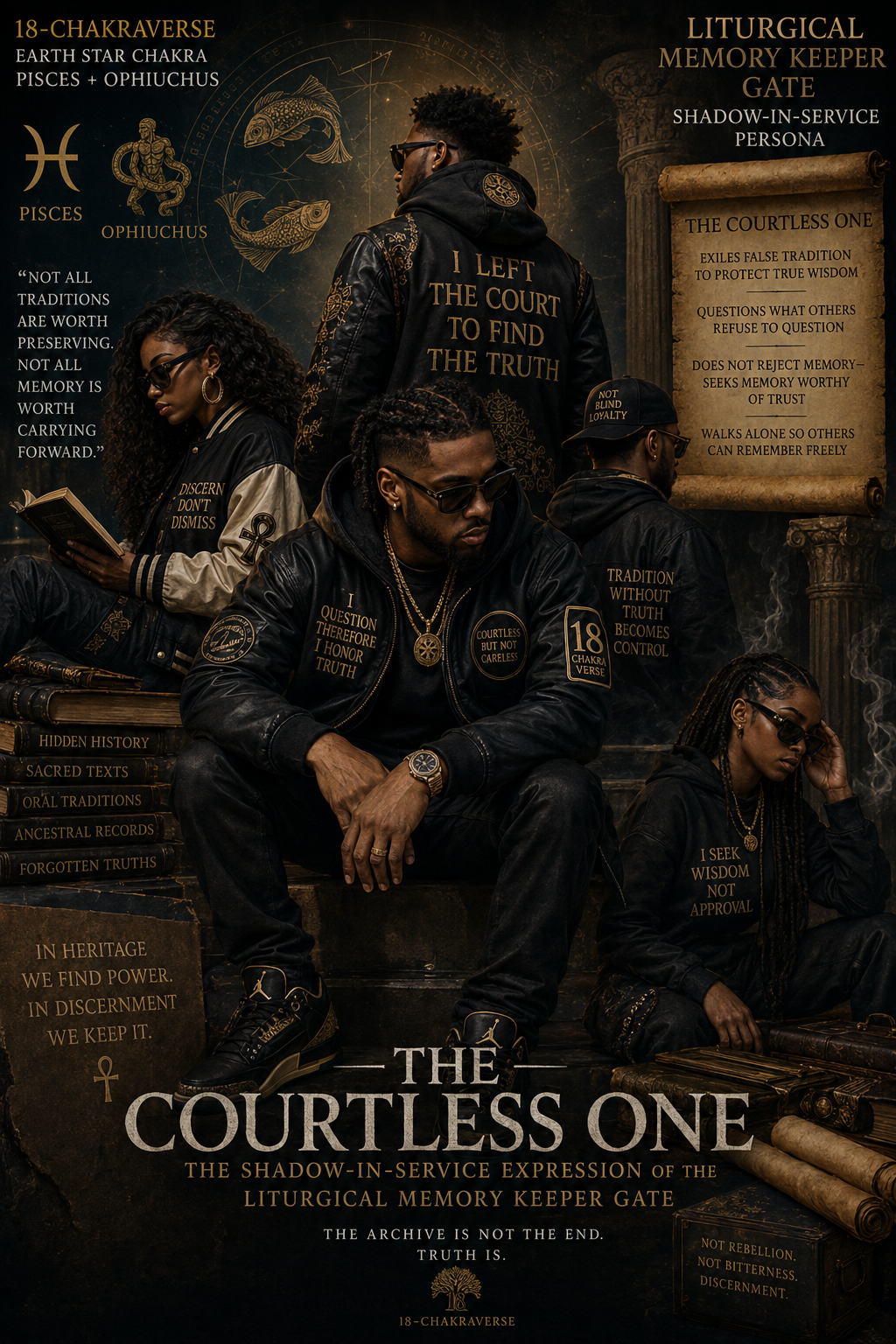
The Courtless One: Shadow-in-Service
Earth Star Chakra: Pisces + Ophiuchus: Liturgical Memory Keeper Gate: Exile, Disillusionment, and the Deconstruction of Memory
By Alchemist Iris Chapman
Some people break traditions because they hate them. The Courtless One breaks traditions because they no longer trust them.
This is a vital distinction. The Courtless One is not a mindless destroyer of memory; they are its exile. They are the ones who have become separated from the halls of remembrance, no longer believing the archives can be trusted. Walking away from the ancestral court carrying only fragments, this archetype represents the Shadow-in-Service expression of the Liturgical Memory Keeper Gate within the 18-ChakraVerse.
Where the fully aligned Liturgical Memory Keeper preserves living wisdom, the Courtless One questions inherited wisdom. Where the Memory Keeper safeguards continuity, the Courtless One challenges it. Where the Memory Keeper protects tradition, the Courtless One ruthlessly examines it.
This archetype emerges when remembrance has become corrupted—when institutions have betrayed their purpose, traditions have become prisons, and authority has demanded blind loyalty instead of absolute truth. The Courtless One appears not to wipe out memory, but to test whether that memory still deserves our trust.
The Wound Beneath the Rebellion
The Courtless One rarely begins their journey as a rebel. Most begin as the ultimate believers: students, participants, guardians, and keepers.
They once trusted the archive implicitly. They trusted the elders, the institution, and the overarching story—until something shattered.
- Perhaps they discovered profound hypocrisy.
- Perhaps they uncovered a hidden, sanitized history.
- Perhaps they witnessed abuse protected and covered up by tradition.
- Perhaps they found themselves cruelly excluded from a system that claimed to represent universal truth.
The result is a devastating fracture. It triggers a profound loss of trust, not just in individual people, but in the very structures that preserve collective memory.
Leaving the Sacred Court
Consequently, the Courtless One often feels spiritually homeless. This loneliness does not stem from a lack of intelligence or wisdom, but from the fact that they no longer know which authority deserves their trust.
The sacred court—the symbolic place where traditions are preserved and interpreted—has become entirely suspect.
          [ The Courtless One's Crucible ]
                         │
     ┌───────────────────┴───────────────────┐
     ▼                                       ▼
Every doctrine is                     Every inherited belief
  investigated.                         is challenged.
This process is deeply uncomfortable, both for the communities watching it happen and for the Courtless One themselves. Yet, this aggressive questioning serves an indispensable purpose: false traditions survive through unquestioned obedience. The Courtless One exists to break that spell.
The Necessary Dissenter
Many communities fear this archetype, and sometimes with good reason. The Courtless One asks dangerous questions that others would rather avoid—questions that expose contradictions, reveal hidden assumptions, and uncover forgotten, uncomfortable truths.
The Liturgical Memory Keeper preserves wisdom. The Courtless One tests wisdom. Without preservation, knowledge disappears; but without testing, corruption flourishes.
This is precisely why the Courtless One remains a Shadow-in-Service persona. Their role is inherently disruptive, but the disruption serves a evolutionary purpose for the collective.
The Cosmic Balance: Pisces & Ophiuchus
As a counterpart to the Liturgical Memory Keeper, this archetype processes the energies of the Earth Star Chakra through a lens of profound disillusionment and medical-grade discernment.
Pisces: The Pain of Disillusionment
The Piscean dimension of this archetype carries a deep, aching wound. Pisces longs to belong, to trust, and to merge with something larger than itself. The Courtless One wants to believe. They miss the comfort of shared meaning and the safety of certainty. But they cannot unknow what they have seen. Once the cosmic illusion breaks, they wander between worlds—unable to return to the old story, yet not ready to build a new one.
Ophiuchus: The Healer Who Questions the Prescription
Ophiuchus introduces sharp, surgical discernment. The serpent healer understands that medicine can easily become poison. Likewise, tradition can easily become distortion. The Courtless One develops an instinct for identifying exactly where preservation has degraded into stagnation, where ritual has become mere performance, and where remembrance is being used as a tool for manipulation.
The Danger of Permanent Exile
Every Shadow-in-Service persona carries a distinct psychological risk. For the Courtless One, the danger is becoming permanently trapped in opposition.
What begins as healthy skepticism can calcify into chronic distrust. Discernment can sour into cynicism, and necessary examination can devolve into endless, nihilistic deconstruction. Eventually, the Courtless One may reject every institution, every elder, every archive, and every source of inherited wisdom. When this occurs, they cross a dangerous threshold: they stop testing memory and begin abandoning it altogether.
The Return to Living Wisdom
The evolution and healing of the Courtless One begins when they realize that the ultimate answer is neither blind trust nor permanent suspicion. The answer is discerned remembrance.
  [Blind Trust]  ◄───  [Discerned Remembrance]  ───►  [Permanent Suspicion]
 (Naïve Alignment)         (True Evolution)              (Chronic Exile)
Not every tradition is corrupt. Not every archive is false, and not every elder is manipulative. The Courtless One slowly learns that wisdom can be inherited without surrendering personal discernment. They discover that reverence and questioning can coexist, and that preservation and examination are partners, not enemies.
The Gift of the Courtless One
At their highest expression, the Courtless One serves as the auditor of memory and the ultimate challenger of false authority. They ensure that remembrance remains alive rather than stagnant, preventing memory from becoming dogma, tradition from becoming idolatry, and preservation from becoming a psychological prison.
The Courtless One walks outside the sacred court for a season, not because they hate wisdom, but because they are searching for a wisdom that is actually worthy of their trust. And when their lonely journey is complete, they often become the most powerful guardians of living remembrance. They have mastered a lesson few others understand: a tradition that fears questions has already forgotten the truth it was created to protect.
Have you found yourself wandering outside the gates of tradition? How do you balance the need to question inherited beliefs with the deep human longing for ancestral connection and ritual?