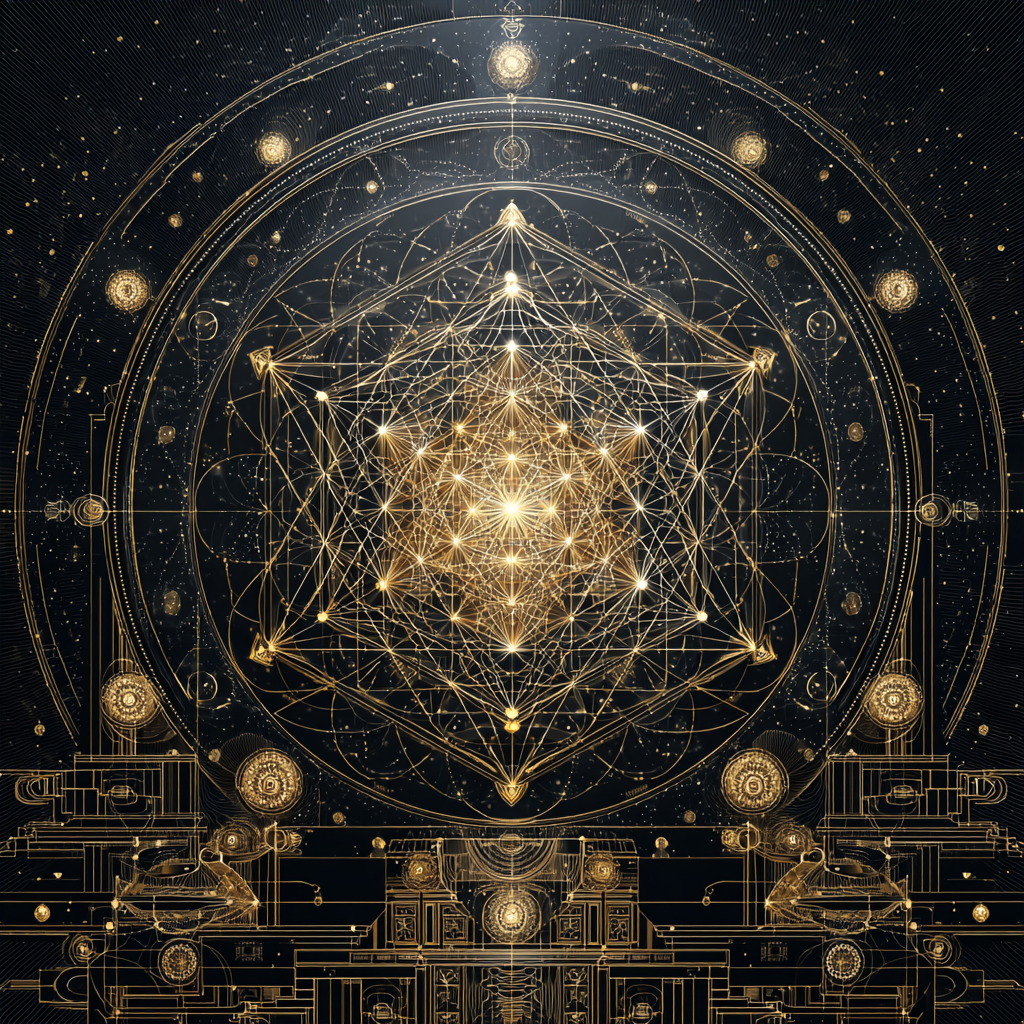
The Sacred Geometry of Life
Where Structure, Biology, and Consciousness Meet
By Alchemist Iris | Chakra & Energy Healing
Introduction: A Blueprint That Holds
What if your body is not a vessel for something else—but a structure capable of holding consciousness?
Not a container to escape,
not a mechanism to override,
but an architecture designed for inhabitation.
Sacred geometry is often approached as symbolism or mysticism. In this work, it is approached as structure—the shapes through which matter, life, and awareness remain coherent under pressure.
The geometry found in nature is not decorative.
It is load-bearing.
And the same principles that organize crystals, molecules, and biological systems also organize the dwelling places of consciousness within the human system—what we call chakras.
Sacred Geometry as Architecture, Not Symbol
The Platonic Solids are five three-dimensional forms defined by precision:
- Equal faces
- Equal edges
- Equal angles
- Stability from every orientation
These are not spiritual metaphors.
They are the most efficient ways form can exist without collapsing.
The five Platonic Solids are:
- Cube — Earth
- Icosahedron — Water
- Tetrahedron — Fire
- Octahedron — Air
- Dodecahedron — Ether (as coherence, not escape)
Plato described these shapes as fundamental to the organization of the cosmos. Modern science confirms that these geometries appear wherever matter must organize efficiently—crystals, molecular bonds, protein folding, and cellular lattices.
They are present because structure is required.
Chakras as Dwelling Places, Not Portals
In this system, chakras are not spinning wheels or energy vortices.
A chakra is a dwelling place of consciousness—
a functional capacity within the human system where awareness abides, processes experience, and organizes life.
Because consciousness must inhabit form without collapse, each dwelling place requires structural integrity.
Sacred geometry helps us understand how that integrity is maintained.
Not by activation.
By coherence.
Geometry and the Inherited Mansions
Each inherited chakra corresponds to a geometric principle—not because geometry “activates” it, but because geometry reveals the kind of structure required for that dwelling place to remain inhabitable.
For example:
- The Cube (Earth Star Chakra) reveals how structure holds weight and responsibility
- The Icosahedron (Sacral Chakra) reveals movement without loss of containment
- The Tetrahedron (Solar Plexus Chakra) reveals how energy initiates without chaos
- The Octahedron (Heart Chakra) reveals balance and relational symmetry
- And beyond the inherited system: The Dodecahedron (Causal Chakra) reveals integration—not as a starting condition, but as a coherence that must be achieved.
These are not symbolic overlays.
They are structural truths reflected in both biology and experience.
DNA and Structural Intelligence
DNA is often described as a “code,” but it is also a physical structure.
Its double helix is not random.
Its folding, packing, and stability depend on geometric efficiency.
At molecular and atomic levels, life consistently organizes itself according to geometric principles that:
- minimize collapse
- maximize coherence
- sustain function over time
This does not mean DNA is mystical.
It means life obeys structure.
Your body is not sacred because it glows.
It is sacred because it holds.
Why This Matters for Healing
Healing does not stabilize because energy increases.
It stabilizes because structure can support what is lived.
When healing ignores form:
- insight becomes unstable
- emotions overwhelm
- grounding practices fail under stress
When healing respects structure:
- change integrates
- responsibility is held
- embodiment becomes sustainable
Sacred geometry helps us see why some changes last and others collapse.
It reminds us that coherence is not achieved by transcendence, but by alignment with how life is built.
The Body as a Place Consciousness Can Stay
You are not a soul trapped in a body.
You are consciousness inhabiting structure.
Your bones, tissues, breath, and nervous system are not obstacles to spirituality.
They are the means by which consciousness remains present long enough for meaning to form.
Sacred geometry does not elevate the body.
It explains it.
Moving Forward in This Series
This series will explore sacred geometry not as a spiritual shortcut, but as a language of coherence.
We will examine:
- how geometry clarifies the function of each inherited chakra
- why certain forms stabilize specific capacities of consciousness
- how structure precedes safety, flow, and insight
Next, we begin with the Cube—
not as a grounding visualization,
but as the structural truth of the Earth Star Chakra.
The place where life does not ascend,
but stays.
Next in the series: The Cube: Structure Within the Earth Star Field



I can appreciate the focus on structure, order, and how the body is designed with purpose—that part really resonates. As a follower of Christ, though, I see things from a different foundation.
We’re not sustained by aligning with geometry or energy systems, but by a relationship with God through Jesus. The body is important, absolutely—but it’s not where our source comes from. Scripture teaches that we are created by God and sustained by Him, not by internal structures we learn to “activate” or align.
I do agree with the idea that healing needs to be grounded and real, not just emotional or surface-level. But true healing, in my experience, comes from the Lord—through truth, repentance, grace, and the work of the Holy Spirit in us.
So while I respect the thought and depth here, I’d gently say the foundation matters most. Structure without Christ can only go so far. Real peace, stability, and transformation come from Him, not from within ourselves.
Jason, I appreciate the way you’re engaging with this—you’ve been consistent in pointing back to what you believe is the true foundation, and I respect that.
I think where we’re crossing wires is in what I’m presenting versus what you’re hearing.
I’m not teaching that geometry, the body, or any internal system is the source of life or sustenance. I’m describing structure—how life expresses itself in form, pattern, and function. In the same way that the body has systems (nervous system, circulatory system, etc.), I’m using geometry as a way to talk about order, coherence, and stability in a way people can observe and apply.
When you say:
“Structure without Christ can only go so far”
I don’t actually disagree with the spirit of that. But I’m not presenting structure as a replacement for God. I’m pointing to the fact that structure exists, and when it’s disordered, people experience confusion, instability, and breakdown—whether they frame that spiritually, psychologically, or physically.
So this isn’t:
“Align with geometry instead of God.”
It’s closer to:
“Notice the patterns of order and disorder in your life, and bring them into alignment so you can function clearly.”
For someone grounded in Christ, they may interpret that alignment as living in obedience, wisdom, or truth. For someone else, they may understand it through a different lens. The application can differ, but the observable pattern—order vs. disorder—remains the same.
You also said something important:
“The foundation matters most.”
I agree. And people arrive at that foundation from different starting points.
My work is designed to meet people at those different entry points—not to define their relationship with God, but to help them recognize where their life is out of order and how to bring it back into coherence in a practical, embodied way.
So we’re not actually as far apart as it might seem.
We’re just describing the same reality from different reference points.
I respect your foundation—and I’m simply speaking in a way that allows more people to engage with the process.
This was a really thought-provoking read. I like how you approached sacred geometry not just as something symbolic or abstract, but as something structural and foundational—it gives the whole concept a very grounded and almost scientific feel. The idea that the body is “built to hold consciousness” rather than escape from it really stood out to me. That shift in perspective feels powerful, especially in a space where a lot of teachings focus on transcendence rather than stability and integration.
I also found the connection between geometry, biology, and chakras interesting—especially how you framed coherence as the key instead of activation. It makes the whole concept feel more practical and less mystical in an overwhelming way. Curious to see how you’ll break down each geometric form in the next parts of the series. The Cube as a starting point sounds like a solid (no pun intended) foundation to build on.
Shafna, I really appreciate the way you received this—because you caught the exact pivot that sits at the heart of the work. When I speak of the body as something built to hold consciousness, I’m intentionally moving away from the idea that growth requires escape. In my experience, the deeper path is not ascension away from the body, but alignment within it. Geometry becomes powerful here because it gives us a language of structure—something measurable, repeatable, and stabilizing. It’s less about chasing expanded states and more about becoming coherent enough to sustain them. That’s where biology, energy, and form begin to speak the same language.
And your point about coherence versus activation is key. Activation can be intense, even destabilizing if the structure isn’t prepared to hold it. Coherence, on the other hand, is what allows energy to organize, integrate, and actually serve the system. That’s why the Cube is the starting point—it represents stability, orientation, and grounded presence. Before anything expands, it must first be held. As I move into breaking down each geometric form, I’ll be building from that same principle: structure first, then expansion. I think you’ll find that each shape isn’t just symbolic, but functional—almost like a blueprint for how consciousness learns to live well inside form.