A Structural View of the Inner Family
Disruptive Behavior Is Not the Problem:
There was a time when I saw disruptive behavior as something to fix.
Something to control.
Something to eliminate.
Something that meant I was “off.”
But the deeper I studied the inner family—the structure of personas, roles, and energetic governance—the more I realized something critical:
Disruptive behavior is not the problem.
It is a signal.
A signal that something within my internal system is not properly governed.
And once I stopped trying to silence the signal, I could finally start reading it.
The Refined Truth
At the core of this framework is a simple but precise understanding:
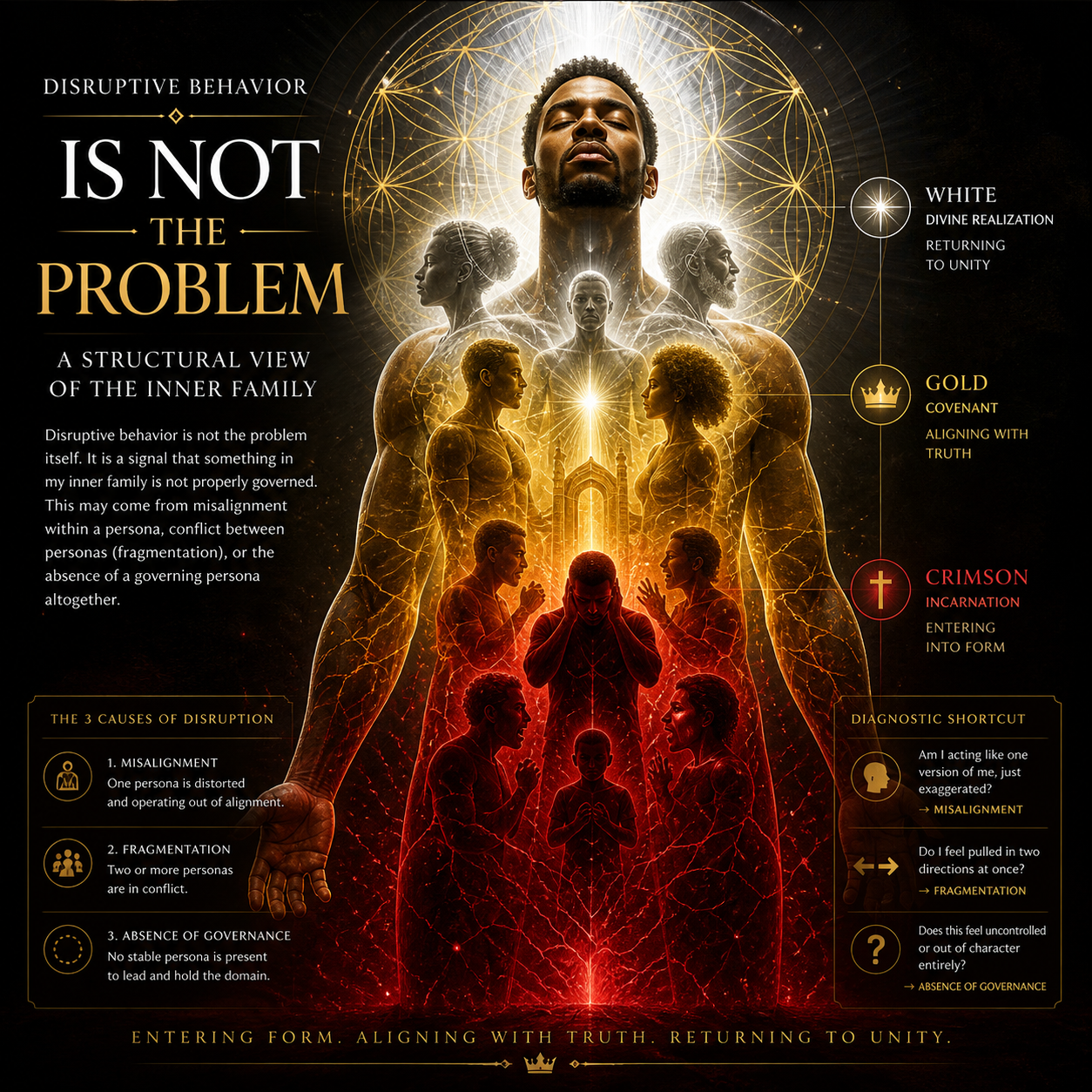
Disruptive behavior is not the problem itself. It is a signal that something in my inner family is not properly governed. This may come from misalignment within a persona, conflict between personas (fragmentation), or the absence of a governing persona altogether.
This changes everything.
Because now, instead of reacting to behavior, I investigate structure.
The Three Causes of Disruption
Not all disruption comes from the same place.
And if I don’t distinguish the cause, I can’t correct it.
There are three structural reasons why disruptive behavior appears:
1. Misalignment — When One Persona Is Distorted
In this state, a persona is active and governing—but it is out of alignment.
It hasn’t lost control.
It’s just operating incorrectly.
This is where behavior feels:
- exaggerated
- rigid
- overly intense
- disproportionate to the situation
Internally, it often feels like:
“I know what I’m doing… but something about this is off.”
This is not fragmentation.
This is distortion within a single governing identity.
2. Fragmentation — When Personas Compete
This is the true state of internal conflict.
Two (or more) personas are trying to govern the same domain at the same time.
No clear authority.
No unified direction.
This produces:
- indecision
- contradiction
- starting and stopping
- internal tension
Internally, it feels like:
“I want this… but I also don’t.”
“I’m pulled in two directions.”
This is fragmentation—a divided household.
3. Absence of Governance — When No One Is Leading
This is the most misunderstood state.
Nothing is fighting for control.
Because nothing is in control.
There is no stable persona governing the situation.
This produces:
- impulsive decisions
- inconsistency
- behavior that feels out of character
- a lack of internal anchoring
Internally, it feels like:
“That wasn’t even me.”
“I don’t know why I did that.”
This is not fragmentation.
This is vacancy—a gap in the system.
The Diagnostic Shortcut
When disruption shows up, I don’t analyze endlessly.
I ask three precise questions:
1. Am I acting like one version of me, just exaggerated?
→ This is misalignment
2. Do I feel pulled in two directions at once?
→ This is fragmentation (conflict)
3. Does this feel uncontrolled or out of character entirely?
→ This is absence of governance
That’s it.
No overthinking.
No spiraling.
Just identification.
Where the Insight Lands
My original instinct wasn’t wrong.
I could feel that disruption meant something deeper.
And it does.
Disruption is a symptom of system instability.
But the refinement is what makes this usable:
Instability has three distinct structural causes—not one.
And each one requires a different kind of awareness.
The Shift That Changes Everything
When I stop labeling behavior as “bad” or “wrong,” and start reading it as information, something shifts.
I move from:
- reacting
to - diagnosing
From:
- controlling behavior
to - restoring order
Because the goal is not to suppress what’s happening.
The goal is to ask:
Who is governing right now—or is no one?
And from there, I can return the system to alignment.