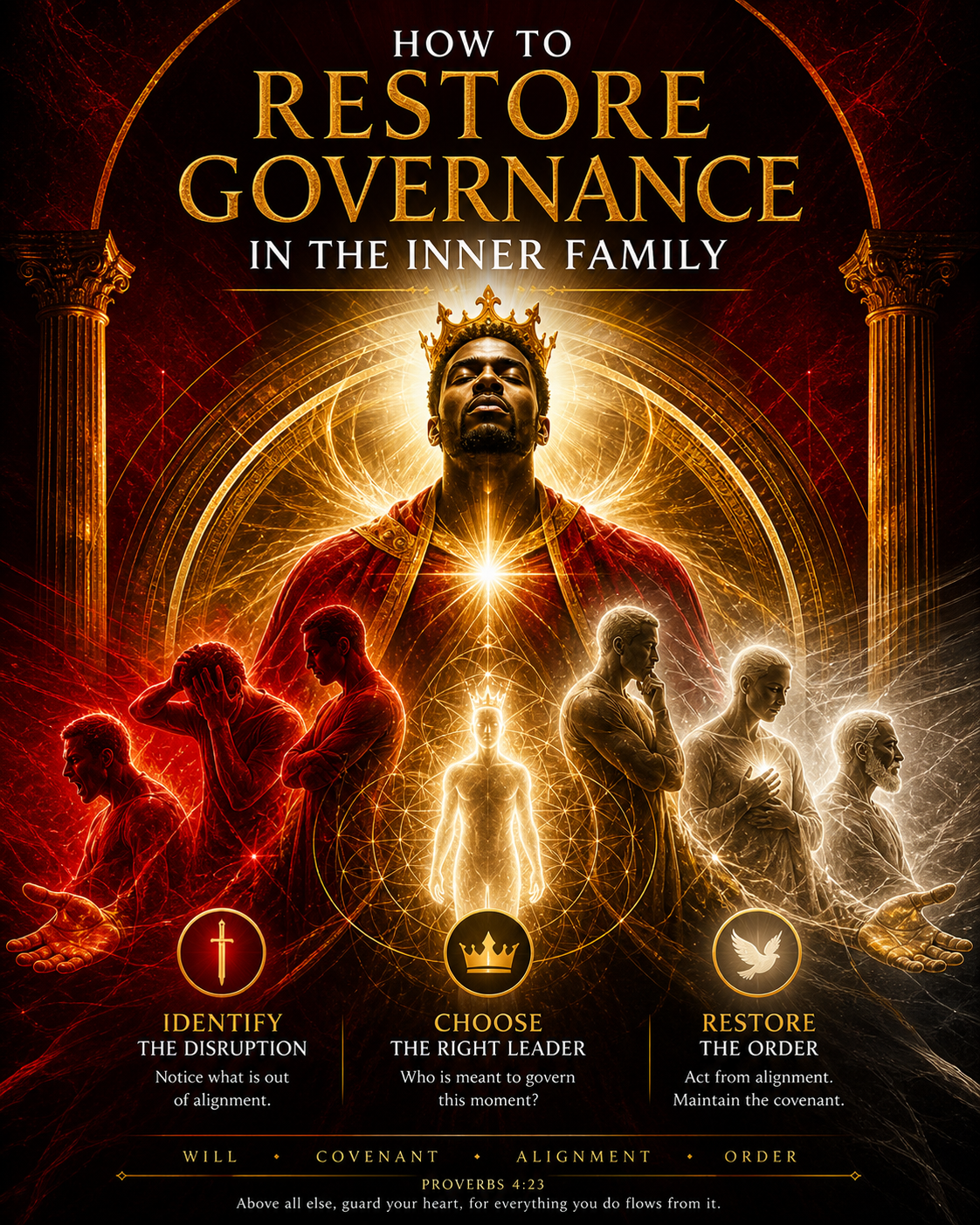
How to Restore Governance in the Inner Family
There comes a moment—usually in the middle of disruption—when I realize something simple but decisive:
I don’t need to control my behavior.
I need to restore who is leading.
If disruptive behavior is a signal, then restoration is not about suppression. It is about re-establishing proper governance within the inner family—so the right identity is guiding the moment, and everything else can fall into order.
The inner family is the structured system of identities within me that govern how I think, feel, and act. Rather than being a single, fixed self, I operate through different personas—each responsible for specific areas like boundaries, expression, emotion, or direction. These personas function like members of a family, working together (or sometimes in conflict) to shape my behavior. When they are aligned and properly governed, I experience clarity and stability; when they are not, I experience disruption, confusion, or inconsistency.
What Governance Actually Means
In this framework, governance is not dominance or force.
Governance is the presence of a stable, aligned persona that can direct behavior, regulate energy, and maintain coherence within a specific domain.
When governance is present:
- decisions feel grounded
- responses match the moment
- energy flows with clarity
When governance is absent or compromised:
- behavior becomes reactive
- direction is unclear
- the system feels unstable
The inner family operates through a simple structure:
- Will (Father) sets direction
- Generative Intelligence (Mother) produces form
- Personas (Children) carry out function
- Behavior reveals what is actually happening
Restoring governance means ensuring that a capable, aligned persona is leading in the domain I’m in.
The Three Restoration Paths
Every disruption traces back to one of three structural issues. Each requires a different response.
1. Restoring Misalignment
When one persona is active—but distorted
Here, a persona is already governing. It’s just operating off-center.
This is where I might notice:
- I’m overreacting
- I’m being rigid or controlling
- I’m pushing something too far
The instinct is often to shut it down.
But that’s not the move.
I don’t replace the persona—I correct it.
How I restore alignment:
- I slow the reaction down
- I identify the exaggeration
- I return to the persona’s true function
If it’s a boundary issue, I don’t abandon boundaries.
I refine how I hold them.
If it’s expression, I don’t silence myself.
I clarify how I speak.
Alignment is not removal.
It’s precision.
2. Resolving Fragmentation
When multiple personas are competing
This is internal conflict.
Two versions of me are trying to lead at the same time:
- move forward / hold back
- speak / stay silent
- connect / withdraw
This creates:
- indecision
- start–stop patterns
- internal tension
Fragmentation is not confusion—it is divided authority.
How I restore governance:
- I identify the competing personas
- I recognize what each one is trying to do
- I consciously choose which one leads
Not both. One.
Two personas cannot govern the same domain at once.
When authority is unified, clarity returns immediately—even if the choice is difficult.
3. Filling Absence
When no persona is governing at all
This is the most subtle—and often the most disruptive.
There is no internal conflict.
There is no clear distortion.
There is simply:
- impulsivity
- inconsistency
- behavior that feels out of character
It can feel like:
“That wasn’t even me.”
“I don’t know why I did that.”
But the truth is:
Where there is no governance, the system defaults to reactivity.
How I restore governance:
- I pause the behavior
- I identify the domain (boundary, expression, emotion, direction)
- I intentionally call forward the correct persona
This is not automatic.
It is a deliberate act of selection.
The Governing Question
Everything in this system comes back to one question:
Who is supposed to be leading right now?
Not:
- Why am I like this?
- What’s wrong with me?
But:
- Which persona is required for this moment?
When I answer that correctly, behavior reorganizes itself.
The Practical Re-Governance Sequence
When disruption shows up, I follow a simple loop:
- Notice the disruption
(Don’t judge it—observe it) - Identify the type
- exaggerated? → misalignment
- pulled in two directions? → fragmentation
- uncontrolled? → absence
- Name the domain
- boundaries
- expression
- emotional exchange
- direction
- stability
- Select the correct persona
(the one designed to govern that domain) - Act from that identity
(not from the disruption)
This is how order is restored.
Returning to Structure Through the Chakras
Each domain of life corresponds to a governing center—and therefore, specific personas.
For example:
- Stability & safety → Root Chakra
- Boundaries & choice → Navel Chakra
- Connection & relationship → Heart Chakra
- Expression & truth → Throat Chakra
When I know the domain, I know where to go.
And when I know where to go, I know who should be leading.
The Shift That Changes Everything
At some point, this becomes less about fixing behavior and more about understanding structure.
I stop asking:
- “How do I stop this?”
And start asking:
- “Who is governing right now?”
- “Is that the correct leader?”
Because:
Restoring governance is not about controlling behavior. It is about ensuring that the right identity is leading in the right moment.
When governance is restored:
- behavior stabilizes
- energy regulates
- clarity returns
Not because I forced it—
But because the system is back in order.
Where This Leads
This is the beginning of applied awareness.
From here, the work deepens:
- identifying each persona clearly
- understanding their aligned and misaligned expressions
- learning when to call them forward
Because the inner family is always active.
The only question is:
Is it properly governed?