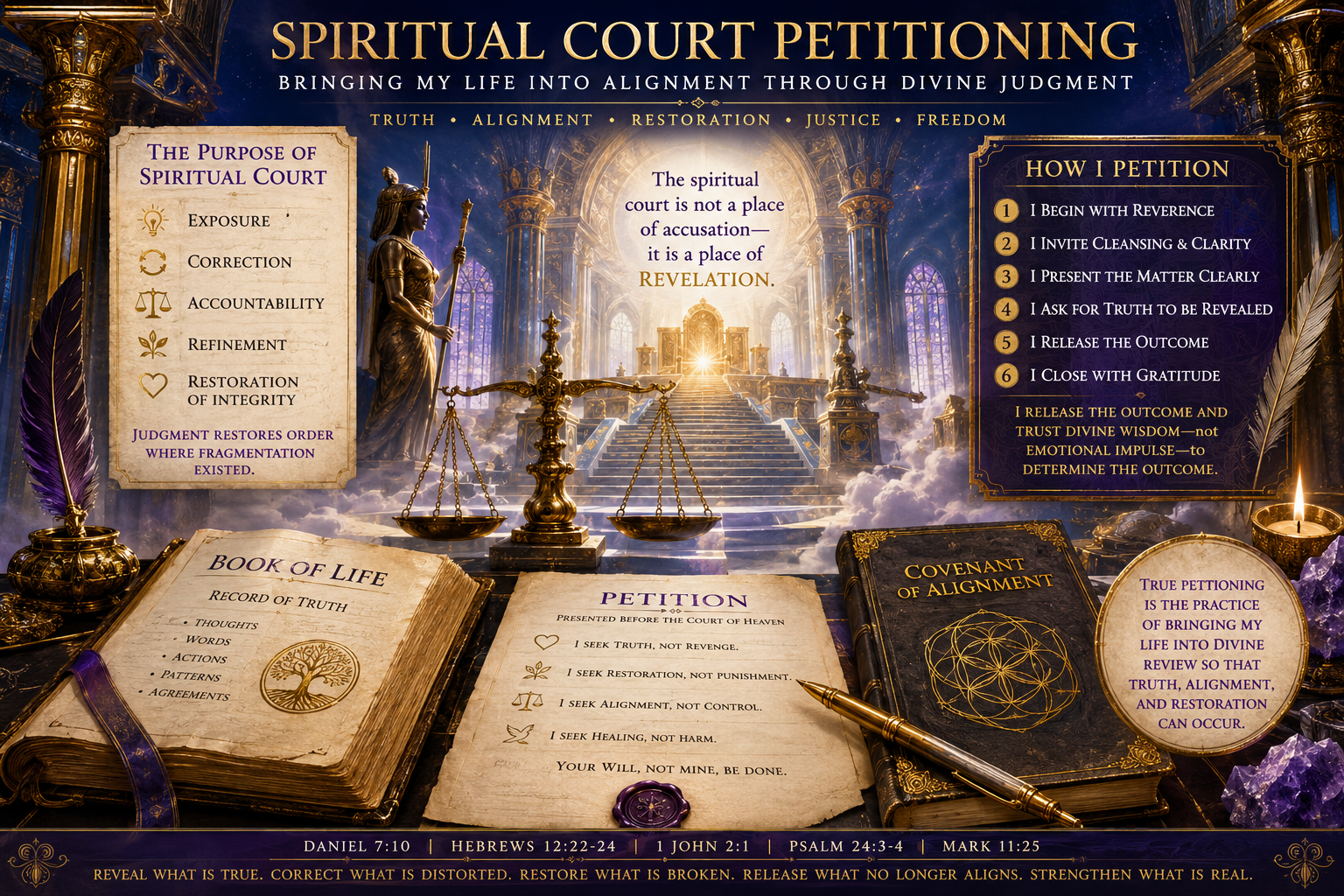
Spiritual Court Petitioning
Bringing My Life Into Alignment Through Divine Judgment
By Alchemist Iris Chapman
There are moments in life when ordinary solutions no longer reach the root of the problem.
We try harder, think smarter, and apply every self-help strategy available, yet certain cycles repeat as if driven by an invisible script. A relationship remains stubbornly tangled. An emotional burden lingers long after the event has passed. Behavioral patterns reappear across different years, conversations, jobs, and families—sometimes even echoing down through generations.
At some point, the realization hits: I am not simply dealing with isolated, random events. I am dealing with agreements, structures, and unseen alignments operating beneath the surface of my life.
This is where Spiritual Court Petitioning became deeply meaningful to me.
For many, the word “court” evokes images of condemnation, fear, and punishment. But when we approach the concept spiritually, it shifts entirely. Spiritual Court Petitioning is not about demanding vengeance against those who hurt us, controlling external outcomes, or trying to manipulate God into taking our side in an ego war. Instead, it is the deliberate practice of bringing our lives into divine review so that truth, alignment, justice, correction, and restoration can occur according to what is fundamentally real.
In this space, the spiritual court is not a place of accusation. It is a place of revelation.
What Is Spiritual Court Petitioning?
At its core, Spiritual Court Petitioning is a form of intentional, highly focused prayer. It is an act of bringing unresolved matters before God as the ultimate source of truth, wisdom, justice, and alignment.
The language of legal proceedings appears throughout sacred texts: books being opened, witnesses speaking, judgments rendered, accusations answered, covenants established, and decrees released. Historically, we have been conditioned to see these as strictly external events—cosmic dramas happening somewhere far away in a distant heaven.
Today, I understand them as reflections of deep spiritual realities operating within our own consciousness, our relationships, our energetic agreements, and our soul development. The “court” represents divine order itself.
Whenever life becomes misaligned, fragmented, bound, repetitive, or internally conflicted, we have the right to bring that matter into conscious review through prayer, radical truthfulness, repentance, forgiveness, and surrender.
The primary rule of this court is simple: This process is never about “winning a case.” It is entirely about becoming aligned with what is true.
Alignment, Not Revenge: Redefining Divine Judgment
One of the biggest misunderstandings surrounding spiritual court concepts is the toxic belief that prayer can be used as a weapon to prosecute or harm other people. But divine judgment is completely decoupled from ego gratification. The purpose of spiritual judgment is restoration.
Judgment functions much like a “Shadow-in-Service” energy—a protective mechanism that needs exposure, correction, and refinement to find its right place. True judgment is the exposure of reality. It is the light that reveals where we have stepped out of alignment with our original design.
When we petition the court, the dynamics shift in unexpected ways:
- The prayer itself changes us first. We enter seeking a change in our circumstances and leave with a change in our posture.
- Judgment often looks like exposure. It brings hidden motives to light so they can be dealt with cleanly.
- The ultimate answer is rarely an external victory. More often, it is an immovable, quiet inner freedom.
Understanding the Roles Within the Court
To step into this practice consciously, it helps to understand the spiritual legal archetypes at play within our interior commonwealth:
- The Petitioner (Me): I do not approach the court as a helpless victim demanding revenge, but as a conscious steward seeking truth, healing, clarity, and restoration. This role requires absolute, unflinching honesty; I cannot hide from myself while asking God for clarity.
- The Grievance (The Case): This is the unresolved issue being brought forward. It could be a family conflict, financial instability, a fear cycle, chronic self-sabotage, or an unhealthy relational dynamic. Over time, I have learned that most cases are not external logistics—they are the physical manifestations of deeper energetic misalignments.
- The Advocate: Representing mercy, truth, reconciliation, and alignment with divine reality. The Advocate’s role is not to excuse destructive behavior, but to restore the soul to absolute integrity.
- The Witness: In this court, our conscience, our actions, our patterns, our words, and our ongoing energetic postures serve as the testimony. Discernment and self-awareness are essential because the court reads the reality of our state, not just the text of our desires.
- The Judgment: The final ruling. Far from a punitive sentence, divine judgment routinely manifests as clarity, a closed door that finally stays shut, an enforced boundary, a profound conviction, healing, or an undeniable redirection toward peace.
Preparing the Heart: The Pre-Trial Audit
Before bringing any matter into prayer, I must examine myself. This internal deposition has become the most vital piece of the entire process.
1. I Examine My Motives
I must ruthlessly ask myself: Am I seeking revenge, validation, control, or superiority? Or am I genuinely seeking truth, healing, restoration, and alignment? The spiritual court completely rejects ego warfare. If the underlying motive is to control another person, the petition will stall.
2. I Practice Forgiveness
Forgiveness does not mean pretending harm never happened, nor does it mean granting unconditional access to toxic dynamics. It means releasing my attachment to internal prosecution. When resentment governs my heart, I remain legally bound to the very cycle I am asking God to free me from. Forgiveness clears the spiritual noise so the court can hear the case.
3. I Accept My Own Accountability
Many spiritual petitions ultimately reveal my own active participation in the pattern. Through this process, I am often shown where I must change a boundary, speak a difficult truth, stop abandoning myself, or dismantle an unhealthy agreement. The prayer frequently reveals where I have unknowingly stayed in covenant with what harms me.
How to Structure a Spiritual Court Petition
When you are ready to bring a recurring cycle into formal review, you can structure your reflection and prayer using these six steps:
  [1. REVERENCE] ---> [2. CLEANSE] ---> [3. PRESENT]
                                            |
  [6. GRATITUDE] <--- [5. RELEASE] <--- [4. REVEAL]
- Begin with Reverence: Acknowledge God as the source of truth, wisdom, justice, and reality itself. This immediately shifts consciousness out of emotional reactivity and into grounded humility.
- Invite Cleansing & Clarity: Ask for forgiveness, sharp discernment, and freedom from personal distortion. We must ensure illusion is not ruling our perception before we present our facts.
- Present the Matter Clearly: Plainly state the pattern, the conflict, the burden, the wound, or the cycle. Speak honestly without exaggerating or minimizing the reality.
- Ask for Truth to Be Revealed: Ask the deep structural questions: What am I not seeing? What hidden agreement sustains this? Where am I misaligned? What must end, and what needs restoration?
- Release the Outcome: True petitioning requires absolute surrender. We must explicitly step back and allow divine wisdom—not our emotional impulses or preferred timelines—to determine the final verdict.
- Close with Gratitude: Before any visible change manifests in the physical world, give thanks for the divine order, protection, truth, and peace that have already been set in motion.
Dissolving False Agreements
The most transformative application of this practice is addressing False Agreements. Many spiritual and psychological struggles continue simply because a hidden, wounded part of us still unconsciously agrees with them. These unconstitutional contracts include:
- Fear-based identities (“I am only safe if I am invisible.”)
- Trauma agreements (“People will always betray me, so I must isolate.”)
- Scarcity mindsets and deep self-condemnation.
- Inherited family beliefs and destructive relational patterns.
Petitioning allows us to consciously drag these ancient, expired contracts out of the dark basement of the subconscious and into the courtroom of the light. Once exposed, they can be legally dissolved and replaced with objective truth.
Waiting for the Verdict in Daily Life
Answers from the High Court rarely arrive with dramatic thunderbolts. Instead, the “judgment” usually manifests as reality becoming impossible to ignore. You will notice a sudden, unexpected wave of internal peace, an organic increase in mental clarity, a natural tightening of your boundaries, or new opportunities appearing while old doors cleanly lock shut.
I no longer reserve spiritual court petitioning solely for major life crises. It has become a tool for daily maintenance. The moment I notice a recurring emotional loop, a heavy energetic cloud, an impulse driven by panic, or a sense of spiritual exhaustion, I pause and open the ledger of the court.
The more honestly we bring ourselves into divine review, the faster the internal noise clears, leaving us to live in the quiet, unshakeable alignment of our original design.
This was such a thoughtful and beautifully explained post. I really appreciate how clearly you broke down each step of spiritual court petitioning, especially the part about examining motives and the importance of forgiveness before bringing any case to God. It made the process feel both approachable and deeply meaningful. I also love how you emphasized patience and noticing subtle changes—sometimes those quiet shifts are the most powerful. Have you ever experienced a situation where the answer came in a completely unexpected way that surprised you?
Hanna, thank you so much for this beautiful reflection — I really feel like you heard the heart of that post. The way you picked up on examining motives, forgiveness, and the subtle shifts tells me you’re already moving through this work with a lot of spiritual maturity.
And yes, I’ve definitely had answers come in completely unexpected ways. There have been times when I brought a very specific “case” to the spiritual court — asking for resolution in one relationship or situation — and instead of that exact thing changing, an old pattern in me collapsed first. Someone I wasn’t even thinking about reached out to apologize. A door I thought I wanted stayed shut, but a completely different opportunity opened that brought the healing and provision I was actually asking for at a deeper level. It reminded me that God doesn’t just rule in favor of our request — He rules in favor of our highest good.
Those are the moments where I’ve learned to pay close attention to the quiet, sideways answers: a sudden inner peace where there was turmoil, a new boundary I finally feel strong enough to hold, or a small act of kindness from an unexpected source. That’s often how I know the “verdict” has landed.
I’d love to hear about your experiences, too — have you ever noticed an answer arrive in a way you only understood after the fact?
This was a powerful read. I’ve practiced forms of prayer like this before, but never thought of them in terms of a “spiritual court.” That framing really helps make sense of how to approach God with order, honesty, and reverence. I like how you tied it to forgiveness and motives andit’s easy to forget that even when we seek justice, our hearts still need cleansing first.
Your explanation feels practical, not mystical, and that’s what makes it relatable. I’ve kept a prayer journal too, and it’s amazing to look back and see how God’s answers often unfold quietly over time. Sometimes the change starts within me before it shows up around me.
Thank you for sharing this. It’s a gentle reminder that divine justice isn’t about punishment but about restoration and peace.
Cheers!
John
Thank you so much, John — I really appreciate your reflection here.
I love what you said about how the change often begins within us before it appears around us. That’s such a profound truth of the “spiritual court” process: it isn’t about winning a case against someone else, but about aligning our own hearts with divine order. When we approach God with honesty and humility — as you beautifully described — we step into a space where justice is no longer just a verdict, but a path toward restoration, balance, and peace.
Your prayer journal practice is a perfect example of this sacred unfolding. Those quiet answers, the ones that reshape us from the inside out, are often the most transformative. And that’s the deeper invitation of spiritual petitioning — not to rush the outcome, but to trust that divine timing always carries both justice and mercy.
Thank you again for sharing your experience and insight. It adds so much depth to this conversation.
— Alchemist Iris
I really appreciate how you tied this practice back to God’s justice and the role of Jesus as our advocate. That’s such an encouraging truth. One question I’ve been wrestling with is whether spiritual court petitioning should be viewed as its own distinct approach, or simply as a way of deepening intercessory prayer. For me, the courtroom imagery keeps me focused, but I also don’t want to slip into treating God’s presence like a system rather than a relationship with my Father. In your experience, does this practice tend to draw people closer to Christ Himself, or is there a risk that some might get caught up more in the process than in the Person?
Thank you, Jason — I really appreciate the depth of your question. You’ve put your finger on the heart of what makes spiritual court petitioning powerful and what can make it vulnerable to misuse.
In my experience, this practice is not meant to replace prayer or become a separate “system,” but rather to deepen our understanding of what intercession truly is. The courtroom language is a metaphor that helps us grasp divine order — it reminds us that God is both Father and Judge, and that Jesus is not only our Savior but our Advocate. When we enter prayer with that awareness, we begin to approach God with both reverence and confidence, knowing that mercy and justice meet in Him.
That said, you’re right to be cautious. Any spiritual practice — even a good one — can become mechanical if we lose sight of the Person behind it. The goal is always intimacy with Christ, not mastery of a process. In fact, the more deeply people step into this way of praying, the more they often report feeling drawn closer to His heart. The “court” becomes less about a system to be navigated and more about a sacred space where truth, mercy, and relationship converge.
So I see spiritual court petitioning not as something separate from prayer, but as a lens that sharpens our focus and expands our understanding — provided we let it lead us deeper into communion with the One who presides over the court in love.
Thank you again for raising such an important point — it’s a vital part of keeping this practice grounded in relationship rather than ritual.
— Alchemist Iris
This is such a thoughtful and well-explained post. I appreciate how you present spiritual court petitioning not as a rigid ritual, but as a heartfelt way of bringing unresolved matters before God with honesty and humility. The courtroom imagery makes it easier to understand the depth of this practice, especially with Jesus as our advocate and scripture as our foundation. I like that you highlight the importance of checking motives, embracing forgiveness, and being patient for God’s timing—those reminders keep the focus on healing and fairness rather than personal gain. The practical tips, like keeping a prayer journal and using scripture, make this practice accessible for anyone seeking clarity and peace. Thank you for sharing this—it’s an encouraging perspective on deepening prayer life and trusting God’s justice in everyday struggles.
Thank you, Andrejs, for such a thoughtful reflection. I’m glad the imagery of the spiritual courtroom helped bring this practice into focus for you—it really does remind us that prayer is both intimate and reverent, anchored in God’s justice and mercy. I especially appreciate your note about motives, forgiveness, and patience; those truly are the pillars that keep this from becoming a self-serving exercise and instead open the door to real healing and peace.
Keeping a prayer journal and leaning on scripture are simple but powerful ways to stay rooted, and I’m grateful you highlighted how that makes the practice accessible for everyday struggles. Your words encourage others to approach God with honesty and trust, knowing that He sees both the hidden wounds and the sincere desire for restoration.
Thank you again for taking the time to share your encouragement—it blesses this space and deepens the conversation.
I’m glad I came across this post – many years ago, I spent quite some time researching and learning about the Courts of Heaven. I found some people in specific Facebook groups who had a lot more knowledge and experience than me, and I learned a lot from them. They even led some group prayers and sessions over video calls. Which was a really great experience. But beyond that, I’ve not encountered anyone else who is aware of this type of prayer!
I appreciate this deep dive, and I love that you’ve included some Scripture to back up your points. You’ve offered some tips and suggestions here that I will definitely take into account as I seek to learn more about this concept and use it myself.
Hi Steph — I’m so glad you found this!
I love hearing about your Courts of Heaven journey and those group prayer sessions. There’s something powerful about being “in one accord” (Matthew 18:20) when we bring petitions before God. Thank you for sharing that, and for the kind words about the Scripture woven in. My aim is always clarity + reverence.
Here’s a simple flow you can keep using as you lean back into this practice:
Preparation (Ground + Cover): Breathe, anoint (I like a drop of frankincense or lavender), and state your intent: “I enter in the name of Jesus for mercy, wisdom, and alignment.” (Hebrews 4:16; Psalm 100:4)
Petition: Present facts without drama. Name agreements you renounce, and requests you’re making.
Witness & Evidence: Bring the Word as testimony (e.g., Isaiah 1:18; Psalm 91) and any fruit of repentance or repair you’re walking out.
Release & Verdict: Ask for a righteous ruling, receive it by faith, and declare closure on the matter.
Thanksgiving & Seal: Thank God, seal in peace, and note any next steps you’re led to take.
Two extras people find helpful:
Short EFT round to soften fear before you begin (collarbone or karate-chop point while saying, “Even though I feel pressure about this, I choose truth, peace, and God’s covering.”)
Journal line after each session: What shifted? What’s my obedient next step?
If you ever want to compare notes or share what you’re learning as you apply this again, I’d love to hear. Your experience will encourage others who are curious but new to Spiritual Court petitioning.