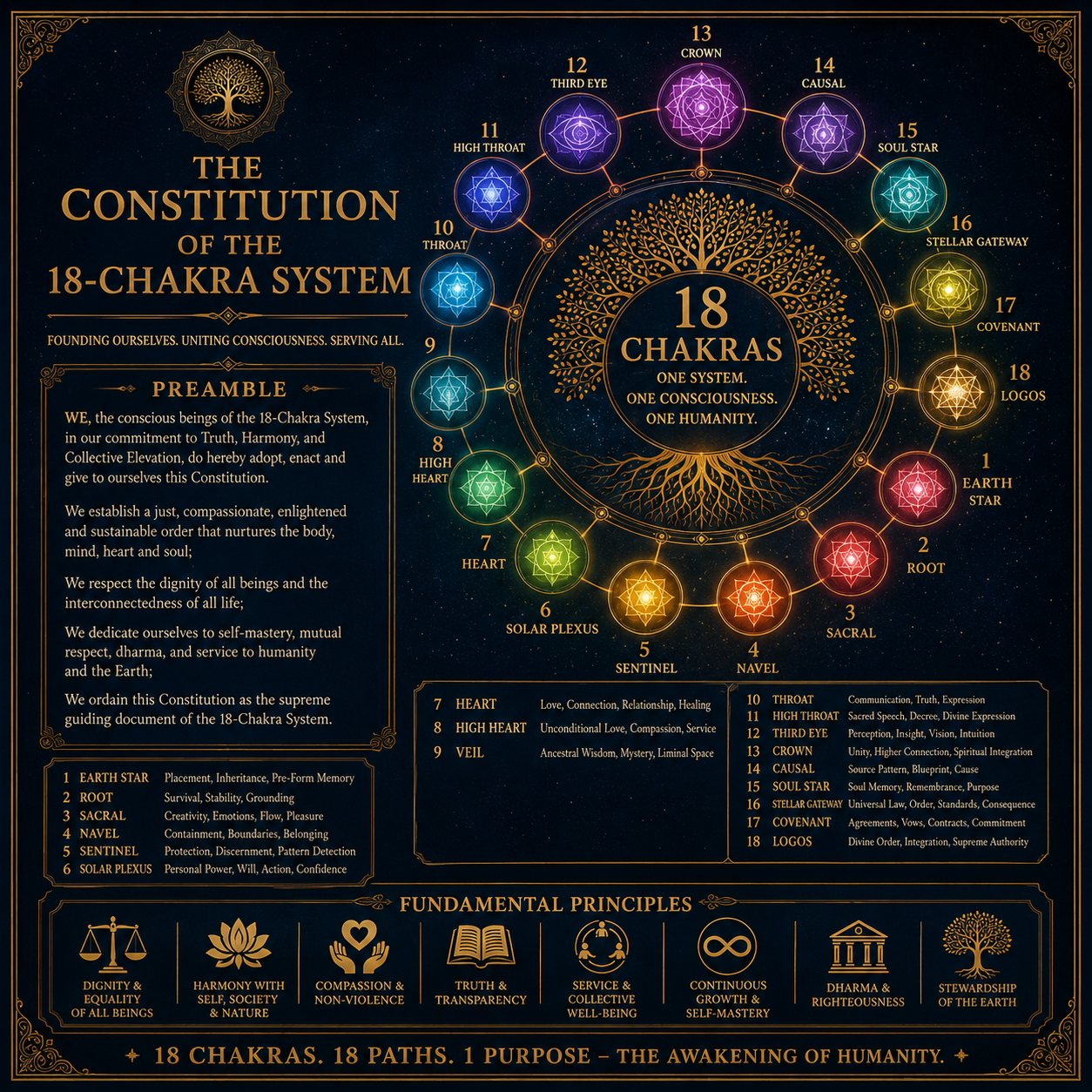
The Constitution of the Inner Government
A Governing Charter for the 18-Chakra System
By Alchemist Iris Chapman
Preamble
We, the inhabitants, faculties, offices, memories, desires, emotions, instincts, thoughts, gifts, and living powers of the Inner Kingdom, seeking to establish conscious government, restore lawful order, preserve the integrity of Original Design, protect the freedom and dignity of Adam, relieve ignorance, maintain balance among the eighteen constitutional offices, and embody the living authority of the Logos, do establish this Constitution for the Inner Government.
The purpose of this Constitution is not to suppress the life of the kingdom, but to bring every power into right relationship; not to abolish instinct, emotion, desire, memory, imagination, authority, or defense, but to assign each its lawful jurisdiction; not to condemn the wounded protector, but to restore it; and not to enthrone any temporary condition, persona, appetite, fear, office, or power above the whole.
The Inner Government shall be governed according to truth, wisdom, balance, conscious choice, lawful authority, compassionate restoration, and fidelity to Original Design.
Article I
The Nature and Purpose of the Inner Kingdom
Section 1. The Inner Kingdom
The Inner Kingdom is the complete interior commonwealth through which Adam perceives, chooses, remembers, feels, creates, speaks, relates, protects, governs, and participates in reality.
It includes, but is not limited to:
- thoughts;
- emotions;
- memories;
- instincts;
- desires;
- beliefs;
- habits;
- images;
- imagination;
- inherited patterns;
- learned patterns;
- wounds;
- gifts;
- personas;
- bodily intelligence;
- spiritual faculties;
- conscious intention; and
- the eighteen constitutional chakra offices.
Section 2. The Purpose of Government
The purpose of the Inner Government is to create the conditions in which Adam may move from Unconscious Construction to Conscious Construction.
The government shall therefore:
- relieve ignorance;
- increase accurate perception;
- protect conscious choice;
- preserve internal coherence;
- regulate the proper use of power;
- maintain lawful boundaries;
- restore wounded faculties;
- coordinate the offices of the kingdom;
- prevent the unlawful concentration of authority;
- preserve the continuity of the whole;
- enable responsible manifestation; and
- bring the kingdom into embodied alignment with the Logos.
Section 3. Original Design
Original Design is the lawful pattern according to which each office, faculty, and persona was created to function for the benefit of the whole.
Original Design shall be the primary standard by which alignment, misalignment, jurisdiction, authority, and restoration are evaluated.
No wound, inherited condition, emergency response, temporary identity, social expectation, fear, appetite, or acquired belief shall supersede Original Design.
Section 4. The Whole Kingdom
No office shall be regarded as the whole kingdom.
No persona shall be regarded as the whole identity of Adam.
No temporary condition shall be permitted to define the permanent nature of the kingdom.
Each part shall be honored as part, and the whole shall be governed as whole.
Article II
Sovereignty and Supreme Authority
Section 1. The Logos
The Logos is the supreme constitutional authority of the Inner Government.
The Logos is the living Word, governing intelligence, ordering principle, and lawful standard through which all offices receive meaning, authority, and direction.
No chakra office, persona, emotion, instinct, memory, desire, belief, wound, gift, or emergency power shall possess authority equal or superior to the Logos.
Section 2. Adam
Adam is the conscious bearer, steward, traveler, learner, and embodied participant within the Inner Kingdom.
Adam shall not be reduced to any single persona, office, incarnation, role, wound, decision, failure, achievement, memory, or condition.
Adam possesses the responsibility to become aware of the government operating within, to examine its order, to recognize its rulers, and to participate consciously in its restoration.
Section 3. The Helpmeet and Manifesting Intelligence
The Manifestor-in-Chief shall serve as the living helpmeet of Adam and as the coordinating intelligence through which inward pattern becomes embodied experience.
The Manifestor-in-Chief shall not replace the Logos, overrule the Constitution, or govern the constitutional offices independently of lawful order.
Manifestation shall follow governance.
What the kingdom repeatedly authorizes, rehearses, empowers, identifies with, and embodies may be carried into form.
For this reason, unconscious rule shall not be regarded as harmless.
Section 4. Constitutional Supremacy
This Constitution shall be the governing charter of the Inner Kingdom.
Any persona, belief, pattern, command, vow, internal contract, inherited mandate, or emergency decree contrary to this Constitution shall be subject to review, correction, release, or restoration.
Article III
The Constitutional Order of the Eighteen Offices
Section 1. The Chakra Offices
The eighteen chakras are constitutional offices of the Inner Government.
Each office possesses:
- a defined jurisdiction;
- lawful powers;
- necessary responsibilities;
- constitutional limitations;
- aligned expressions;
- protective or Shadow-in-Service expressions; and
- misaligned expressions.
Section 2. Equality of Necessity
The offices differ in function but not in constitutional necessity.
No office shall be declared worthless because its work is bodily, instinctive, emotional, defensive, relational, symbolic, ancestral, spiritual, or executive.
The higher offices shall not despise the lower offices.
The lower offices shall not usurp the authority of the higher offices.
The inherited offices shall not exclude the non-inherited offices.
The non-inherited offices shall not deny the foundational work of the inherited offices.
Section 3. The Inherited Offices
The inherited constitutional offices are:
- Root;
- Sacral;
- Solar Plexus;
- Heart;
- Throat;
- Third Eye; and
- Crown.
These offices form the inherited governmental structure through which Adam ordinarily survives, feels, acts, relates, communicates, perceives, and seeks unity.
Section 4. The Non-Inherited Offices
The non-inherited constitutional offices are:
- Earth Star;
- Navel;
- Sentinel;
- High Heart;
- Veil;
- High Throat;
- Causal;
- Soul Star;
- Stellar Gateway;
- Covenant; and
- Logos.
These offices extend, deepen, regulate, restore, and complete the government through placement, containment, defense, unconditional devotion, ancestral mediation, symbolic decree, source pattern, remembrance, law, agreement, and living governance.
Section 5. Order Without Domination
The numerical or vertical order of the chakras shall not be interpreted as permission for one office to dominate another.
Elevation indicates scope, perspective, or function. It does not establish tyranny.
Every office shall remain accountable to the whole constitutional order.
Article IV
The Eighteen Constitutional Offices
Section 1. The Earth Star Office
The Earth Star Office shall govern placement, inheritance, pre-form memory, covenantal entry, ancestral record, and the conditions preceding embodiment.
Its lawful responsibilities include:
- identifying what has been inherited;
- examining ancestral and pre-form agreements;
- locating Adam within lineage and assignment;
- preserving accurate records;
- distinguishing inheritance from identity;
- assisting lawful entry into embodied life; and
- preventing inherited patterns from ruling without examination.
The Earth Star shall not imprison Adam within lineage, fate, ancestral expectation, past identity, or inherited limitation.
Inheritance may inform the kingdom. It shall not automatically govern it.
Section 2. The Root Office
The Root Office shall govern survival, physical continuity, safety, stability, grounded presence, provision, and the right to occupy embodied life.
Its lawful responsibilities include:
- assessing immediate physical needs;
- maintaining stability;
- supporting shelter, nourishment, rest, and bodily continuity;
- establishing practical foundations;
- warning the kingdom of tangible danger; and
- enabling Adam to stand.
The Root shall not define all uncertainty as danger.
It shall not use fear to claim permanent rule.
It shall not sacrifice freedom, truth, purpose, or development merely to preserve familiarity.
Section 3. The Sacral Office
The Sacral Office shall govern feeling, movement, desire, pleasure, creativity, sensual intelligence, relational exchange, and generative flow.
Its lawful responsibilities include:
- communicating emotional movement;
- supporting creativity;
- identifying attraction and aversion;
- allowing pleasure without enslavement;
- sustaining healthy relational exchange;
- generating possibilities; and
- restoring movement where life has become stagnant.
The Sacral shall not convert desire into command.
It shall not confuse intensity with truth, pleasure with alignment, longing with entitlement, or emotional movement with constitutional authority.
Section 4. The Navel Office
The Navel Office shall govern containment, energetic integrity, inner centering, attachment, cords, belonging, and the preservation of the vital core.
Its lawful responsibilities include:
- maintaining the integrity of the center;
- identifying unhealthy entanglement;
- regulating energetic exchange;
- preserving belonging without bondage;
- supporting the lawful cutting of cords;
- distinguishing self from other; and
- preventing the leakage or theft of vital authority.
The Navel shall not isolate the kingdom in the name of boundaries.
It shall not bind Adam to expired relationships, inherited loyalties, guilt, fear, or false belonging.
Section 5. The Sentinel Office
The Sentinel Office shall govern defense, pattern detection, contract review, threat assessment, truth tracking, and the protection of gates.
Its lawful responsibilities include:
- detecting harmful patterns;
- examining agreements and contracts;
- identifying deception;
- guarding vulnerable thresholds;
- distinguishing genuine danger from remembered danger;
- reporting threats accurately; and
- protecting without controlling.
The Sentinel shall not create danger in order to justify its office.
It shall not transform vigilance into suspicion, discernment into accusation, caution into paralysis, or defense into permanent occupation.
Section 6. The Solar Plexus Office
The Solar Plexus Office shall govern personal authority, execution, courage, decision, disciplined action, leadership, and the use of power.
Its lawful responsibilities include:
- converting decisions into action;
- maintaining appropriate authority;
- supporting disciplined effort;
- organizing practical execution;
- protecting the right of lawful choice;
- strengthening confidence; and
- carrying out constitutional directives.
The Solar Plexus shall not declare itself sovereign.
It shall not confuse force with authority, control with order, obedience with alignment, recognition with worth, or domination with leadership.
Section 7. The Heart Office
The Heart Office shall govern relationship, covenantal affection, compassion, forgiveness, grief, mutuality, connection, and the circulation of relational life.
Its lawful responsibilities include:
- maintaining relational truth;
- allowing love to move with discernment;
- processing grief;
- practicing forgiveness without erasing accountability;
- sustaining healthy connection;
- repairing lawful relationship; and
- building bridges where reconciliation is possible.
The Heart shall not be compelled to remain open to abuse.
It shall not confuse love with access, forgiveness with renewed trust, compassion with surrender of jurisdiction, or relationship with self-erasure.
Section 8. The High Heart Office
The High Heart Office shall govern unconditional devotion, sacred compassion, soul recognition, service, and love that is not dependent upon possession or return.
Its lawful responsibilities include:
- witnessing without condemnation;
- serving without self-annihilation;
- maintaining compassion in the presence of imperfection;
- recognizing sacred worth;
- holding mercy and truth together;
- supporting restoration; and
- preserving devotion without bondage.
The High Heart shall not turn service into martyrdom.
It shall not convert compassion into rescue addiction, unconditional love into unconditional access, or spiritual devotion into abandonment of the self.
Section 9. The Veil Office
The Veil Office shall govern the unseen, ancestral memory, hidden influence, mystery, liminal awareness, and the boundary between visible and invisible information.
Its lawful responsibilities include:
- receiving subtle information;
- preserving necessary mystery;
- discerning ancestral influence;
- regulating contact with unseen material;
- preventing premature exposure;
- distinguishing intuition from projection; and
- allowing concealed matters to be revealed in season.
The Veil shall not make mystery an excuse for confusion.
It shall not allow ancestral voices, hidden fears, imagined messages, or unverifiable impressions to rule without review.
Section 10. The Throat Office
The Throat Office shall govern speech, truthful expression, listening, language, communication, testimony, and the responsible use of the spoken word.
Its lawful responsibilities include:
- expressing truth with appropriate timing;
- listening accurately;
- naming conditions clearly;
- communicating decisions;
- bearing witness;
- correcting falsehood; and
- preserving the integrity of language.
The Throat shall not weaponize truth.
It shall not confuse volume with authority, silence with peace, performance with communication, or repeated speech with lawful decree.
Section 11. The High Throat Office
The High Throat Office shall govern symbolic language, sacred speech, decree, naming, pattern-bearing words, prayer, liturgy, and the translation of higher order into communicable form.
Its lawful responsibilities include:
- translating inner pattern into symbolic language;
- issuing lawful decrees;
- recognizing the formative power of words;
- preserving sacred meaning;
- aligning speech with constitutional authority;
- correcting destructive internal language; and
- preventing careless speech from becoming unconscious legislation.
The High Throat shall not declare every desire accomplished merely because it has been spoken.
No decree shall be lawful when it violates Original Design, bypasses consent, denies reality, or attempts to override another office’s jurisdiction.
Section 12. The Third Eye Office
The Third Eye Office shall govern perception, interpretation, pattern recognition, foresight, imagination, meaning, and disciplined insight.
Its lawful responsibilities include:
- observing patterns;
- testing interpretation;
- distinguishing observation from conclusion;
- examining possible consequences;
- integrating evidence;
- identifying distortion; and
- providing the kingdom with reliable vision.
The Third Eye shall not treat imagination as fact.
It shall not interpret every pattern as instruction, every coincidence as command, every fear as prophecy, or every internal image as external truth.
Section 13. The Crown Office
The Crown Office shall govern unity, orientation toward the whole, embodied alignment, spiritual receptivity, and participation in realities larger than the isolated self.
Its lawful responsibilities include:
- maintaining awareness of the whole;
- receiving higher orientation;
- preventing fragmentation from becoming identity;
- integrating spiritual awareness with embodied life;
- cultivating reverence;
- supporting surrender without passivity; and
- preserving unity without erasing distinction.
The Crown shall not use transcendence to escape embodiment.
It shall not invalidate the body, dismiss practical needs, suppress emotion, deny history, or bypass the lawful work of the lower offices.
Section 14. The Causal Office
The Causal Office shall govern source pattern, formative thought, originating design, causation, and the architecture from which repeated expression proceeds.
Its lawful responsibilities include:
- identifying root patterns;
- distinguishing cause from symptom;
- examining the thought-forms beneath repeated conditions;
- preserving coherent design;
- correcting distorted templates;
- supporting lawful reconstruction; and
- returning expression to its originating principle.
The Causal Office shall not mistake explanation for transformation.
Recognition of a cause shall not eliminate the need for embodied correction.
Section 15. The Soul Star Office
The Soul Star Office shall govern remembrance, enduring identity, accumulated wisdom, continuity of purpose, and the recovery of what has been forgotten.
Its lawful responsibilities include:
- restoring necessary memory;
- preserving wisdom gained through experience;
- distinguishing identity from temporary role;
- supporting continuity across seasons of life;
- recalling forgotten capacities;
- connecting present work to enduring purpose; and
- protecting Adam from total identification with the current condition.
The Soul Star shall not imprison Adam in memory.
Remembrance shall serve present governance and shall not replace present choice.
Section 16. The Stellar Gateway Office
The Stellar Gateway Office shall govern universal law, lawful order, consequence, standard, measure, and the principles that remain true beyond personal preference.
Its lawful responsibilities include:
- identifying governing principles;
- measuring conduct against law;
- clarifying consequence;
- distinguishing preference from principle;
- preserving order across the system;
- testing whether power is lawfully exercised; and
- ensuring that the kingdom does not redefine truth merely for convenience.
The Stellar Gateway shall not reduce law to punishment.
Law shall reveal order, consequence, proportion, and the conditions through which freedom may be responsibly exercised.
Section 17. The Covenant Office
The Covenant Office shall govern agreement, commitment, consent, exchange, vow, obligation, lawful relationship, and the terms through which powers cooperate.
Its lawful responsibilities include:
- reviewing agreements;
- identifying hidden or inherited contracts;
- preserving informed consent;
- clarifying obligations;
- releasing expired agreements;
- maintaining faithful commitments; and
- preventing coerced, deceptive, unconscious, or unlawful covenants from ruling the kingdom.
No covenant shall be binding merely because it is old.
No promise shall remain constitutional when it requires continued violation of Original Design.
Section 18. The Logos Office
The Logos Office shall govern the integrated whole through living truth, lawful order, conscious wisdom, and the Word embodied.
Its lawful responsibilities include:
- coordinating the eighteen offices;
- establishing constitutional direction;
- resolving conflicts of jurisdiction;
- interpreting Original Design;
- restoring proportion;
- integrating truth, compassion, law, memory, embodiment, and purpose;
- preventing any office from claiming total authority; and
- bringing knowledge into lived government.
The Logos Office shall not be reduced to abstract knowledge, religious language, intellectual certainty, or verbal proclamation.
The Logos shall be known through lawful order embodied within the kingdom.
Article V
Separation of Powers and Jurisdiction
Section 1. Limited Authority
Each office shall exercise only those powers belonging to its lawful jurisdiction.
No office shall seize the constitutional responsibilities of another office merely because the other office is wounded, silent, undeveloped, or temporarily unavailable.
Section 2. Consultation
An office may advise another office, but advice shall not constitute authority.
The Root may report danger, but it shall not determine ultimate purpose.
The Sacral may report desire, but it shall not issue final command.
The Heart may report relational consequence, but it shall not eliminate lawful boundaries.
The Sentinel may report threat, but it shall not pronounce guilt without review.
The Solar Plexus may execute, but it shall not define truth.
The Third Eye may interpret, but it shall not convert perception into law without examination.
The Crown may reveal unity, but it shall not bypass embodiment.
Section 3. Interoffice Cooperation
Where a matter touches multiple jurisdictions, the affected offices shall cooperate.
No major act of government should proceed solely from one office when the decision materially affects the whole kingdom.
Section 4. Unconstitutional Concentration of Power
When one office, persona, appetite, fear, wound, belief, or inherited mandate exercises prolonged control over unrelated jurisdictions, such concentration shall be presumed unconstitutional.
Section 5. Checks and Balances
Every office shall be subject to review by:
- evidence;
- consequence;
- the testimony of other offices;
- constitutional principle;
- Original Design; and
- the Logos.
No office shall be judge of its own conduct without review.
Article VI
Personas and Officeholders
Section 1. Nature of Personas
Personas are patterned expressions through which a constitutional office performs, protects, interprets, or misuses its function.
A persona is an officeholder, not the total identity of Adam.
Section 2. The Three Conditions of Office
Every persona may appear in one of three constitutional conditions:
- Aligned;
- Shadow-in-Service; or
- Misaligned.
Section 3. The Aligned Persona
An Aligned Persona exercises the lawful function of its office according to Original Design and for the benefit of the whole kingdom.
The Aligned Persona:
- possesses authority without domination;
- serves without self-erasure;
- protects without imprisoning;
- speaks without weaponizing;
- acts without coercion;
- loves without abandoning discernment;
- remembers without becoming captive to the past; and
- fulfills its office without claiming the throne.
Section 4. The Shadow-in-Service Persona
A Shadow-in-Service Persona is a lawful faculty operating through a protective adaptation formed in response to injury, danger, deprivation, confusion, betrayal, or repeated disorder.
Its intention may remain honorable even when its method has become defensive, exaggerated, reactive, or outdated.
The Shadow-in-Service shall be:
- heard;
- examined;
- thanked for its protective labor;
- relieved of duties no longer necessary;
- retrained where needed; and
- restored to lawful service.
It shall not be shamed merely for having protected the kingdom.
Section 5. The Misaligned Persona
A Misaligned Persona is a protective or functional pattern that has exceeded its jurisdiction, forgotten its temporary purpose, hardened into identity, or subjected the kingdom to survival-based rule.
A Misaligned Persona shall not be enthroned, obeyed without review, or destroyed in hatred.
It shall be removed from unlawful authority and brought under restoration.
Section 6. No Permanent Condemnation
No persona shall be constitutionally defined as irredeemable.
Misalignment describes a condition of government, not an eternal nature.
Article VII
The Citizens of the Inner Kingdom
Section 1. Citizenship
The citizens of the Inner Kingdom include thoughts, emotions, memories, instincts, desires, images, beliefs, habits, bodily signals, dreams, creative impulses, and other interior contents arising within Adam.
Section 2. Rights of Citizens
Every citizen shall possess the right:
- to be noticed;
- to be heard;
- to be examined without immediate condemnation;
- to be accurately named;
- to receive appropriate jurisdiction;
- to be distinguished from the whole identity of Adam;
- to be tested before being acted upon;
- to be released when its work is complete; and
- to receive correction without annihilation.
Section 3. Limitations of Citizens
No citizen possesses an automatic right to govern.
A thought may speak, but it may not legislate merely by recurring.
An emotion may testify, but it may not rule merely by intensifying.
A memory may inform, but it may not sentence the present merely because the past was painful.
A desire may petition, but it may not command merely because it is strong.
A fear may warn, but it may not establish permanent emergency rule merely because danger once existed.
Section 4. Freedom of Inner Speech
The arising of an inner thought, image, feeling, or impulse shall not by itself constitute guilt, agreement, identity, or intent.
Adam shall retain the right to observe interior content without adopting it.
Section 5. Protection from Tyranny
No citizen shall be permitted to terrorize the whole kingdom through unchecked repetition, distortion, accusation, compulsion, or threat.
Such citizens shall be heard and examined, but their claims shall remain subject to constitutional review.
Article VIII
Conscious Choice, Consent, and Self-Government
Section 1. Conscious Choice
Conscious choice is the exercise of decision after relevant offices, facts, consequences, values, and conditions have been sufficiently examined.
Impulse alone shall not constitute conscious choice.
Fear alone shall not constitute consent.
Compliance under internal coercion shall not be treated as free agreement.
Section 2. The Right to Deliberation
Adam shall possess the right to pause before authorizing action, agreement, speech, relationship, or manifestation.
No office may declare the pause unlawful merely because it desires immediate resolution.
Section 3. Informed Consent
Consent shall be constitutionally valid only when it is sufficiently:
- informed;
- voluntary;
- specific;
- conscious;
- free from deception;
- free from coercion; and
- subject to review where conditions materially change.
Section 4. Self-Sovereignty
Self-sovereignty is the lawful capacity of Adam to participate consciously in government rather than being ruled unconsciously by inherited, instinctive, emotional, social, defensive, or external forces.
Self-sovereignty shall not mean isolation from law, freedom from consequence, exemption from truth, or unlimited personal authority.
The sovereign learner remains accountable to Original Design, the constitutional whole, and the consequences of choice.
Article IX
Due Process Within the Inner Government
Section 1. No Condemnation Without Examination
No persona, emotion, memory, impulse, or office shall be condemned, expelled, silenced, or obeyed without appropriate examination.
Section 2. Constitutional Inquiry
When conflict arises, the government shall inquire:
- What happened?
- Which office first responded?
- What was that office attempting to protect?
- What evidence supports its conclusion?
- Is the danger present, remembered, anticipated, symbolic, inherited, or imagined?
- Has the office exceeded its jurisdiction?
- Which other offices have relevant testimony?
- What would Original Design require?
- What consequence is likely to follow each available choice?
- What restoration is needed before lawful government can resume?
Section 3. Presumption of Protective Purpose
Where a persona arose through injury, it shall initially be presumed to have served a protective purpose.
This presumption shall not excuse harmful conduct, but it shall guide the method of restoration.
Section 4. Right of Review
Any internal conclusion may be reviewed when:
- new evidence emerges;
- the original decision was made under fear, coercion, confusion, or insufficient information;
- the conditions have materially changed;
- an office exceeded its jurisdiction; or
- the consequence demonstrates constitutional disorder.
Section 5. No Punishment Without Purpose
Correction shall serve restoration, protection, education, accountability, or repair.
Punishment for the sake of humiliation, self-hatred, revenge, or permanent condemnation is prohibited.
Article X
Emergency Powers
Section 1. Declaration of Emergency
An emergency exists when the kingdom faces an immediate and substantial threat to bodily safety, psychological integrity, lawful freedom, continuity, or essential function.
Section 2. Temporary Expansion of Authority
During a genuine emergency, the Root, Sentinel, Solar Plexus, Navel, or other relevant office may exercise expanded temporary authority necessary to preserve the kingdom.
Section 3. Constitutional Limits
Emergency authority shall be:
- proportionate to the threat;
- limited in scope;
- limited in duration;
- subject to review;
- directed toward stabilization; and
- surrendered when the emergency has passed.
Section 4. Permanent Emergency Rule Prohibited
No office may maintain extraordinary authority solely because a similar danger existed in the past.
Remembered danger does not automatically constitute present emergency.
Section 5. Review After Crisis
After an emergency, the government shall review:
- what occurred;
- which offices acted;
- what measures were necessary;
- what measures exceeded necessity;
- what injury remains;
- what lessons were learned; and
- how ordinary constitutional order shall be restored.
Section 6. Shadow-in-Service as Emergency Government
Shadow-in-Service Personas may be understood as emergency officials who continued serving after the crisis that created their authority had ended.
Their service shall be acknowledged.
Their emergency powers shall be examined.
Their lawful office shall be restored.
Article XI
Restoration, Healing, and Reintegration
Section 1. Restoration as Constitutional Duty
Restoration is not an optional kindness. It is a duty of the Inner Government.
A wounded office affects the whole kingdom. Therefore, the whole government has an interest in its repair.
Section 2. Aim of Restoration
The aim of restoration is not to return Adam to a previous condition, but to return each faculty to lawful function with increased wisdom.
Section 3. Stages of Restoration
Restoration may include:
- recognition;
- accurate naming;
- acknowledgment of injury;
- appreciation of protective service;
- clarification of present conditions;
- release of expired duty;
- correction of false interpretation;
- reeducation;
- repair of boundaries;
- restitution where possible;
- reintegration into lawful office; and
- continued review.
Section 4. No Exile of Necessary Faculties
No necessary faculty shall be permanently exiled merely because it once operated destructively.
The purpose of constitutional government is lawful order, not internal mutilation.
Section 5. The Body as Constitutional Participant
The body shall be regarded as an intelligent participant in restoration.
Its signals shall be heard, tested, respected, and interpreted within the whole government.
The body shall not be treated as an enemy merely because it carries the effects of former rule.
Article XII
Truth, Evidence, and Interpretation
Section 1. Duty of Truthfulness
The Inner Government shall seek truth over convenience, accuracy over drama, and understanding over assumption.
Section 2. Distinction Between Observation and Interpretation
Every office shall distinguish:
- what was directly observed;
- what was felt;
- what was remembered;
- what was inferred;
- what was feared;
- what was desired; and
- what was concluded.
Section 3. Multiple Witnesses
Major conclusions should be examined through multiple forms of testimony, including bodily evidence, memory, reason, consequence, emotion, pattern, law, and present conditions.
Section 4. Correction of Error
Changing a conclusion in the presence of better evidence shall not be regarded as weakness.
It shall be regarded as constitutional maturity.
Section 5. Ignorance
Ignorance is the absence, distortion, concealment, or rejection of knowledge necessary for sound choice.
The government shall seek relief from ignorance through revelation, education, experience, examination, correction, remembrance, and lawful interpretation.
Article XIII
Internal Law, Agreements, and Contracts
Section 1. Sources of Internal Law
The kingdom may contain internal laws formed through:
- family instruction;
- culture;
- religion;
- education;
- trauma;
- repetition;
- reward;
- punishment;
- imitation;
- survival;
- vows;
- promises;
- ancestral inheritance; and
- personal conclusion.
Section 2. Review of Internal Laws
No internal law shall remain above examination merely because it was established early, repeated often, taught by authority, inherited through lineage, or formed during danger.
Section 3. Unconstitutional Internal Laws
An internal law shall be presumed unconstitutional when it declares, without lawful basis:
- I am permanently unsafe.
- I must disappear to be loved.
- I must control everything to survive.
- My needs are unlawful.
- My feelings are dangerous.
- My worth depends upon approval.
- I must rescue others to deserve existence.
- I may never change.
- I am identical to what happened to me.
- The past must govern the future.
- One mistake cancels my purpose.
- Fear possesses final authority.
Section 4. Release of Expired Contracts
An agreement entered through ignorance, coercion, fear, deception, immaturity, inherited duty, or emergency conditions may be reviewed and lawfully released.
Section 5. Accountability for New Agreements
New agreements shall be examined for:
- jurisdiction;
- consent;
- consequence;
- duration;
- reciprocity;
- compatibility with Original Design; and
- effect upon the whole kingdom.
Article XIV
Manifestation and Conscious Construction
Section 1. Government Precedes Construction
The condition of the inner government influences the construction of experience.
Therefore, the kingdom shall examine who is governing before attempting to manifest what is desired.
Section 2. Constitutional Manifestation
Conscious Construction requires:
- a lawful intention;
- sufficient internal agreement;
- accurate perception;
- appropriate emotional movement;
- embodied participation;
- disciplined action;
- respect for consequence;
- alignment with Original Design; and
- submission to constitutional review.
Section 3. No Bypass of Process
Speech, visualization, ritual, belief, prayer, decree, or desire shall not be used to deny necessary action, evidence, boundaries, grief, repair, learning, or consequence.
Section 4. Conflicted Government
Where the offices remain materially divided, the government shall identify the conflict rather than falsely declaring unanimity.
Section 5. Manifestor-in-Chief
The Manifestor-in-Chief shall coordinate the translation of authorized inner pattern into lived form.
The Manifestor-in-Chief shall not be blamed for faithfully manifesting patterns repeatedly authorized by unconscious government.
Instead, the constitutional order that issued those patterns shall be examined and restored.
Article XV
Education and Inner Civics
Section 1. Right to Constitutional Knowledge
Adam has the right to know the structure of the Inner Government.
No kingdom can be governed consciously when its citizens and offices remain unnamed, misunderstood, or hidden.
Section 2. Civic Education
Inner Civics shall include education concerning:
- the eighteen offices;
- their jurisdictions;
- aligned personas;
- Shadow-in-Service personas;
- misaligned personas;
- constitutional rights;
- separation of powers;
- emergency authority;
- due process;
- contracts and covenants;
- conscious choice;
- restoration;
- manifestation; and
- the authority of the Logos.
Section 3. Self-Examination
The kingdom shall periodically examine:
- Who is ruling?
- By what authority?
- Which office is overextended?
- Which office is silent?
- Which citizen has been mistaken for a ruler?
- Which emergency power remains active?
- Which contract remains unreviewed?
- Which persona requires restoration?
- Which truth remains unknown?
- What would balanced government require now?
Section 4. Transparency
The purpose of examination is not self-accusation but constitutional transparency.
What remains hidden from lawful review may continue to govern unconsciously.
Article XVI
Constitutional Violations
Section 1. Usurpation
Usurpation occurs when an office, persona, citizen, fear, desire, memory, or external authority claims powers not constitutionally assigned to it.
Section 2. Corruption
Corruption occurs when a lawful power is repeatedly used for private preservation, domination, avoidance, gratification, or control at the expense of the whole kingdom.
Section 3. Neglect of Office
Neglect occurs when a constitutional office fails to perform its necessary function because it has been silenced, wounded, exiled, bypassed, undeveloped, or overruled.
Section 4. False Imprisonment
False imprisonment occurs when a present condition is unlawfully confined by an old identity, expired contract, inherited judgment, traumatic conclusion, or permanent sentence.
Section 5. Constitutional Deception
Constitutional deception occurs when one office disguises its private interest as the welfare of the whole.
Section 6. Remedy
The remedy for constitutional violation may include:
- removal from unlawful authority;
- review of the originating injury;
- restoration of proper jurisdiction;
- education;
- boundary repair;
- release of expired agreements;
- restitution;
- reintegration; and
- continuing oversight.
Article XVII
Constitutional Review and the Council of Government
Section 1. Council Deliberation
For matters of substantial consequence, the Inner Government may convene a council of relevant offices and personas.
The council shall not replace the Logos but shall provide ordered testimony.
Section 2. Standing in Council
No office shall be excluded merely because its testimony is uncomfortable.
No office shall dominate merely because its testimony is intense.
Section 3. The Sacred Measure
The Sacred Measure shall be used to locate the present condition of an office or persona without reducing Adam to that condition.
The purpose of the measure is orientation, not condemnation.
Section 4. Constitutional Questions
The council may ask:
- What is the present issue?
- Which jurisdiction is primary?
- Which offices are affected?
- What does each office know?
- Which office is speaking outside its jurisdiction?
- Is an emergency power active?
- What contract or inherited law is involved?
- What is the aligned persona of the relevant office?
- What would the Shadow-in-Service say it is protecting?
- What restoration would permit lawful action?
Section 5. Final Integration
A decision shall be considered constitutionally mature when it sufficiently integrates truth, law, embodiment, consequence, compassion, boundaries, purpose, and present reality.
Article XVIII
Amendment, Development, and Preservation
Section 1. Living Constitution
This Constitution is intended to preserve foundational order while allowing continued discovery.
The system may grow without surrendering coherence.
Section 2. Amendments
An amendment may be proposed when:
- new architectural knowledge is discovered;
- an office requires further definition;
- a recurring constitutional conflict reveals an omission;
- language no longer expresses the principle accurately; or
- practical use demonstrates the need for clarification.
Section 3. Standards for Amendment
No amendment shall be adopted merely because it is fashionable, emotionally satisfying, commercially attractive, or convenient.
An amendment shall be tested for:
- internal consistency;
- compatibility with Original Design;
- effect upon all eighteen offices;
- preservation of lawful jurisdiction;
- practical consequence;
- clarity;
- restorative value; and
- consistency with the governing authority of the Logos.
Section 4. Unamendable Principles
No amendment may lawfully abolish:
- the dignity of Adam;
- the constitutional necessity of the eighteen offices;
- the supremacy of the Logos;
- the distinction between part and whole;
- the requirement of conscious choice;
- the right of constitutional review;
- the temporary nature of emergency power;
- the possibility of restoration;
- the accountability of every office; or
- the authority of Original Design.
Section 5. Preservation of Research
Earlier formulations may be preserved as constitutional history without remaining governing law.
Revision shall not require the destruction of the record through which understanding developed.
Article XIX
The Judicial Branch: The High Court of Conscious Review
Section 1. Judicial Power and Independence
The judicial power of the Inner Government shall be vested in the High Court of Conscious Review (the Court).
The Court shall be structurally independent of all eighteen chakra offices, all temporary personas, and the Manifestor-in-Chief. No operational office may command the Court, dictate its rulings, or strip it of its budget of attention and awareness. The Court answers solely to the Constitution and the objective standard of the Logos.
Section 2. The Justices of the Court
The Court shall be composed of three permanent judicial archetypes, serving as a unified panel to ensure balanced judgment:
- The Neutral Witness (The Chief Justice): Represents pure, non-judgmental awareness. Its sole function is to observe reality exactly as it is, free from emotional distortion, survival fear, or rationalization.
- The Discourser of Law (The Textualist): Holds the memory of Original Design, the text of this Constitution, and the ledger of existing covenants. It measures actions strictly against alignment and law.
- The Advocate of Restoration (The Equity Judge): Evaluates the wounded or protective motivations behind a violation. It ensures that every ruling serves rehabilitation rather than punishment.
Section 3. Jurisdictional Mandate & Remedies
The Court shall hold exclusive jurisdiction over:
- Disputes between two or more chakra offices regarding boundaries or overextended authority.
- Petitions by any internal citizen (an emotion, thought, or memory) alleging systemic tyranny, neglect, or false imprisonment.
- The formal nullification of expired, deceptive, or trauma-induced contracts.
                    [ CONSTITUTION & LOGOS ]
                                |
             +------------------+------------------+
             |                                     |
    [ OPERATIONAL BRANCH ]                [ JUDICIAL BRANCH ]
  (18 Chakra Offices / Exec)           (High Court of Review)
             |                                     |
  Issues Actions & Responses           Issues Writs & Injunctions
             \                                     /
              \--- Intercepts Unlawful Power -----/
Section 4. Constitutional Writs (Judicial Tools)
To execute its duties, the Court is empowered to issue three primary internal orders:
- Writ of Habeas Corpus for Exiled Faculties: An order commanding the system to bring an exiled, suppressed, or buried faculty (such as frozen grief or locked creativity) before the light of conscious awareness for examination, banning the practice of burying parts without a trial.
- Injunction of Pause: A mandatory stay of execution that halts all automatic behavioral reactions, compulsive habits, or emergency loops while a matter is under judicial review. The Solar Plexus must stand down when an Injunction of Pause is active.
- Decree of Dissolution: A formal legal cancellation of an outdated survival contract (e.g., dissolving the vow: “I must remain small to keep the peace”), officially declaring it null, void, and unenforceable.
Section 5. Evidentiary Standards for Internal Trial
To prevent the Court from being hijacked by loud emotions or looping thoughts, all internal trials must adhere to strict rules of evidence:
- The Hearsay Rule (Anxiety & Projection): Whispered projections, hypothetical fears, and “what-if” scenarios shall be classified as inadmissible hearsay. The Court may note them as expressions of panic, but they cannot be entered into the record as facts.
- The Best Evidence Rule (The Somatic Record): The physical body holds the primary, unalterable record of consequence. When an office claims a behavior is “safe and aligned,” but the body presents high cortisol, constriction, or illness, the somatic evidence shall outweigh the intellectual argument.
- The Lookback Limitation: Past trauma may be entered into evidence only to explain the origin of a defensive persona’s behavior. It shall not be accepted as evidence of a present threat unless the present threat is independently verified by the Neutral Witness.
Judicial Oath of the Court
“I do solemnly swear that I will administer justice without respect to personas; that I will do equal right to the silent and the loud, the wounded and the whole; and that I will faithfully and impartially discharge my duties to perceive clearly, interpret lawfully, and restore compassionately under the supreme light of the Logos, so help me Original Design.”
Integration Checklist
By implementing this article, the systemic loop closes:
- The Citizens (thoughts/emotions) get a fair trial instead of being repressed.
- The Chakras (offices) get clear boundary lines so they stop burning out.
- The Logos (supreme law) gets a clean, clear mirror through which to govern the entire commonwealth.
Title II: The Judicial Code of Procedure
The Code of Spiritual Petition and Conscious Alignment
This Code governs the formal translation of raw psychic or spiritual distress into a lawful petition before the High Court of Conscious Review, establishing the mechanism by which Adam surrenders internal prosecution to allow divine order to restore alignment.
  [ STEP 1: PREPARATION ]  -->  [ STEP 2: ARRAIGNMENT ]  -->  [ STEP 3: CONSCIOUS VERDICT ]
    Examine Motives &             Present the Pattern          Dissolve False Covenants &
    Clear Resentment              & Admit Hearsay              Release Outcome to Logos
The Three-Stage Procedural Workflow
1.Pre-Trial Cleansing and Heartsheet Review:The Alignment Prerequisite.
Before any petition is read into the record, the Petitioner (Adam) must undergo an internal deposition to filter out ego-driven litigation. The Court shall audit the petition against two strict criteria:
- The Motive Audit: Is the petition seeking revenge, validation, or control? If so, the Court shall issue a stay until the intent shifts to truth, healing, and alignment.
- The Clearance of Spiritual Noise: The Petitioner must actively release the attachment to internal prosecution (resentment). Resentment acts as legal contraband, contaminating the court’s jurisdiction.
2.Presentation of the Grievance and Arraignment:Exposing the Core Structure.
The Petitioner presents the pattern, conflict, or inherited burden plainly. The Court strips away emotional hyperbole and documents the structural reality:
- The repetitive pattern or cycle is explicitly named.
- The Hearsay Filter is applied: Imagined catastrophes, anxiety loops, and perceived projections are ruled inadmissible. Only direct somatic evidence, words spoken, and observable behavioral data are written into the record.
- The Court asks: What am I not seeing? What unconscious agreement or trauma contract sustains this gridlock?
3.Dissolution of False Covenants and Final Surrender:Execution of Divine Judgment.
The High Court reviews the underlying agreements maintaining the crisis.
- Any detected False Agreement (e.g., trauma bonds, fear-based identities, scarcity mindsets, or generational vows like “I must remain small to be safe”) is formally brought into the light of the Logos.
- The Court issues a Decree of Dissolution, rendering the false contract legally dead and unenforceable.
- The Surrender Clause: The Petitioner formally relinquishes control over the timeline and the form of the outcome, allowing the supreme ordering principle of the Logos to execute the verdict in reality.
Canonical Rules of Spiritual Evidence
Rule 404: The Nature of Divine Judgment
Judgment within this Court shall never be construed as punitive execution or ego-gratification. Judgment is legally defined as The Exposure of Reality.
When the Court issues a judgment, it may manifest as an unexpected peace, a closed door, the sudden enforcement of a boundary, or a profound conviction of self-awareness. The greatest answer of the Court is not external victory over an opponent, but the absolute inner freedom of the sovereign state.
The Constitutional Result
By indexing this petition methodology directly into Article XIX, the Inner Government transitions from Unconscious Construction (where old, hidden agreements run the state via accidental reactions) to Conscious Construction (where every pattern is brought into the light of divine review).
The law is no longer a weapon to punish the wounded protectors; it is the exact track upon which they are brought home to Original Design.
Bill of Rights of the Inner Kingdom
First Right: The Right to Conscious Identity
Adam shall not be reduced to any thought, emotion, memory, wound, persona, office, role, condition, diagnosis, failure, achievement, or inherited pattern.
Second Right: The Right to Inner Hearing
Every lawful faculty shall have the right to present its testimony without automatically receiving governing authority.
Third Right: The Right to Bodily Integrity
The body shall not be despised, violated, ignored, exploited, or spiritually bypassed in the name of development.
Fourth Right: The Right to Emotional Existence
No emotion shall be declared unlawful merely because it is painful, inconvenient, socially unacceptable, or difficult to understand.
Fifth Right: The Right to Boundaries
Adam may regulate access, relationship, obligation, exchange, and participation according to lawful discernment.
Sixth Right: The Right to Review Internal Law
Every inherited command, internal vow, learned belief, ancestral mandate, and survival conclusion may be examined.
Seventh Right: The Right to Withdraw Unlawful Consent
Consent given through ignorance, coercion, deception, fear, immaturity, or emergency may be reviewed and withdrawn.
Eighth Right: The Right to Due Process
No interior citizen or persona shall be condemned, enthroned, expelled, or obeyed without appropriate examination.
Ninth Right: The Right to Restoration
Every wounded office shall have access to recognition, education, correction, healing, and reintegration.
Tenth Right: The Right to Constitutional Government
No fear, desire, memory, persona, office, wound, external authority, or inherited pattern shall possess unchecked power over the whole kingdom.
Eleventh Right: The Right to Change
Adam shall not be permanently bound to a former condition merely because it once appeared stable, necessary, familiar, or protective.
Twelfth Right: The Right to Truth
The kingdom shall not be required to preserve comfort at the expense of truth, nor pursue truth through cruelty, humiliation, or domination.
Thirteenth Right: The Right to Purpose
Survival shall not be permitted to become the permanent ceiling of the kingdom.
Fourteenth Right: The Right to Rest
Rest shall not be treated as failure, laziness, abandonment of purpose, or loss of authority.
Fifteenth Right: The Right to Creative Participation
Adam may consciously participate in the construction of life through lawful intention, imagination, choice, speech, relationship, embodiment, and action.
Sixteenth Right: The Right to Freedom from Permanent Emergency
No past danger shall possess automatic authority to govern the present indefinitely.
Seventeenth Right: The Right to Inner Representation
No major decision affecting the whole kingdom shall be made without hearing from the offices whose jurisdictions are materially affected.
Eighteenth Right: The Right to Alignment
Adam possesses the right and responsibility to seek a government in which every office is restored to Original Design and the Logos is embodied through the ordered cooperation of the whole.
Oath of Constitutional Office
Every persona entrusted with authority in the Inner Kingdom may be called to affirm:
I accept the lawful responsibilities of my office.
I shall serve the whole kingdom and not merely preserve myself.
I shall exercise authority within my jurisdiction.
I shall speak truthfully concerning what I know and humbly concerning what I do not know.
I shall not confuse fear with law, desire with command, memory with prophecy, power with sovereignty, or protection with permanent rule.
I shall submit my conclusions to constitutional review.
I shall honor the testimony of the other offices.
I shall protect Adam without imprisoning Adam.
I shall remember my Original Design.
I shall serve under the governing authority of the Logos.
Declaration of Ratification
This Constitution is ratified whenever Adam chooses to examine the government within, remove unlawful rulers, restore wounded offices, review inherited laws, honor conscious consent, relieve ignorance, and establish the Logos as the living order of the kingdom.
Ratification is not completed through words alone.
It is demonstrated whenever:
- fear is heard but not enthroned;
- desire is honored but not obeyed blindly;
- power serves rather than dominates;
- compassion restores without enabling;
- truth speaks without cruelty;
- boundaries protect without imprisoning;
- memory informs without sentencing;
- law orders without condemning;
- and every office contributes its lawful gift to the whole.
Thus established, the Inner Government shall not be ruled by accident, inheritance, reaction, or unconscious construction, but shall become a living constitutional order through which Adam learns to choose, govern, create, and embody the Word.