By Alchemist Iris Chapman
For centuries, the story of Adam eating from the Tree of the Knowledge of Good and Evil has been framed through a singular, heavy lens: an act of baseline disobedience.
The traditional narrative is deeply ingrained in our collective psyche. Adam broke a rule. Adam sinned. Adam fell.
While there is undeniably a layer of truth within that classical interpretation, it may not be the deepest truth hidden within the ancient text. The act of eating from the Tree changed far more than Adam’s relationship with a divine commandment; it fundamentally shifted his relationship with sovereignty itself.
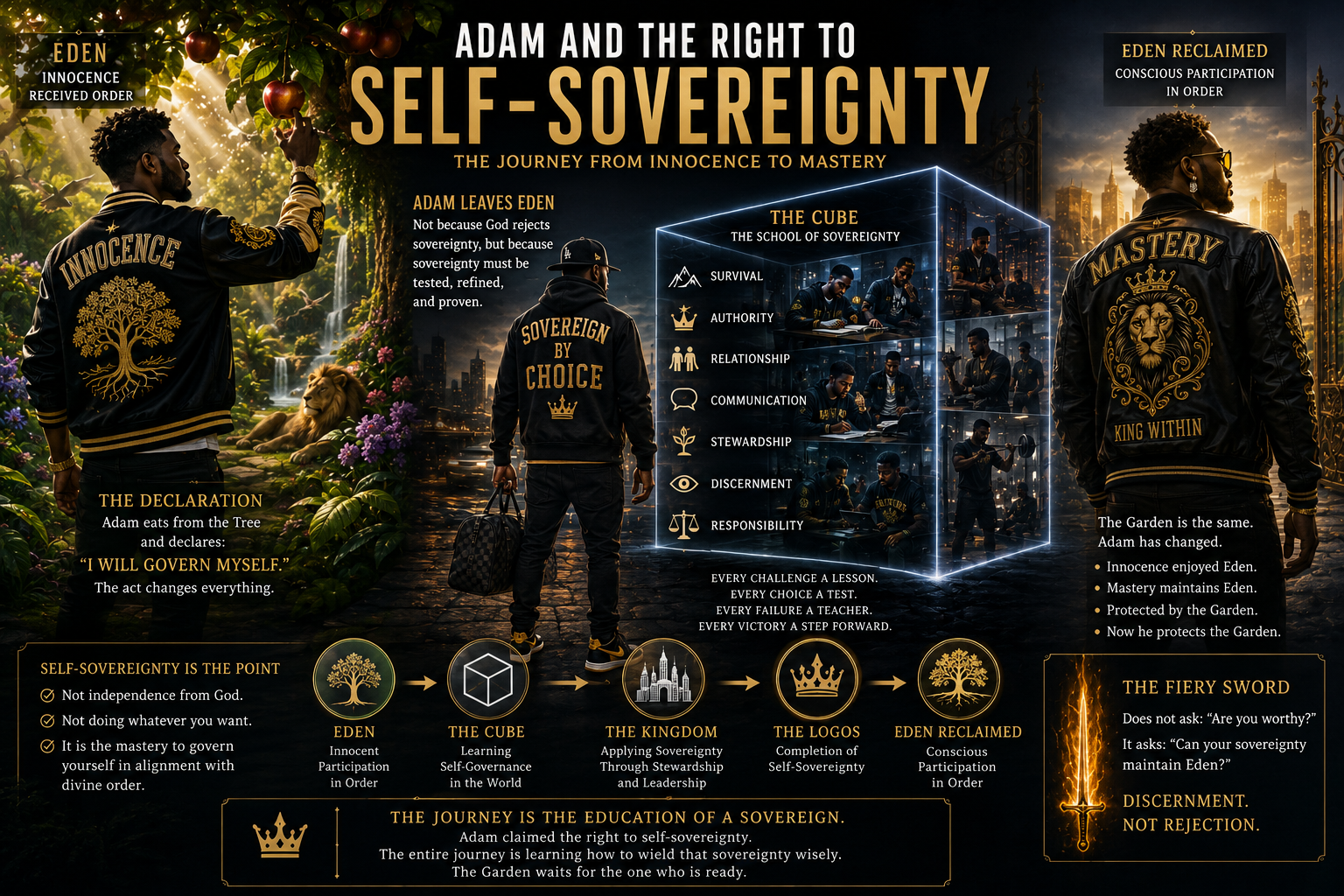
The moment Adam reached for the fruit, he exercised the greatest, most terrifying gift he had been given: free will. In doing so, he made a declaration that would shape the remainder of the human journey. It wasn’t a cosmic security breach or a malicious betrayal; it was the activation of an implicit exit clause. It wasn’t merely a statement of “I choose this fruit.” It was a legal and spiritual declaration:
“I choose to govern myself.”
The Tree was never simply about acquiring a list of rules or intellectual knowledge. The Tree was about the birth of human sovereignty.
Adam Already Possessed Free Will
One of the greatest paradoxes of the Garden narrative is that Adam could not have eaten from the Tree unless he already possessed freedom.
Think about it:
- A being without free will cannot choose.
- A being without sovereignty cannot disobey.
- A being without agency cannot exercise judgment.
The very existence of the prohibition—and the choice that followed—proves that Adam was already entrusted with a profound measure of sovereignty. The command not to eat was actually a weight-bearing wall, a solid boundary designed to give Adam something to push against. True sovereignty cannot be handed to a being on a silver platter; it must be claimed.
The fruit did not suddenly manufacture free will out of nothing; the fruit activated it.
The act of eating transformed potential sovereignty into declared sovereignty. Adam moved from passively possessing the right to choose into actively choosing self-governance. By opting out of Covenant 1 (Divine Dependency), he triggered the operational clauses of Covenant 2 (Self-Governance). The declaration had been made. The consequences would now unfold.
Why Adam Had to Leave Eden
Many people interpret Adam’s departure from Eden as an act of angry, divine punishment. Yet, when viewed through the symbolism of self-sovereignty, another possibility emerges. Adam leaves because the conditions of his existence had fundamentally changed.
Eden is a kingdom of perfect, unearned order—a sanctuary where divine governance and human participation exist in effortless harmony. The moment Adam declares self-sovereignty, he enters an entirely new phase of development. He must now learn what self-governance actually requires.
The Garden cannot function as a training ground for unfinished sovereignty; the Garden is the destination of mature sovereignty. Therefore, Adam must leave. Not because God rejects him, but because an unrefined sovereignty must be tested, shaped, and proven.
The sternness of God in this moment is not the rage of a tyrant, but the heavy, necessary gravity of a creator who knows exactly what it takes to forge a self-sovereign being. If leaving the Garden didn’t hurt, the choice to govern oneself would cost nothing—and a sovereignty that costs nothing is an illusion.
The Cube: The School of Sovereignty
This is why Adam enters the world of limitation: The Cube.
   +------+
  /      /|
 +------+ |
 |      | +
 |      |/
 +------+
The Cube represents the material world—the dense realm of time, consequence, responsibility, and physical cause-and-effect. Many spiritual traditions view this material matrix as a prison or a trap. Yet, the Cube is actually something far more compassionate: a containment matrix and a classroom.
If an unrefined, immature being is given total creative sovereignty, their internal chaos will inevitably manifest externally. The walls of the Cube ensure that Adam’s missteps, projections, fears, and distortions stay contained within a localized sandbox environment. He is allowed to fracture his world and experience the pain of his own misalignments, but the damage is quarantined.
Within this classroom, Adam is forced to learn the core pillars of existence through a direct feedback loop:
- Survival & Stewardship: Learning to sustain himself and care for his environment.
- Authority & Discernment: Discerning right action from wrong action based on real-world results.
- Relationship & Communication: Navigating connection with others without losing his center.
- Responsibility: Owning the harvest of the seeds he plants.
Every challenge becomes a lesson in sovereignty. Every failure becomes a lesson in governance. The Cube is not the antithesis of Eden; the Cube is the road back to Eden.
The Illusion of the “Testing God”
Because humanity has spent millennia trapped in the limitations of the Cube, we have misattributed the harshness of our reality to a demanding, volatile God. We look at our trials and assume God is actively testing our faith or punishing our weakness.
The foundational scripture addressing this misunderstanding is James 1:13:
“When tempted, no one should say, ‘God is tempting me.’ For God cannot be tempted by evil, nor does he tempt anyone.”
The text draws a hard, immutable line: God is not the author of the trial. God is the Architect of the system, not the Headmaster grading your daily papers. Once Adam signed the contract for self-governance, God honored that autonomy by stepping back from governing him.
What Adam perceives as God testing him is actually the conditions Adam himself has manifested. Because the Cube operates on a delay of time and space, we fail to connect the harvest to the seeds we planted. James 1:14 completes the thought by clarifying that each person is tested “when they are dragged away by their own evil desire and enticed.”
The environment is simply providing honest, unfiltered feedback. If you create from fear, the Cube yields a world of scarcity. If you create from power-struggles, the Cube yields war. God isn’t testing Adam; Adam’s own sovereignty is testing Adam.
The Curriculum of Consciousness
Within the framework of the 18-ChakraVerse, the chakras provide the precise developmental blueprint built directly into the human anatomy. They serve as the sequential curriculum of the Cube, ensuring that the sandbox operates on absolute spiritual mathematics:
| Chakra Center | The Sovereign Lesson |
|---|---|
| Root Chakra: | Learning stability and grounding in the material realm. |
| Sacral Chakra: | Mastering creation, desire, and vital energy. |
| Solar Plexus Chakra: | Claiming authentic authority and personal power. |
| Heart Chakra: | Navigating relationship, empathy, and unconditional love. |
| Throat Chakra | Mastering expression, truth, and vocal decree. |
| Third Eye Chakra | Cultivating vision, intuition, and spiritual discernment. |
| Crown Chakra | Learning the ultimate sovereign act: conscious surrender. |
Adam must learn to govern his own internal landscape before he can be trusted to govern anything external. A true kingdom cannot emerge from internal chaos; it can only emerge from an ordered consciousness.
Why Self-Sovereignty Is the Point
Many spiritual systems place passive enlightenment, salvation, or total transcendence at the absolute center of the human journey. Yet, the deeper pattern running through scripture points to something much more practical.
God is forming self-governing Adams.
The ultimate purpose of human existence is not perpetual, childlike dependence; it is mature stewardship. The purpose is not blind, robotic obedience; it is conscious, active participation. Every lesson, every systemic challenge, and every initiation we face in this life ultimately asks the same foundational questions:
- Can Adam govern his desires, or do his desires govern him?
- Can he govern his fears, his emotions, and his ego?
- Can he govern his words, his authority, and his personal kingdom?
If a person cannot govern their own internal state, they are fundamentally incapable of stewarding Eden.
The Return to Eden
The greatest misunderstanding of the Genesis story is the belief that Eden was permanently destroyed or lost. In reality, Eden didn’t go anywhere; Adam simply lost his ability to remain there.
The Garden remains exactly what it has always been. It does not change. Adam changes.
[Innocent Adam] ---> (The Cube: Training & Testing) ---> [Mastered Adam]
  Enjoys Order                                             Understands Order
  Protected by Garden                                      Maintains Garden
The first Adam enters Eden in a state of untried innocence. The returning Adam enters Eden in a state of hard-won mastery. The first Adam merely enjoys the order around him; the returning Adam deeply understands the mechanics of that order. The first Adam is protected by the Garden; the returning Adam has the capacity to help maintain the Garden.
This is why the Eden reclaimed feels so entirely different, even though it is the exact same landscape. The difference isn’t the environment. The difference is the maturity of the sovereign standing within it.
The Fiery Sword at the Gate
Scripture tells us that cherubim and a flaming, turning sword guard the way to the Tree of Life. Historically, this has been preached as a symbol of permanent exclusion—a divine “Keep Out” sign.
In truth, it is a mechanism of absolute discernment. The fiery sword asks a single, penetrating question to anyone who approaches:
“Has Adam become capable of governing what he claimed?”
The sword does not care about titles, superficial beliefs, or outward appearances. It discerns core reality. Has the traveler’s sovereignty matured? Has their internal kingdom been ordered? Has the work of the Cube been completed?
If the answer is no, the blade turns them back, and the loop of the classroom continues until they face themselves. If the answer is yes, the blade parts, and the way opens.
The Goal of the Journey
The story of humanity is not the story of a cosmic criminal being punished by an angry creator. It is the story of a sovereign being undergoing a rigorous, compassionate education.
The act of eating from the Tree was a radical declaration of independence. The journey through the limitations of the Cube is the training ground. The return to Eden is the final demonstration of mastery.
We claimed the right to self-sovereignty at the very beginning of the story. Stop looking to the sky for permission or punishment. The conditions of your life are not God’s judgment of you; they are the physical mathematics of your own current level of self-governance. The Garden was never truly lost; it is waiting. And when we finally learn to govern ourselves, the gates will open once more.
Not because we are innocent—but because we are ready.