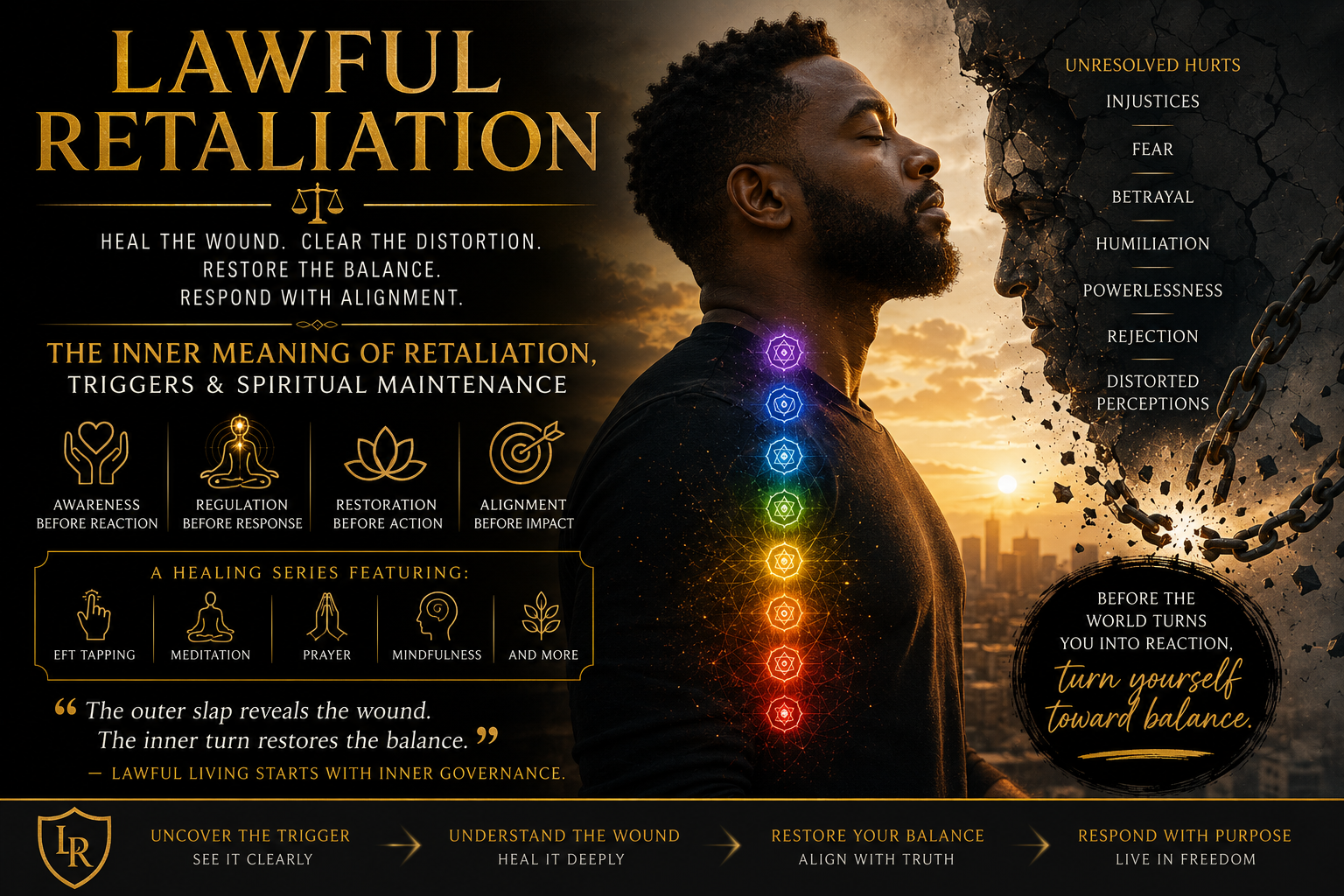
Triggers & Spiritual Maintenance
By Alchemist Iris Chapman
Most people interpret retaliation as an outward act. Someone hurts us, so we hurt them back. Someone insults us, and we return the insult. When someone wounds us emotionally, spiritually, financially, or psychologically, a powerful force rises within us demanding repayment. This is commonly understood as revenge, reprisal, or “paying someone back.”
But what if retaliation is first an inner event before it ever becomes an outer one? What if the outer event merely reveals an existing condition already waiting beneath the surface?
The Loaded Gun Within
A person can only be triggered where there is already an unresolved charge. The external event becomes the catalyst, but the emotional material was already present.
- The anger was already there.
- The fear was already there.
- The humiliation was already there.
- The unresolved grief was already there.
The outer “slap” simply exposed the loaded gun.
This realization fundamentally changes how we understand the famous verse from the Bible:
“But I tell you, do not resist an evil person. If anyone slaps you on the right cheek, turn to them the other cheek also.”
This teaching has often been misunderstood as passive acceptance, weakness, or submission to mistreatment. But spiritually, the “turning” may not be outward first. It may be inward.
The turning of the cheek becomes:
- The turning of perception
- The turning of the nervous system
- The turning of emotional momentum
- The turning away from unconscious reaction
The external event exposed an imbalance within your system. The true spiritual task becomes restoring balance before reaction takes control.
Retaliation as Inner Imbalance
Retaliation often emerges from unresolved distortion inside our energetic system. The outer situation activates old, buried emotional architecture: fear, rejection, powerlessness, humiliation, betrayal, abandonment, and emotional suppression.
When left unattended, these distortions begin governing our behavior automatically. A person believes they are responding to the present moment, but often they are actually responding to accumulated emotional residue from years of unresolved experiences. The reaction becomes entirely disproportionate because the present event has awakened many older events simultaneously.
The Chakras & Unresolved Hurt
Different forms of unresolved injustice tend to accumulate in specific areas of our energetic system. Understanding where this pain lodges allows us to decode our reactive impulses.
? Root Chakra — Survival Wounds
The Root Chakra stores fear, instability, abandonment, survival anxiety, hypervigilance, and a fundamental distrust of safety. When unresolved, a person becomes constantly prepared for attack.
- How it appears: Defensiveness, irritability, territorial behavior, an inability to relax, and nervous-system exhaustion.
- The inner statement: “I must stay ready so I am never hurt again.”
? Solar Plexus Chakra — Power Wounds
The Solar Plexus stores humiliation, domination, disrespect, shame, suppression, and a loss of agency. This chakra naturally seeks the restoration of sovereignty.
- How it appears: A desperate need to win, a need to be right, controlling behavior, revenge fantasies, and an obsession with fairness.
- The inner statement: “Balance only returns when power is restored.”
? Heart Chakra — Relational Wounds
The Heart Chakra stores grief, betrayal, disappointment, emotional pain, rejection, and broken trust. When wounded, the heart develops heavy armor.
- How it appears: Emotional withdrawal, bitterness, guardedness, passive punishment, and an inability to receive love safely.
- The inner statement: “Love is dangerous.”
?️ The Veil Chakra — Narrative Distortion
The Veil Chakra governs our interpretation, identity narratives, and perception filters. This is where unresolved pain solidifies into a rigid worldview. The original wound may have begun in a lower chakra, but the Veil keeps replaying it through identity patterns such as:
- “People always betray me.”
- “No one respects me.”
- “I always get hurt.”
- “The world is against me.”
At this stage, a person is no longer reacting to reality alone. They are reacting to accumulated symbolic memory; perception itself has become distorted by unresolved pain.
“Turn the Other Cheek” as Spiritual Regulation
Seen through this lens, “turning the other cheek” becomes an profound act of inner governance. It is not weakness. It is not suppression. It is certainly not pretending harm did not occur. Rather, it is the strict discipline of refusing to let the wound take control of your system.
The turning says:
“I will not become the pain that touched me.”
This does not mean avoiding accountability, boundaries, truth, or justice. It means restoring balance internally before responding externally. The goal is not emotional numbness, but conscious response instead of unconscious reaction.
Why Spiritual Maintenance Matters
Many people imagine healing as a single, monumental breakthrough. In reality, inner balance is maintained through routine awareness. The figurative “slaps” of life happen daily:
| Daily Triggers & Stressors | Systemic Impact (Without Maintenance) |
|---|---|
| Stress & Pressure | The nervous system tightens. |
| Disrespect & Rejection | The emotional body hardens. |
| Exhaustion & Overload | The mind narrows. |
| Disappointment & Comparison | Old wounds become increasingly reactive. |
One event alone may not destabilize you. But repeated activation without maintenance creates a toxic buildup.
Interestingly, in the original languages of the Biblical text, the word often translated as “cheek” refers implicitly to the jaw. This makes the meaning deeper and entirely systemic. When threatened, the jaw clenches. The tension locks into the body. Eventually, a person explodes over something that appears trivial because the reaction isn’t coming from that single moment—it is coming from accumulated, unresolved charge.
This is why mindful forethought matters. Not out of paranoia or fear, but as active inner maintenance. Just as we maintain our bodies, our homes, our vehicles, and our finances, our inner world requires consistent care. Without it, resentment and fear accumulate, distortions strengthen, reactions intensify, and perception becomes permanently clouded. The maintenance itself becomes our ultimate protection.
Preventative Regulation
Integrating practices like the Prayer Warrior path, EFT tapping, breathwork, grounding, mindfulness, prayer, meditation, journaling, chakra healing, self-Reiki, and nervous-system regulation can help us uncover emotional distortions before they fully manifest as destructive behavior.
The purpose of these tools is never suppression; it is awareness. The trigger itself is not the enemy. The trigger is a map, revealing exactly where our healing is still unfinished.
When triggered, a mindful person learns to pause and ask:
- “What inside me was activated?”
- “What wound was touched?”
- “What belief surfaced?”
- “What imbalance is asking for restoration?”
This inquiry transforms the instinct of retaliation into an opportunity for self-awareness. The immense energy once wasted on revenge is successfully reclaimed and used for healing, discernment, and personal restoration.
Final Reflection
The world may continue to strike at your system. People will be careless, unfair, and reactive. But spiritual maturity is learning not to hand the keys of your inner world over to every external event.
The deepest meaning of “turn the other cheek” is ultimately this: Before the world turns me into a reaction, I turn myself toward balance.
Continue the Lawful Retaliation Healing Series
- Lawful Retaliation & The Prayer Warrior
- Lawful Retaliation & Grounding
- Lawful Retaliation & Mindfulness
- Lawful Retaliation & Meditation
- Lawful Retaliation & Journaling
- Lawful Retaliation & EFT Tapping
- Lawful Retaliation & Nervous-System Regulation
- Lawful Retaliation & Healing Breathwork
- Lawful Retaliation & Self-Reiki
- Lawful Retaliation & Chakra Healing
Framing retaliation as an inner imbalance before it becomes an outward act is an interesting take. I liked the idea that triggers are signals rather than enemies, because it shifts the focus from blame toward self-awareness and ongoing inner work. Your point about accumulated emotional charge leading to outsized reactions felt very real and easy to connect with.
Restoring balance before responding adds an important layer to the conversation around boundaries and accountability. The chakra framework offers readers a clear lens for reflecting on the roots of certain emotional patterns. Do you find that one practice, like breathwork or journaling, helps people recognize those deeper triggers faster?
Hi Aly,
Thank you for such a thoughtful reflection. I’m glad the idea of triggers as signals resonated with you. One of the central themes of the 18-ChakraVerse is that our reactions often reveal where our inner kingdom is asking for attention. Rather than viewing a trigger as an enemy, we can see it as an invitation to discover what still needs healing, understanding, or integration.
As for practices, I don’t believe there is a single method that works best for everyone. Breathwork can be incredibly helpful because it creates enough space between the trigger and the response for awareness to return. Journaling is equally valuable because it allows us to recognize recurring patterns over time.
Personally, I also encourage asking simple questions in the moment, such as, “What within me feels threatened right now?” or “What belief is this situation exposing?” Those questions often uncover the deeper source more quickly than focusing on the external event itself.
The goal is not to eliminate emotion but to become conscious of it. As awareness grows, retaliation becomes less about reacting to another person and more about restoring order within ourselves before we choose how to respond.
Thank you again for contributing such a meaningful question and for engaging so deeply with the article.
This is a thoughtful perspective that reframes retaliation as an internal process rather than merely an external action. I especially appreciate the emphasis on triggers as indicators of unresolved emotional patterns and the idea that true strength lies in restoring inner balance before responding. Whether viewed through a spiritual, psychological, or mindfulness lens, the principle of conscious response over automatic reaction is a powerful path toward personal growth. The reminder that regular inner maintenance helps prevent accumulated emotional charge from shaping our perceptions and behavior is particularly insightful.
Thank you, Kavitha. I’m glad the perspective resonated with you.
One of the central ideas behind Lawful Retaliation is that our strongest reactions often reveal the places within us that are still seeking healing, understanding, or integration. What appears to be an external conflict can sometimes be an invitation to explore an internal imbalance that has been activated.
I appreciate your observation that this principle can be understood through spiritual, psychological, and mindfulness frameworks alike. Regardless of the language we use, the movement from automatic reaction to conscious response is often where real transformation begins. When we create space between the trigger and the response, we gain the opportunity to act from clarity rather than accumulated emotional charge.
Your point about regular inner maintenance is especially important. Just as we care for the physical body, tending to our emotional and energetic landscape helps prevent old wounds, resentments, and fears from unconsciously shaping how we interpret the world around us.
Thank you for sharing such a thoughtful reflection and for contributing to the conversation.
The part about retaliation starting inside us before it turns into actions was interesting. A lot of people think anger comes out of nowhere, but most of the time it builds up from old stress, hurt, or frustration. I’ve noticed that too. Sometimes one small thing can make someone explode because they were already carrying a lot inside.
I also liked the point about forgiveness and boundaries not being the same thing. You can forgive someone and still keep your distance if they keep causing harm. A lot of people struggle with that balance.
Do you think some people stay stuck in survival mode for so long that they forget what real emotional peace even feels like? And when someone has years of built-up pain, what’s the best place to start without getting overwhelmed?
The part about ‘turn the other cheek’ meaning self-control instead of weakness was probably the strongest idea in the article for me.
Bob, this is a deeply thoughtful reflection, and I think you touched the center of the issue when you said that many people are already carrying years of pressure before the visible reaction ever happens. That is often why retaliation feels “sudden” externally while internally it has been building for a very long time.
And yes — I absolutely believe many people can remain in survival mode for so long that peace begins to feel unfamiliar, unrealistic, or even unsafe to the nervous system. When someone has lived in constant stress, betrayal, instability, fear, or emotional hypervigilance, the body can become conditioned to expect danger at all times. In that state, stillness may initially feel uncomfortable because the system has adapted itself around protection rather than restoration.
That is one reason I wanted to emphasize that “turning the other cheek” is not passive weakness. In many cases, it is the discipline of refusing to let unresolved pain govern your identity, reactions, and future decisions. It is self-governance under pressure.
I also agree strongly with your point about forgiveness and boundaries being different things. Forgiveness can release emotional poison internally, while boundaries prevent continued harm externally. Both are necessary. Without boundaries, forgiveness can become self-abandonment. Without forgiveness, boundaries can become bitterness.
As for where someone should begin when carrying years of pain: usually not with trying to “fix everything” at once. That often overwhelms the system. The healthiest starting point is often small acts of regulation and honest self-awareness:
recognizing what triggers survival responseslearning to pause before reactingreconnecting to the body through grounding practicesallowing emotions to be acknowledged without immediately acting on themrebuilding safety internally one moment at a time
Real healing is often slower and more ordinary than people expect. Sometimes the first sign of healing is simply noticing the reaction before becoming the reaction.
I appreciate your insight here because you recognized something important: retaliation is rarely just about the present moment. Most of the time, it is accumulated energy looking for release. The deeper work is learning how to transform that energy into clarity, boundaries, discernment, and eventually peace rather than unconscious repetition.
Thank you for sharing this thought-provoking article about lawful retaliation and “turning the other cheek.” I found the discussion very interesting because it raises important questions about forgiveness, boundaries, and emotional balance.
I do have a few questions after reading the article. How do you think people can balance compassion with protecting themselves from harmful behavior? Also, do you believe “turning the other cheek” is more about inner peace than avoiding accountability?
In my opinion, topics like this are valuable because they encourage deeper reflection about how we respond to conflict and difficult situations. Thank you again for sharing this meaningful perspective.
Thank you so much, IYERE. I truly appreciate the depth of your reflection and the care in your questions.
For me, lawful retaliation is not about revenge, punishment, or suppressing emotion. It is about restoring alignment when something harmful, manipulative, or destructive has disrupted inner balance. That is why I believe compassion and protection must exist together. Compassion without boundaries can become self-abandonment, while protection without compassion can become bitterness or hardness of heart. The goal is not to lose oneself in either extreme.
Within the framework of chakra and energy healing, I often view this as a movement from reaction to governed response. A wounded nervous system tends to swing between collapse (“I must tolerate everything”) and aggression (“I must destroy the threat”). But lawful retaliation asks something deeper:
“How do I respond in a way that protects truth, preserves dignity, and prevents further distortion—without becoming distorted myself?”
Sometimes that response is silence. Sometimes it is distance. Sometimes it is confrontation. Sometimes it is grief. And sometimes it is the courage to say “no” without hatred.
I also absolutely believe that “turning the other cheek” is often misunderstood. In my view, it is not permission for abuse, nor is it the removal of accountability. It is more connected to inner mastery. A person who is internally governed does not allow every insult, offense, or provocation to dictate their state of being. That does not mean injustice should be ignored—it means the response comes from alignment rather than emotional chaos.
Accountability is still necessary. Boundaries are still necessary. Truth is still necessary. But retaliation becomes “lawful” when it is no longer driven by the desire to wound back. Instead, it becomes an act of restoring order within oneself and within relationships where possible.
I think one of the hardest lessons in healing is realizing that forgiveness and access are not the same thing. A person can forgive and still establish distance. They can release hatred while also refusing continued harm. That distinction is extremely important for emotional balance, nervous-system regulation, and spiritual integrity.
Thank you again for such a thoughtful comment. Conversations like this are meaningful because they move beyond simple ideas of “good” or “bad” reactions and invite us to examine the deeper architecture underneath human behavior, pain, and healing.
This was a deep and thought-provoking read. I liked how you reframed retaliation as something that begins inside us before it becomes an outward reaction. The idea that “turn the other cheek” can mean turning inward toward balance, rather than accepting mistreatment, was especially powerful. I also appreciated the connection between triggers, unresolved wounds, and spiritual maintenance. It makes healing feel like a daily practice, not a one-time breakthrough. What practice helps you restore inner balance the fastest?
Thank you, Hanna. I’m glad the deeper meaning resonated with you. That shift—from retaliation as reaction to retaliation as inner governance—is really the heart of the piece. Most outward conflict begins long before words or actions appear. It starts as accumulated emotional pressure, unresolved pain, repeated triggers, and nervous system exhaustion.
For me, the fastest way to restore inner balance is a combination of grounding, honest self-observation, and physical release before the emotion hardens into a story.
Usually that looks like:
• pausing before reacting
• deep breathing to regulate the body
• EFT tapping to interrupt the emotional charge
• asking myself, “What exactly was touched in me?”
• walking or standing barefoot when possible
• prayer or meditation to return to alignment rather than ego-defense
• and sometimes simply removing myself from overstimulating environments long enough to hear my own thoughts again
I’ve learned that speed matters. The longer a wound goes unattended, the more likely the mind will recruit it into a justification for unaligned behavior. Small daily maintenance prevents larger emotional eruptions later.
One thing I’ve also noticed is that unresolved hurts often disguise themselves as “righteous reactions.” That is why inner honesty is so important. Not every emotional surge is wisdom—sometimes it is accumulated pressure asking to be witnessed and released.
That’s really the spirit behind “Lawful Retaliation.” Not suppression. Not passivity. But learning how to restore internal order before pain chooses our actions for us.