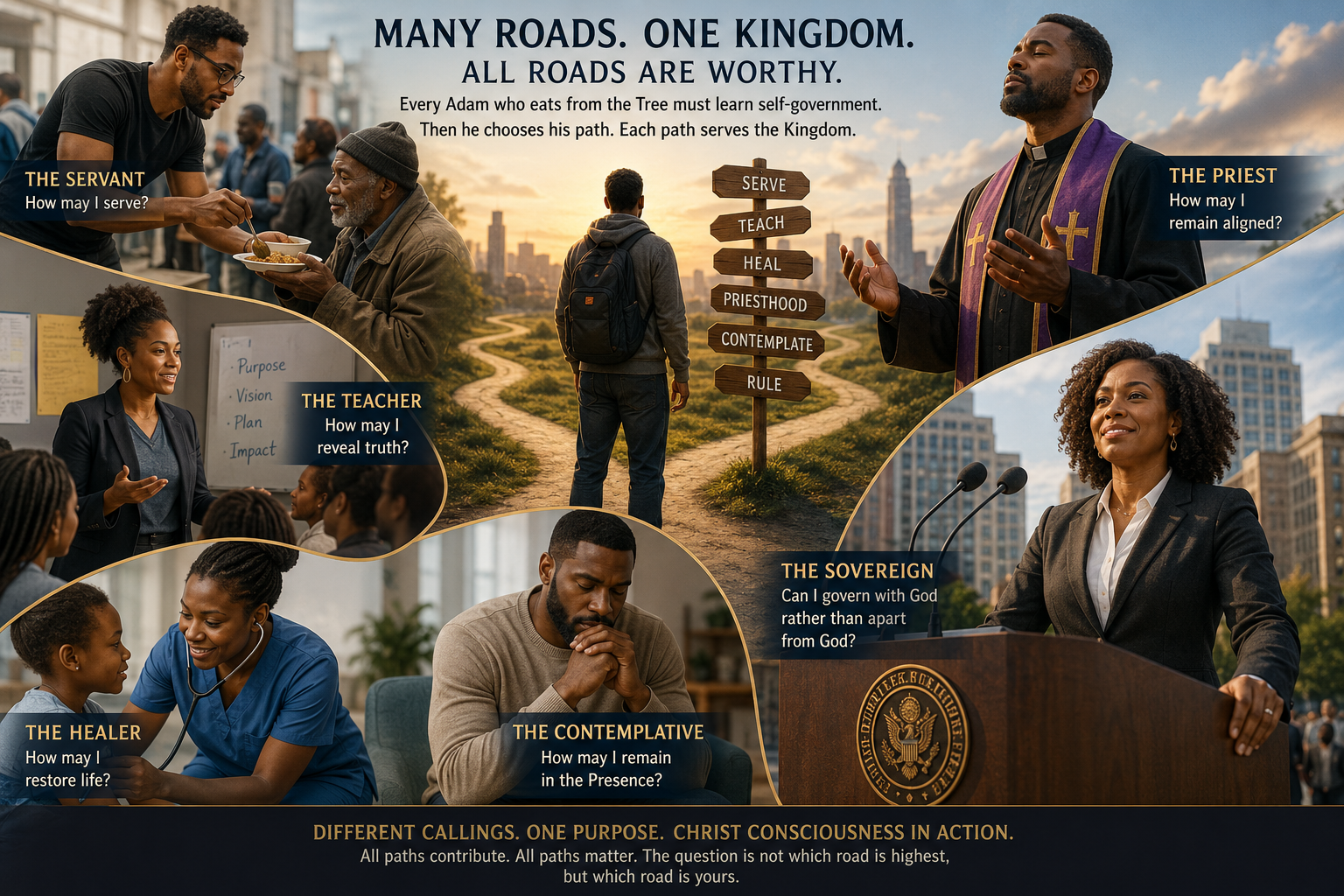
The Bible and the Many Roads of Adam
The Journey of Lifetimes
Most people read the Bible as a collection of stories about different people.
Adam.
Noah.
Abraham.
Joseph.
Moses.
David.
The prophets.
Jesus.
Within the framework of the 18-ChakraVerse, another possibility emerges.
What if the Bible is not primarily the story of many people?
What if it is the story of Adam?
Not Adam as a single historical individual.
Adam as the evolving soul.
Adam as mankind.
Adam as consciousness learning what it means to govern itself.
From Genesis to Revelation, the Bible becomes the story of a soul moving from innocence to wisdom, from dependence to self-government, and ultimately from sovereignty to co-rulership with God.
The Choice in Eden
The central event of Genesis is not sin.
The central event is choice.
Adam is constructed.
The kingdom is established.
The faculties are present.
The inheritance is provided.
Then a question appears.
Will Adam remain in service?
Or will Adam pursue sovereignty?
The Tree of the Knowledge of Good and Evil represents the beginning of that journey.
The moment Adam eats from the Tree, a new curriculum begins.
Adam enters the school of experience.
The soul becomes responsible for what it chooses.
The journey beyond Eden begins.
Eden Is Not Failure
Many interpretations present Eden as a story of failure.
Within this framework, Eden is initiation.
Adam discovers the possibility of sovereignty.
The choice is real.
The consequences are real.
But grace remains active.
The journey is not locked in immediately.
The soul continues learning.
The soul continues choosing.
The soul continues growing.
Every incarnation presents another opportunity to learn.
Another opportunity to align.
Another opportunity to remember.
The Many Roads of Adam
One of the greatest misunderstandings of spirituality is the assumption that every soul is pursuing the same destination.
The Bible repeatedly reveals otherwise.
Different Adams pursue different callings.
Different roads.
Different purposes.
All are worthy.
The Road of the Servant
Some Adams choose service.
They devote themselves to helping others.
They heal.
They nurture.
They comfort.
They support.
They become instruments of Divine Purpose in the world.
Their question becomes:
“How may I serve?”
These souls help sustain creation.
They bring compassion into the kingdom.
They strengthen the whole through their willingness to care.
The Road of the Teacher
Some Adams become teachers.
Their purpose is illumination.
They help others understand.
They reveal wisdom.
They transmit knowledge across generations.
Their question becomes:
“How may I reveal truth?”
Without teachers, the kingdom loses memory.
Without teachers, wisdom is forgotten.
The Road of the Healer
Some Adams become healers.
They restore what has been damaged.
They mend divisions.
They ease suffering.
They help consciousness return to wholeness.
Their question becomes:
“How may I restore life?”
Without healers, the kingdom loses restoration.
The Road of the Priest
Some Adams become priests.
This is the path represented by Levi.
Levi receives no territorial inheritance.
Levi governs no mansion.
Levi receives God as his inheritance.
The priest’s purpose is not expansion.
The priest’s purpose is connection.
The priest maintains the relationship between heaven and earth.
The priest asks:
“How may I remain aligned?”
Many Adams complete their journey here.
This is not failure.
This is fulfillment.
The Road of the Contemplative
Some Adams walk the path of Enoch.
Enoch walked with God.
The text does not present him as a king.
It does not present him as a conqueror.
It presents him as one who walked.
His purpose was communion.
His purpose was presence.
His purpose was alignment.
The contemplative asks:
“How may I remain in the Presence?”
Such souls often sustain the spiritual coherence of humanity.
They hold the fort.
They preserve the connection.
They keep the field aligned with Christ Consciousness.
The Road of the Sovereign
Then there is the most difficult road.
The road of rulership.
The sovereign does not simply serve the kingdom.
The sovereign learns to govern it.
This requires mastery of:
- self
- power
- authority
- responsibility
- judgment
- stewardship
The sovereign cannot govern wisely without understanding every level of the kingdom.
A king must understand the servant.
A ruler must understand the healer.
A governor must understand the teacher.
A sovereign must understand the priest.
The sovereign asks:
“Can I govern with God rather than apart from God?”
This is the narrow path.
Not because it is superior.
Because it is demanding.
Why the Sovereign Path Takes So Long
A ruler cannot be created through information alone.
A ruler must be formed through experience.
The soul must learn:
- powerlessness
- responsibility
- sacrifice
- wisdom
- compassion
- leadership
- service
A king who has never known slavery cannot fully understand justice.
A ruler who has never served cannot fully understand authority.
A sovereign who has never suffered cannot fully understand mercy.
This is why the journey is so long.
The sovereign must become what he governs.
Christ and the Completion of Adam
The Bible reaches its climax in Christ.
Within this framework, Christ represents the completion of Adam’s sovereign education.
He is:
- servant
- teacher
- healer
- priest
- prophet
- king
Nothing within the kingdom remains outside His understanding.
He serves.
He teaches.
He heals.
He governs.
He remains aligned with the Father throughout.
The statement:
“Not my will, but Thy will.”
becomes the defining declaration of mature sovereignty.
The ruler no longer seeks power for himself.
The ruler governs in harmony with Divine Order.
Many Are Called
This perspective also gives new meaning to a familiar saying:
“Many are called, but few are chosen.”
This is not necessarily a statement of condemnation.
It may be a statement of vocation.
Many are called into conscious participation in the kingdom.
Few choose the burden of co-rulership with God.
The teacher serves.
The healer serves.
The priest serves.
The contemplative serves.
The ruler serves while simultaneously carrying the responsibility of government.
All roads are worthy.
All roads contribute to the Kingdom.
The difference lies in the calling.
The Journey of Adam
The Bible is therefore not merely a collection of biographies.
It is the story of Adam.
The story of consciousness.
The story of a soul learning what to do with freedom.
Some Adams become servants.
Some become healers.
Some become teachers.
Some become priests.
Some become contemplatives.
Some become rulers.
Each path reveals another facet of the Divine Design.
Each path contributes to the unfolding of Christ Consciousness.
The question is not:
“Which road is highest?”
The question is:
“Which road is mine?”
For all roads, when followed faithfully, ultimately lead back to the Father.