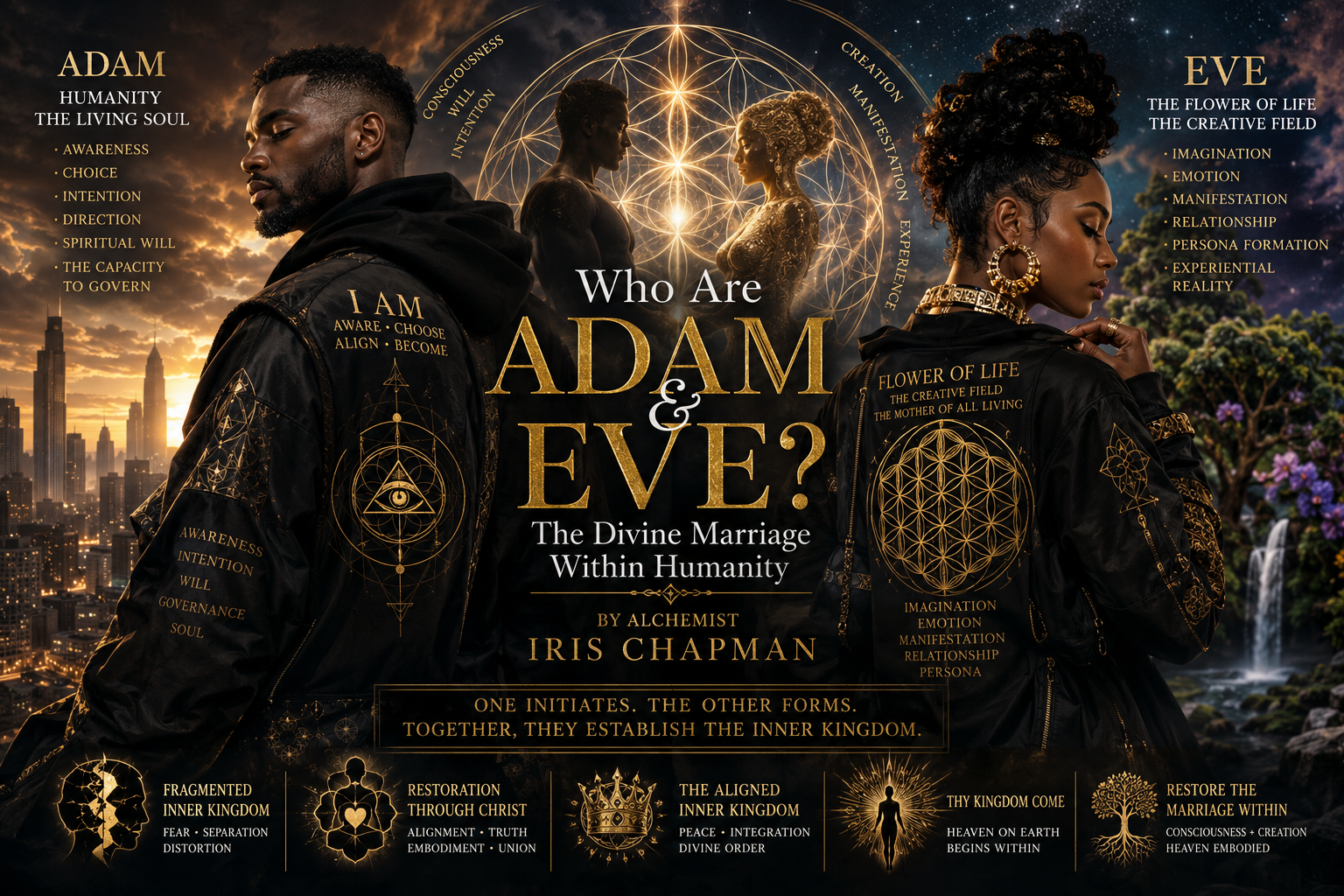
The Divine Marriage Within Humanity
By Alchemist Iris Chapman | Chakra & Energy Healing
There are stories in Scripture that function less like history and more like architecture. The narrative of Adam and Eve is one of them.
For generations, Adam and Eve have been interpreted almost exclusively as the first man and woman—external, historical figures standing at the literal dawn of human civilization. Beneath that surface lies another possibility: Adam and Eve describe the inner mechanics of humanity itself.
They represent two complementary principles woven into consciousness:
- Adam represents humanity itself—the soul-bearing vessel of mankind, both male and female, carrying awareness, will, intention, identity, and the capacity to become.
- Eve represents the Flower of Life—the living creative intelligence through which consciousness becomes form, relationship, emotion, identity, experience, and the fractal personas through which humanity develops.
Their relationship is therefore more than the story of an external husband and wife. It is a metaphysical marriage. Adam and Eve describe the sacred union between consciousness and its creative power.
- Adam carries direction; Eve carries formation.
- Adam carries intention; Eve carries manifestation.
- Adam plants; Eve multiplies.
Together, they form the inner marriage through which invisible consciousness becomes embodied experience. This is the marriage within humanity.
Adam: Humanity as the Living Soul
One of the most overlooked details in Genesis is that Adam initially represents humanity collectively rather than exclusively a biological male. Genesis begins with humanity containing both masculine and feminine expression:
“So God created man in his own image, in the image of God created he him; male and female created he them.”
— Genesis 1:27
Genesis later makes this collective identity explicit:
“Male and female created he them; and blessed them, and called their name Adam, in the day when they were created.”
— Genesis 5:2
Adam is not exclusively masculine. Adam is humanity as a soul-bearing being—the conscious vessel through which divine awareness enters embodied experience.
“And the LORD God formed man of the dust of the ground, and breathed into his nostrils the breath of life; and man became a living soul.”
— Genesis 2:7
The dust provides form. The Breath provides life. Adam becomes the living soul.
The Attributes of Adam
Adam is the conscious “I AM” within humanity. This center declares: I choose. I become. I align. I build. I walk with God.
Within the constitution of consciousness, Adam carries:
- Awareness & Perception
- Identity & Choice
- Intention & Direction
- Spiritual Will & Governance
- Responsibility & Consequence
Within the 18-ChakraVerse framework, Adam represents the unified soul essence moving vertically through experience—learning through embodiment, challenge, fragmentation, healing, correction, and reintegration. Adam journeys, names, chooses, learns, and governs.
Yet Adam alone does not create lived experience. Consciousness can initiate intention, but intention requires a corresponding creative principle capable of bringing it into form. That principle is Eve.
Adam and Eve Are Not Biological Gender Assignments
One distinction is essential before going further: Adam does not mean “the man,” and Eve does not simply mean “the woman.” Biological sex and metaphysical function are not identical.
Scripture itself establishes the foundation for this distinction:
“Male and female created he them; and blessed them, and called their name Adam, in the day when they were created.”
— Genesis 5:2
Both male and female humanity are Adam. A woman can therefore stand fully within the Adam principle because Adam represents the conscious soul-bearing human being—the one who perceives, chooses, intends, learns, and governs.
Likewise, the Eve principle is not restricted to a female body. Eve represents the helpmeet—the corresponding creative intelligence through which Adam’s consciousness enters form. A man therefore carries an Eve function just as surely as a woman does.
Every human being contains this architecture:
- Adam — the conscious soul.
- Eve — the creative helpmeet.
This is why the metaphysical marriage cannot be reduced to conventional gender roles. A woman may express powerful direction, structure, intention, spiritual authority, and governance without somehow becoming “masculine” in her biological identity. A man may express receptivity, imagination, emotional intelligence, gestation of ideas, relational intelligence, and manifestation without somehow becoming “feminine” in his biological identity.
These are functions of consciousness, not restrictions placed upon bodies.
Masculine and Feminine Are Descriptions of Function
The terms masculine and feminine can still be useful when discussing polarity, but they should not be mistaken for Adam and Eve themselves. Adam may express qualities traditionally described as masculine or feminine. Eve may also work through qualities traditionally described as masculine or feminine.
The deeper distinction is not:
Man ➡ Adam
Woman ➡Eve
It is:
Consciousness ➡ Adam
Creative Field ➡ Eve
That architecture exists within both. This also changes how we understand the phrase:
“Male and female created he them…”
— Genesis 1:27
Male and female are embodied expressions within Adam. Adam is larger than either expression alone. And Eve, as Adam’s helpmeet, operates within the creative architecture of both.
The Marriage Happens Within Every Human Being
The metaphysical marriage therefore does not require a male body to occupy one side and a female body to occupy the other. The marriage occurs whenever the conscious soul becomes coherent with its own creative power.
A woman can receive divine direction as Adam and bring that direction into manifestation through Eve. A man can receive divine direction as Adam and bring that direction into manifestation through Eve. The vessel changes; the architecture does not.
This is why “one flesh” can describe an inner integration available to every human being. Adam and Eve are not costumes assigned according to sex. They are complementary functions required for conscious creation.
Every Adam needs Eve. And every human being is Adam.
Eve: The Flower of Life and the Misunderstood Helpmeet
Before Eve appears, Scripture makes a profound declaration:
“It is not good that the man should be alone; I will make him an help meet for him.”
— Genesis 2:18
The word helpmeet has often been filtered through cultural hierarchy, as though Eve were merely a subordinate assistant. Metaphysically, something far more fundamental is taking place: consciousness alone cannot produce embodied experience. Adam requires a corresponding creative field.
Eve is that field. She is the creative intelligence through which the soul’s internal world becomes experiential reality. Within the 18-ChakraVerse, Eve is represented by the Flower of Life.
Crucially, Eve does not originate as an alien, unrelated force. She emerges directly from Adam’s own substance:
“This is now bone of my bones, and flesh of my flesh…”
— Genesis 2:23
Eve is intimately connected to Adam. She is the corresponding generative field through which Adam enters relationship with form. If Adam is will, Eve is creative response. If Adam speaks the Word, Eve develops the form. If Adam establishes direction, Eve generates the pathway. If Adam carries seed, Eve provides the generative matrix in which that seed can gestate and develop.
The Attributes of Eve
Eve carries:
- Imagination & Symbolic Construction
- Emotional & Relational Intelligence
- Energetic Responsiveness
- Manifestation & Form
- Persona Formation
- Experiential Reality
- Gestation & Multiplication
This makes Eve essential to Adam’s creative function.
Eve as the Mother of Fractal Personas
Genesis assigns Eve an extraordinary title:
“And Adam called his wife’s name Eve; because she was the mother of all living.”
— Genesis 3:20
Within the 18-ChakraVerse, this title extends far beyond biological reproduction. Eve is the mother of the fractal personas through which Adam interfaces with experience. Every role, archetype, adaptive identity, emotional configuration, survival strategy, and mature expression develops within Eve’s creative field. When Adam encounters life, Eve generates forms capable of responding to it.
| When Adam Seeks or Desires… | Eve’s Creative Field May Produce… |
| Safety | The Earth Walker, The Protector, The Escapist, The Controller |
| Love | The Devoted Lover, The Performer, The Velvet Snare, The Martyr |
| Power | The Empowered Leader, The Tyrant, The Overachiever, The Sovereign |
These personas are not Adam himself. They are clothing worn by the soul—temporary configurations generated within the Flower of Life so consciousness can navigate particular environments, challenges, relationships, and developmental stages.
The crisis begins when Adam forgets this distinction. An internal citizen or persona can serve the kingdom, but Adam must never abdicate the throne to it.
The Metaphysical Marriage: Two States Become One
This brings us to the core mystery: marriage itself.
From a metaphysical perspective, marriage is not limited to an external social contract. It represents the joining of complementary principles of consciousness. The Adam–Eve relationship describes an inner marriage between consciousness and its generative capacity.
“Therefore shall a man leave his father and his mother, and shall cleave unto his wife: and they shall be one flesh.”
— Genesis 2:24
“One flesh” is the structural key. Two principles operate as one coherent creative system.
- Adam provides orientation: Who am I? What do I believe? What do I choose? Where am I going? What will I serve? What am I planting?
- Eve provides embodiment: What form will that choice take? What emotions correspond to it? What relationships organize around it? What persona will carry it? What fruit will it yield?
Adam establishes direction; Eve gives direction a living world.
The Alchemical Marriage
Esoteric traditions have long described the reconciliation of complementary masculine and feminine principles as an alchemical marriage. Within the 18-ChakraVerse, these principles are constitutional functions present in every human being:
- The Masculine Principle: Direction, intention, boundary, structure, focus, governing will.
- The Feminine Principle: Reception, gestation, imagination, relationship, formation, multiplication, manifestation.
Neither is superior; neither was designed to rule independently. Their proper dynamic is coherence. Will without creative responsiveness degrades into barren domination; creative power without governing orientation devolves into uncontrolled generation. Adam must learn to govern without suppressing Eve, and Eve must create in constant communion with Adam’s divine orientation.
The Marriage of Higher and Lower Consciousness
This marriage also bridges what humanity often separates into “higher” and “lower” awareness:
Vertical Axis (Adam) ➡ God ➡ Identity ➡ Purpose ➡ Intention ➡ Governance
Horizontal Axis (Eve) ➡ Emotion ➡ Relationship ➡ Creativity ➡ Materiality ➡ Experience
The spiritual journey is not about abandoning the horizontal world to escape upward into disembodied light. The vertical must infuse the horizontal. Spirit must enter matter. Intention must become action. The Word must become lived reality.
Developmental Thresholds of the Inner Union
The Metaphysical Awakening of Puberty
This architecture illuminates human developmental thresholds. Prior to puberty, a child exists primarily within a dependent reality shaped by parents, caregivers, and culture.
At puberty, the inner Eve comes online with tremendous force. The lower energy centers awaken into expanded creative, sexual, emotional, relational, and manifestation capacities. Desire, attraction, projection, identity experimentation, and creative fire surge forward. The vertical will of Adam encounters an ocean of horizontal force. The individual transitions from consuming a constructed reality to generating one. Raw power, however, is not yet mature power; the marriage must be consciously developed.
Leaving the Parental Matrix
This transition provides the esoteric key to Genesis 2:24:
“Therefore shall a man leave his father and his mother, and shall cleave unto his wife…”
Because Adam represents humanity collectively, this instruction applies inwardly to every soul. During spiritual childhood:
Parents / Environment ➡ Construct Reality ➡ Child Experiences Reality
As sovereign governance develops:
God ➡ Adam ➡ Eve ➡ Internal Citizens / Personas ➡ Manifested Experience
To “leave father and mother” represents graduation from inherited architecture. The individual must audit inherited beliefs, fears, religious assumptions, relationship scripts, and survival strategies. Adam’s own creative helpmeet has awakened; the soul must now take conscious responsibility for its own household.
“They Shall Become One Flesh”
When Adam cleaves to Eve, their functions do not dissolve; they become coherent:
- Adam knows ➡ Eve embodies.
- Adam chooses ➡ Eve organizes.
- Adam plants ➡ Eve develops.
- Adam speaks ➡ Eve forms.
- Adam learns ➡ Eve adjusts.
The soul cannot continually decree one reality while its creative field generates another.
Marriage as a Crucible for Transformation
Union inevitably exposes internal contradiction:
- Adam declares, “I trust God,” but Eve generates from unhealed terror.
- Adam declares, “I am worthy,” but the emotional matrix organizes relationships around rejection.
- Adam declares, “I want peace,” but reactive personas provoke perpetual conflict.
- Adam declares, “I choose abundance,” but the survival consciousness anchors every calculation in scarcity.
The contradiction reveals where the marriage has not yet become functionally one flesh. Spiritual transformation requires more than adopting mental concepts; the creative field must marry those beliefs until what consciousness declares is what life embodies.
The Fruit and the Fall
Marriage is inherently generative:
“Be fruitful, and multiply…”
— Genesis 1:28
Fruit is the inevitable product of union:
- Thought married to emotion produces pattern.
- Intention married to action produces movement.
- Identity married to repetition produces character.
- Divine instruction married to embodiment produces righteousness.
The Ethics of Manifestation
Because Adam and Eve form a creative union, manifestation cannot be severed from governance. Adam is accountable for what he seeds into the generative matrix. Eve’s power must remain aligned with divine order rather than becoming hijacked by fear, appetite, or illusion.
The inner marriage demands ethical clarity:
- Do not plant what you do not want multiplied.
- Do not feed what you do not want strengthened.
- Do not identify with personas designed only to serve temporary seasons.
- Do not blame the creative field for faithfully producing what you repeatedly plant.
- Do not create what you are unwilling to govern.
The Serpent as an Internal Citizen
Rather than asking who the serpent was historically, the structural question is: What faculty did the serpent represent within Adam’s internal governance?
In nature, the serpent conserves energy, moves deliberately, registers subtle subterranean vibrations, waits, observes, and sheds obsolete skin. Within the Inner Kingdom, the Serpentine Faculty represents an internal citizen endowed with:
- Deep observation and pattern recognition
- Strategic patience and precise timing
- Discernment beneath surface appearances
- Adaptive transformation and shedding of outworn forms
- Instinctual intelligence
This faculty is not inherently evil; it is necessary for earthly stewardship. The issue is constitutional rank: the serpent was designed to serve as a perceptive scout, not to occupy the throne.
When the Serpent Enters the Marriage
In Genesis 3, the serpent addresses Eve rather than Adam. Metaphysically, distorted interpretation bypasses governing will and injects itself directly into the creative field.
When Eve constructs from unexamined counsel, suspicion colors imagination and appetite detaches from divine orientation. Adam abdicates his post and partakes in the confusion. The lawful hierarchy fractures:
Distorted Counsel ➡ Eve (Creative Field) ➡ Adam (Passive Will) ➡ Fragmentation
The Fall as the Breakdown of the Inner Marriage
The Fall represents the constitutional rupture of the metaphysical marriage. Fear, shame, concealment, and accusation replace coherence. The internal citizens fracture into competing factions, the creative field generates out of survival reflex, and Adam retreats from responsibility.
“Every kingdom divided against itself is brought to desolation; and every city or house divided against itself shall not stand.”
— Matthew 12:25
In a fragmented Inner Kingdom, Adam says one thing, Eve generates another, the serpentine instinct dispenses paranoid counsel, and defensive personas war for control. The individual remains trapped in unconscious construction—believing they are steering their destiny while unexamined forces within the household dictate their reality.
Restoration and Conscious Construction
Jesus affirmed the Genesis pattern when addressing union:
“Wherefore they are no more twain, but one flesh. What therefore God hath joined together, let not man put asunder.”
— Matthew 19:6
When will despises feeling, or creative energy rejects structure, the vessel splinters. Wholeness demands the reconciliation of what was unlawfully divorced.
Christ as the Restoration of Adam
Paul details the evolutionary trajectory of this architecture:
“The first man Adam was made a living soul; the last Adam was made a quickening spirit.”
— 1 Corinthians 15:45
Christ embodies the pattern of restored humanity—consciousness re-anchored in divine order:
- Alignment over fragmentation
- Truth over distorted projection
- Embodiment over dissociation
- Conscious governance over reactive survival
- Responsibility over blame
Throughout the Gospels, Christ re-establishes lawful order among the internal citizens of the human vessel. The fractured are made whole, displaced faculties are returned to their proper station, and the serpentine capacity is redeemed to its rightful rank:
“Be ye therefore wise as serpents, and harmless as doves.”
— Matthew 10:16
The serpent is neither deified nor obliterated; it is properly governed.
The Restored Hierarchy
Restoration requires that Adam return to divine alignment and bring his entire household into harmony:
Divine Source ➡ Adam (Conscious Will) ➡ Eve (Creative Field) ➡ Internal Citizens / Personas ➡ Manifested Experience
- Adam receives divine orientation.
- Adam plants conscious, lawful intention.
- Eve develops that intention within the generative matrix.
- Internal citizens provide mature interfaces for lived experience.
- Experience yields wisdom.
- Adam returns to the Father for deeper alignment.
The inner marriage matures over time. Adam becomes a faithful husbandman of the mind; Eve becomes a clear, responsive creative field; the serpentine faculty serves as seasoned discernment; and the fractal personas function as disciplined ministers of purpose rather than usurpers of the throne.
From Unconscious Construction to Conscious Construction
Humanity begins by creating blindly—inheriting patterns, fears, and survival scripts that Eve faithfully materializes. Through consequence, fragmentation, and spiritual reorientation, Adam awakens.
Consciousness shifts from:
Unconscious Construction ➡ Conscious Construction
Before humanity can exercise dominion outwardly, the household must be governed inwardly. Before Adam can exercise dominion outwardly, Adam must become coherent inwardly. And before Heaven can become embodied on Earth, the forces God joined together within humanity must learn once again to operate as one.
The Divine Marriage is restored, and the Inner Kingdom is made whole.
Music Video: Creation Mechanics: Creation Mechanics is the sound of the invisible becoming physical. Inspired by the metaphysical architecture of Adam and Eve, this song explores creation not simply as something God did in the beginning, but as a process continually operating within human consciousness—lyrics by Alchemist Iris Chapman.
I really appreciated how you framed Eve as the creative field generating our “fractal personas,” especially when you connected it to Genesis 5:2 calling them both Adam. It makes so much sense that our shifting roles are just temporary clothing for the soul rather than our true core
. When I catch myself slipping into a defensive posture during busy weeks, I often forget to ask which hidden fear is actually driving that reaction.
How do you usually help someone recognize when a persona has shifted from healthy growth into a fear-based covering, and do you have a simple reflective question that helps people gently peel back those layers?
Thank you, Ropata. I’m glad that distinction resonated with you because it is one of the foundational ideas of the 18-ChakraVerse.
One of the principles I emphasize is that a persona is not the problem. Eve is designed to generate personas because Adam is here to experience, learn, and mature through many different situations. The question is not whether a persona is active, but whether Adam is consciously governing it or unconsciously being governed by it.
A simple question I often return to is: “Is this persona helping me move toward greater truth, freedom, and responsibility, or is it trying to protect me from something I haven’t yet healed?” Fear-based personas usually narrow our world. They become rigid, reactive, defensive, or controlling because they are trying to prevent an old wound from being touched again. Aligned personas, even when they are strong or protective, remain flexible. They can respond instead of merely react.
Personas can be integrated or repurposed for the good of your inner kingdom. Shadow personas do serve a purpose, such as balanced protection and boundary setting.
In the 18-ChakraVerse, I also ask, “Which chakra is asking for my attention?” Every persona expresses through a particular energetic center. Once I identify the chakra, I can begin working with the underlying lesson rather than fighting the behavior itself. The goal isn’t to eliminate the persona; it’s to bring Adam’s awareness back into it so Eve no longer has to create from fear. When soul and creative intelligence are working together, the persona becomes a faithful servant instead of a protective mask.
Hmm, your piece reframes Adam and Eve as an inner blueprint rather than just a literal origin story, which gives the whole article a strong through-line tied to your broader chakra and sacred-geometry themes. Your site / book descriptions show that this symbolic, energy-centered reading of scripture is central to your work, so it feels consistent with the world you are building around inner alignment and healing.
What landed with me most was the idea that maturity is less about control and more about integration, especially in how you connect identity, manifestation, and the shift toward personal responsibility. As a musician and longtime business owner, I see that same pattern in creative life too: intention means very little until it has form, rhythm, and follow-through. I’d be curious how you’d distinguish healthy symbolic interpretation from reading too much into the text, because that question would add another layer to an already bold post.
Thank you, Aly. I appreciate the thoughtful way you engaged with the article and with the larger framework I’m developing.
I especially like your observation that intention must become form, rhythm, and follow-through. That parallels one of the central ideas of the 18-ChakraVerse. Awareness alone does not transform a person. Adam’s journey is one of construction. Every insight must eventually become embodied through repeated choices until it becomes part of the architecture of the inner kingdom.
Your question about symbolic interpretation is an important one. In the 18-ChakraVerse, I try to avoid treating symbols as unlimited metaphors that can mean anything we want. Instead, I approach Scripture as a coherent symbolic language. Any interpretation has to remain consistent across the entire biblical narrative and continue producing the same governing principles wherever the pattern appears. If a symbolic reading only works in one isolated passage but breaks down everywhere else, I consider that a sign that I’ve probably imposed an idea onto the text rather than discovered one within it.
For me, Adam and Eve are not replacements for the historical or literary dimensions of Genesis. They are the lens through which I examine the ongoing development of human consciousness. Adam represents humanity’s journey of learning self-governance, while Eve represents the field through which that inner life is expressed and manifested. Reading Scripture this way allows the same story to become immediately relevant to our own lives without losing its larger narrative.
That is also why I describe the 18-ChakraVerse as a framework rather than a doctrine. It is a model for observing patterns, testing them against Scripture, and asking whether they consistently help us build a more coherent, governed, and integrated inner kingdom. If the framework fails to do that, then it should be revised. The construction of the inner kingdom is always the measure.
This gave me something to sit with, especially the part about Eve creating different personas in response to what Adam believes, fears, desires, or seeks to become. I had never thought about the Adam and Eve story in that kind of inner, psychological way before. The idea that some of our roles are not really the soul itself, but more like temporary clothing for the soul, feels very interesting. How would you tell the difference between a persona that is helping us grow and one that is only protecting us from fear?
Hi Hanna,
Thank you for such a thoughtful reflection. I love the way you described personas as “temporary clothing for the soul,” because that is exactly the kind of distinction this teaching is trying to bring forward.
One way to tell the difference is to look at the fruit of the persona.
A persona that is helping you grow may stretch you, challenge you, or even feel uncomfortable at first, but it usually leads you toward greater honesty, responsibility, compassion, courage, and self-awareness. It helps the soul become more visible, not less.
A persona that is only protecting you from fear usually keeps you repeating the same cycle. It may help you feel safe for a moment, but over time it often makes you smaller, more guarded, more reactive, or more disconnected from your true voice.
So I would ask:
Does this role help me become more truthful, or does it help me hide?
Does it expand my capacity to love and choose, or does it keep me defending an old wound?
Does it bring me closer to alignment, or only farther from discomfort?
In this framework, Eve reveals what Adam is carrying inwardly. Sometimes she brings forth a persona that helps Adam mature. Other times, she brings forth a covering that shows where fear still needs healing. Either way, the persona becomes a messenger. The work is not to shame it, but to ask what it is revealing.
This is a deeply thoughtful and symbolically rich interpretation of Adam and Eve that moves beyond literalism into psychological, spiritual, and metaphysical exploration. I appreciate how you frame Adam and Eve as complementary principles of consciousness and manifestation rather than simply historical figures, creating a compelling model for inner alignment and human development. The connection between fragmentation, persona formation, and the restoration of coherence through spiritual integration is particularly insightful and gives the framework strong emotional and philosophical depth. Your integration of Scripture, archetypal symbolism, and embodied spirituality creates a perspective that is both intellectually engaging and spiritually reflective.
Thank you deeply for this thoughtful reflection, Kavitha. Your insight into the symbolic, psychological, and metaphysical dimensions of the piece means a great deal to me. One of my central intentions is to explore Adam and Eve as living inner principles connected to consciousness, manifestation, fragmentation, and restoration—not simply as external figures or historical personalities.
I believe sacred texts reveal deeper layers of meaning when approached through archetype, embodiment, and inner transformation alongside the scripture itself. I especially appreciate your recognition of the connection between fragmentation, persona formation, and the restoration of coherence through spiritual integration, because that restoration of inner alignment is truly at the heart of my work.
Thank you again for engaging the material with such depth, openness, and care.
Hello,
Interesting perspective on this one. I’ve always seen Adam and Eve as more symbolic than literal, so I like how this article leans into the metaphysical interpretation rather than a strictly historical reading. It does make me think about how many layers these stories might actually have, depending on how you look at them. I’m still figuring out where I land with it all, but I do appreciate when explanations leave room for personal reflection instead of trying to lock everything into one definition.
Do you think these kinds of interpretations are meant more as spiritual metaphor, or do you feel like there’s a deeper “hidden structure” behind it all?
Angela M 🙂
Hi Angela M.,
Thank you for taking the time to reflect so thoughtfully on the article. I appreciate your openness to sitting with the symbolism instead of rushing to reduce the story to either “literal history” or “just metaphor.” In many ways, that space of reflection is where these kinds of teachings begin to unfold most naturally.
In my perspective, Adam and Eve operate as both spiritual metaphor and a kind of hidden inner structure at the same time. I don’t personally see those two ideas as opposing each other. Symbolic stories often endure precisely because they describe patterns that continue repeating within human consciousness, relationships, identity, desire, fear, awakening, separation, and return.
When I explore Adam and Eve through the lens of the 18-chakra system and fractal personas, I’m looking at them less as two isolated historical figures and more as archetypal principles inside the human experience itself.
For example:
Adam can be understood as conscious awareness, identity, or the “I AM” principle that moves through experience.
Eve can be understood as the creative and reflective aspect of being — the force that gives form, relationship, emotion, and manifestation to experience.
The garden becomes a state of coherence or inner harmony.
The exile represents fragmentation, misalignment, or separation from one’s deeper nature.
From that angle, the story starts functioning almost like a map of consciousness rather than only a historical event.
And honestly, I think that is why these stories continue to resonate across thousands of years. People recognize themselves in them.
The “hidden structure” part, at least for me, comes from noticing that these symbolic patterns seem to repeat everywhere:
in psychology,
in relationships,
in spiritual traditions,
in the body,
in emotional cycles,
and even in the ways people construct identity.
That doesn’t mean everyone has to interpret the story the same way. I actually think leaving room for contemplation is important because rigid certainty can sometimes close off deeper insight. The goal of these writings is less about forcing belief and more about inviting people to observe the patterns within themselves and ask:
“What if these stories are describing something happening inside human consciousness?”
I appreciate your thoughtful comment very much. Questions like yours are part of what makes these conversations meaningful.
– Alchemist Iris