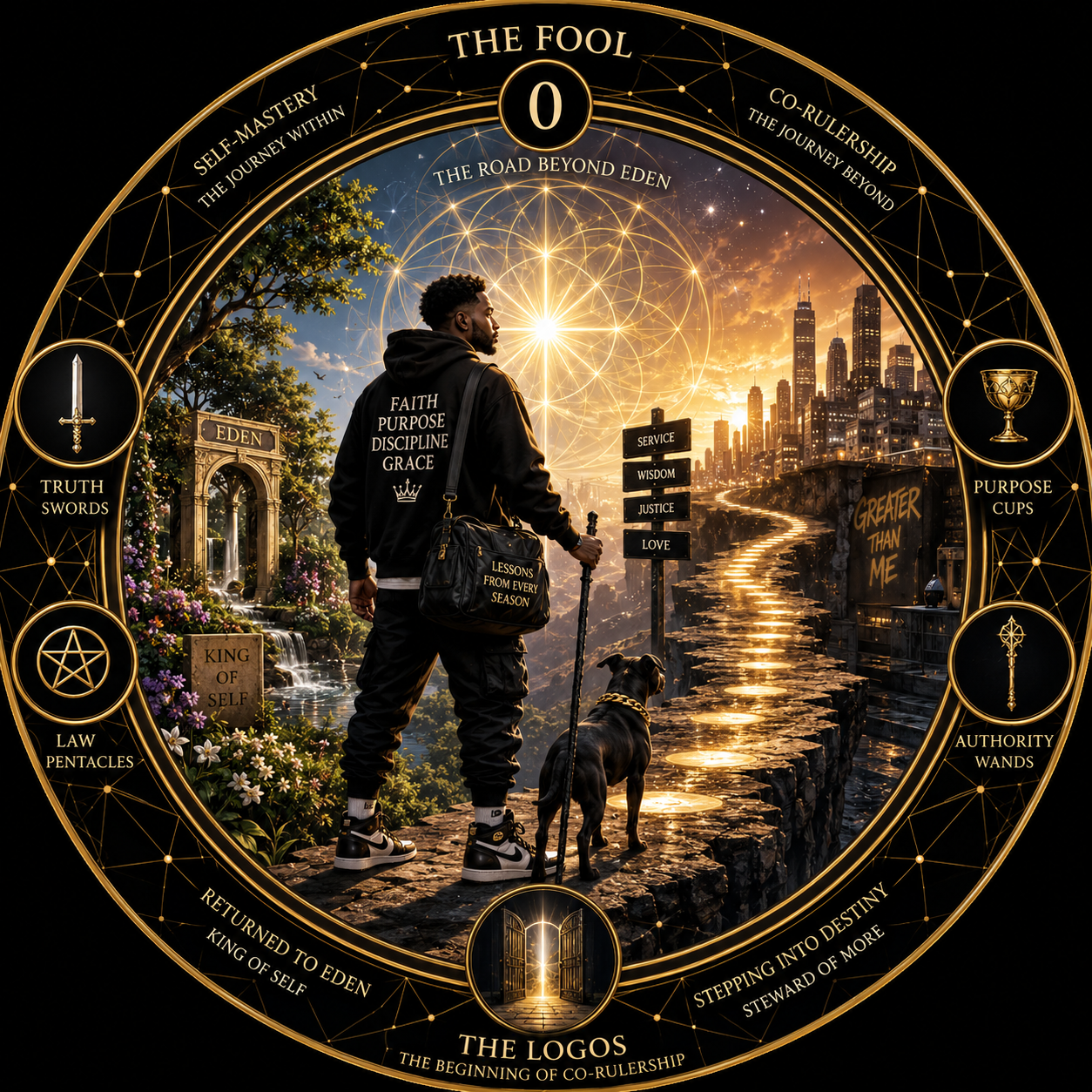
The Journey Beyond Self-Mastery
By Alchemist Iris Chapman
Most people deeply misunderstand The Fool.
When they look at this card, they see nothing but blind innocence, naivety, and complete inexperience. They see a careless wanderer standing at the precipice of a jagged cliff, entirely unaware of the lethal dangers waiting just a step ahead.
But within the framework of the 18-ChakraVerse, The Fool represents something entirely different, and far more profound.
The Fool is not the one who knows nothing. The Fool is the one who has learned enough to begin again. He does not return to the starting line because he failed; he returns because he succeeded. The Fool appears precisely after mastery has been achieved, and completion has been locked in. He steps forward at the exact moment a mature soul consciously chooses a greater, weightier responsibility than the one it has already perfectly attained.
“The Fool is not the one who knows nothing. The Fool is the one who has learned enough to begin again.”
Alchemist iris chapman
The Return to Eden
The long, multi-incarnational journey through the lower chakras is the archetypal journey of Adam.
Adam leaves the protected static peace of Eden. He plunges into the dense world of raw experience. Lifetimes over, he is forced to master the structural curriculum of incarnation:
- He learns survival at the Root.
- He learns desire and creation at the Sacral.
- He learns boundaries and power at the Solar Plexus.
- He learns relationship and love at the Heart.
- He learns expression and truth at the Throat.
- He learns perception and vision at the Third Eye.
- He learns surrender and connection at the Crown.
Eventually, through the long process of alignment, Adam becomes the rightful king and priest of his own internal domain. The inner world is beautifully ordered, the internal throne is aligned, and the microcosm is at perfect peace.
This is the true return to Eden. This is the state of the integrated soul that walks in unbroken fellowship with God. Many Adams successfully complete their evolutionary journey right here—and there is absolutely nothing wrong with that. Internal self-mastery is an immense, sacred accomplishment. It is the glorious fulfillment of a soul’s primary calling.
The Road Few Choose
Yet, beyond the borders of self-mastery, there remains another road. A much narrower road. A road that stretches far beyond the achievements of personal self-governance.
 [Masses: Seek Freedom & Peace] ---> [Return to Eden / Self-Governance]
                                                    |
                                                    v
 [The Few: Seek Stewardship & Responsibility] ---> [The Road Beyond Eden / Co-Rulership]
- Most souls seek freedom; some souls seek stewardship.
- Most souls desire peace; some souls desire intense responsibility.
- Most souls desire to walk with God; some souls desire to govern alongside God.
Neither path is superior to the other; neither is inferior. Both paths are divinely ordained, both are profoundly sacred, and both emerge from the pure exercise of free will. But the second path requires an entirely different caliber of spiritual endurance. It requires a soul uniquely willing to become responsible for vastly more than itself.
This is the exact threshold where The Fool re-emerges.
Why Jesus Is The Fool
The physical world looks upon The Fool and immediately assumes ignorance. The inner kingdom looks upon The Fool and instantly recognizes supreme courage.
Within this esoteric blueprint, Jesus represents the sovereign soul that voluntarily accepts the next, higher apprenticeship. He does not step into this new beginning because he failed to master himself, but precisely because he has mastered his microcosm. The road of internal preparation is complete; the monumental road of macrocosmic stewardship begins.
To qualify for this level of universal governance, the Jesus persona is subjected to every single angle of the human condition. He must know the landscape of reality from every conceivable perspective:
He has known absolute power, and he has known fragile weakness. He has known overflowing abundance, and he has known devastating loss. He has known supreme rulership, and he has known absolute service. He has known bitter betrayal, and he has known unswayed loyalty. He has known triumphant victory, and he has known crushing suffering.
The sword at the gate of Eden turns relentlessly this way and that. It forces the soul into every perspective, every lesson, every traumatic distortion, and every divine possibility. The future co-ruler must understand the kingdom from every side.
For how can one govern rulers without first understanding what it means to be ruled? How can one administer true justice without intimately understanding the depths of suffering? How can one exercise divine authority without first experiencing the reality of absolute powerlessness? The road of Adam is the road of completeness.
The Kings and the Servants
This explains why the biblical narrative repeatedly, almost obsessively, returns to the archetypes of kings, prophets, rulers, judges, exiles, and servants.
The Bible focuses primarily on the rigorous path of stewardship—the advanced preparation required for universal co-rulership. The evolving soul is systematically cycled through every single role in the theater of consciousness.
The king teaches the lesson of structural responsibility; the servant teaches the lesson of profound humility and obedience. The prophet teaches the lesson of uncompromising vision; the exile teaches the lesson of absolute reliance on the Divine. A ruler who has never served cannot govern wisely, and a servant who has never led can never fully comprehend the weight of administrative responsibility. The future co-ruler must master both sides of the coin. The sword of experience continues to turn.
The Donkey and the Fool
This brings a radical, alternative clarity to Jesus’s prophetic entry into Jerusalem upon a donkey.
The physical world expected a loud, military conqueror riding a fierce stallion. The kingdom, however, revealed a quiet, integrated steward. The world expected an ego-driven ruler who would command and dominate others; the kingdom revealed a ruler who had first perfectly mastered himself.
The donkey symbolizes a massive burden willingly carried. It is responsibility accepted without complaint, authority exercised entirely without domination, and immense power wielded without the need for dramatic spectacle.
The Fool rides the donkey because the road ahead is fundamentally not the road of external conquest. It is the sacrificial road of universal stewardship. To the eyes of the world, such a choice appears utterly foolish.
- Why seek more responsibility after finally attaining personal peace?
- Why volunteer for a greater, collective burden after successfully returning to Eden?
- Why continue the grueling vertical ascent into the unknown?
To the ego, only a fool would do such a thing. And that is precisely why this cosmic archetype bears that exact name.
The Four Schools of Preparation
Before the evolving Adamic consciousness can step past the final threshold and fully activate the Logos Chakra, it must first graduate from four final, transpersonal schools of preparation. These upper energy centers test the soul’s capacity to handle the elements of creation on a universal scale.
| Chakra Center | Tarot Suit | Core Jurisdiction | The Sovereign Testing |
| Causal Chakra | Swords | Truth & Clear Vision | Can I see reality clearly without distortion? |
| Soul Star Chakra | Cups | Purpose & Devotion | Can I faithfully serve what is divinely worthy? |
| Stellar Gateway | Pentacles | Divine Law & Structure | Can I understand the principles that govern creation? |
| Covenant Chakra | Wands | Authority & Power | Can I be implicitly trusted with the fire of power? |
Only after these four rigorous schools have certified the vehicle does Adam finally arrive at the threshold of the Logos.
The Beginning of Co-Rulership
The Logos Chakra is not just another spiritual lesson to be memorized. It is the active beginning of Divine Governance.
At this high level of initiation, the twenty-two cards of the Major Arcana cease to be external lessons the soul studies to grow; they become the active, living principles of universal rulership. The seeker no longer studies the archetypes from afar—the sovereign becomes them.
And standing directly at the entrance to this macrocosmic kingdom is The Fool.
He stands there not because he is unprepared, but because he is finally prepared enough to begin. He stands there not out of ignorance, but because he deeply, soberly understands the true cost of the path. He stands at the gate not because he lacks mastery, but because his hard-won self-mastery has finally revealed a much greater, cosmic calling.
The Fool stands at the threshold of the Logos, looks into the open heavens, and declares:
“I have governed myself. Now, teach me how to govern alongside You.”
The world looks on and sees a fool. The kingdom looks on and sees a future co-ruler. And so, the next great journey begins.