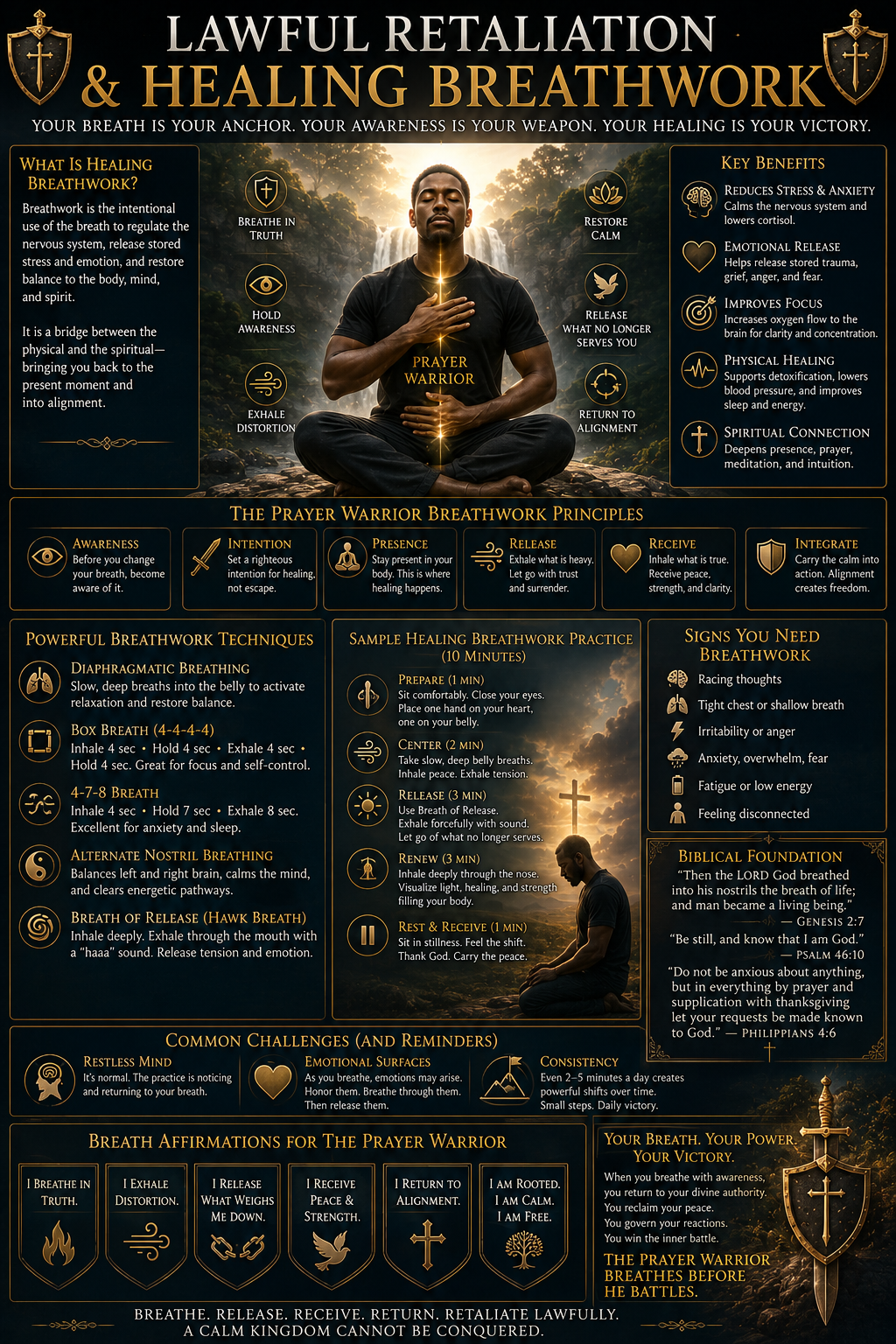
Lawful Retaliation & Healing Breathwork
Calming the System Before Emotional Overload Takes Control
By Alchemist Iris Chapman
Part of the Lawful Retaliation Healing Series
Almost every emotional reaction you experience begins inside your physical flesh long before it ever crystallizes into a conscious thought. Your heart rate aggressively spikes. Your jaw locks up tight. Your respiration instantly turns shallow and short. Your nervous system rapidly prepares for immediate, physical danger.
By the time you consciously register that you are emotionally activated, your body has already crossed the border into raw survival mode.
This physiological jumpstart is exactly why emotional triggers feel so violently powerful: the biology responds first, and the rational mind merely constructs a frantic explanation after the fact. Within the Lawful Retaliation framework, this mechanical reality matters deeply because unresolved emotional wounds do not live in your field as abstract concepts—they exist as hardened, automated nervous-system patterns.
Fear, stress, blinding anger, crushing overwhelm, and deep-seated trauma each possess a specific, signature breathing blueprint that alters your chemistry. When your breathing becomes chronically dysregulated, your entire emotional landscape grows highly reactive. This is where healing breathwork transforms into a sovereign weapon. It manually forces your biology back into regulation before internal emotional overload can escalate into destructive, chaotic behavior, giving you a way to turn inward before you react outward.
The Bridge Between Mind and Muscle
At its foundation, breathwork is the practice of consciously directing the rhythm, depth, and pacing of your inhalation and exhalation. Unlike the unconscious, automatic breathing that keeps you alive, intentional breathwork forces you to take control of your primary energetic pump, directly influencing both your cellular biology and your nervous system.
                             [THE COMPULSIVE ESCALATION LOOP]
Trigger ───> Automatic Shallow Breathing ───> Sympathetic Flooding ───> Unconscious Overload

                             [THE CONSCIOUS BREATH INTERRUPTION]
Trigger ───> 🌬️ [INTENTIONAL RHYTHM] ───> Parasympathetic Switch ───> Sovereign Restored
Because your respiratory rate is directly wired to your autonomic nervous system, changing the way you breathe is the fastest mechanical way to shift your body out of fight, flight, freeze, panic, or chronic hypervigilance and pull it straight back into standard regulation, grounding, calm clarity, and absolute safety. In the truest sense, the breath acts as a biological suspension bridge between your conscious mind and your unconscious body.
Most people commit the fatal error of trying to “think” their way out of acute emotional activation. But when emotional overwhelm strikes, the problem is physiological first. Your bloodstream is already being flooded with stress hormones, your muscles are tightening defensively, your heart is racing, and your oxygen efficiency has plummeted.
Trying to think logically in this survival state is a biological impossibility. Intentional breathwork completely derails this physical escalation. It sends an unyielding mechanical signal to your nervous system declaring: “The danger is not as immediate as the body believes.” This intervention forces open a vital buffer space between the raw activation and your final reaction. In that exact space, your sovereign, conscious choice becomes possible again.
Respiring Through the Energetic Architecture
During moments of intense emotional activation, your breathing distortions cause immediate blockages across your internal energetic anatomy. By utilizing targeted breathwork, you can consciously clear the specific restrictions within your chakras before they manifest as destructive, physical patterns:
- 🔴 Root Chakra: Fear and existential survival stress instinctively contract your diaphragm, forcing a high, shallow chest breath that feeds nervous-system hypervigilance. Deep, low diaphragmatic breathing restores an unyielding sense of primal safety, stability, and physical grounding.
- 🟡 Solar Plexus Chakra: Anger, volatile control struggles, and intense emotional tension lock up your upper abdomen, causing restricted, forced, or choppy breathing patterns. Intentional breath softening melts this internal pressure, restoring emotional regulation and personal power.
- 💚 Heart Chakra: The heavy impact of grief, deep betrayal, and profound emotional pain creates a suffocating sensation of constriction and tightness across the rib cage. Fluid, expansive chest breathing gently stretches and breaks up this energetic armor, reopening your emotional flow.
- 🔵 Throat Chakra: Suppressed emotions, swallowed tears, and your unspoken truth manifest as a tight, choked throat locking up your breathing rhythm. Conscious, uninhibited vocalized exhalations release these ancient emotional holding patterns, clearing your line of expression.
The Law of Preventative Maintenance
   [CRISIS RESPONSE SPIRITUALITY]               [SOVEREIGN BREATH MAINTENANCE]
  ┌─────────────────────────────────┐        ┌─────────────────────────────────┐
  │ Wait for Explosive Outburst    │        │ Empty the Stress Cup Hourly     │
  │ Try to Rationalize Overwhelm    │   vs   │ Anchor the Biology in Safety    │
  │ High Chemical / Cortisol Shock  │        │ Continuous Parasympathetic Calm │
  │ Shattered Sovereign Control     │        │ Total Domination of the Field   │
  └─────────────────────────────────┘        └─────────────────────────────────┘
Too many individuals treat breathwork like a medical inhaler—something you only reach for when you are actively hyperventilating or completely losing your mind. But internal emotional overload is a slow, compounding process. Daily stressors, micro-disappointments, unspoken boundary violations, digital overstimulation, and emotional suppression slowly stack up in your system like a game of Jenga. Without consistent maintenance, your nervous system experiences profound fatigue until a relatively minor external event causes your entire inner kingdom to collapse into a disproportionately massive outburst.
This is why the Prayer Warrior treats breathwork as a strict, non-negotiable lifestyle maintenance discipline. Just as you maintain the cleanliness of your physical body, you must actively clear the toxic buildup from your nervous system. A consistently regulated breath changes how you interact with reality, producing absolute emotional stability, unclouded environmental perception, precise self-awareness, and unshakeable stress resilience.
Tactical Respiratory Modalities
Different breath structures manipulate your biology in completely distinct ways. You must deploy the exact respiratory tool your inner kingdom requires based on the current terrain:
🌿 The Physiological Sigh (For Instant Amygdala Down-Regulation)
Popularized through modern neurobiological research, this is the absolute fastest mechanical way to shatter acute anxiety, panic, or escalating stress in real-time.
- The Mechanic: Take a deep, rapid inhale through your nose, immediately follow it with a second sharp, short sniff through your nose to fully inflate the tiny air sacs (alveoli) in your lungs, then release a long, slow, sweeping exhale through an open mouth. Repeat this cycle 2 to 5 times to dump excess carbon dioxide and instantly trigger your parasympathetic “rest and restore” response.
🟦 Box Breathing (For High-Pressure Stabilization & Razor Focus)
The exact operational protocol used by elite military operators to maintain flawless concentration and absolute emotional steadiness in high-threat combat zones.
- The Mechanic: Inhale deeply through your nose for a strict count of 4, hold that breath with a relaxed throat for a count of 4, exhale completely through your mouth for a count of 4, and hold the empty lungs for a count of 4. Repeat this perfect square matrix for several rounds to freeze mental chatter and ground your field.
🌙 Alternate Nostril Breathing / Nadi Shodhana (For Deep Energetic Calibration)
A highly sophisticated traditional yogic technology designed to balance the left and right hemispheres of your brain, settle a scattered mind, and clear energetic debris.
- The Mechanic: Gently close your right nostril with your thumb and inhale slowly through your left nostril. At the peak of the inhale, release your right nostril and close your left nostril with your ring finger, releasing a slow, smooth exhale through the right side. Inhale right back up through the right side, switch, and exhale left. Continue this alternating cadence to rapidly dissolve ambient anxiety.
🔥 The Wim Hof Method (For High-Voltage Energy & Stress Conditioning)
An advanced, highly activating modality that utilizes deep, rapid breathing cycles followed by prolonged breath retentions to flood the body with oxygen and intentionally stress-condition the nervous system.
- Precautions: Because this method aggressively shifts your internal chemistry, it must be practiced with extreme caution. Practice only while sitting or lying down in a completely safe environment. Never practice this method while driving, standing in water, or operating heavy machinery. If you have underlying cardiovascular concerns, severe panic conditions, respiratory disorders, or high blood pressure, you must consult a qualified healthcare professional before engaging in this style of breathwork.
Guided Quantum Somatic De-Escalation
For Acute Trigger Activation & Biological Restoration
The absolute second you feel an emotional trigger catch fire in your body, or find your mind starting to spin out into an outrage cycle, drop your defenses and guide your system through this precise respiratory blueprint.
Step 1: Secure the Perimeter
Sit or lie down comfortably, planting both feet firmly against the floor if sitting. Roll your shoulders back and down, unhinging your jaw completely. Place your dominant hand flat over your heart center and your non-dominant hand flat over your lower abdomen to map the physical movement of your container.
Step 2: The Vacuum Inhale
Close your eyes and pull a slow, steady, expansive breath in through your nose for a count of 4. Direct the air deep past your chest into your lower belly, watching your bottom hand lift as your abdomen balloons outward. Feel the absolute fullness of the air.
Step 3: The Sovereign Suspension
Hold that full breath at the top for a quiet count of 2. Keep your throat entirely relaxed, your shoulders soft, and your face calm. Do not strain; simply exist in the absolute stillness of the suspension.
Step 4: The Dissolution Exhale
Part your lips slightly and release a slow, controlled, audible exhale for a count of 6. As the air leaves your body, feel your muscles physically softening, your chest dropping, and the raw emotional pressure draining straight out of your field.
Step 5: The Alignment Decree
Repeat this exact breathing loop for 5 consecutive rounds. On every slow exhale, anchor your consciousness by repeating these four sovereign commands silently inside your mind:
- “I slow my breath down completely before I choose to react.”
- “I actively command my physical body to return to safety.”
- “I restore absolute balance and law within my own borders.”
- “I refuse to lose my identity to this temporary emotional trigger.”
Once the five rounds are complete, return to your natural breathing cadence. Keep your hands on your body for a moment longer to notice the immediate deceleration of your heart rate, the cooling of your skin, and the spacious clarity that has returned to your mind.
The Code of the Sovereign
In the Lawful Retaliation framework, breathwork is stripped of passive, airy-fairy escapism. Your breath is your first line of defense. It is your mechanical interruption to emotional escalation, your unyielding bridge back to conscious awareness, your literal biological signal of safety to an activated nervous system, and your pathway back to true sovereignty.
Before the chaos of the world can twist your unhealed emotions into a weapon of automated reaction, step back onto your throne, seize control of your respiration, and breathe your entire system back into perfect restoration first.
If you are ready to master your biological engine today, let me know which of these four breathing techniques your inner kingdom needs right now, or tell me how your breathing patterns shift (like gasping, holding, or hyperventilating) the moment you are triggered so we can dial in your custom defense response.
🌿 Continue the Lawful Retaliation Healing Series
- Lawful Retaliation & The Prayer Warrior
- Lawful Retaliation & Grounding
- Lawful Retaliation & Mindfulness
- Lawful Retaliation & Meditation
- Lawful Retaliation & Journaling
- Lawful Retaliation & EFT Tapping
- Lawful Retaliation & Nervous-System Regulation
- Lawful Retaliation & Healing Breathwork
- Lawful Retaliation & Self-Reiki
- Lawful Retaliation & Chakra Healing