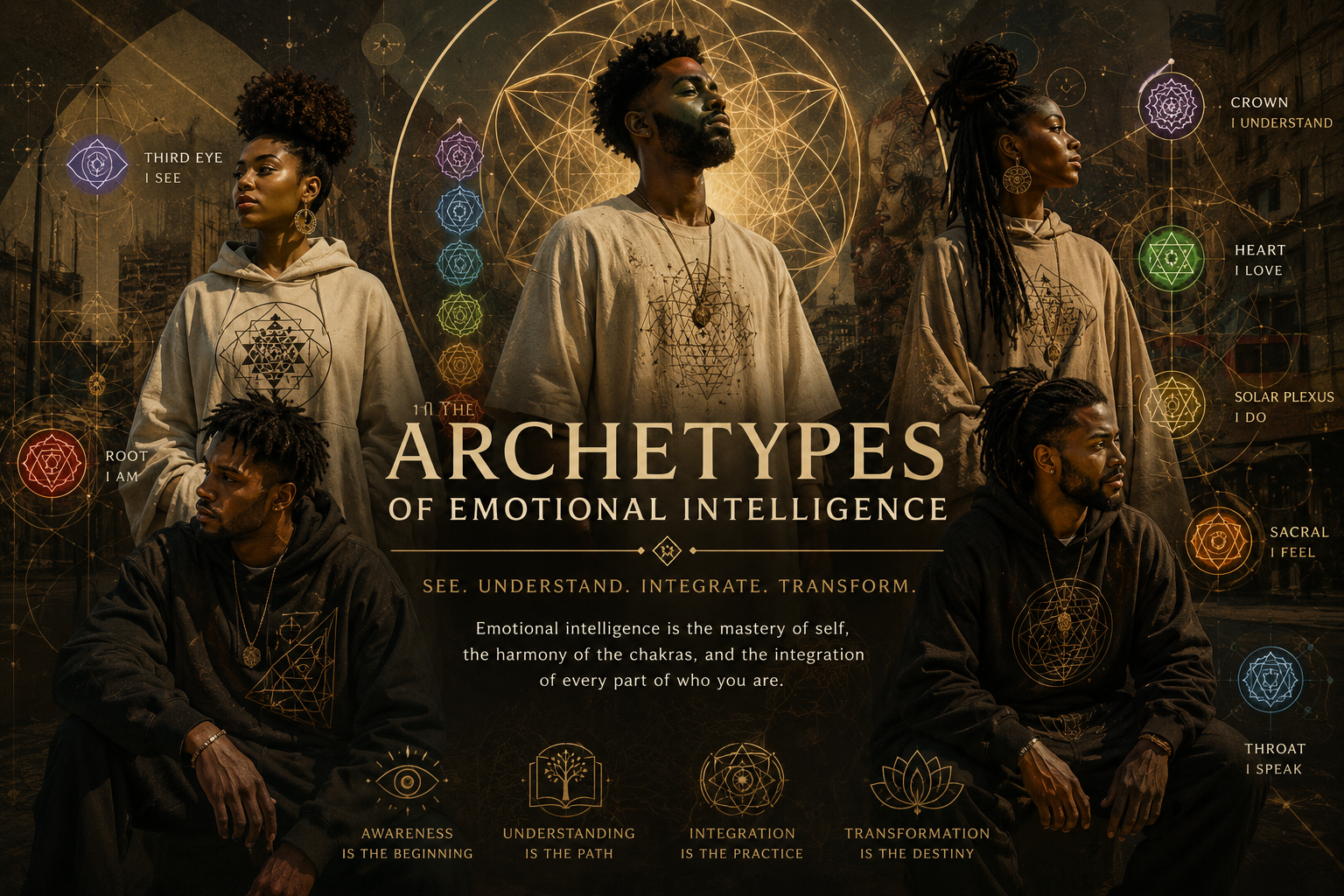
The Archetypes of Emotional Intelligence
Mapping the Inner Architecture of the Psyche
By Alchemist Iris Chapman
There are patterns of emotional behavior that repeat across history, mythology, film, scripture, politics, relationships, and everyday life. These patterns appear so consistently that they begin to feel larger than personality alone. The same emotional structures emerge in kings, inventors, warriors, visionaries, lovers, rulers, artists, and ordinary people trying to survive the weight of existence.
- Some become consumed by fear.
- Some become frozen by grief.
- Some become intoxicated by power.
- Some lose themselves in transcendence.
- Some spend their entire lives hiding behind performance, control, intellect, or emotional armor.
The names change. The centuries change. The costumes change. But the emotional architecture remains remarkably similar.
This is where archetypes begin.
Emotional Intelligence Is More Than Emotion
Emotional intelligence (EI or EQ) is the ability to recognize, understand, and manage both our own emotions and the emotions of the people around us. It is one of the most important dimensions of human maturity because it shapes communication, relationships, leadership, perception, and the ability to remain psychologically balanced under pressure.
A person may possess a high IQ and still struggle emotionally. History repeatedly demonstrates this truth. Brilliant minds often collapse beneath unresolved emotional fragmentation. Visionaries may become isolated within perception itself. Powerful leaders may become consumed by insecurity, fear, or ego instability.
Intelligence alone does not stabilize consciousness. Emotional maturity does.
The Four Pillars of Emotional Intelligence
Modern emotional intelligence theory is often divided into four primary domains. These pillars act as the foundation for navigating both our internal landscapes and our external social worlds.
| Pillar | Core Definition | The Cost of Devaluation |
| Self-Awareness | The ability to recognize your own emotions, understand emotional triggers, and observe how your internal state shapes behavior, perception, and decision-making. | Without self-awareness, emotions remain unconscious and begin controlling identity from beneath the surface. |
| Self-Management | The ability to regulate impulses, manage distress, adapt to changing circumstances, and respond consciously rather than react emotionally. | This is where emotional maturity begins transforming survival into stability. |
| Social Awareness | The ability to perceive the emotions, needs, and energetic states of others through empathy, observation, and emotional attunement. | This includes recognizing relational dynamics, emotional tension, and the invisible emotional currents operating within groups. |
| Relationship Management | The ability to communicate honestly, maintain healthy boundaries, navigate conflict, and build emotionally coherent relationships. | This is emotional intelligence expressed outwardly through connection, leadership, compassion, and emotional responsibility. |
The Chakra System as Emotional Architecture
The chakra system can be understood not merely as a spiritual framework, but as an ancient architecture of emotional intelligence and human consciousness. Each chakra governs a different dimension of emotional and psychological development:
- The Root Chakra: Governs safety, survival, grounding, fear, nervous system regulation, and the body’s relationship to stability.
- The Sacral Chakra: Governs emotional fluidity, intimacy, attachment, pleasure, emotional openness, and creative exchange.
- The Solar Plexus Chakra: Governs identity, confidence, shame, willpower, leadership, self-worth, and the construction of personal authority.
- The Heart Chakra: Governs compassion, grief, forgiveness, vulnerability, emotional integration, and relational coherence.
- The Throat Chakra: Governs emotional honesty, expression, communication, performance, suppression, and authentic truth.
- The Third Eye Chakra: Governs perception, symbolic understanding, discernment, projection, intuition, and psychological vision.
- The Crown Chakra: Governs transcendence, existential meaning, higher consciousness, spiritual integration, and humanity’s relationship to the infinite.
These systems do not function independently. Emotional maturity emerges when they remain relationally balanced rather than fragmented into extremes. When imbalance occurs, archetypes emerge.
Archetypes as Emotional Patterns
Archetypes are recurring emotional structures expressed through human behavior. They are the fearful protector, the wounded visionary, the performer hiding pain, the ruler consumed by power, the martyr, the exile, the conqueror, the misunderstood genius, and the emotionally armored survivor.
These patterns repeat across civilizations because they emerge from universal emotional experiences. Human beings do not merely experience emotions; they organize themselves around emotional survival strategies. Over time, those strategies become identity.
Frozen Grief and Emotional Armor
A figure like Batman represents more than a fictional hero. He embodies a profound emotional archetype: grief frozen into identity.
[Child Experiences Unbearable Loss]
               │
               ▼
[Nervous System Concludes the World is Unsafe]
               │
               ▼
[Control Becomes Protection]
               │
               ▼
[Emotional Armor Becomes Identity]
The mask is no longer a disguise; it becomes the structure through which the personality survives. This is a classic Root Chakra distortion expressed through hypervigilance, emotional rigidity, and identity built entirely around protection.
The Performer and Distorted Expression
The Joker archetype represents another emotional structure entirely. Beneath chaos often lies collapsed authentic expression. Pain becomes performance. Emotional instability becomes spectacle. Laughter becomes defense. Identity dissolves into fragmentation and reaction.
When an individual no longer trusts honest emotional communication, the psyche externalizes pain through distortion, provocation, theatricality, and chaos. This is emotional intelligence collapsing beneath unresolved fragmentation.
The Visionary and the Burden of Perception
Figures like Nikola Tesla or J. Robert Oppenheimer reveal another archetypal pattern: consciousness expanding beyond emotional containment.
- The mind perceives invisible systems.
- The intellect reaches beyond ordinary limits.
- Awareness expands rapidly.
- But emotional grounding struggles to keep pace.
The result can become isolation, dissociation, obsession, existential burden, and fragmentation beneath transcendence. The issue is not brilliance itself. The issue is whether emotional maturity evolved alongside expanded perception. Without grounding, higher awareness destabilizes the psyche rather than integrating it.
Emotional Intelligence and the Nervous System
One of the greatest misunderstandings surrounding emotional intelligence is the assumption that emotions exist only within the mind. They do not. The body remembers emotional experience.
- Fear conditions the nervous system.
- Trauma shapes perception.
- Hypervigilance alters behavior.
- Suppressed grief creates emotional rigidity.
- Shame distorts identity.
- Isolation fragments emotional regulation.
This is why emotional intelligence cannot be separated from embodiment. A dysregulated nervous system often struggles to sustain emotional maturity because survival states override reflective awareness. The Root Chakra especially reveals this deep relationship between emotional intelligence and physiological safety.
Healing, therefore, becomes more than positive thinking. It requires nervous system stabilization, emotional integration, symbolic awareness, and conscious embodiment.
The Tragedy of Emotional Immaturity
History repeatedly demonstrates that emotional immaturity can corrupt power, genius, spirituality, leadership, creativity, and vision. A person may master the external world while remaining internally fragmented.
This is why emotional intelligence matters so deeply. It is not weakness. It is not passivity. It is not emotional indulgence. It is the capacity to remain coherent under pressure.
The 18-Chakra System and Emotional Maturity
The 18-chakra system expands this understanding even further by recognizing that consciousness contains layered emotional structures, inherited personas, symbolic identities, and archetypal adaptations that emerge throughout life.
People do not simply “become themselves.” They construct personas to survive experiences. Some personas protect; some distort. Some compensate; some conceal. Some preserve emotional wounds, while others eventually evolve into wisdom. The journey of emotional intelligence is not the destruction of these parts of the self, but the integration of fragmentation into coherent consciousness.
Why Archetypes Matter
Archetypes allow emotional patterns to become visible. They externalize invisible emotional structures so they can be consciously recognized rather than unconsciously lived out.
When we study historical figures, fictional characters, spiritual symbols, or mythological narratives, we are witnessing emotional structures operating at an amplified scale. The conqueror, the exile, the visionary, the martyr, the ruler, the performer, the wounded protector—these archetypes are not distant from humanity. They are humanity.
The Future of Emotional Intelligence
Modern society has accelerated intellectual stimulation while emotional development struggles to keep pace. Information expands rapidly, but nervous systems remain dysregulated. Identity becomes fragmented beneath endless stimulation, performance, comparison, emotional suppression, and psychological overload.
This is why emotional intelligence may become one of the defining challenges of our time. Not merely intelligence, and not merely spirituality—but integrated consciousness. It is the hard-won ability to remain emotionally grounded while navigating increasingly complex realities.
The Archetypal Journey
The purpose of studying archetypes is not judgment; it is recognition. It is the drive to understand:
- What patterns shape behavior?
- What emotional wounds construct identity?
- What personas emerged for survival?
- What distortions prevent integration?
- What strengths remain hidden beneath fragmentation?
The archetypes of emotional intelligence reveal that every human being is navigating an inner architecture of fear, love, power, grief, perception, expression, and meaning.
Perhaps healing begins the moment these patterns become visible. Because what can finally be seen… can finally be understood.
This is a thought-provoking piece, and I like how it frames emotional intelligence as something deeper than communication skills or self-help buzzwords. The idea of archetypes as recurring emotional survival patterns provides the article with a strong lens for readers trying to understand why certain behaviors recur.
I’m curious how you see the line between a useful archetype and a label that might box people in too tightly. Do you think these patterns are best used as reflective tools for self-awareness, or as more fixed maps of personality and development?
Another question that came to mind is how you’d help someone move from recognition to practice. If a reader identifies with the armored protector, the performer, or the wounded visionary, what would be the first grounded step toward real emotional integration in everyday life?
Hi Aly,
Thank you for another thoughtful question. You touched on something that is very important to me because the archetypes in the 18-ChakraVerse are not intended to become labels or identities. They are maps, not destinations.
I believe we all express many archetypes throughout our lives depending on the situation we are facing. An individual may lead like a Sovereign in one area of life, respond like a Wounded Visionary in another, and occasionally fall into the habits of a Performer when seeking approval. The purpose is not to decide, “This is who I am,” but to ask, “What part of my inner kingdom is speaking right now?”
Recognition is only the beginning. Integration happens when we become conscious enough to pause before reacting and ask what the archetype is trying to accomplish. Every shadow persona developed for a reason. It usually began as an attempt to protect us, even if it no longer serves us today. Once we understand the need beneath the behavior, we can begin choosing the aligned expression instead of repeating the familiar pattern.
That’s why each archetype in the 18-ChakraVerse is paired with aligned and misaligned expressions. The goal isn’t to eliminate parts of ourselves but to bring every part into conscious service of the inner kingdom.
Thank you for raising these questions. Conversations like this add another layer to the exploration and encourage all of us to move beyond recognition into intentional practice.
This is a fascinating breakdown of how emotional intelligence intersects with our energetic framework. As a personal development blogger and spiritual explorer, I am always looking for ways to bridge the gap between psychological growth and energetic alignment. The way you mapped specific emotional archetypes to our energy centers makes complete sense, and it provides a great practical roadmap for inner work.
I am very familiar with the traditional seven-chakra system, but exploring the concept of an expanded 18-chakra system is completely new to me. It really expands the scope of how deeply we can look at our energetic anatomy and emotional maturity. I love the idea that as our emotional intelligence matures, we open up completely new levels of perception and energetic capacity.
For someone who is transitionally shifting from working with the primary seven energy centers into exploring this larger 18-chakra map, where do you recommend focusing our awareness first to avoid feeling overwhelmed?
Hi Hari,
Thank you for such a thoughtful comment. I really appreciate that you recognized the bridge between psychological growth and energetic alignment—that’s exactly the gap I hope the 18-ChakraVerse helps illuminate.
Your question is an important one because many people assume they need to learn all 18 chakras at once. In reality, the expanded system isn’t meant to replace the traditional seven chakras; it provides the larger architecture that explains why the seven function the way they do.
My recommendation is to continue working with the seven inherited chakras first, but begin viewing them through the lens of self-governance rather than simply energy centers. Ask questions like:
What pattern is this chakra teaching me to master?What recurring emotional response keeps appearing here?How can I move from unconscious reaction to conscious choice?
Once that foundation becomes stable, the additional eleven chakras unfold much more naturally. Rather than introducing new emotional themes, they expand your awareness into purpose, stewardship, perception, covenant, and ultimately conscious co-creation. They reveal the larger curriculum the soul is moving through.
I often compare it to building a house. You don’t start with the roof—you strengthen the foundation first. The seven inherited chakras are that foundation, while the remaining eleven reveal the architecture of why the house exists in the first place.
I also have a “Start Here” page that may help: https://chakraandenergyhealing.com/start-here/
Thank you again for sharing your perspective. I love hearing from fellow explorers who are passionate about integrating psychology, spirituality, and conscious development. I hope you’ll continue the journey with us as we unpack each layer of the framework.
This was a very thoughtful and deep read. I really liked how you connected emotional intelligence with archetypes, the nervous system, and the chakra system instead of describing it only as “managing emotions.” The idea that people can build whole identities around fear, grief, control, or protection felt very true. It also made me think about how emotional maturity is not just about being calm, but about recognizing our patterns before they quietly run our lives.
Thank you, Hanna. I’m glad that perspective resonated with you.
One of the central ideas behind the article is exactly what you highlighted: emotional intelligence is not simply about controlling emotions or appearing calm on the surface. It is about developing the awareness to recognize the deeper patterns, archetypes, and protective strategies that shape our reactions long before we consciously choose them.
Many of these patterns begin as intelligent adaptations to life experiences. Fear, grief, control, protection, and avoidance often serve a purpose at first. The challenge comes when they quietly become identities rather than temporary responses. When that happens, we can find ourselves living from the pattern instead of consciously choosing our actions.
Your observation about emotional maturity is especially insightful. True maturity is often less about suppressing emotions and more about becoming aware of the forces operating beneath them. The moment we can observe a pattern rather than automatically become it, we create space for choice, growth, and transformation.
Thank you for taking the time to read and share such a thoughtful reflection.
This article really shows how emotional patterns can quietly shape a person’s whole identity over time, especially when fear, grief, or shame are never fully dealt with. I’ve seen this in real life too because some people become so focused on control or protecting themselves that they stop expressing who they really are. I also liked the point about emotional intelligence being connected to the nervous system and not just the mind because stress and anxiety absolutely affect how people react and communicate.
Do you think someone can recognize their archetype on their own, or does it usually take other people to point it out first? Can a person carry multiple archetypes at the same time depending on the situation they are in? Also, how do you tell the difference between healthy self-protection and emotional armor that is starting to damage relationships?
Thank you, Bob. I appreciate your thoughtful questions.
I do believe many people can begin to recognize their own archetypes, but it is often difficult at first because we tend to see ourselves through the lens of our intentions rather than our patterns. Archetypes reveal themselves through repetition—especially in the situations that consistently trigger us, challenge us, or seem to follow us throughout life. Self-reflection, journaling, and honest observation can uncover a great deal, but trusted friends, family members, or mentors can sometimes help us see blind spots that we have normalized.
And yes, a person can absolutely express multiple archetypes at the same time. In my work, archetypes are not fixed identities but recurring patterns of adaptation. Someone may embody a compassionate and emotionally intelligent archetype in one area of life while operating from a fearful or defensive archetype in another. Different environments, relationships, and stress levels can activate different patterns.
Your final question is an important one. Healthy self-protection creates enough safety for connection to remain possible. Emotional armor, on the other hand, often prevents connection altogether. One useful distinction is to ask: “Is this boundary helping me stay present, or helping me stay hidden?” Healthy boundaries preserve authenticity while protecting well-being. Emotional armor typically develops from unresolved fear, grief, shame, or betrayal and eventually begins to isolate the very person it was designed to protect. When protection consistently blocks intimacy, trust, vulnerability, or honest communication, it may be a sign that armor has replaced healthy boundaries.
In many ways, the journey of emotional intelligence is learning which parts of ourselves are serving life and which parts were built for survival but are no longer necessary. Awareness is often the first step toward that transformation.
Thank you for sharing this interesting article about the archetypes of emotional intelligence. I found the topic very relatable because emotional intelligence affects relationships, communication, and everyday decision-making.
I do have a question after reading the article. Do you think people mostly stay within one emotional archetype, or can these patterns change over time through experience and personal growth?
I also liked the discussion about self-awareness because understanding our own emotions can really improve how we respond to others. this was a thoughtful and meaningful topic. Thank you again for sharing.
Hi IYERE,
Thank you for such a thoughtful reflection. I’m really glad the article resonated with you, especially the connection between emotional intelligence, relationships, communication, and daily life—because that is where these archetypal patterns become most visible.
To your question: I don’t believe people remain fixed within a single emotional archetype for life.
In the framework I work with, archetypes are more like energetic or psychological patterns we move through depending on our level of awareness, healing, environment, stress, and personal development. Some patterns become dominant because they were reinforced over time, but they are not permanent identities.
A person may embody one archetype in relationships, another in conflict, and another in leadership or creativity. Under pressure, people often fall into protective or survival-based emotional patterns. Through self-awareness, reflection, healing, and intentional practice, those patterns can gradually evolve into more aligned expressions.
That is one reason self-awareness is so important. Once we become conscious of a pattern, we are no longer completely controlled by it. We gain the ability to pause, observe, and choose a different response instead of reacting automatically.
I also think emotional growth is rarely linear. Sometimes life experiences refine us gently, and other times difficult seasons expose patterns we didn’t realize we were carrying. Both can become opportunities for deeper emotional intelligence and maturity.
I really appreciate your insight and your question. Conversations like this are meaningful because they encourage people to reflect on themselves with honesty rather than judgment.
Thank you again for reading and sharing your thoughts.