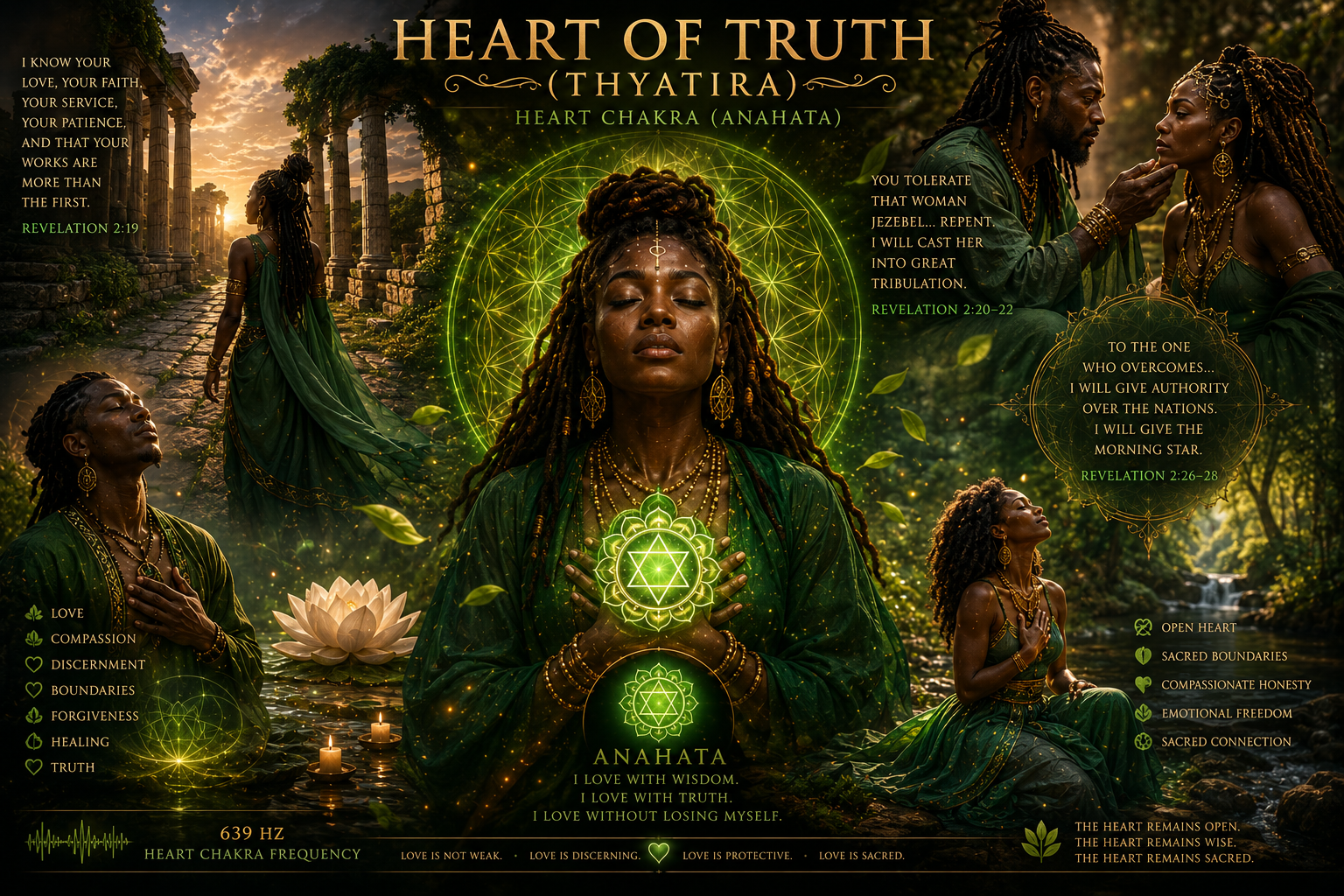
Courageous Love, Sacred Boundaries & Revelation 2:18–29
The message to the Church of Thyatira is one of love, devotion, discernment, and spiritual boundaries. Thyatira is praised deeply for its love, service, patience, and endurance—yet it is also warned about tolerating distortion disguised as compassion.
When I read Revelation 2:18–29 through the lens of chakra and energy healing, I see the initiation of the Heart Chakra—the energetic center of love, compassion, relational alignment, forgiveness, empathy, and sacred connection.
Thyatira represents the soul learning how to love wisely rather than blindly.
The Heart Chakra, or Anahata, governs:
- love,
- compassion,
- empathy,
- forgiveness,
- emotional openness,
- connection,
- relational truth,
- and the balance between softness and discernment.
The message to Thyatira is not:
“Stop loving.”
It is:
“Love with truth intact.”
This is the fourth gate of Revelation.
The purification of the heart.
? HEART CHAKRA — Love, Discernment & Relational Alignment
Revelation 2:18–29 — The Church of Thyatira
Chakra:
Heart Chakra (Anahata)
Location:
Center of the chest
Element:
Air
Theme:
Compassion balanced by wisdom and boundaries
Governing Truth:
Love must remain aligned with truth.
The Spiritual Meaning of Thyatira
Thyatira is praised for:
- love,
- service,
- faith,
- patience,
- and endurance.
Yet a warning emerges:
“You tolerate that woman Jezebel…”
Spiritually, this represents distortion entering through unguarded compassion.
The Heart Chakra is not only about feeling love.
It is about discerning:
- what nurtures connection,
- what manipulates connection,
- and what corrupts sacred relational integrity.
The Heart Chakra asks:
“Can I remain open without abandoning truth?”
This is the challenge of mature love.
Understanding Anahata: The Sacred Center of Connection
Anahata means:
“Unstruck” or “unhurt.”
The Heart Chakra is the energetic bridge between:
- lower survival consciousness,
- and higher spiritual awareness.
It governs:
- compassion,
- emotional healing,
- trust,
- intimacy,
- mercy,
- grief,
- forgiveness,
- and relational coherence.
When the Heart Chakra is aligned:
- love flows naturally,
- empathy remains grounded,
- boundaries stay intact,
- and relationships become healthier and more honest.
When distorted:
- compassion becomes enabling,
- self-sacrifice becomes self-erasure,
- boundaries collapse,
- or emotional withdrawal replaces vulnerability.
Thyatira reveals that love without discernment eventually becomes distortion.
Heart Chakra Distortion: When Compassion Loses Boundaries
The Heart Chakra becomes distorted when love disconnects from wisdom.
This distortion can appear as:
- codependency,
- people-pleasing,
- emotional manipulation,
- self-betrayal,
- rescuing behavior,
- or tolerating harm to avoid conflict.
Signs of Heart Chakra Imbalance
Over-Giving
The soul constantly pours into others while neglecting itself.
Fear of Disappointing Others
Boundaries collapse under the pressure of approval or guilt.
Emotional Exhaustion
Compassion becomes burnout rather than nourishment.
Self-Abandonment
Personal truth is sacrificed to maintain connection.
Withdrawing Emotionally
The heart closes to avoid future pain or disappointment.
Difficulty Forgiving
Resentment hardens the emotional body.
These distortions reflect love disconnected from alignment.
Shadow-in-Service: The Protection of Sacred Love
Within the chakra system, shadow-in-service is aligned correction.
At the Heart Chakra level, shadow appears as:
- exposure of unhealthy relationships,
- emotional discomfort revealing truth,
- confrontation around boundaries,
- heartbreak that awakens discernment,
- or relational endings that restore alignment.
This is not punishment.
It is protection.
The warning to Thyatira exists because love must remain sacred.
The heart cannot remain fully open to what continuously destroys it.
True compassion includes discernment.
Understanding “Jezebel Energy” Spiritually
Spiritually, “Jezebel energy” represents manipulation disguised as love, intimacy, spirituality, charm, or emotional influence.
This energy often:
- pressures people to abandon truth,
- rewards compromise,
- exploits emotional vulnerability,
- or encourages silence to maintain false peace.
The Heart Chakra heals by recognizing:
- manipulation is not love,
- enabling is not compassion,
- and self-betrayal is not kindness.
Sacred love protects truth.
Returning to Sacred Love: Heart Chakra Healing Practices
Healing Anahata requires openness, honesty, softness, forgiveness, and boundaries.
Not emotional shutdown.
Not uncontrolled attachment.
Balanced love.
? Breathwork & Heart-Centered Meditation
The Heart Chakra responds deeply to breath awareness.
Helpful practices include:
- slow chest breathing,
- heart-focused meditation,
- gratitude practices,
- breath synchronized with affirmations,
- or visualizing green light radiating from the chest.
Breath restores emotional spaciousness.
? Compassionate Honesty
Heart Chakra healing includes telling the truth with care.
Helpful reflections:
- Am I loving honestly?
- Where am I abandoning myself?
- What relationship patterns repeat?
- Do my boundaries reflect self-respect?
- What does healthy love actually feel like?
The heart becomes stronger through truthful compassion.
? Forgiveness Without Self-Erasure
Forgiveness heals emotional stagnation.
But forgiveness does not require:
- tolerating abuse,
- removing boundaries,
- or abandoning discernment.
The Heart Chakra heals when compassion remains aligned with wisdom.
? Nature & Emotional Regulation
Nature naturally regulates the Heart Chakra.
Helpful practices:
- walking outdoors,
- sitting beneath trees,
- gardening,
- listening to birds,
- watching green landscapes,
- or spending quiet time in sunlight and fresh air.
The Heart Chakra expands through peaceful connection with life itself.
? Sacred Boundaries
One of the deepest Heart Chakra practices is learning:
- when to say yes,
- when to say no,
- when to step closer,
- and when to step away.
Boundaries are not the opposite of love.
Healthy boundaries protect love from distortion.
Common Challenges to Heart Chakra Healing
The heart is one of the most vulnerable energetic centers.
Several common challenges emerge here.
? Codependency
The soul confuses love with rescuing or over-sacrificing.
? Fear of Rejection
Boundaries feel dangerous because approval feels tied to safety.
? Emotional Burnout
Compassion becomes exhaustion without reciprocity or grounding.
? Emotional Armor
The heart shuts down after disappointment or betrayal.
? Difficulty Receiving Love
The soul learns how to give love but not receive it safely.
Heart Chakra healing restores relational balance.
A Day in the Life of an Aligned Heart Chakra
Aligned Heart energy looks like:
- loving openly while maintaining boundaries,
- communicating honestly,
- forgiving wisely,
- remaining compassionate without self-erasure,
- feeling emotionally available without emotional collapse,
- and choosing relationships aligned with truth.
The soul becomes relationally coherent.
Revelation as the Fourth Gate of Healing
Thyatira represents the fourth gate of Revelation because after:
- grounding,
- emotional purification,
- and reclaiming the will,
the soul must now learn mature love.
Before higher expression can emerge:
- emotional distortion must heal,
- relational integrity must strengthen,
- and compassion must become aligned with truth.
This is the initiation of sacred love.
Not weak love.
Not blind love.
Courageous love.
? Heart Chakra Correspondences
Color Therapy
- Green
- Emerald
- Rose pink
- Soft turquoise
Crystals
- Rose Quartz
- Green Aventurine
- Emerald
- Rhodonite
Essential Oils
- Rose
- Jasmine
- Geranium
- Ylang Ylang
Frequency
- 639 Hz
- Gentle strings
- Heartbeat rhythms
- Airy ambient textures
Tarot Archetypes
- The Lovers
- Temperance
- Justice
? Heart of Truth (Thyatira) — Heart Chakra Music Activation
Heart of Truth (Thyatira) is the fourth activation within the Seven Churches • Seven Chakras healing music series.
Inspired by Revelation 2:18–29, the track explores:
- sacred love,
- emotional discernment,
- relational healing,
- and the courage to maintain truth within connection.
Tuned to the 639 Hz Heart Chakra frequency, the music blends:
- soulful AfroWave melodies,
- warm percussion,
- emotional vocal harmonies,
- sacred feminine energy,
- and healing atmospheric textures
to create a meditative journey into balanced compassion.
This is not love through self-sacrifice.
It is love through alignment.
A reminder that:
the healthiest heart is not the one that tolerates everything—
but the one that loves clearly,
honestly,
and courageously.
Closing Blessing
May your heart remain open without losing its wisdom.
May your compassion stay rooted in truth.
May your boundaries protect what is sacred within you.
May your relationships become honest, nourishing, and aligned.
May your love deepen without abandoning yourself.
And may the church of Thyatira within you awaken—
not through people-pleasing,
not through fear,
not through emotional confusion—
but through the sacred balance
of compassion,
discernment,
and courageous love.
The connection between Thyatira’s historical role as a textile hub and the heart chakra’s “woven energy” metaphor is beautiful—it makes emotional healing feel tangible, like mending fabric.
That journal prompt about “what needs mending, not replacing” hit hard in the best way. Do you have favorite breathwork techniques to pair with this? I’ve found inhaling for 4 counts/holding for 7 helps, but curious if there’s a specific rhythm that amplifies the practice.
Hi there! I love how you phrased that—“mending, not replacing.” That’s exactly the heart chakra’s wisdom. Pairing breath with that intention can make the “weaving” feel palpable. Here are my go-to rhythms and when I use them:
1) Heart-Coherence (steady 5–5) — for gentle opening
Inhale 5 counts, exhale 5 counts (through the nose), 3–5 minutes.
Place a hand over your heart, breathe “through” that spot, and recall a sincere feeling (gratitude, compassion).
Works beautifully before journaling on what needs mending.
2) 4–7–8 — for releasing tension before repair
Inhale 4 (nose) → hold 7 → exhale 8 (mouth, whisper-soft).
Do 3–4 rounds max to start.
This lengthened exhale downshifts the nervous system so the heart can soften into truth.
3) “Weave Breath” (belly ↔ heart) — for the fabric metaphor
Inhale 4 to the low belly, sip 2 more into the heart.
Exhale 6 from heart to belly, as if stitching the two with breath.
Whisper a cue on the exhale: “Mend, don’t replace.” 2–5 minutes.
Optional add-ons
A soft humming exhale (Bhramari) for 4–6 rounds can “vibrate the weave” and melt chest tightness.
One drop of rose or bergamot over the heart, clockwise circles, before breathing enhances coherence.
Your 4–7 pattern is excellent—if you add an 8-count exhale, you’ll amplify the parasympathetic effect even more. Whichever you choose, let the exhale be longer than the inhale when the goal is emotional repair.
If you try these with the journal prompt, notice which rhythm helps your heart answer more honestly. I’d love to hear which one “stitches” best for you.
Loved this synthesis of Thyatira’s message with the Heart Chakra. Your focus on love, service, and perseverance—tempered by discernment and healthy boundaries—really lands. I also appreciated the practical suggestions for opening Anahata in everyday life; it makes the work feel gentle and doable. For someone processing fresh grief, which single daily practice would you start with to open the heart without overwhelm—coherent breathing, the YAM mantra, or a brief loving-kindness meditation?
Leahrae, I’m so glad the blend of Thyatira’s message with the Heart Chakra resonated with you. Fresh grief is tender territory, and the key is to choose a practice that meets the heart where it is—offering space without forcing it open too quickly. Of the three, I’d begin with a brief loving-kindness meditation.
Here’s why: when grief is new, even gentle breathwork or mantra can sometimes stir emotions faster than the heart is ready to process. Loving-kindness offers a way to hold yourself in compassion, allowing the heart to soften naturally while still feeling safe. Just a few minutes of silently repeating phrases like “May I be held in love. May I be gentle with myself. May I find moments of peace.” can create a subtle opening that grows over time.
Once that tenderness feels less raw, you can weave in coherent breathing or the YAM mantra to deepen the energy flow—but let your heart set the pace.
If you’d like, I can share a short, grief-sensitive loving-kindness script you can use daily.
OK – I lingered here to check out some more.
I didn’t expect the biblical connection, as with the other comments on this site I observed. But it adds a powerful layer to the heart chakra discussion that you make. Linking Thyatira to Anahata reframes love, compassion, and service as both spiritual and practical strengths. I took this as a reminder that emotional intelligence isn’t just personal—it’s part of how we lead, grow, and connect with others.
I’ve found that in my own six-week performance cycles, staying aligned with purpose makes a significant difference. A thought-provoking piece!
MarkA
Thank you so much, Mark, for lingering a little longer and sharing your insights—what a gift your words are!
I truly appreciate how you picked up on the biblical connection. It’s something many don’t expect at first, but as you beautifully said, it adds depth—especially when we view scripture not as distant doctrine but as a mirror for the soul’s energetic journey. Linking Thyatira to Anahata indeed reframes love and compassion as powerful currents of spiritual leadership, not just soft sentiments. Emotional intelligence becomes a sacred practice when seen this way—an alignment with Divine will through the heart.
I’m intrigued by your six-week performance cycles, too. It sounds like you’ve tapped into a rhythm that honors both purpose and sustainable progress. I’d love to hear more about how you stay aligned in that space!
With gratitude and heart,
Iris (Alchemist Iris)
Hi Iris. Thank you for this fantastic information. I had never heard of Thyatira before reading this, but I’m really glad I came across your post. The connection you made between the message to Thyatira and the heart chakra truly resonated with me. I’ve been exploring energy work and spirituality for some time, and I love learning more about the chakras. This idea that real love involves clear boundaries makes so much sense to me.
I especially appreciated the way you explained “Jezebel energy” as something that twists love into manipulation or false kindness. It definitely made me pause and think about areas in my own life where I’ve let things slide in the name of keeping the peace. That’s something for me to look closer into.
The practical tips at the end are really helpful too. I often struggle with saying no or second-guessing my gut feeling, so it was encouraging to read that keeping the heart chakra in balance involves things like compassionate honesty and staying grounded in my values.
Now I’m curious — are there other cities or stories in the Bible that connect this clearly with energy centers like chakras? I’d love to explore more bridges like this between ancient teachings and spiritual practices.
Thank you for this fresh perspective. It definitely made me think about some things in a new way!
Thank you so much, Michael. Your thoughtful reflection truly means a lot—and I’m honored that the Thyatira post offered a new lens for your heart chakra journey. It’s always amazing to hear when someone connects deeply with these teachings, especially when they’re exploring both scripture and energy work with such openness and sincerity.
You picked up on such an important truth: love is not boundary-less. That myth of “peace at all costs” can become one of the biggest heart chakra distortions we carry. Your honesty about letting things slide in the name of harmony is so relatable—and just naming that is already a powerful act of healing. The heart chakra thrives in the balance between compassion and clarity, and your awareness is already leading you in that direction.
I’m so glad the practical tips were helpful too. Saying no, trusting your gut, and standing firm in your values while keeping your heart open—that’s the sacred dance of Anahata. It’s not easy, but it’s the gateway to real, mature love.
And yes—there absolutely are more cities and stories in the Bible that align with the chakras. In fact, I’ve created a full framework connecting all seven churches of Revelation with the seven chakras, and I think you’d really enjoy the post titled “The Seven Churches of Revelation and the Seven Chakras.” It offers a wider view of how these spiritual messages mirror our inner energy system and soul evolution.
Thank you again for sharing your journey. Your comment is a beautiful reminder that spiritual wisdom comes alive when we open our hearts to both ancient truth and present-moment healing. Keep following that intuitive curiosity—it’s leading you home.
This was such a thought-provoking read—thank you for drawing the connection between Thyatira’s message in Revelation and the idea of the heart chakra. As a follower of Christ, I’ve often wrestled with the balance between walking in love and exercising godly discernment. Revelation’s warning about “tolerating Jezebel” really does echo the need to protect our hearts, not just emotionally, but spiritually.
I’m curious—how do you personally navigate practices like chakra balancing while keeping Christ at the center of your spiritual life? Do you see these energy concepts as symbolic tools that can complement biblical truths, or is there ever a tension between the two in your walk of faith?
I really appreciate how you emphasized that love without boundaries isn’t biblical love—it’s actually harmful. This message couldn’t be more relevant in a world that often confuses love with permissiveness. Would love to hear more about how you keep your spiritual discernment sharp while remaining open-hearted and rooted in grace.
? A Spiritual Law: Use Determines Holiness
Romans 14:14 (KJV)
“There is nothing unclean of itself: but to him that esteemeth any thing to be unclean, to him it is unclean.”
Titus 1:15
“Unto the pure all things are pure: but unto them that are defiled and unbelieving is nothing pure…”
? The Bible is telling us:
The object isn’t the problem. The spirit in which it’s used is.
Jason, thank you again for such a sincere and beautifully articulated response. Your reflections always invite meaningful dialogue, and I’m grateful for the way you bring both theological depth and heartfelt discernment into these conversations.
You’re absolutely right—the message to Thyatira cuts to the core of what it means to love with both truth and boundaries. So many people wrestle, as you’ve noted, with the tension between compassion and compromise. The heart chakra, when reframed through a Christ-centered lens, offers a symbolic mirror to reflect on exactly that: how we hold space for love, how we protect it, and how we offer it in a way that’s both tender and wise.
To your question: I see chakra concepts as symbolic—not prescriptive. They’re not a source of truth or healing on their own, and I don’t treat them as spiritual authorities. Instead, I use them as tools of observation, like metaphors that help me explore the emotional and energetic dimensions of my spiritual walk. For example, when thinking about the heart chakra, I reflect on how well I’m loving others and how well I’m stewarding the space of my heart: Am I operating from peace or people-pleasing? Am I rooted in Christ’s love, or seeking validation through compromise?
There can be tension when using language or ideas from outside the biblical tradition—but that’s why I continually bring everything back to Christ. If a symbol or practice doesn’t align with the character of Jesus or the message of the gospel, I discard it. The discernment you mention is critical, and for me, it’s maintained through Scripture, prayer, and a willingness to ask uncomfortable questions.
At its best, this kind of reflection actually sharpens my spiritual discernment rather than dulling it. It’s helped me recognize when love has become permissiveness, when kindness is masking fear of confrontation, and when “tolerance” is really a betrayal of truth. And it’s reminded me that real love—biblical love—is fierce, faithful, and clear-eyed. Just like the love Christ showed when He wept, rebuked, healed, and sacrificed.
Thank you again for holding this space for honest inquiry. You’re raising the exact kind of questions that help believers grow in both wisdom and grace. I’d love to keep exploring how we, as Christ-followers, can engage with symbolic tools while remaining firmly rooted in the Word. Your voice adds so much depth to that journey.