By Alchemist Iris | Chakra & Energy Healing
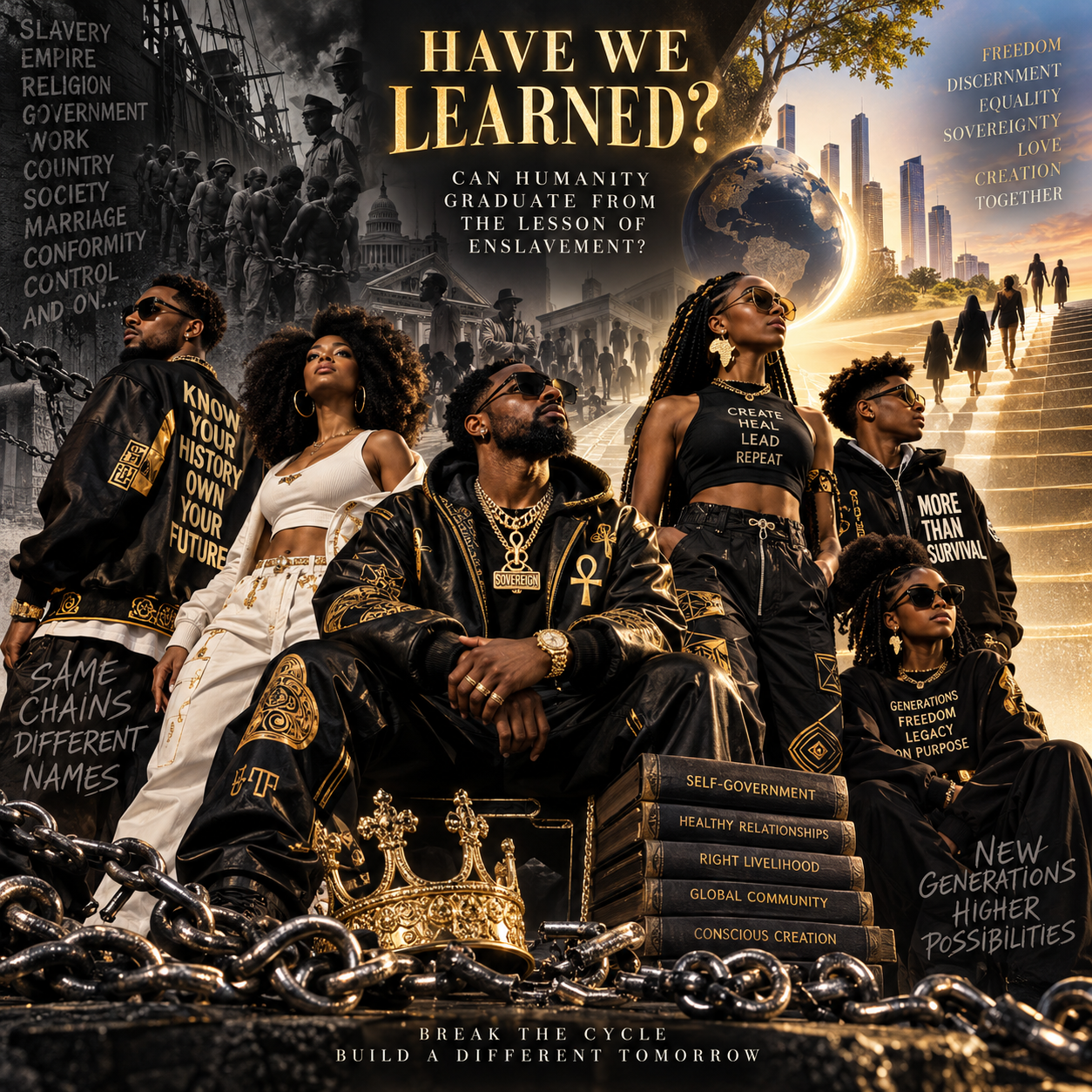
What if one of the great lessons running through recorded human history has been enslavement? Not only slavery in its most literal and horrific form—the ownership of one human being by another. But the larger architecture of enslavement. Human beings have repeatedly surrendered themselves to:
- Masters
- Kings
- Empires
- Governments
- Religious institutions
- Employers
- Economic systems
- Social expectations
- Gender roles
- Marriage structures
- Cultural identities
- Political identities
- Systems that promise security in exchange for sovereignty
The names change. The uniforms change. The institutions change. But an ancient question keeps returning:
Who governs Adam?
And perhaps an even more important question has finally arrived:
Have we learned? Can humanity graduate from this lesson?
The History Available to Us Is Filled With Masters
Look across recorded history and a pattern becomes difficult to ignore. Someone is almost always attempting to govern someone else.
- Conqueror and conquered.
- Master and slave.
- King and subject.
- Lord and serf.
- Colonizer and colonized.
- Employer and laborer.
- Patriarch and household.
- Institution and member.
- State and citizen.
Sometimes the relationship is openly coercive. Sometimes it is contractual. Sometimes it is culturally enforced. Sometimes people willingly participate because the structure provides something they need. These relationships are not morally identical, and they should not be treated as though they are. But they repeatedly raise the same developmental question:
How much sovereignty will a human being surrender in exchange for provision, protection, belonging, certainty, status, or survival?
That question appears everywhere. And Scripture places it directly in front of us.
Egypt: The Obvious Form of Enslavement
Egypt gives us the form we recognize immediately.
“The Egyptians made the children of Israel to serve with rigour.”
— Exodus 1:13
Pharaoh controls labor. Pharaoh controls movement. Pharaoh controls production. Pharaoh even attempts to control reproduction.
The enslaved person becomes an instrument of someone else’s system. So God brings Israel out. But something remarkable happens after liberation: the people do not immediately become capable of governing themselves. They enter the wilderness. That distinction matters.
Leaving the master and becoming sovereign are not the same developmental event. Egypt can release your body while Egypt remains inside your consciousness.
The Energetic Architecture of Enslavement
Within energy healing and the mechanics of consciousness, enslavement is never purely political or economic. It is an energetic event. The architecture of Pharaoh anchors itself directly into the human energy body:
- The Root (Survival): The system manufactures chronic instability—fear of starvation, exposure, or expulsion. When the Root is kept in constant alarm, survival overrides sovereignty.
- The Sacral (Creation): Creative, vital power is siphoned away from original expression and redirected into transactional maintenance and passive consumption.
- The Solar Plexus (Will): This is the literal throne of self-governance. When a person is enslaved, this center is abdicated: “You decide for me. You tell me what is true. You tell me what I am worth.”
Before a whip ever touches skin, the internal seat of authority has already been outsourced. The system simply takes up residence in the space the sovereign person abandoned.
The Wilderness: What Happens When Nobody Is Holding the Leash?
The wilderness exposes the problem beneath enslavement. What happens when external government is removed?
- Can you govern appetite?
- Can you tolerate uncertainty?
- Can you make decisions without someone deciding for you?
- Can you remain disciplined when nobody is forcing you?
- Can you encounter fear without immediately demanding another authority to rescue you?
- Can you take responsibility for the consequences of your choices?
The wilderness is therefore not simply geography. It is a laboratory of self-government.
This makes Israel’s later request for a king especially revealing.
“Now make us a king to judge us like all the nations.”
— 1 Samuel 8:5
Samuel warns them what centralized human authority can become. The king will take. He will take sons, daughters, fields, vineyards, servants, livestock, and production.
And still the people demand a king.
They escaped Pharaoh, and then they asked for another human structure to govern them. That should make us uncomfortable. Because Pharaoh is not merely a historical person.
Pharaoh is an architecture.
The Trap of the Ex-Slave Identity
Israel spent forty years in the desert until an entire generation passed away. Why? Because you cannot enter sovereignty while clinging to the identity of an oppressed victim.
Escaping the oppressor is not enough. You must also release the identity you built around resisting them.
When your sense of purpose, righteousness, or community is entirely defined by opposition to a master, you remain energetically tethered to that master. Rebellion is not freedom; it is merely the inverse of obedience. Both are still controlled by the existence of Pharaoh.
Graduation requires dropping the grievance identity entirely so that true self-authorship can begin.
We Keep Rebuilding Pharaoh
Humanity abolishes one structure and frequently constructs another.
- We overthrow kings and create governments.
- We abolish feudal systems and create economic hierarchies.
- We escape religious authoritarianism and surrender ourselves to political ideology.
- We leave oppressive workplaces and build businesses that consume every waking hour.
The cage becomes more sophisticated. Sometimes it even becomes comfortable.
Today, Pharaoh rarely needs a whip or a decree. He controls through frictionless convenience.
We willingly surrender our attention, privacy, discernment, and capacity for critical thought in exchange for algorithms that curate our opinions and platforms that automate our lives. When survival panic doesn’t work, comfort will. A cage padded with ease is still a cage.
The issue is not structure itself. Structure is necessary for civilization. Cooperation requires agreements, communities require boundaries, and organizations require administration.
The issue is the surrender of sovereignty. Does the structure serve the human being—or does the human being become property of the structure?
The Internal Master: Biochemical Enslavement
We point easily to external tyrants, but we routinely ignore the dictator sitting in our own physiology.
A human being can be legally free, economically independent, and geographically unrestrained, yet remain entirely enslaved to:
- Dopamine loops and compulsive stimulation
- Chronic dysregulation of the nervous system
- Unexamined childhood trauma responses
- Addictions to outrage, grievance, and validation
- Unconscious emotional patterns that dictate every decision
If you escape an oppressive institution only to be ruled by your own unintegrated impulses and biochemical cravings, you have not graduated. You have simply replaced an external overseer with an internal one.
And Then There Is Marriage
This question becomes particularly provocative when applied to marriage.
Marriage can be covenant, companionship, love, family, stability, intimacy, and extraordinary creative partnership.
Historically, however, societies have also constructed marriage through concepts of ownership, hierarchy, economic dependency, compulsory roles, and restricted agency.
If marriage means that one sovereign human being acquires authority over another simply because a covenant has been formed, we have not escaped the master/subject model. We have brought it into the home.
Marriage Metaphysics Tells a Different Story
From a metaphysical perspective, marriage is not fundamentally about ownership. It is about union.
Complementary principles encounter one another without destroying their distinction. Creation requires differentiation. Two coherent forces enter relationship and generate something neither produces independently. That is Creation Mechanics.
The question is therefore not: Who owns whom?
It is: What can we create together?
- Can I love you without possessing you?
- Can I covenant with you without controlling you?
- Can I remain myself without preventing you from remaining yourself?
- Can we cooperate without establishing a master?
- Can we create a third field—the marriage—without either partner becoming property of that field?
Union without the loss of sovereignty is the only mature model of covenant.
Work Can Become Another Master
Modern work exposes the exact same dynamic. Many people are legally free and yet have remarkably little authority over their own existence.
- Wake when required.
- Travel when required.
- Work when required.
- Ask permission to rest, vacation, or attend to family.
- Produce according to someone else’s priorities.
- Receive enough compensation to return and do it again.
Employment is not literal slavery; conflating the two erases crucial distinctions of legal ownership and freedom of exit. But employment can still expose the underlying question: Who governs your life?
The danger is not work. Work is creative power. Adam was given work in Genesis, but Adam was not created for the workplace. The danger is allowing the mechanism through which we obtain resources to become the ruler of our being.
Even Country and Faith Can Become Masters
Community matters. Citizenship matters. Collective responsibility matters.
But when identification with a nation, a political party, or a religious creed requires surrendering conscience, moral discernment, or the shared humanity of outsiders, something has shifted. The structure has stopped being a platform for cooperation; it has become an idol that governs the person.
“Ye shall have no other gods before me.”
— Exodus 20:3
Idolatry is not limited to stone statues. Sometimes the thing sitting on the throne is an institution, an ideology, or a system.
Freedom Is Harder Than Escape
People participate in rebuilding their own cages because sovereignty carries immense weight.
Freedom means there is no Pharaoh to blame, no institution to decide for you, and no authority to rescue you from the consequences of your choices.
Self-government requires:
- Discernment and emotional regulation
- Solar-plexus accountability and internal discipline
- Coexisting with other sovereign beings who hold equal authority
This raises a practical reality: what happens when two sovereign beings collide over resources or direction, and neither holds power over the other?
The immature instinct is coercion—one must dominate the other. The mature sovereign path requires something vastly higher: voluntary arbitration, conscious boundaries, transparent negotiation, and intentional sacrifice for the greater whole. Order must be maintained through shared resonance and mature covenant, not domination.
Jesus: Authority Without Domination
Jesus provides an extraordinary correction to humanity’s obsession with power:
“The princes of the Gentiles exercise dominion over them, and they that are great exercise authority upon them. But it shall not be so among you.”
— Matthew 20:25–26
Notice what Jesus does not say. He does not eliminate authority; he alters its architecture.
Power no longer requires domination.
Leadership no longer requires ownership.
Authority no longer requires another person’s diminishment.
Adam must learn to escape Pharaoh. But the harder lesson is: Do not become Pharaoh.
The Final Test of Sovereignty
It is relatively easy to recognize oppression when someone else holds the whip. It is vastly harder when you hold the power.
What happens when you become the parent, the spouse, the employer, the minister, the teacher, or the leader?
Do you reproduce the hierarchy that once governed you?
Or have you learned something higher?
The mature sovereign does not merely demand personal freedom. He recognizes, respects, and protects sovereignty in others. That is the dividing line between simple rebellion and spiritual graduation.
Can We Graduate?
Within the 18-ChakraVerse, humanity’s trajectory is not a perpetual loop of escape and capture. It is a developmental ascent toward competent, embodied sovereignty.
The goal is never chaos or the dissolution of all structure. The higher work is building structures where sovereign beings can collaborate without converting one another into property:
- Covenant without possession
- Leadership without domination
- Work without servitude
- Community without conformity
- Marriage without ownership
- Technology without addiction
- Comfort without compliance
- Order without enslavement
We have changed the names of the rulers, the systems, the economies, and the laws for thousands of years. Yet the fundamental question has never changed:
Who governs Adam?
Eventually, every soul must stand integrated—regulated within, unshackled without—and declare:
Under God, I govern myself.
And I do not need to enslave you in order to remain free.
That is graduation. And humanity is standing in the examination hall right now.
Have we learned?