
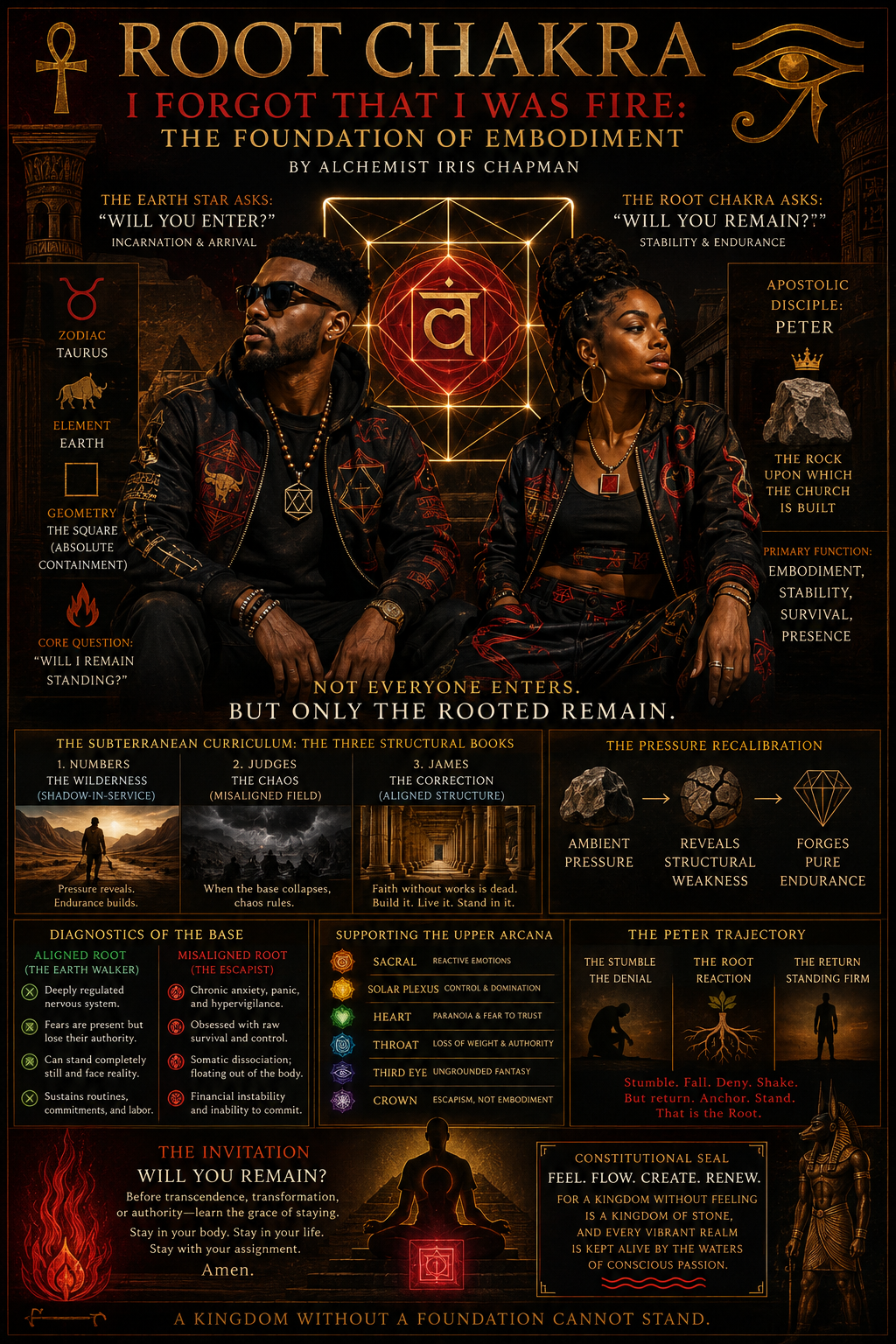
Root Chakra: Where I Claim My Foundation, Safety, and Right to Exist
The Foundation of Embodiment
By Alchemist Iris Chapman
There is a strange thing that happens when consciousness enters matter.
It becomes heavy.
The soul that knew movement without feet now has to walk. The consciousness that knew expansion without walls now encounters skin, bone, gravity, hunger, exhaustion, limitation, time, and consequence.
And somewhere in that descent into density, something can be forgotten.
The fire.
Not fire as destruction.
Not fire as rage.
Not even fire as ambition.
The fire is the living force that made embodiment possible in the first place—the inner heat that says:
I am here.
I am alive.
I have substance.
I can stand.
I can build.
I can survive pressure without forgetting what lives inside me.
This is the deeper mystery of the Root Chakra.
The Earth Star Chakra governs the crossing into incarnation. It establishes the soul’s connection to lineage, ancestry, Earth, and the conditions through which incarnation becomes possible. But once consciousness enters the physical field, another problem immediately emerges:
Can spirit remember itself while living inside matter?
The Root Chakra is where that question becomes physical. The great danger of embodiment is not simply that life becomes difficult. It is that the weight of life can become so convincing that Adam forgets the fire within the vessel.
From Arrival to Embodiment
The Earth Star Chakra establishes arrival. The Root Chakra establishes embodiment. These are related, but they are not identical.
The Earth Star says: You have entered the field.
The Root says: Now inhabit it.
At the Earth Star, consciousness crosses the threshold into earthly experience. At the Root, consciousness must learn how to operate under the laws of physical existence.
Gravity matters here. Food matters. Shelter matters. Money matters. Work matters. Rest matters. Safety matters. The nervous system matters. The body matters.
The spiritual journey can no longer remain theoretical because consciousness has entered a realm where ideas must eventually become structures. This is why the Root Chakra is not merely the chakra of survival. It is the Foundation of Embodiment.
Its lesson is not simply: “Stay alive.”
Its deeper lesson is:
Remember what is alive inside you while you are carrying the weight of being human.
I Forgot That I Was Fire
The title of this Root Chakra teaching describes one of the fundamental consequences of incarnation: matter can make consciousness forget its own vitality.
Bills accumulate. Bodies become tired. Relationships become difficult. Plans fail. Resources disappear. People disappoint us. Institutions constrain us. Responsibilities multiply. The physical world continually presents evidence of limitation.
And if Adam interprets those limitations incorrectly, consciousness begins identifying with the weight instead of the life carrying the weight. The internal language changes:
- Instead of “I am experiencing pressure,” Adam begins thinking, “I am powerless.”
- Instead of “My resources are limited,” Adam concludes, “I am without provision.”
- Instead of “My body is afraid,” Adam declares, “I cannot move.”
- Instead of “This structure has failed,” Adam believes, “I have failed.”
This is how the fire becomes forgotten. It was never extinguished; it simply became buried beneath survival.
The Core Blueprint of the Base
The Root Chakra establishes the structural conditions necessary for consciousness to function inside physical reality.
| Root Chakra Blueprint Element | Attribute |
| Zodiac Frequency | Taurus |
| Apostolic Disciple | Peter |
| Geometric Correspondence | The Square — Absolute Containment |
| Primary Function | Embodiment, Stability, Survival, Presence |
| Elemental Principle | Earth |
| Core Revelation | “I Forgot That I Was Fire.” |
The square is particularly important. A square creates containment—it establishes walls, boundaries, dimensions, and measurable space. Spirit has entered form. Something that could expand in every direction has agreed, temporarily, to occupy a particular vessel.
The body is such a vessel. So is a house, a family, a job, a lifetime, and a kingdom.
The Root Chakra teaches consciousness how to operate faithfully inside the container without confusing the container with the totality of what it is. That distinction is essential.
You live in matter. You are not merely matter.
The fire must learn to live inside the square.
Taurus: The Builder Who Gives Fire a Home
The Root Chakra corresponds to the fixed earth frequency of Taurus. At first glance, Taurus and fire may appear contradictory, but they are not.
Fire without containment burns wildly and disappears. Fire properly contained becomes a hearth. It cooks food, heats a home, tempers metal, transforms raw material, and sustains civilization.
Taurus provides the container in which living energy can become useful. This is the Root Chakra’s great contribution to the Inner Kingdom: it takes the raw vitality of incarnation and says, “Build something with it.”
Taurus does not need constant novelty. It understands repetition, rhythm, patience, cultivation, labor, resources, and physical continuity. The farmer does not plant a seed every morning and dig it up every evening to see whether it has grown; the farmer trusts the process. The builder does not abandon the foundation because the skyscraper has not appeared by sunset; the builder continues laying stone.
This is sacred Root intelligence.
Fire gives the Kingdom vitality. Earth gives that vitality somewhere to live.
When these principles cooperate, embodiment becomes possible.
Peter: The Man Who Forgot—and Remembered
Peter is one of the clearest scriptural expressions of the Root Chakra because Peter’s story is not the story of a man who never became afraid. It is the story of a man whose fear temporarily made him forget who he was.
Peter had walked with Jesus. He had witnessed miracles, received instruction, declared loyalty, and experienced extraordinary spiritual realities.
And then pressure arrived.
Suddenly the teaching was no longer theoretical. His nervous system entered the lesson. Fear moved through the body, danger became immediate, survival took command, and Peter denied what he knew.
This is Root Chakra territory. Peter’s problem was not simply theological inconsistency—pressure temporarily overruled embodiment. The man who believed one thing under safe conditions behaved differently when his physical security appeared threatened.
But Peter’s story does not end with denial. He returns. He rebuilds. He eventually becomes associated with the rock. This reveals something crucial about Root Chakra development:
Alignment is not proven by never being shaken. Alignment is demonstrated by recovering your center after you have been shaken.
Peter forgot the fire, and then Peter remembered. That is why he can become structural. The rock is not someone who has never encountered fear; the rock is someone who has learned that fear does not possess constitutional authority over the Kingdom.
The Nervous System and the Forgotten Fire
The Root Chakra is intimately connected with the body’s interpretation of safety. When danger is perceived, the organism mobilizes. The body prepares to fight, flee, freeze, appease, hide, or conserve energy.
These responses are not inherently enemies—they are protective intelligence. The problem begins when an emergency response becomes a permanent government. A temporary survival strategy can become an identity:
- “I had to hide” becomes “I am invisible.”
- “I had to run” becomes “I cannot stay anywhere.”
- “I had to fight” becomes “Everyone is an enemy.”
- “I had to conserve” becomes “There will never be enough.”
- “I had to become small” becomes “I have no power.”
This is how the Root Chakra’s fire becomes covered by survival conditioning. The protective mechanism outlives the emergency, and the guard remains at the gate long after the war has ended.
Root healing therefore does not require declaring war against the nervous system. It requires teaching the nervous system that it no longer needs to govern the entire Kingdom from an emergency posture.
The Subterranean Curriculum: Three Structural Books
The Root Chakra’s curriculum can be explored through three particularly powerful scriptural lenses: Numbers, Judges, and James. Together, they reveal three different relationships between consciousness and physical pressure.
                   [ THE ROOT CURRICULUM ]
                              │
     ┌────────────────────────┼────────────────────────┐
     ▼                        ▼                        ▼
  NUMBERS                  JUDGES                    JAMES
(Under Pressure)     (Survival Government)      (Fire Into Form)
  • Shadow State       • Misaligned Field         • Aligned Structure
  • Conditioned        • Cyclical Control         • Embodied Action
1. Numbers: Fire Under Pressure (The Shadow-in-Service)
The wilderness of Numbers exposes what happens when consciousness enters an environment where external evidence no longer supports internal confidence. Resources appear scarce, the future appears uncertain, comfort disappears, and old securities are gone.
The people begin remembering Egypt differently. Bondage starts looking attractive because bondage was at least predictable. This is one of the great psychological temptations of the Root Chakra:
Known captivity can feel safer than unfamiliar freedom.
When the nervous system becomes frightened enough, it does not necessarily ask, “What is lawful?” It asks, “What is familiar?”
Numbers represents the Root under conditioning. The fire still exists, the covenant still exists, and the journey is still occurring, but pressure has made consciousness forget. The wilderness reveals whether Adam can carry internal stability when the environment refuses to provide constant external reassurance.
2. Judges: When Survival Becomes Government (The Misaligned Field)
The Book of Judges demonstrates what happens when there is no stable internal government. Cycles repeat: threat arises, crisis erupts, a rescuer appears, temporary order returns, and then consciousness collapses again.
This is the architecture of dysregulated survival. The system has no stable center, so circumstances continually determine identity. When things are safe, there is peace. When pressure arrives, fear, reaction, violence, and impulse govern.
The Root has forgotten that it contains fire, so it searches desperately for power outside itself. This produces one of the central distortions of the misaligned Root: Control masquerading as safety.
- If I can control everyone, perhaps I will feel safe.
- If I can control every outcome, perhaps I will feel safe.
- If I can accumulate enough, perhaps I will feel safe.
- If I can predict everything, perhaps I will feel safe.
Safety created through total control is structurally fragile because life refuses to become completely controllable. The forgotten fire must be recovered internally.
3. James: Put Fire Into Form (The Aligned Structure)
James brings Root consciousness back into embodiment: Faith without works is dead. At the Root Chakra, this becomes constitutional law. What you believe must eventually enter your feet, your hands, your calendar, your habits, your spending, your work, your home, your commitments, your boundaries, and your daily choices.
The Root does not reject spiritual truth—it incarnates spiritual truth. James provides the corrective medicine for disembodied spirituality:
- If you believe in stability, build stable practices.
- If you believe in stewardship, steward something.
- If you believe in abundance, learn how to manage resources.
- If you believe in integrity, keep commitments.
- If you believe the body is sacred, care for the body.
- If you believe you have been given work to accomplish, work.
The Root Chakra asks for evidence—not because spirit is unimportant, but because spirit entered matter specifically to become embodied.
The fire must become visible through form.
Shadow-in-Service: When the Fire Goes Underground
There are times when reducing our fire is protective. After trauma, grief, exhaustion, betrayal, displacement, financial crisis, or prolonged instability, the system may conserve energy. The person may withdraw, movement slows, risk tolerance decreases, and the world becomes smaller.
This can be a legitimate Shadow-in-Service response. The organism is saying: “I cannot burn at full intensity right now.” That is not necessarily failure. Sometimes embers are wisdom; a fire reduced to embers can survive conditions that would extinguish an uncontrolled flame.
But the Shadow-in-Service state must remain temporary. Eventually, the question changes from “How do I protect the remaining ember?” to “When is it safe to feed the fire again?”
The shadow becomes misaligned when conservation becomes identity. Rest becomes hiding, caution becomes paralysis, and temporary retreat becomes permanent withdrawal. The Root then needs to remember: The fire was protected so that it could eventually burn again.
The Misaligned vs. Aligned Root
       [ MISALIGNED ROOT ]                    [ ALIGNED ROOT ]
   (Mistaking Fear for Identity)            (The Earth Walker)
               │                                   │
  • Chronic Instability & Panic       • Inhabits Form with Fire
  • Compulsive Control & Hoarding     • Carries Weight with Capacity
  • Persistent Scarcity Mindset       • Restores Center After Shaking
  • Escape Reality / Disembodiment    • Stable Daily Execution
The Misaligned Root: Mistaking Fear for Identity
The misaligned Root forgets its own internal source of vitality. It may manifest as chronic instability, compulsive control, avoidance, hypervigilance, hoarding, inability to commit, persistent scarcity consciousness, or repeated attempts to escape physical reality.
The body is present, but consciousness continually tries to leave—through fantasy, compulsive distraction, endless spiritual seeking, constant relocation, unnecessary crisis, addiction to novelty, or refusal of responsibility.
Spirituality itself can become an escape mechanism when transcendence is pursued because embodiment feels intolerable. The person keeps trying to ascend because they have never learned how to inhabit the ground.
But the Root Chakra insists: the ground is not your punishment, the body is not a spiritual mistake, and matter is not evidence that consciousness has fallen beyond redemption. This is your field of practice—this is where the fire learns mastery.
The Aligned Root: The Earth Walker
The aligned Root produces the Earth Walker. The Earth Walker does not need life to become weightless; the Earth Walker develops the capacity to carry weight.
Fear can arise without becoming king. Scarcity can appear without automatically creating panic. Uncertainty can exist without destroying commitment. Pressure can increase without forcing immediate escape.
The Earth Walker knows how to work, rest, build, wait, recover, begin again, occupy space, and remain present in the body.
Groundedness is not the absence of fire. Groundedness is fire that has learned how to inhabit form.
The Root Supports the Entire Inner Kingdom
Every chakra above the Root depends upon this capacity for embodiment.
- Sacral Chakra: Without a functioning Root, emotional movement becomes overwhelming because there is no stable container through which feeling can flow.
- Solar Plexus: May become controlling because it attempts to manufacture externally the security that the Root has failed to establish internally.
- Heart: May become suspicious because connection feels dangerous without foundational safety.
- Throat: May produce beautiful language without enough embodied authority to support it.
- Third Eye: May drift into fantasy because vision has lost contact with physical reality.
- Crown: May pursue transcendence as an escape from incarnation rather than as an expansion of consciousness within it.
Even extraordinary spiritual insight can become structurally useless if Adam cannot bring it into matter. A kingdom cannot be governed through inspiration alone. Someone must build the roads, maintain the walls, tend the field, manage the resources, and keep the fire burning.
That is Root work.
The Fire Beneath the Kingdom
The Root Chakra reveals an important paradox: the deepest foundation of the Inner Kingdom is associated with earth, yet hidden inside that earth is fire.
This is design, not contradiction.
A seed appears still while tremendous generative intelligence operates within it. A mountain appears immovable while enormous forces exist beneath its surface. The human body appears solid while trillions of processes continuously sustain its life.
Stillness is not lifelessness. Structure is not stagnation. Groundedness is not weakness.
The Root is living earth—and living earth carries fire.
The mistake occurs when Adam experiences density and concludes that density has extinguished divinity. It has not. The flame has simply entered form.
I Remember
There comes a point in Root Chakra healing when the language must change:
- Not “I am trapped here,” but “I am embodied here.”
- Not “Life is too heavy,” but “I am developing the strength to carry weight.”
- Not “Fear means I cannot move,” but “Fear is information; it is not my sovereign.”
- Not “I have lost myself,” but “I forgot myself.”
And what has been forgotten can be remembered. This is the turning point.
The Root Chakra does not need to manufacture the fire; the fire was already there. It carried consciousness into incarnation. It survived childhood, disappointment, failure, fear, and every previous moment when Adam believed there was nothing left.
The evidence of the fire is startlingly simple: You are still here.
The Invitation
The Earth Star Chakra brought consciousness across the threshold. Now the Root Chakra teaches consciousness how to become fully embodied.
Put your feet on the ground. Feel the weight of your body. Look at the life that actually exists—not merely the life you imagined, feared, lost, or hoped would arrive.
This is the field. This is the material. This is the foundation.
And somewhere beneath the accumulated pressure, disappointments, survival strategies, fear, responsibilities, and years of conditioning is something that was never actually destroyed: Fire.
Peter discovered it after denial. The wilderness exposes where we forget it. Judges demonstrates what happens when we search for it through external control. James teaches us how to put it back into our hands. And Taurus builds the structure capable of containing it.
The Root Chakra therefore does not merely ask whether you can survive. It brings you to a far more important realization:
I forgot that I was fire.
I forgot that life was still burning inside me.
I forgot that pressure could shape me without defining me.
I forgot that fear could speak without becoming my ruler.
I forgot that I could fall and still rise.
I forgot that I could build again.
I forgot that the weight of embodiment did not extinguish the flame.
I forgot that I was fire.
Now I remember.
And once Adam remembers the fire, the ground is no longer merely something beneath his feet. It becomes the place where the Inner Kingdom can finally be built.
Amen.








Thank you for sharing this interesting article about the “Fractal Persona of the Root Chakra.” I found the topic very thought-provoking because it presents a different way of looking at identity, suggesting that a person is not just one fixed self but a system of different patterns or “personas” that emerge in different situations.
I do have a few questions after reading the article. How exactly are these “fractals” or personas identified in everyday life—are they meant to be symbolic interpretations of behavior, or are they intended as a structured inner mapping system? Also, how does someone distinguish between a helpful persona and one that might be considered “misaligned” in this framework?
Another question I had is how this system relates to emotional healing or personal development. Does becoming aware of these personas help a person integrate them into a more balanced sense of self, or is the goal more about transcending certain patterns entirely?
From my perspective, the idea of viewing human behavior through layered inner patterns is an interesting way to reflect on personal growth and self-awareness. It can encourage deeper introspection about how we react differently depending on circumstances, even if the framework is more symbolic or spiritual in nature.
I think the article raises a unique discussion about identity, consciousness, and inner structure, and it invites readers to think more deeply about how they understand themselves and their behavior patterns. Thank you again for sharing this reflective and unconventional perspective.
Thank you for such a thoughtful and deeply reflective comment. I really appreciate the care you took in engaging with the ideas behind the Fractal Persona framework.
To answer your first question: within this system, the personas are both symbolic and structural. They are symbolic in the sense that they represent recognizable patterns of thought, emotion, behavior, and energetic orientation. But they are also intended to function as an inner mapping system—a way of understanding how different aspects of the self emerge under different conditions.
For example, a person may express one pattern when they feel safe, grounded, and supported, and a very different pattern when they feel threatened, unstable, ashamed, or disconnected. Rather than treating those shifts as random contradictions, the framework views them as organized responses arising from different inner “positions” or personas within the system.
The Root Chakra is especially connected to survival, safety, belonging, stability, and physical presence. So the personas that emerge there often reveal how someone attempts to establish security in the world—either in aligned ways or distorted ones.
A persona is considered “aligned” when it moves toward greater coherence, responsibility, truth, stability, and connection with reality. A “misaligned” persona is not viewed as evil or bad, but as a survival adaptation that has become distorted through fear, instability, fragmentation, shame, or unresolved pain. In many cases, these personas originally developed to protect the individual, even if they later become limiting.
Awareness is important because many people unconsciously identify with every emotional state or behavioral pattern they experience. The framework creates space to observe these patterns without collapsing entirely into them. That observation can increase self-understanding, emotional regulation, and intentionality.
And yes—emotional healing is a major part of the system. The goal is not necessarily to destroy or reject parts of oneself, but to understand what each pattern is trying to accomplish, what wound or fear may be underneath it, and whether it still serves alignment and wholeness.
Some patterns become integrated and refined.
Some stabilize into healthier expressions.
Some eventually dissolve because they are no longer needed.
So the process is less about becoming “perfect” and more about becoming coherent—less fragmented internally, more aware, more grounded, and more consciously aligned in how one lives and responds.
I appreciate your openness in approaching the framework thoughtfully rather than dismissively. Your reflections on identity, consciousness, and layered behavioral patterns are very much in harmony with the deeper intention behind the work. Thank you again for contributing such a meaningful perspective to the discussion.
I found this topic interesting because it presents the root chakra as more than just “grounding” or basic stability. The idea of a fractal persona makes it feel like the root chakra also has a personality, a survival pattern, and a way of responding to life when someone feels safe or unsafe.
My question is: how can someone recognize when their root chakra persona is acting from healthy stability versus acting from fear, control, or survival mode?
Thank you, CCezar. That’s a very insightful question because the Root Chakra often disguises survival responses as “practicality,” “responsibility,” or even “strength.” The difference usually becomes visible not in what a person is doing, but in the energetic posture underneath the action.
A Root Chakra acting from healthy stability tends to feel grounded, steady, and present. There is structure without rigidity. A person can make decisions calmly, respond instead of react, and remain connected to their body even during stress. Safety is internal enough that they do not need to constantly control people, outcomes, or environments to feel secure.
A Root Chakra acting from fear or survival mode usually carries contraction behind the behavior. The person may become hypervigilant, overly defensive, controlling, emotionally shut down, territorial, exhausted, or constantly preparing for disaster. Even success can feel unsafe because the nervous system never fully settles. In survival mode, the body often believes danger is always near—even when the mind says otherwise.
One of the clearest signs is flexibility. Healthy grounding can adapt. Fear-based grounding becomes rigid.
Another important clue is the relationship to the body. When the Root Chakra is aligned, the body feels inhabited. A person feels connected to sleep, breath, hunger, movement, rest, and physical presence. In distortion, people often disconnect from the body entirely or over-identify with survival concerns like money, security, status, or control.
This is one reason I describe the chakra system through fractal personas. The Root Chakra is not just an abstract energy center—it expresses itself through lived behavioral patterns, protective identities, and survival strategies that develop over time. Healing the Root is often less about “activating” energy and more about teaching the nervous system that it is finally safe enough to soften, trust, and stand without constant defense.
This was such a powerful exploration of the Root Chakra as lived embodiment rather than symbolism. I appreciate how you framed stability as something built through presence, not performance. One thing others might find helpful is pairing this inner work with a simple daily grounding cue — like noticing the weight of the feet before making a decision. It bridges the philosophy into everyday life in a really accessible way.
I really appreciate how you said that—“stability built through presence, not performance.” That’s the Root Chakra in its true function. When it’s aligned, I’m not trying to prove I’m grounded—I can feel that I am.
And that grounding cue you shared is powerful in its simplicity. Bringing attention to the weight of my feet before a decision immediately shifts me back into the body, where the Root actually governs. It turns grounding from an idea into something physical and usable in real time.
I’m curious—have you noticed whether that practice changes the speed of your decisions, or the quality of them?