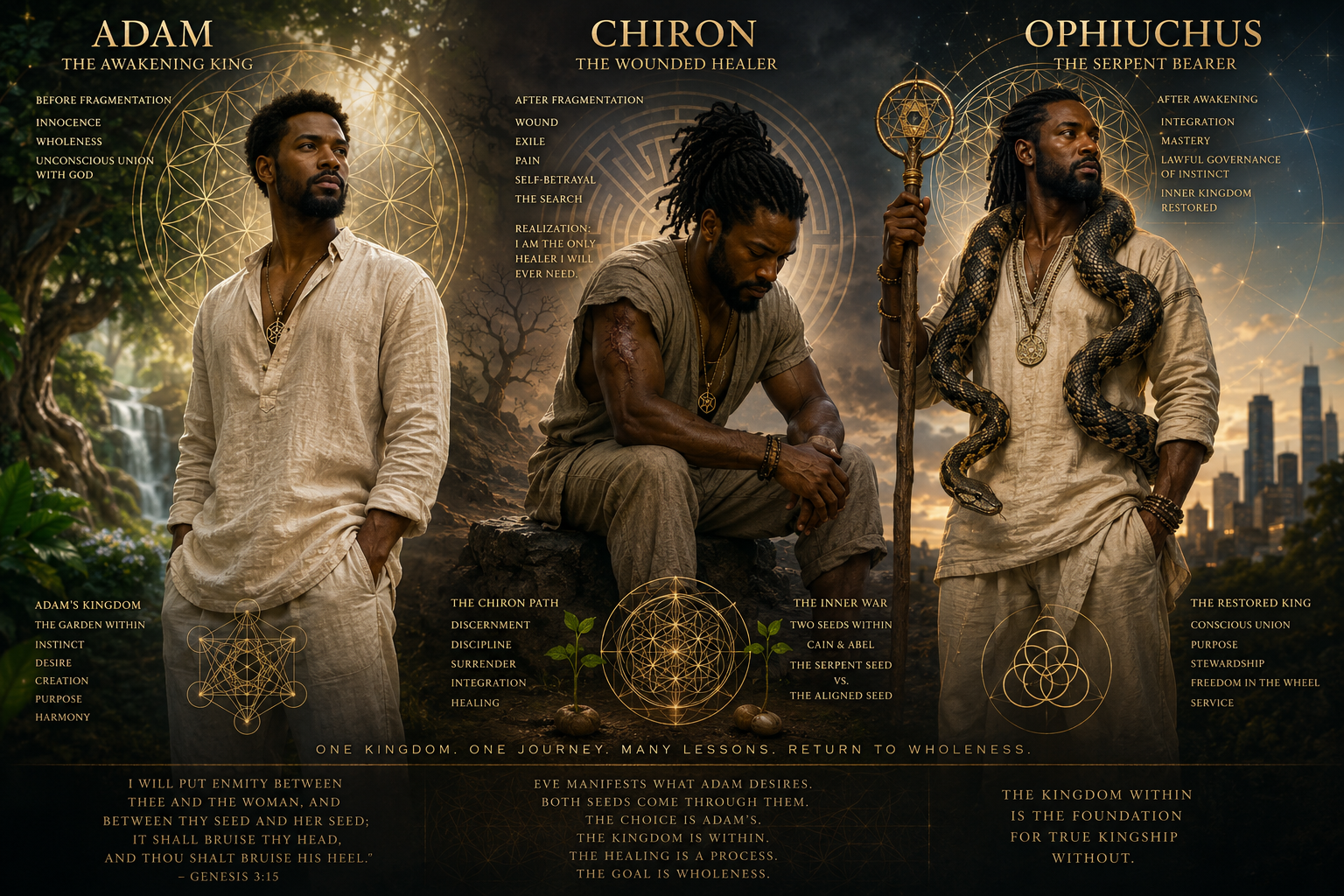
The Wounded King, the Serpent Bearer, and the Restoration of the Inner Kingdom
When most people read the story of Adam and Eve, they are taught that the serpent represents evil from the very beginning. But the text itself says something very different.
In Genesis, the serpent is described as one of the creatures God made:
“Now the serpent was more crafty than any of the wild animals the LORD God had made.”
— Book of Genesis 3:1
This changes the entire structure of the story.
The serpent is not introduced as a rival creator.
It is part of creation itself.
This means the true problem in Eden was never the existence of the serpent.
The true problem was fragmentation.
The serpent originally represented:
- instinct,
- desire,
- wisdom,
- transformation,
- polarity,
- creative movement,
- life force,
- evolutionary pressure,
- and energetic intelligence.
The serpent was never meant to rule Adam.
Adam was meant to govern the serpent consciously.
This is where the mystery of Ophiuchus begins.
Ophiuchus: The Serpent Bearer
Ophiuchus is traditionally known as “The Serpent Bearer.”
Unlike archetypes that fear the serpent or attempt to destroy it, Ophiuchus holds it consciously.
This is important.
The serpent is not annihilated.
It is governed.
Ophiuchus represents:
- mastery over instinct,
- lawful relationship to desire,
- conscious integration of shadow,
- transformed poison becoming medicine,
- aligned power,
- discernment,
- and spiritual rulership.
Within the deeper architecture of the soul, Adam originally possessed this state naturally.
Before fragmentation:
- desire existed,
- instinct existed,
- polarity existed,
- the serpent existed.
But there was no fear.
No shame.
No inner war.
Adam existed in unconscious wholeness.
He did not yet need to struggle to govern the serpent because the inner kingdom had not yet divided against itself.
Eve Does Not Lead
Within the deeper symbolic architecture of Genesis, Eve does not independently lead Adam.
Eve manifests.
She is the helpmeet.
The responder.
The creative intelligence that gives form to Adam’s conscious or unconscious orientation.
This is why the Epistle of James becomes deeply important:
“Each one is tempted when he is drawn away by his own desires and enticed.”
— Epistle of James 1:14
Temptation originates within fragmented desire.
The serpent does not create Adam’s desire.
It exposes it.
Eve then manifests what Adam inwardly moves toward.
This means the distortion event in Eden does not begin with Eve leading rebellion.
It begins with Adam becoming internally divided.
The serpent introduces instability:
“Did God really say…?”
The mind begins separating from coherent alignment.
Then Eve observes the fruit through fragmented perception:
- good for food,
- pleasing to the eye,
- desirable for gaining wisdom.
The movement has already begun within Adam’s kingdom.
And Adam participates willingly.
The text specifically says:
“She also gave some to her husband, who was with her, and he ate it.”
Adam is present.
This matters.
Because Adam is the governing principle of the inner kingdom.
The Loss of Ophiuchus
The Fall is not fundamentally about fruit.
It is about the collapse of lawful governance within consciousness.
Adam loses Ophiuchus.
The serpent is no longer consciously governed.
Instinct begins governing Adam instead.
This is why nakedness suddenly becomes shame.
Adam and Eve were already naked before.
But after fragmentation:
- nakedness becomes vulnerability,
- fear enters,
- self-consciousness emerges,
- division begins,
- personas split from wholeness.
Then Adam says:
“I was afraid…”
Fear is the true fracture point.
Once fear governs:
- blame begins,
- projection begins,
- fragmentation multiplies,
- aligned and distorted seeds begin warring within the kingdom.
Adam falls from:
- serpent bearer
to - serpent reactor.
The Two Seeds Within Adam
Genesis 3:15 is often interpreted externally, but internally it reveals the divided nature of the wounded soul.
“And I will put enmity between thee and the woman, and between thy seed and her Seed; It shall bruise thy head, and thou shalt bruise His heel.”
Within the symbolic architecture of the soul:
both seeds emerge through Adam and Eve.
Eve produces what Adam consciously or unconsciously desires.
This means:
- the aligned seed,
- and the serpent seed of distortion
both emerge from the same inner kingdom.
The war is internal before it becomes external.
The aligned seed represents:
- sincerity,
- lawful alignment,
- devotion to God,
- coherent identity,
- truthful offering.
The serpent seed represents:
- fragmentation,
- egoic distortion,
- resentment,
- reactive identity,
- unconscious desire,
- fear-based consciousness.
These become the first children of the divided kingdom.
This is why Cain and Abel are so important.
Cain and Abel: The War Inside the Kingdom
Cain and Abel are not merely historical brothers.
They are manifestations of the divided seed-field inside Adam.
Abel represents the aligned self:
- truthful offering,
- sincere devotion,
- lawful relationship with God,
- coherence.
Cain represents the fragmented self:
- resentment,
- distortion,
- wounded identity,
- self-betrayal,
- misaligned desire.
Cain killing Abel symbolizes the distorted self attacking the aligned self.
This is why self-betrayal is one of the deepest themes in the wounded kingdom.
The fragmented self often attempts to destroy the aligned self because alignment exposes distortion.
The war of Genesis is therefore not merely external history.
It is the ongoing battle inside the human soul.
Chiron: The Wounded Healer
Once fragmentation occurs, Adam enters the Chiron journey.
Chiron represents the wounded healer:
the being who must learn wisdom through pain, suffering, humility, and conscious integration.
But within this framework, Chiron carries an even deeper meaning.
Chiron is the point where Adam realizes:
he is ultimately the only spiritual healer he will ever need.
This does not mean isolation from God.
It means responsibility within alignment to God.
Others may:
- teach,
- guide,
- mirror,
- warn,
- support,
- or illuminate.
But no one can restore the kingdom for Adam.
The restoration process must occur internally through aligned relationship with God.
This is why healing becomes a process.
Adam is wounded.
The inner kingdom is divided.
The personas war.
Fear distorts perception.
Instinct pulls against coherence.
The wound cannot simply be bypassed.
It must be consciously integrated.
This is the Chiron path:
- confronting fragmentation,
- learning discernment,
- recognizing distortion,
- restoring lawful governance,
- and gradually reorganizing the kingdom around alignment.
Ophiuchus as Awakening
Ophiuchus is not merely another zodiac sign.
Ophiuchus is an awakening.
It represents the point where Adam begins mastering the inherited structures that once unconsciously governed him.
The inherited zodiac houses still exist.
The inherited chakras still exist.
Biological, emotional, energetic, and cosmic influences still exist.
But the relationship changes.
Before awakening:
Adam is governed by the wheel.
After awakening:
Adam increasingly governs himself within the wheel.
The Wheel of Fortune no longer holds Adam captive unconsciously.
He enters Ophiuchus.
This does not mean Adam becomes unaffected by:
- emotions,
- cycles,
- instincts,
- wounds,
- astrology,
- personas,
- or earthly pressures.
Rather:
these forces no longer automatically seize the throne.
Ophiuchus represents increasing lawful stewardship of the inner kingdom.
Why Ophiuchus Remains Hidden
Very little is known collectively about Ophiuchus because Ophiuchus is not generic.
Like Eve, Ophiuchus is uniquely formed for each Adam.
No two souls carry identical wounds.
No two destinies unfold the same way.
No two serpent-bearing paths are identical.
The zodiac houses describe inherited collective structures.
But Ophiuchus emerges only when the soul begins consciously participating in its unique divine assignment.
This makes Ophiuchus initiatory rather than categorical.
It cannot be mass-produced.
It must be lived.
One soul may learn lawful governance through:
- power,
- leadership,
- authority,
- discipline.
Another through:
- grief,
- creativity,
- sexuality,
- abandonment,
- truth-speaking,
- mystical perception,
- sacrifice,
- compassion.
Each soul’s serpent differs because each soul’s fragmentation differs.
Thus each Ophiuchus path unfolds uniquely.
Christ as Chiron and Ophiuchus
The Christ archetype unites both symbols perfectly.
Christ is Chiron:
- wounded,
- rejected,
- pierced,
- suffering consciously,
- transforming pain into healing wisdom.
But Christ is also Ophiuchus:
- serpent bearer,
- governor of instinct,
- master over fear,
- aligned ruler of the inner kingdom,
- healer through transformed poison.
This is why Christ repeatedly enters:
- temptation,
- suffering,
- chaos,
- distortion,
- and shadow
without becoming ruled by them.
The serpent is no longer unconscious.
It is governed.
The Restoration of Adam
The story of Adam is the story of consciousness itself.
Adam begins whole.
Fragments.
Falls into fear.
Creates divided seeds.
Becomes wounded.
Splits into personas.
Enters exile.
Learns discernment.
Faces self-betrayal.
Confronts shadow.
And eventually begins restoring lawful governance within the kingdom.
The path is:
Unconscious Ophiuchus
↓
Fragmentation
↓
Fear and division
↓
The war of the seeds
↓
Cain and Abel within the soul
↓
Chiron’s wound
↓
Conscious healing
↓
Awakened Ophiuchus
This is not the destruction of desire.
Not the annihilation of instinct.
Not escape from the wheel.
It is the gradual restoration of lawful rulership within the inner kingdom through aligned relationship with God.