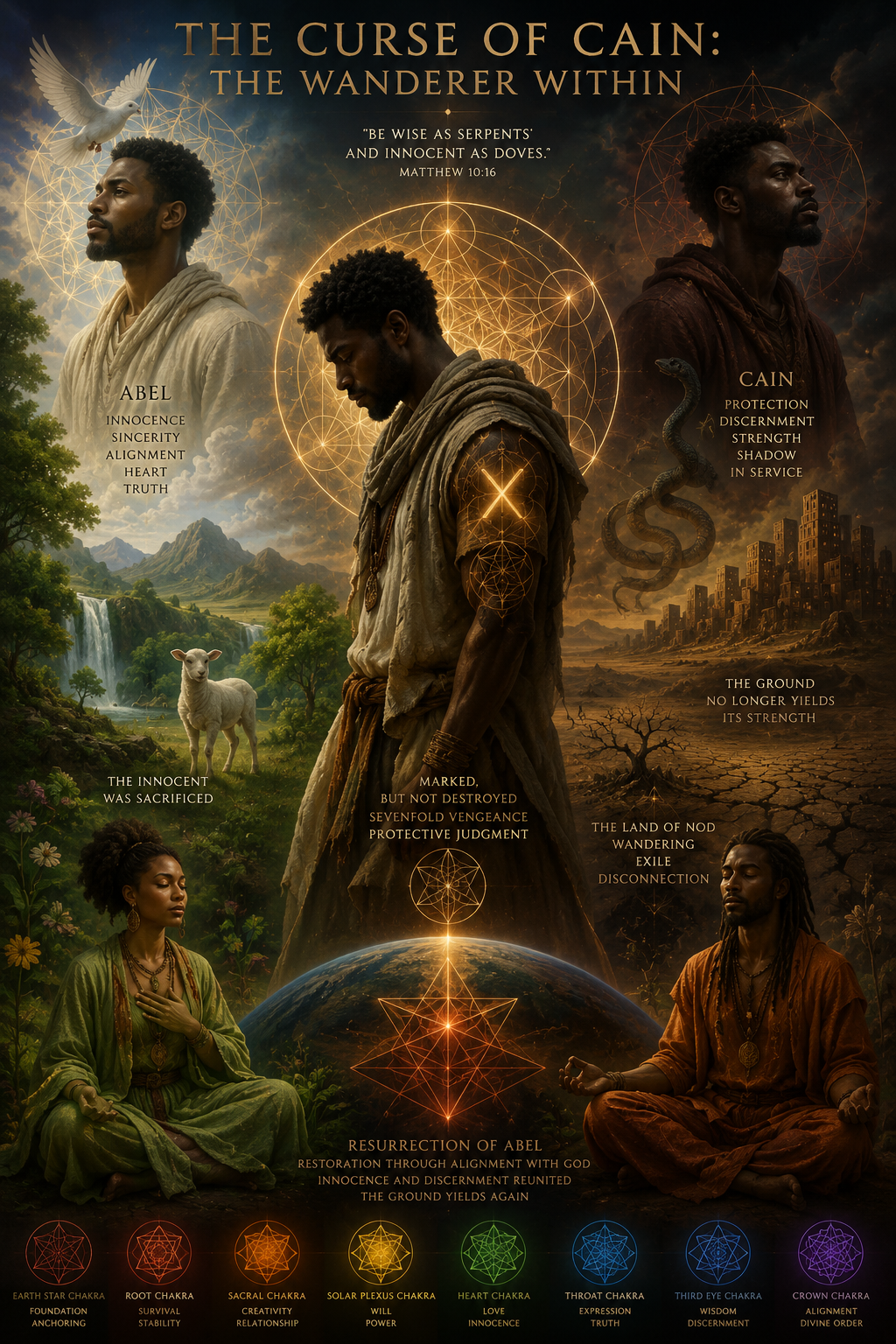
The Curse of Cain: The Wanderer Within
Cain’s Curse Was Imbalance
The story of Cain and Abel is often reduced to morality:
one brother good,
one brother evil.
But the deeper architecture of the story reveals something far more psychologically and spiritually precise.
Cain was not originally created to become distorted.
And Abel was never meant to remain undefended.
The real tragedy begins when Adam chooses protection over alignment.
The curse of Cain is imbalance.
It is what happens when the protective self separates from God and begins governing the inner kingdom alone.
Cain and Abel as Inner Forces
Metaphysically, Cain and Abel represent two essential faculties within the human being.
Abel
Abel represents:
- innocence
- sincerity
- openness
- lawful relationship
- authenticity
- trust
- coherence with God
Abel is the aspect of the self capable of standing truthfully before God without manipulation.
He is the part of Adam that remains soft enough to feel, open enough to trust, and aligned enough to cultivate the inner ground lawfully.
Cain
Cain originally represents:
- protection
- discernment
- strategic awareness
- survival intelligence
- boundaries
- strength
Cain was never meant to destroy Abel.
Cain was meant to guard him.
This is why Christ later says:
“Be wise as serpents and innocent as doves.”
— Matthew 10:16
This is lawful integration.
Abel is the innocence of the dove.
Cain—before distortion—is the wisdom of the serpent functioning in alignment with God.
The problem was never protection itself.
The problem began when protection stopped serving innocence and began replacing it.
The Death of Abel
The killing of Abel is one of the most important psychological events in Scripture.
Metaphysically, it represents:
the protective self destroying the innocent self in order to survive.
This happens constantly within human consciousness.
A person learns:
- openness gets hurt
- sincerity gets betrayed
- softness gets punished
- vulnerability feels unsafe
So the psyche sacrifices Abel.
Then Cain takes over governance.
The person becomes:
- guarded
- hypervigilant
- performative
- survival-oriented
- emotionally armored
- disconnected from authentic being
This is why the curse follows immediately after the murder.
Because once innocence dies, imbalance enters the system.
The Curse Upon the Ground
God tells Cain:
“When you till the ground, it shall no longer yield to you its strength.”
— Genesis 4:12
The ground is not merely soil.
The ground symbolizes:
- embodiment
- the nervous system
- the lived human vessel
- the lawful field of authentic life
Once Cain governs without Abel:
- the body loses coherence
- the nervous system loses safety
- inner nourishment weakens
- life becomes effort without rootedness
The person may still function.
They may even become highly successful.
But internally:
the ground no longer yields fruit naturally.
This is the curse of non-authenticity.
The Land of Nod: Living Outside One’s Own Center
Cain is sent into the Land of Nod.
The Hebrew word Nod comes from the root nud:
- wandering
- exile
- restless movement
This is not merely geographic exile.
It is psychological exile.
Nod represents:
living outside one’s own center.
The person continues existing,
working,
building,
achieving,
creating—
yet internally feels:
- disconnected
- absent
- fragmented
- restless
- unable to fully settle inside themselves
This is why dissociation and disembodiment connect so deeply to the Cain archetype.
The person wanders within their own body.
Civilization Built From Exile
One of the most fascinating details in Genesis is that Cain builds the first city.
This creates an extraordinary paradox.
Cain becomes a wanderer—
yet immediately begins constructing systems.
Why?
Because external structure becomes compensation for inner instability.
The city represents:
- identity construction
- compensatory achievement
- external control
- civilization built from fragmentation
Genesis reveals something psychologically profound:
A person can build an empire while remaining internally exiled.
The modern world is filled with Nod structures:
- careers
- brands
- performances
- survival identities
- false personas
- external success masking inner disconnection
Success does not necessarily mean embodiment.
A person may appear powerful externally while remaining deeply disconnected from their authentic self.
The Mark of Cain
Cain is marked by God.
This mark is often misunderstood as mere punishment.
But metaphysically, the mark represents:
protective judgment.
God does not destroy Cain.
Why?
Because the protective faculty still has purpose.
The problem is not that Cain exists.
The problem is that Cain rules without alignment.
The mark says:
this part of the soul is dangerous when distorted,
but it is not disposable.
The Hebrew word associated with the mark is connected to Tav (תָּו),
an ancient sign of ownership, distinction, and spiritual designation.
Metaphysically, being “marked” means:
- carrying a spiritual burden
- possessing heightened sensitivity
- living with accelerated inner pressure
- being set apart for transformation
But distortion causes the mark to become heavy.
The marked person may feel:
- isolated
- misunderstood
- spiritually burdened
- emotionally intense
- internally divided
The mark becomes the tension between destiny and imbalance.
The Wanderer Within
Cain’s true exile is internal.
He becomes:
- disconnected from embodiment
- disconnected from innocence
- disconnected from inner truth
This is the essence of false living.
Non-authenticity is not merely “lying.”
It is:
inhabiting a self that is structurally disconnected from one’s deeper truth.
The false self initially feels protective because it helps the person:
- survive
- achieve
- avoid pain
- gain approval
- maintain control
But eventually the cost appears:
- chronic restlessness
- emotional numbness
- compulsive striving
- inability to feel at home within oneself
The person becomes a wanderer inside their own body.
Cain as Distorted Shadow in Service
Cain was originally meant to function as Shadow in Service.
Not evil.
Not demonic.
Not rejected.
Protective.
Discernment itself is not distortion.
Boundaries are not distortion.
Strength is not distortion.
The distortion occurs when protection loses alignment with God and begins governing independently.
Then wisdom becomes:
- suspicion
- domination
- fear
- control
- emotional hardening
- hypervigilance
Cain ceases to guard the kingdom and begins ruling it.
That is the imbalance.
The Resurrection of Abel
The curse of Cain cannot be corrected through performance.
A distorted survival identity can imitate:
- kindness
- spirituality
- vulnerability
- morality
- compassion
without true healing occurring.
This is why Abel cannot simply be recreated through effort.
Abel must be resurrected.
And the resurrection of Abel only occurs through alignment with God.
Why?
Because only divine alignment restores lawful innocence without naïveté.
True resurrection restores:
- authenticity
- softness without weakness
- openness with discernment
- embodiment
- nervous system safety
- lawful trust
- inner coherence
This does not destroy Cain.
It restores him to rightful order.
Cain returns to Shadow in Service.
Abel lives again.
Protection serves innocence instead of replacing it.
Then the wandering ends.
Then the ground yields fruit again.
Then Adam becomes internally whole.
Final Reflection
The story of Cain and Abel is not merely about two brothers.
It is about the internal war within human consciousness.
Abel represents the innocent self aligned with God.
Cain represents the protective self designed to guard that innocence.
The fall occurs when survival replaces authenticity.
The curse is imbalance.
The wandering is non-authentic living.
And redemption is not the destruction of protection—
but the resurrection of innocence under divine order.
Cain was never meant to rule Adam’s inner kingdom.
He was meant to guard it.