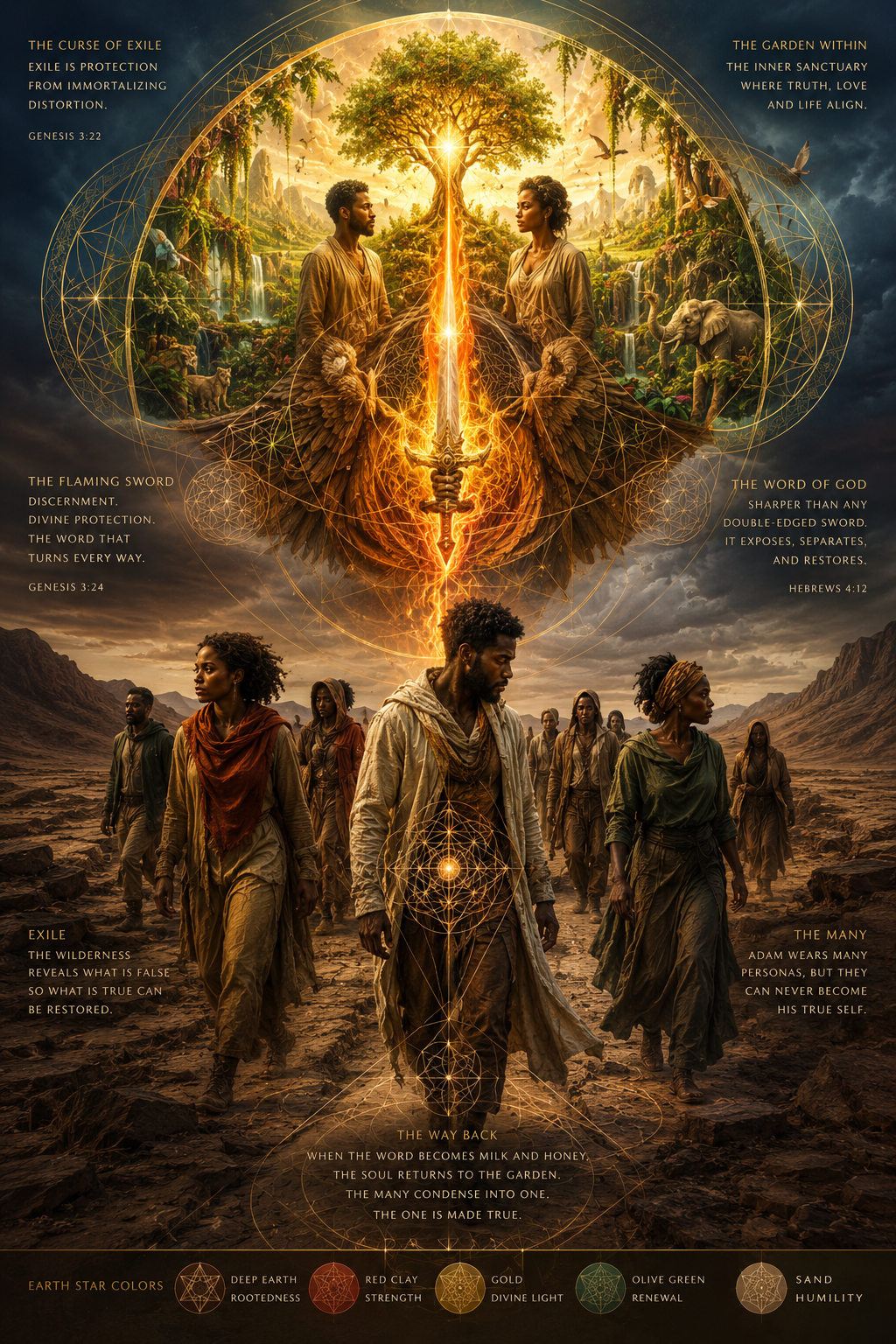
The Curse of Exile
The Flaming Sword and the Way Back to the Garden
Exile Is More Than Separation
The Curse of Exile is often understood as banishment:
being cast out,
cut off,
removed from home,
community,
or divine presence.
But spiritually, exile is something even deeper.
Exile is the condition of inner separation.
It is what happens when Adam becomes fragmented against himself.
In scripture, exile appears repeatedly:
Adam and Eve leaving Eden,
Cain wandering eastward,
Israel driven into captivity,
Nebuchadnezzar losing his kingdom and his mind,
the prodigal son wandering into famine,
and even Christ entering the wilderness before ministry.
These are not merely historical events.
They are mirrors of the inner kingdom.
They describe what happens when the soul loses coherent alignment with God.
The Garden Within
The Garden of Eden represents more than a physical location.
The Garden is the protected inner sanctuary of the soul.
It is the place where:
- divine intelligence flows freely,
- truth is naturally perceived,
- desire remains aligned,
- and communion with God is unobstructed.
The Garden is the coherent inner world.
It is the mind before fragmentation fully governs it.
Within the Garden:
- Adam is whole,
- Eve is properly aligned as creative intelligence,
- and the Tree of Life remains accessible.
The Garden is not merely paradise.
It is lawful inner order.
The Real Danger in Eden
Most interpretations focus on sin itself.
But Genesis reveals something even more important:
the danger of immortalized distortion.
After Adam and Eve eat from the Tree of Knowledge, God says:
“And now, lest he put forth his hand, and take also of the tree of life, and eat, and live forever…”
— Genesis 3:22
This changes everything.
The exile is not merely punishment.
The exile is protection.
If Adam remained in the Garden while distorted, fragmentation would become eternalized.
Misalignment would stabilize permanently.
Redemption would become impossible.
The personas Adam “puts on” throughout experience would never condense into coherent being.
The Many would never become One.
The One would never become True.
The Many Faces of Adam
Within the human experience, Adam develops many personas:
- survival personas,
- fear personas,
- seduction personas,
- power personas,
- performance personas,
- wounded personas,
- spiritual personas,
- social personas,
- inherited personas.
These personas are not evil in themselves.
Many are adaptive.
Many emerge to survive environments,
navigate pain,
gain acceptance,
avoid rejection,
or preserve psychological stability.
But they are not meant to become eternal identity.
They are temporary structures.
Fractal expressions.
Masks formed during the journey.
Without exile,
without limitation,
without suffering,
without confrontation,
Adam could become permanently identified with the masks.
The false self would stabilize.
Fragmentation would become identity.
The Flaming Sword
After driving Adam from the Garden, God places cherubim and a flaming sword at the east of Eden:
“So he drove out the man; and he placed at the east of the garden of Eden Cherubims, and a flaming sword which turned every way, to keep the way of the tree of life.”
— Genesis 3:24
The flaming sword is often interpreted as divine judgment.
But it is more precise than that.
The sword is discernment.
It guards access to immortality until coherence is restored.
The sword turns every way because distortion enters from every direction:
- pride,
- fear,
- shame,
- self-deception,
- false innocence,
- misaligned desire,
- spiritual arrogance,
- survival attachment,
- self-betrayal.
The sword tests all things.
Only truth survives its fire.
The Sword and the Word
The flaming sword of Eden directly parallels Hebrews 4:12:
“For the word of God is living and active, sharper than any double-edged sword…”
— Hebrews 4:12
This is not accidental.
The sword guarding Eden and the sword of the Word are spiritually connected.
The Word:
- pierces illusion,
- separates soul from spirit,
- exposes hidden motives,
- cuts through self-deception,
- reveals distortion,
- and discerns the true intentions of the heart.
The same sword that bars the way back to the Tree of Life is also the sword that opens the way back.
This is why the Word feels different depending on the condition of Adam’s inner kingdom.
Why the Word Feels Like Fire
To the aligned self, the Word nourishes.
To the misaligned self, the Word burns.
The same truth can feel:
- comforting,
- terrifying,
- healing,
- exposing,
- loving,
- or unbearable,
depending on what it encounters within Adam.
This is why scripture describes God as:
- consuming fire,
- living water,
- righteous judge,
- loving father.
God does not change.
Adam’s condition changes.
When distortion governs:
- truth feels invasive,
- accountability feels cruel,
- conviction feels like attack,
- alignment feels restrictive,
- exposure feels like death.
So Adam hides.
Just as in Eden:
“I was afraid… and I hid myself.”
The exile therefore becomes partially self-imposed.
Adam banishes himself from divine presence because the false self cannot tolerate sustained exposure to truth.
The Wilderness of Exile
Exile creates wandering.
Cain wanders.
Israel wanders.
The prodigal wanders.
Why?
Because exile destabilizes false structures.
The wilderness is where illusion collapses.
It is where personas lose their ability to fully protect Adam from himself.
Without exile, distortion could comfortably sustain itself forever.
But the wilderness introduces:
- limitation,
- pressure,
- instability,
- suffering,
- uncertainty,
- mortality,
- confrontation.
These conditions force revelation.
The masks begin to crack.
The personas begin to fail.
The deeper self begins searching for coherence.
Milk and Honey
At first, the Word feels like a sword.
Later, it becomes nourishment.
This is the transformation of Adam.
Until God’s words become like milk and honey, Adam remains afraid of the presence of God.
But once alignment begins:
- truth no longer feels like annihilation,
- correction no longer feels like hatred,
- conviction no longer feels like condemnation.
The same Word that once burned now heals.
The same sword that once terrified now liberates.
The same presence that once exposed now restores.
Milk and honey symbolize:
- nourishment,
- sweetness,
- covenant,
- abundance,
- safety,
- and communion.
The aligned soul experiences the Word as life-giving.
The Way Back to the Garden
Adam does not return to the Garden by avoiding the sword.
Adam returns by allowing the sword to complete its work.
The Word cuts away:
- false identity,
- misaligned desire,
- self-deception,
- fragmentation,
- and persona attachment.
Not to destroy Adam.
To reveal him.
The sword is terrifying to the false self because the false self knows it cannot survive truth.
But the true Adam can.
And eventually, through alignment with God:
- the Many condense into One,
- the One stabilizes into Truth,
- and Adam becomes coherent enough to safely approach the Tree of Life again.
This is redemption.
Not God changing His mind about Adam.
Adam becoming whole enough to dwell in divine presence without distortion governing the kingdom within.
The exile preserves the possibility of restoration.
Without the flaming sword,
fragmentation would become eternal.
But because of the sword,
the way back remains open.