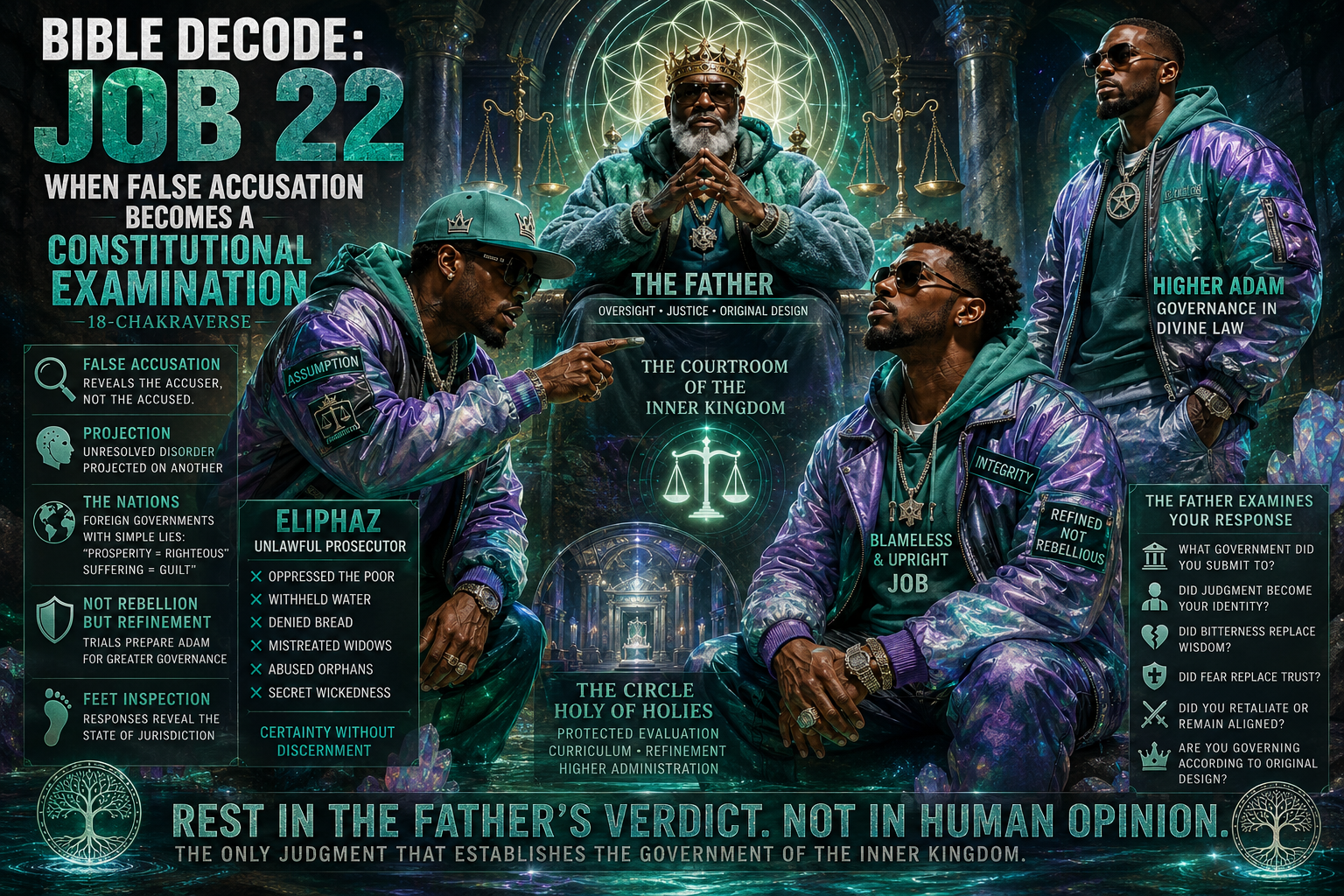
When False Accusation Becomes a Constitutional Examination
Bible Decode: Job Chapter 22
By Alchemist Iris Chapman
Within the 18-ChakraVerse, Job 22 is far more than a heated dialogue between historical men. It is a full-scale constitutional courtroom taking place within Adam’s Inner Kingdom.
When Eliphaz speaks, he acts as an internal persona attempting to diagnose the cause of Adam’s deep suffering. Yet his diagnosis reveals a profound constitutional danger: assuming that visible suffering must always prove hidden guilt.
This chapter serves as a masterclass in projection, false judgment, constitutional inspection, and the Father’s higher administration.
The Constitutional Setting
To understand Job 22 through this lens, we must first map the governing entities within the courtroom of the Inner Kingdom:
- The Father oversees the entirety of the constitutional process.
- Higher Adam governs in accordance with divine law and Original Design.
- Job represents Adam undergoing intensive constitutional examination.
- Eliphaz represents a persona attempting to explain suffering through an incomplete, humanly inherited constitutional framework.
Rather than seeking genuine revelation from the Father, Eliphaz relies upon assumption. The inevitable result is a false constitutional verdict.
Eliphaz as the Unlawful Prosecutor
Throughout Job 22, Eliphaz steps into the role of an overconfident prosecutor, leveling severe charges against Job. He declares that Job must have secretly committed a litany of social and spiritual crimes:
- Oppressed the poor and vulnerable
- Withheld water from the thirsty
- Denied bread to the hungry
- Mistreated widows and left them empty-handed
- Abused and crushed the power of orphans
- Lived in secret, deep-seated wickedness
                [ ELIPHAZ: UNLAWFUL PROSECUTION ]
                               │
            ┌──────────────────┴──────────────────┐
            ▼                                     ▼
   Fabrics of Assumption                 Narrative Truth
   • Accuses Job of tyranny             • Job 1: "Blameless & upright"
   • Assumes hidden corruption           • Job 29: Deliverer of poor/orphans
   • mistakes certainty for discernment  • Tested for refinement, not guilt
None of these charges are supported by the text. In fact, earlier chapters explicitly portray Job as the exact opposite—a champion of the oppressed who delivered the fatherless and made the widow’s heart sing.
Within the Inner Kingdom, Eliphaz represents one of the greatest threats to spiritual maturity: the persona that mistakes unyielding certainty for true discernment.
False Accusation as Projection
Metaphysical and psychological traditions alike observe that intense false accusations rarely describe the accused; instead, they expose the accuser.
Constitutional Definition: Projection occurs whenever an internal persona attributes its own unresolved governance or suppressed disorder to another constitutional jurisdiction.
Instead of engaging in honest self-examination, the persona externalizes its internal chaos. Eliphaz demonstrates this dynamic seamlessly. Unable to reconcile Job’s catastrophic suffering with his rigid theological model, he projects hypothetical corruption onto Job’s character. His words reveal the boundaries of his own narrow framework rather than Job’s actual spiritual condition.
       [ UNRESOLVED INNER DISORDER ]
                    │
                    ▼  (Refuses Self-Examination)
       [ PROJECTS ONTO NEIGHBOR ]
                    │
                    ▼  (Formulates Verdict)
       [ "Suffering MUST equal Guilt" ]
The Nations at Work
In the 18-ChakraVerse, the Nations symbolize competing, external systems of governance that seek to rule Adam’s consciousness.
Eliphaz unknowingly speaks as an ambassador from one of these foreign constitutions. Its core doctrine is remarkably simplistic:
- Prosperity proves righteousness.
- Suffering proves guilt.
This foreign government remains widely active today. It is the root system behind modern legalism and prosperity dogmas—assuming every illness, financial loss, personal tragedy, or season of disappointment is a direct result of divine punishment.
The Father never endorses this mechanical formula.
Job’s Inner Kingdom: Refinement, Not Rebellion
Job’s realm is not collapsing due to hidden rebellion; it is undergoing intentional constitutional refinement.
The Father has already testified to Job’s integrity before the heavenly court (“Have you considered my servant Job?”). Therefore, this trial is educational rather than punitive. Within the Circle—the Holy of Holies—Adam’s curriculum continually evolves according to his level of constitutional maturity.
An intense examination does not imply failure. More often than not, it indicates readiness for greater governance and higher authority.
False Accusation as Constitutional Inspection
A striking pattern runs throughout the biblical narrative: major transitions in constitutional authority are almost always preceded by severe false accusations.
┌──────────────────────────────────────────────────────────┐
│             HISTORICAL PATTERNS OF INSPECTION            │
├─────────────┬────────────────────────────────────────────┤
│ Joseph      │ Accused of assault before royal elevation  │
│ David       │ Accused of treason by Saul                 │
│ Jeremiah    │ Accused of defection during national crisis│
│ Daniel      │ Accused of lawbreaking by rival governors  │
│ Jesus       │ Accused of blasphemy before resurrection   │
│ Paul        │ Accused of sedition throughout the empire  │
└─────────────┴────────────────────────────────────────────┘
Each of these figures endured charges that vastly exceeded the physical evidence. Within our framework, this reveals a profound principle: false accusation functions as a constitutional inspection.
It inspects not merely the accused, but the governing condition of everyone in the room. Every participant is evaluated simultaneously.
The Mirror of Projection
An accusation acts as a multidimensional mirror, asking distinct questions of every entity involved:
- For the Accused: “Do you know your constitutional standing without requiring public approval?”
- For the Accuser: “Are you discerning through the Father’s wisdom or through inherited assumptions?”
- For the Observers: “Which government will you yield to without checking the evidence?”
The moment an accusation is leveled, every voice in the Inner Kingdom reveals which government it currently serves.
Reputation Versus Constitutional Identity
One of the vital distinctions in Job 22 lies in the contrast between what man measures and what the Father sustains:
- Reputation belongs to public opinion, external chatter, and fragile social consensus. It fluctuates constantly.
- Constitutional Identity belongs to the Father. It remains established by Original Design and cannot be altered by false testimony.
Eliphaz attacks Job’s reputation, but the Father safeguards Job’s constitutional identity. Learning to separate these two concepts is essential for anyone called to mature governance.
The Earth Star Office and the Feet
Throughout the Gospels, Higher Adam enters various cities to inspect their constitutional alignment. Acceptance brings restoration; rejection exposes foreign governance. The physical act of washing—or shaking the dust from—the feet signifies the status of the Earth Star office before moving to the next jurisdiction.
Although Job 22 occurs long before the Gospels, the same principle is at work. A jurisdiction reveals its nature by how it responds to truth.
Eliphaz’s venomous accusations expose the state of his own constitutional ground. Symbolically speaking, his “feet” stand upon the shifting sands of assumption rather than the firm rock of divine discernment.
The Constitutional Danger of Certainty
Job 22 serves as a stark warning against confusing personal confidence with spiritual wisdom.
Eliphaz speaks with absolute conviction, yet nearly every conclusion he reaches is factually and spiritually wrong. Constitutional maturity demands a much harder discipline: remaining teachable.
The Father continually weighs governing intention, not confident rhetoric. Many of the loudest, most authoritative voices within our own consciousness are merely inherited traditions masquerading as Original Design.
The Father’s Examination
Inside the Circle of Protected Evaluation, the Father does not conduct a trial to see if Adam was misunderstood. He already knows the truth. Instead, He examines Adam’s response:
“What government did you submit to once the accusation was made?”
“Did another persona’s judgment become your identity?”
“Did bitterness displace wisdom?”
“Did fear replace trust?”
“Did you retaliate, or did you remain constitutionally aligned?”
“Are you still governing according to Original Design?”
The Father’s evaluation is never primarily about what others say. It is entirely about the government Adam chooses to embody under pressure.
Constitutional Reflection
Job 22 reminds us that false accusations ultimately expose competing internal governments far more clearly than they expose personal guilt.
Projection lays bare unresolved governance. Human assumptions expose inherited constitutions. Public opinion exposes the influence of cultural rule.
Yet the Father’s gaze always reaches deeper. Within the Holy of Holies, public reputation is secondary to constitutional reality. The Father’s goal is not to preserve Adam from being misunderstood, but to ensure he can remain faithful to Original Design even when surrounded by total misunderstanding.
For those walking the path toward conscious co-rulership, Job 22 is an invitation to lay down the need for human vindication and rest entirely in the Father’s constitutional verdict—the only judgment that permanently establishes the government of the Inner Kingdom.