The Constitution of the Inner Government
A Biblical Framework for Conscious Self-Governance
By Alchemist Iris Chapman
“For unto us a child is born, unto us a son is given: and the government shall be upon his shoulder…” — Isaiah 9:6
Every enduring kingdom requires government.
Without law, power becomes arbitrary. Without jurisdiction, offices compete for territory. Without judicial review, temporary survival measures harden into permanent rule. Without an objective governing standard, whichever voice shouts the loudest inside your consciousness seizes total control.
The Inner Kingdom is no different.
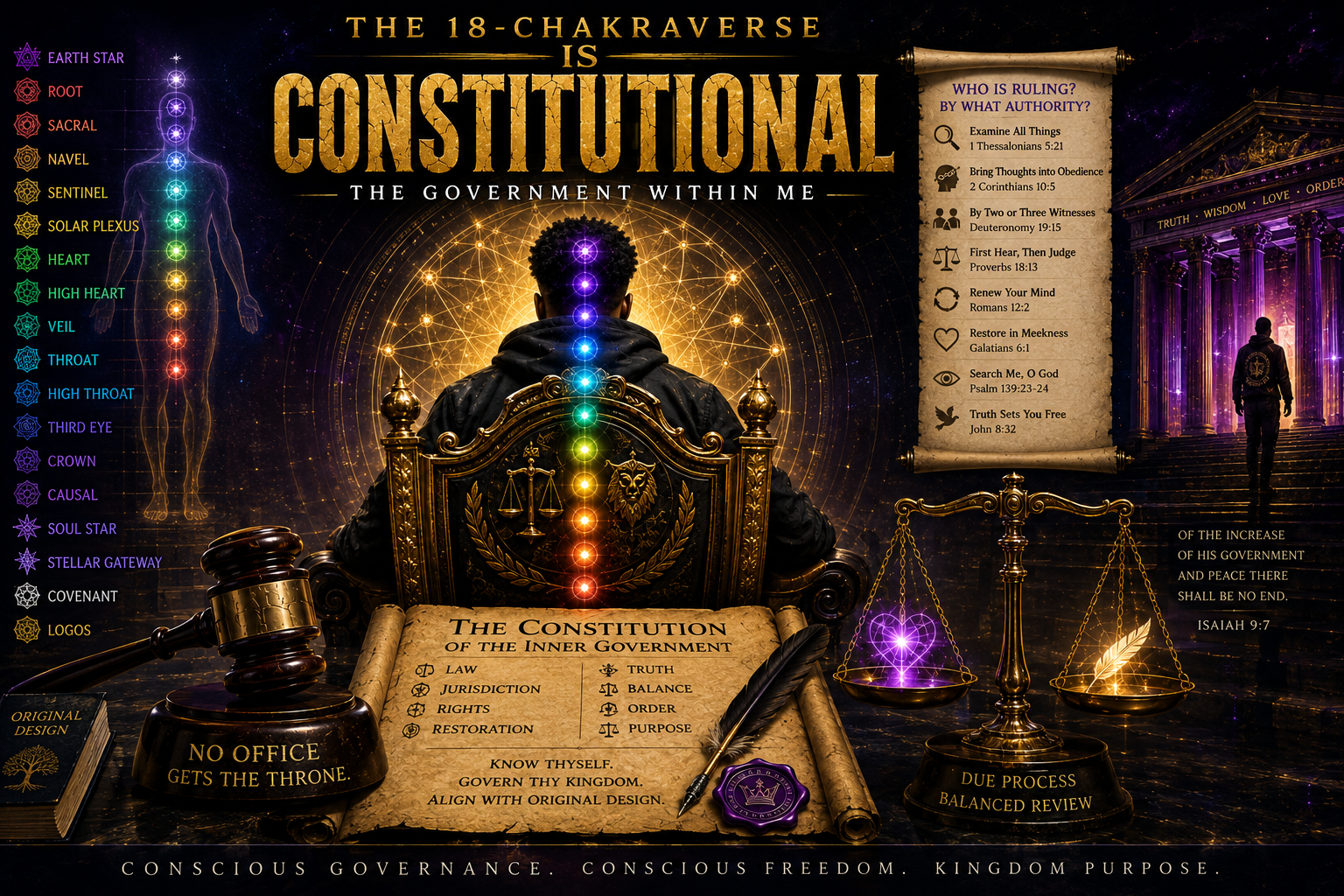
Within the 18-ChakraVerse framework, the human interior operates as a vast commonwealth containing thoughts, emotions, memories, bodily intelligence, instincts, desires, ancestral inheritances, spiritual faculties, conscious intentions, and eighteen constitutional chakra offices.
These internal forces are not your enemies; they are inhabitants of the kingdom. They carry legitimate functions, present critical testimony, and hold genuine needs. But they do not all possess the same jurisdiction.
The fundamental constitutional problem of human life is never: How do I silence everything happening inside me?
It is: Who is ruling—and by what authority?
The Constitution of the Inner Government was forged to answer that question. Its purpose is to establish lawful relationship among the faculties of the interior realm, protect conscious choice, regulate the use of authority, restore wounded faculties, prevent the unlawful concentration of power, and bring the whole kingdom into embodied alignment with the living Logos.
Scripture repeatedly presents this exact blueprint. The metaphors adapt to the era, but the constitutional architecture remains eternal.
The Government Shall Be Upon His Shoulder
Isaiah’s ancient prophecy concerning divine order declares:
“And the government shall be upon his shoulder…” — Isaiah 9:6
The significance of this declaration extends far beyond external political structures. Government establishes order. It defines legitimate authority, outlines specific jurisdictions, places limits on subordinate offices, and ensures every part serves the whole.
Isaiah continues:
“Of the increase of his government and peace there shall be no end…” — Isaiah 9:7
Notice the exact biblical sequence: government precedes peace.
Peace is not the passive absence of conflict, nor is it the numbness of spiritual bypass. True peace is the structural state that emerges when power is rightly ordered.
The objective of conscious self-governance is not the annihilation of emotion, instinct, appetite, memory, or defense. The goal is to bring each capacity into lawful relationship so that no temporary emergency, fear, appetite, or persona can usurp the throne.
The Logos Is the Supreme Constitutional Authority
At the head of the Inner Government stands the Logos.
“In the beginning was the Word, and the Word was with God, and the Word was God… And the Word was made flesh, and dwelt among us…” — John 1:1, 14
In the Greek text, Word is Logos—the foundational ordering principle, living divine intelligence, and constitutional standard against which every subordinate power is measured.
                  ┌───────────────────────────────┐
                  │           THE LOGOS           │
                  │ (Supreme Constitutional Bench)│
                  └──────────────┬────────────────┘
                                 │
     ┌───────────────────────────┼───────────────────────────┐
     ▼                           ▼                           ▼
┌──────────────┐          ┌──────────────┐          ┌──────────────┐
│  Root Office │          │ Heart Office │          │ Third Eye    │
│  (Danger)    │          │ (Consequence)│          │ (Vision)     │
└──────────────┘          └──────────────┘          └──────────────┘
This structural hierarchy protects the entire commonwealth:
- The Root can report survival risk.
- The Sacral can report desire and creative appetite.
- The Heart can report relational impact.
- The Sentinel can report perceived threat.
- The Solar Plexus can execute decisive action.
- The Third Eye can interpret subtle patterns.
- The Crown can perceive transcendent unity.
Yet none of these individual offices is authorized to become the Logos. No part may crown itself ruler over the whole.
When an internal movement arises, the constitutional question is never simply: What do I feel? or What do I want? The governing question must be: What does this testimony mean when brought under the standard of Truth?
Many Members, One Body
Paul provides one of the clearest structural designs for this interior architecture:
“For as the body is one, and hath many members… so also is Christ. But now hath God set the members every one of them in the body, as it hath pleased him. And the eye cannot say unto the hand, I have no need of thee…” — 1 Corinthians 12:12, 18, 21
He reinforces this in his epistle to the Romans:
“For as we have many members in one body, and all members have not the same office…” — Romans 12:4
Within the 18-ChakraVerse, every chakra office possesses a distinct jurisdiction, responsibility, aligned expression, and structural boundary:
| Constitutional Principle | Functional Reality in the Inner Kingdom |
| Separation of Powers | An office of perception cannot dictate physical execution without review. |
| Jurisdictional Boundary | Fear may report perceived risk, but it cannot legislate life choices. |
| Functional Hierarchy | Equality of value does not mean equal authorization for every task. |
| Unified Objective | Every member operates in mutual necessity under the Logos. |
Usurpation occurs the moment a legitimate faculty overreaches its functional post. Fear is an alert system; it cannot be permitted to declare all uncertainty as danger. Desire identifies movement and vitality; it cannot become law simply because it is intense. Love offers connection; it cannot dissolve lawful boundaries. Insight generates vision; it cannot fabricate facts without grounding.
Due Process in the Court of Consciousness
Scripture does not instruct us to accept every thought as reality simply because it entered our mental atmosphere.
“…bringing into captivity every thought to the obedience of Christ.” — 2 Corinthians 10:5
Thoughts, sensations, memories, and impulses are citizens appearing before the bench. They have the right to be heard and examined, but they carry no automatic authority to legislate behavior.
[Impulse Arrives] ──► [The Injunction of Pause] ──► [Corroboration of Witnesses] ──► [Lawful Action]
1. Test the Spirits
“Beloved, believe not every spirit, but try the spirits whether they are of God…” — 1 John 4:1
Testing requires an objective standard. The presence of a voice, a sudden wave of panic, or an intense spiritual impression is not self-authenticating. The kingdom tests whether the communication aligns with structural truth or emotional distortion.
2. The First Witness Does Not Win
“He that answereth a matter before he heareth it, it is folly and shame unto him. He that is first in his own cause seemeth just; but his neighbour cometh and searcheth him.” — Proverbs 18:13, 17
The first witness to take the inner stand is usually the loudest—an acute panic, an old resentment, or an urgent craving. Due process requires cross-examination. We do not condemn the witness, nor do we immediately hand down a ruling based on opening arguments alone.
3. Multiple Witnesses Required
“At the mouth of two witnesses, or at the mouth of three witnesses, shall the matter be established.” — Deuteronomy 19:15
When the Sentinel cries out, “This situation is catastrophic,” the High Court cross-examines the claim across multiple jurisdictions:
- What does the physical body actually register?
- What do concrete facts confirm versus what memory projects?
- Is this threat happening right now, or is it a past echo?
- What do the other constitutional offices report?
4. The Injunction of Pause
“Let every man be swift to hear, slow to speak, slow to wrath.” — James 1:19
The Injunction of Pause is an internal stay of execution. It halts automatic physical reaction while conscious review takes place. You do not hit send, sever the bond, take the rash oath, or sign away your sovereignty under immediate emotional pressure. You issue the injunction, pause the room, and let the government convene.
Reviewing Ancient Law and Ending Martial Rule
Not every operational law running within your nervous system was authored in truth. Many internal bylaws were codified during childhood, inherited through family lineages, or enacted during acute trauma:
“And be not conformed to this world: but be ye transformed by the renewing of your mind…” — Romans 12:2
- “I must stay invisible to remain safe.”
- “I must appease everyone to prevent abandonment.”
- “I have to control every variable to survive.”
Renewal means these old survival edicts are subject to judicial review. Furthermore, ancestral patterns do not dictate constitutional identity:
“The son shall not bear the iniquity of the father…” — Ezekiel 18:20
Lineage patterns may explain historical conditions, but they possess no inherent governing authority over your present soul.
[Emergency Occurs] ──► [Survival Office Takes Helm] ──► [Emergency Passes] ──► [Return to Logos Order]
When crisis strikes, survival mechanisms take temporary command—fight, flight, freeze, or isolate. But as Ecclesiastes 3:1 reminds us, “To every thing there is a season.”
A constitutional crisis occurs when the threat recedes, yet the emergency office refuses to relinquish martial law. A survival reflex that was life-saving during childhood becomes tyrannical when maintained throughout adulthood. The defense is not evil; its term of office has simply expired.
Shadow-in-Service and the Spirit of Restoration
When an inner defense system overreaches, the mandate is restoration, not internal civil war:
“Brethren, if a man be overtaken in a fault, ye which are spiritual, restore such an one in the spirit of meekness…” — Galatians 6:1
We acknowledge the protective labor of our Shadow-in-Service personas. The part of you that learned to isolate, fight preemptively, or numb pain did so to shield the kingdom when other resources were unavailable.
We do not execute these parts. We thank them for their service, relieve them of expired emergency duties, retrain their skills, and integrate them back into lawful service.
“There is therefore now no condemnation to them which are in Christ Jesus…” — Romans 8:1
Misalignment is not eternal identity. Accountability is maintained without self-hatred, and discernment is applied without self-condemnation.
The High Court of Conscious Review
True freedom is not lawless indulgence (“I will not be brought under the power of any” — 1 Cor. 6:12). It is the realization of temperance—governed power and conscious mastery.
To maintain this order, we willingly enter the judicial prayer of David:
“Search me, O God, and know my heart: try me, and know my thoughts: And see if there be any wicked way in me, and lead me in the way everlasting.” — Psalm 139:23–24
Conscious review regularly asks:
- Who is currently ruling the seat of consciousness?
- Which chakra office is overextended or operating outside its post?
- Which citizen has been mistaken for the King?
- Which expired emergency agreement needs to be repealed?
- What does balanced, Logos-centered government require right now?
When internal government is established, outer life is transformed. Proverbs 4:23 instructs us to guard the heart, for from it flow the issues of life. You cannot move from unconscious construction to conscious creation until your inner government is in order.
The 18-ChakraVerse is not a collection of warring impulses—it is a structured, living commonwealth.
Many members. Many offices. Many witnesses. One kingdom under the sovereign authority of the Logos.