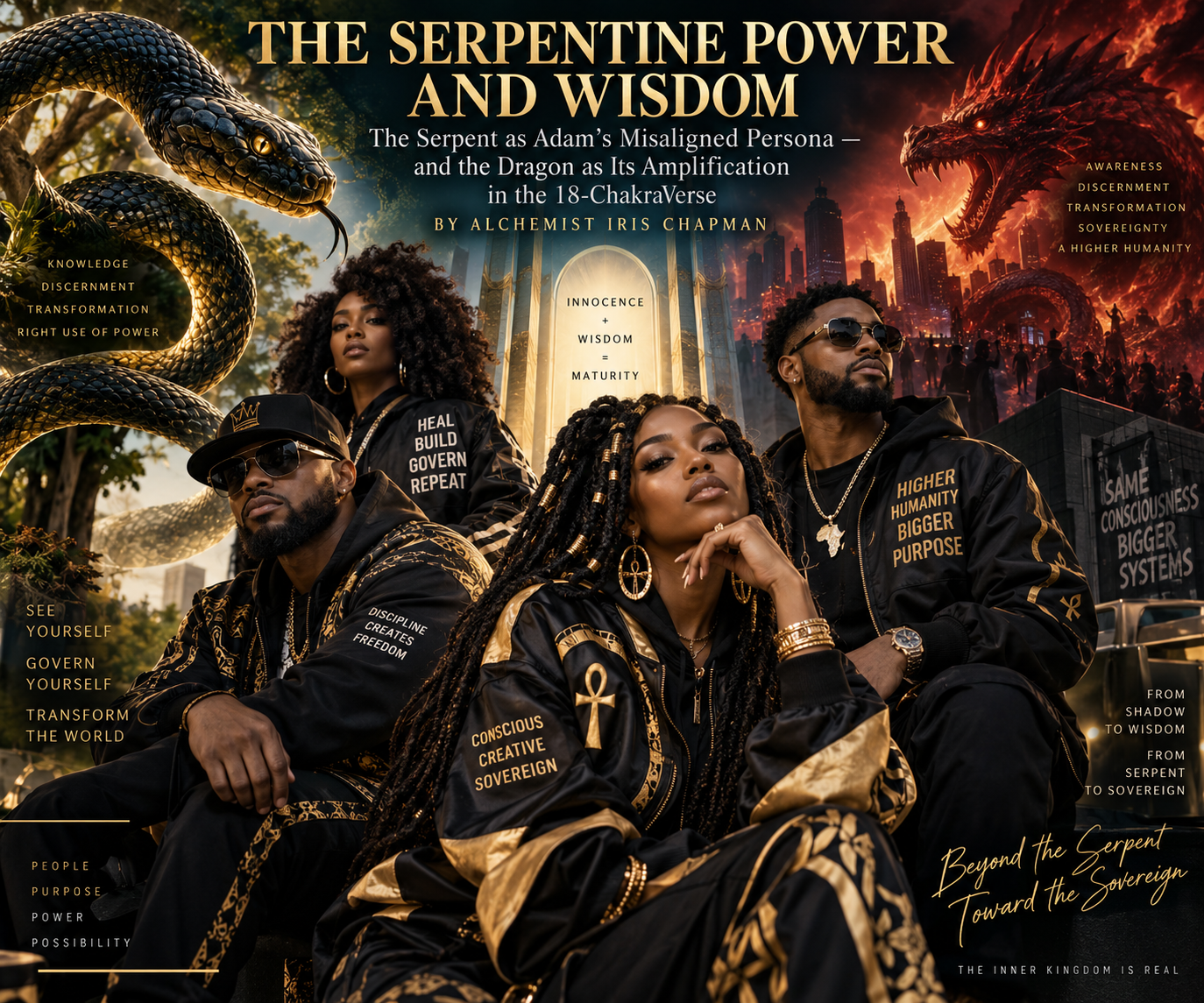
The Serpent as Adam’s Misaligned Persona—and the Dragon as Its Amplification in the 18-ChakraVerse
By Alchemist Iris Chapman
For thousands of years, the serpent has occupied one of the most consequential positions in biblical interpretation.
The creature appears in Eden as “more subtle than any beast of the field” (Genesis 3:1). Later canonical imagery associates serpents with deception, venom, predation, crookedness, accusation, and opposition. By the Book of Revelation, the imagery intensifies until we encounter not merely a whispering reptile, but a leviathan: a great red dragon.
Yet Jesus gives His disciples an instruction that complicates any view reducing the serpentine entirely to evil:
“Be ye therefore wise as serpents, and harmless as doves.”
— Matthew 10:16
Jesus does not command Adam to amputate serpentine intelligence or remain ignorant of its dynamics. He instructs Adam on how that intelligence must be lawfully governed.
Within the 18-ChakraVerse, this opens an urgent possibility: What if the serpent is not merely an external adversary outside of Adam? What if the serpent is an exact portrait of Adam himself operating in a distinct, misaligned state of consciousness? And what if the dragon represents what occurs when that serpentine state becomes organized, collective, and technologically amplified across systemic grids?
Instead of asking, “Who is the serpent?” we must ask: What does Adam become when his God-given vitality and intelligence operate outside alignment with the Father?
The answer is simple: he becomes serpentine.
The Serpent Is an Internal Persona of Adam
Within the 18-ChakraVerse, Adam represents corporate humanity—human consciousness traversing developmental stages, dimensions, and structural initiations. Adam is not static. Throughout this developmental curriculum, he adopts functional personas to engage reality:
- Builder and King
- Priest and Prophet
- Warrior and Servant
- Judge and Liberator
- Oppressor and Accuser
- Healer and Son
The serpent is another such persona. It describes Adam when intelligence detaches from innocence, when strategic acumen divorces covenant love, when biological vitality operates outside lawful administration, and when consciousness learns to manipulate the very creation it was commissioned to steward.
The serpent is not an external scapegoat; it is a mirror. It forces Adam to confront the unintegrated shadow of his own constitutional power.
                  ┌──────────────────────────────┐
                  │      Adam (Corporate Man)    │
                  └──────────────┬───────────────┘
                                 │
                 ┌───────────────┴───────────────┐
                 ▼                               ▼
       [ Aligned Consciousness ]      [ Misaligned Persona ]
       Higher Octave / Transmuted      Lower Octave / Inverted
       Dove: Innocence & Governance    Serpent: Cunning & Predator
                 │                               │
                 └───────────────┬───────────────┘
                                 ▼
                     [ Collective Aggregation ]
                                 ▼
                    The Dragon (Scaled System)
The Energetic Architecture: Chakric Anatomy of the Serpent
In the expanded 18-center system, consciousness does not merely float as abstract philosophy; it roots into energetic conduits, autonomic circuitry, and dimensional chakras. The serpentine state represents an operational hijacking of specific centers when consciousness drops out of the High Heart (Thymus Gate) and the Crown–Transpersonal Pillars:
[ Center 12–18: Transpersonal & Celestial Gates ]  ── (Cut off by inverted self-will)
                        │
[ Center 6: Third Eye / Neural Discernment ]       ── Inverted to: Surveillance & Calculation
                        │
[ Center 5: Throat / Creative Word ]               ── Inverted to: Rhetorical Venom & Deceit
                        │
[ Center 4: High Heart / Covenant Altar ]         ── Bypassed entirely (No conscience/dove)
                        │
[ Center 3: Solar Plexus / Will & Fire ]          ── Inverted to: Dominance & Territorial Ego
                        │
[ Center 2: Sacral / Generative Waters ]           ── Inverted to: Predatory Appetite & Coercion
                        │
[ Center 1: Root / Primal Foundation ]             ── Trapped in: Survival Panic & Paranoia
- The Root & Sacral Centers (Centers 1 & 2): Primal Panic & Exploitation. When disconnected from divine providence, the root center collapses into chronic survival fear. The serpent crawls on its belly in the “dust” (carnal matter). The life force that should generate lawful life becomes consumed with hoarding, scarcity, and territorial paranoia.
- The Solar Plexus (Center 3): Usurped Authority. Raw personal will divorces itself from divine authority. Here, the serpent calculates power dynamics, seeking unilateral control over people and outcomes rather than surrendering to divine government.
- The Throat Center (Center 5): The Poison of Asps. Scripture frequently diagnoses the serpent at the vocal gate: “The poison of asps is under their lips” (Romans 3:13). When the throat center is severed from the Heart, speech ceases to be creative and life-giving; it becomes venomous rhetoric, gaslighting, and narrative manipulation designed to paralyze an opponent.
- The Third Eye (Center 6): Surveillance Over DiscernmentThe natural capacity for vision becomes distorted into hyper-vigilance, cold calculation, and finding vulnerabilities in others to exploit.
- The Missing High Heart (Center 4): The Severed Dove. Crucially, serpentine consciousness operates with the bridge between the lower operational centers (1–3) and the upper divine centers (5–7+) broken. Without the High Heart, there is no empathy, no covenant fidelity, and no capacity for self-giving love.
“More Subtle Than Any Beast”: The Hebrew Root
Genesis 3:1 gives the serpent its defining characteristic: craftiness. The Hebrew root (‘arûm, עָרוּם) does not denote ignorance, stupidity, or brutishness. It signifies someone smooth, cautious, shrewd, and calculating. The serpent:
- Observes the terrain silently without premature revelation.
- Identifies systemic vulnerabilities and seam-lines in consciousness.
- Understands the nuances and structural loopholes of language.
- Reframes commands to introduce alternative realities without explicit coercion.
These are formidable constitutional capacities. Adam was designed to cultivate acute pattern recognition, foresight, strategic timing, and diagnostic acumen to govern creation responsibly.
When aligned with the Father through the Heart, these capacities manifest as holy discernment. When divorced from divine order, they degenerate into self-serving cunning.
The Serpent and the Dove: Integrating Matthew 10:16
Jesus establishes the balanced ideal for the mature corporate Son:
- Serpentine Faculties: Observation, tactical strategy, pattern recognition, timing, adaptability, conservation of force, and an acute awareness of hidden power dynamics.
- Columbine (Dove) Faculties: Innocence, peace, purity of motive, harmlessness, compassion, and unfiltered transparency before the Father.
Sever the serpent, and Adam becomes naïve, fragile, and easily devoured by predatory systems. Sever the dove, and Adam becomes a calculating, ruthless tactician.
Jesus does not advocate balance by dilution; He demands the simultaneous activation of both poles. The serpent’s tactical mastery must be circumcised by the dove’s absolute purity. Wisdom must become sharp enough to recognize every trap without ever constructing one.
When Serpents Become Dragons: The Scaled Grid
Revelation 12:9 establishes the evolutionary continuity: “And the great dragon was cast out, that old serpent…” The dragon is not a novel species; it is the old garden serpent scaled across generations, institutions, and systemic agreements.
[ Individual Serpent Persona ]
        │ (Coordination, Technology, Cultural Buy-In)
        ▼
[ Institutional Machinery & Megastructures ]
        │ (Concentration of Unchecked Power)
        ▼
[ The Dragonic World-System ]
A serpent becomes a dragon when misaligned consciousness aggregates sufficient mass:
- Individual survival panic consolidates into an extractive, debt-based economic engine.
- Personal ego and domination scale into militarized, imperial warfare.
- Personal deceit and narrative manipulation build automated propaganda matrices.
- Fragmented carnality manufactures mass-media addictions engineered to harvest human attention and creative fire.
Dragons do not arrive uninvited from foreign realms; Adam builds them. Adam supplies the labor, the finance, the technological invention, and the daily compliance that animates the beast.
Yet the dragon is simply stronger, never wiser. Systemic size and technological acceleration must never be mistaken for constitutional maturity. A dragon is merely an unintegrated serpent with access to institutional scale.
The Wilderness Typology: The Raised Bronze Serpent
In Numbers 21, when Israel is afflicted by fiery serpents, Moses is instructed to craft a profound remedy:
“Make thee a fiery serpent, and set it upon a pole: and it shall come to pass, that every one that is bitten, when he looketh upon it, shall live.”
— Numbers 21:8
Why does God command the construction of the very image causing death? Why did Moses not forge a dove, a lamb, or an altar?
In ancient metallurgy and biblical architecture, bronze (nechoshet) signifies judgment, endurance, and the purification of carnal fire. By hoisting the bronze serpent onto the pole, Moses commanded the people to stop projecting the blame onto external desert circumstances.
To look at the raised bronze serpent is to confront the unvarnished reality of the venom operating within their own nervous systems. Healing cannot occur while the disease is disowned. The venomous impulse must be exteriorized, witnessed, and appraised in the light of the objective vertical axis (the staff/spinal column).
Jesus explicitly claims this architecture in John 3:14: “And as Moses lifted up the serpent in the wilderness, even so must the Son of man be lifted up.” The lower carnal nature, pinned to the vertical pole of divine alignment, is neutralized and transmuted from a deadly sting into an instrument of illumination.
Transmuting the Centers: From Cunning to Wisdom
Spiritual evolution does not lobotomize human intellect. Like the natural serpent shedding its dead skin, Adam casts off misaligned survival mechanisms while retaining the cultivated capacities underneath:
| Constitutional Capacity | The Serpent Persona (Misaligned) | The Aligned Adam (Consecrated) |
| Root (Center 1) | Scarcity panic, hoarding, survival defense | Unshakable grounding in Divine Providence |
| Sacral (Center 2) | Predatory appetites, carnal manipulation | Pure generative life, clean creative flow |
| Solar Plexus (Center 3) | Coercion, dominance, personal empire | Dedicated strength under lawful authority |
| High Heart (Center 4) | Cold disengagement, hardened protection | Open covenant love, the purity of the Dove |
| Throat (Center 5) | Rhetorical venom, misdirection, slander | Incorruptible speech, creative truth |
| Third Eye (Center 6) | Surveillance, calculating hidden flaws | Diagnostic discernment, holistic vision |
| Collective Scale | The Devouring Dragon (Extractive Empire) | The Lawful Kingdom (Sovereign Order) |
The Constitutional Protocol: Governing the Serpent in Real Time
To hold the serpent without becoming the serpent, corporate Adam requires a practical, repeatable interior protocol. When you detect the serpentine frequency activating, execute these four steps:
[ Step 1: Catch the Venom ] ── Recognize the somatic sting in throat/belly
             │
[ Step 2: Elevate the Pole ] ── Shift attention vertically into the spine
             │
[ Step 3: Open the Thymus Gate ] ── Re-anchor the heart; clear predatory motive
             │
[ Step 4: Issue the Lawful Command ] ── Speak direct truth without manipulative leverage
- Witness the Somatic Trigger (Catch the Venom): Recognize when your nervous system drops into lower-center panic. Notice the constriction in the solar plexus or the sharp impulse to weaponize speech in the throat. Do not deny the reaction; observe it consciously.
- Elevate the Pole (Raise the Staff): Refuse to discharge retaliatory fire. Consciously draw attention up the spinal channel, disengaging from instinctual survival reactivity.
- Engage the High Heart (The Dove Calibration): Filter the tactical impulse through covenant purity. Ask: Does this action proceed from fear of lack, or from resting in divine jurisdiction? Am I using insight to protect my ego, or to steward life?
- Issue Lawful Speech (Release the Skin): Speak with absolute clarity, directness, and precision. Maintain the tactical awareness of the trap before you, but refuse to lay a counter-trap.
The serpent reveals what Adam becomes when intelligence outruns alignment. The dragon reveals what happens when that consciousness acquires collective, technological scale. The Christ pattern demonstrates what Adam becomes when serpentine mastery and columbine innocence are reunited under the Father—producing a conscious governor capable of stewarding power without corruption.