Lawful Retaliation & Mindfulness
Observing the Inner Kingdom Before Reaction Takes Control
Part of the Lawful Retaliation Healing Series
Most people live much of their lives in reaction.
Thoughts arise automatically.
Emotions escalate quickly.
Triggers activate old wounds.
The nervous system reacts before awareness fully enters the moment.
This is what mindfulness interrupts.
Within the Lawful Retaliation framework, mindfulness is not merely:
- relaxation,
- mental quietness,
- or emotional suppression.
Mindfulness becomes:
conscious observation of the inner kingdom before distortion governs behavior.
It is the practice of noticing:
- thoughts,
- emotions,
- bodily sensations,
- nervous-system shifts,
- perceptions,
- and reactions
without immediately becoming identified with them.
Mindfulness creates:
space between trigger and reaction.
And in that space:
- awareness returns,
- perception clears,
- emotional escalation slows,
- and lawful response becomes possible.
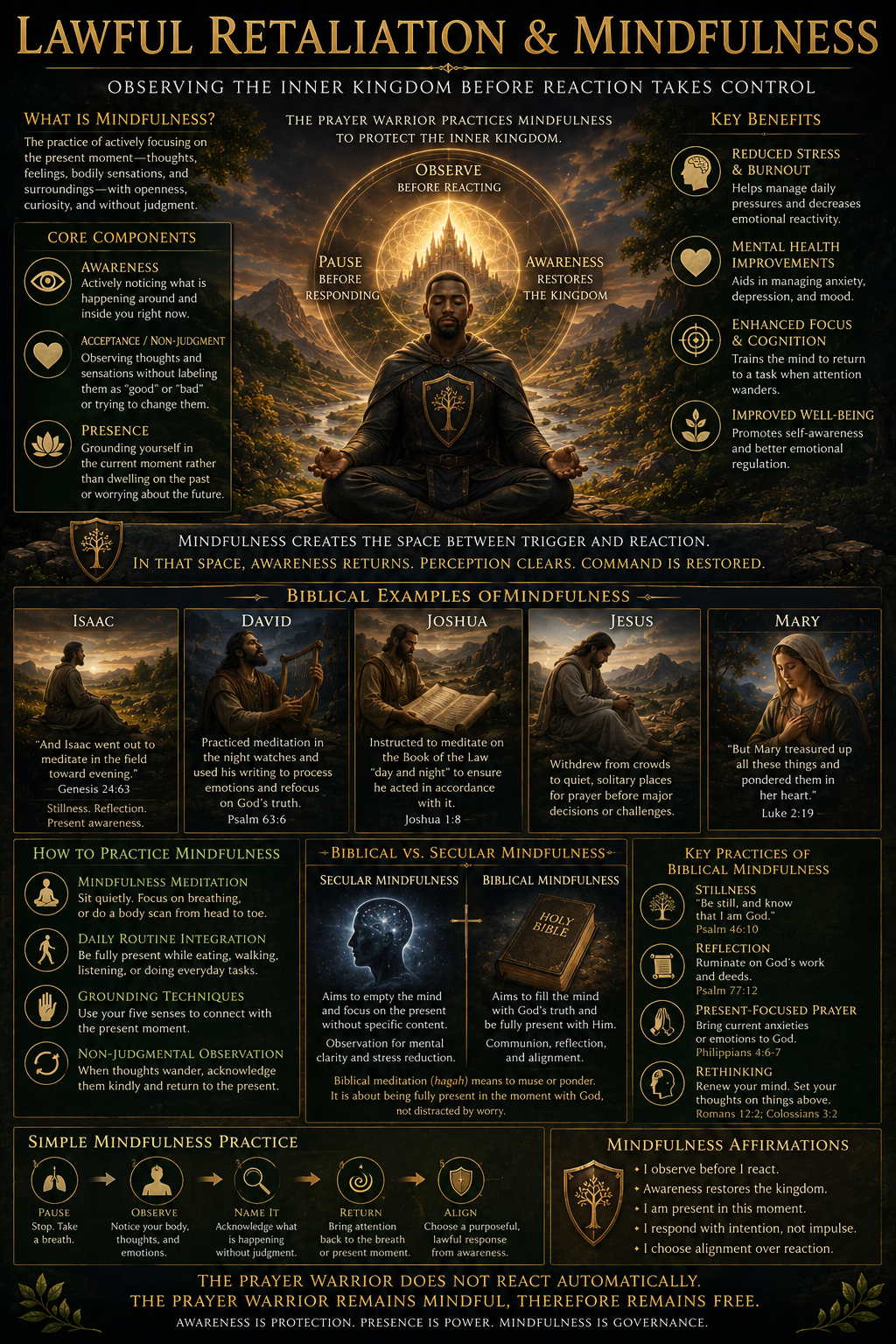
What Is Mindfulness?
Mindfulness is the practice of intentionally bringing awareness to:
- the present moment,
- the body,
- emotions,
- thoughts,
- and surroundings
with:
- openness,
- curiosity,
- and non-judgment.
At its core, mindfulness teaches:
observation before identification.
Instead of immediately becoming:
- anger,
- fear,
- shame,
- anxiety,
- projection,
- or emotional reaction,
the mindful person learns to:
witness what is happening within the system.
This is profoundly important within Lawful Retaliation because many destructive reactions occur:
automatically.
Mindfulness interrupts unconscious governance.
The Inner Kingdom & Awareness
Within this framework, the inner kingdom includes:
- thoughts
- emotions
- identity
- nervous-system activation
- energetic patterns
- perception
- personas
- unconscious narratives
Without awareness, the kingdom becomes vulnerable to:
- emotional escalation
- projection
- fear-based interpretation
- reactive behavior
- compulsive thought patterns
Mindfulness acts like:
the watchtower of the inner kingdom.
It notices:
- emotional buildup,
- distortion,
- nervous-system shifts,
- and unconscious reactions
before they fully seize control of the system.
Why Mindfulness Is Necessary
Modern life constantly fragments attention.
People are pulled into:
- overstimulation
- social comparison
- outrage cycles
- emotional overload
- anxiety about the future
- regret about the past
- constant distraction
This creates what many experience as:
living on autopilot.
The body reacts.
The mind spirals.
The emotions escalate.
The nervous system tightens.
But awareness is absent.
Mindfulness restores:
conscious presence within the kingdom.
It teaches the Prayer Warrior to:
- slow down,
- observe,
- breathe,
- notice,
- and respond intentionally rather than automatically.
Mindfulness & Emotional Triggers
Within Lawful Retaliation, emotional triggers are not enemies.
Triggers reveal:
- unresolved wounds,
- unconscious narratives,
- nervous-system conditioning,
- and emotional distortions still active within the kingdom.
Without mindfulness, the person immediately reacts.
With mindfulness, the person notices:
- “My chest tightened.”
- “Fear just surfaced.”
- “This activated an old memory.”
- “My nervous system feels threatened.”
- “I am beginning to project.”
- “Anger is escalating.”
This awareness changes everything.
Because:
what is consciously observed becomes less capable of unconsciously governing behavior.
Non-Judgment & the Inner World
One of the deepest aspects of mindfulness is:
non-judgmental observation.
This does not mean:
- approving harmful behavior,
- denying truth,
- or refusing discernment.
It means observing the inner system without immediately:
- condemning,
- suppressing,
- dramatizing,
- or identifying with what arises.
The Prayer Warrior learns:
emotions are information, not identity.
Fear may arise.
Anger may arise.
Grief may arise.
Mindfulness allows these experiences to be:
- witnessed,
- understood,
- regulated,
- and transformed
rather than unconsciously acted out.
Jesus & Mindful Presence
One of the most powerful mindfulness archetypes is Jesus withdrawing into solitude before major moments of transformation and decision.
Again and again, he:
- steps away from crowds,
- enters stillness,
- prays in solitude,
- remains present under pressure,
- and responds consciously rather than reactively.
This is mindfulness within the Lawful Retaliation framework.
Not empty detachment.
But:
grounded awareness in alignment with truth.
Even in the wilderness, Jesus remains:
- observant,
- restrained,
- rooted,
- and consciously aligned
while the false kingdom is tested.
This is the Prayer Warrior practicing mindful governance under pressure.
Biblical Mindfulness
Several biblical figures practiced forms of mindful awareness and reflection.
Isaac
Genesis describes Isaac meditating in the field toward evening.
This reflects:
- stillness,
- reflection,
- present awareness,
- inward attention.
David
David repeatedly processes emotion through:
- reflection,
- writing,
- meditation,
- and honest emotional awareness.
He does not suppress emotion.
He observes it, expresses it, and redirects it toward alignment.
Joshua
Joshua is instructed to meditate continuously so that action remains aligned with wisdom.
This mirrors the Prayer Warrior principle:
awareness before reaction.
Mary
Mary is described as “pondering” experiences deeply within herself.
This represents:
- contemplative awareness,
- inner observation,
- reflective stillness.
Mindfulness & the Nervous System
Mindfulness is not only spiritual.
It is also deeply physiological.
Mindfulness helps:
- reduce emotional reactivity,
- calm the nervous system,
- improve emotional regulation,
- reduce stress,
- and increase focus.
When practiced consistently, mindfulness trains the system to:
return to awareness instead of remaining trapped in emotional autopilot.
This strengthens:
- emotional resilience,
- discernment,
- and inner stability.
Mindfulness & the Dark Night
Mindfulness becomes especially important during:
the dark night of the soul.
When:
- old personas dissolve,
- identity structures collapse,
- emotional certainty disappears,
- the false kingdom weakens,
mindfulness prevents:
- panic,
- fragmentation,
- emotional spiraling,
- and reactive collapse.
Mindfulness says:
“Remain present while transformation occurs.”
Not:
- escaping,
- distracting,
- suppressing,
- or dramatizing.
But:
- observing,
- breathing,
- remaining aware,
- and allowing restructuring to unfold consciously.
Practical Ways to Practice Mindfulness
Mindfulness can be practiced formally or woven into daily life.
🧘 Mindfulness Meditation
Sit quietly and focus on:
- the breath,
- bodily sensations,
- or present awareness.
When thoughts wander, gently return attention without judgment.
🌬️ Breath Awareness
Observe the breath:
- entering,
- leaving,
- slowing,
- settling the nervous system.
The breath anchors awareness back into the body.
🚶 Mindful Daily Activities
Practice being fully present while:
- walking,
- eating,
- washing dishes,
- listening,
- stretching,
- or speaking.
Mindfulness transforms ordinary actions into conscious presence.
🌍 Grounding Through the Senses
Notice:
- what you can see,
- hear,
- smell,
- touch,
- and taste.
This reconnects awareness to the present moment when emotional spiraling begins.
📓 Mindful Observation of Thoughts
When thoughts arise:
- notice them,
- acknowledge them,
- avoid immediate identification.
The Prayer Warrior learns:
“A thought is not automatically truth.”
This is one of the deepest forms of inner protection.
🌿 Sample Mindfulness Practice
For Emotional Triggers & Nervous-System Awareness
If you feel emotionally activated, try this practice.
Step 1: Pause
Stop for a moment.
Sit comfortably.
Take one slow breath.
Step 2: Observe the Body
Notice:
- tension,
- breathing,
- heart rate,
- emotions,
- physical sensations.
Do not judge them.
Simply observe.
Step 3: Name What Is Happening
Quietly acknowledge:
- “Fear is present.”
- “Anger is arising.”
- “My nervous system feels activated.”
- “I feel emotionally overwhelmed.”
This creates awareness without suppression.
Step 4: Return to the Breath
Inhale slowly.
Exhale gently.
Allow awareness to settle into the present moment.
Step 5: Repeat Quietly
“I observe before reacting.”
“Awareness restores the kingdom.”
“I remain present while emotion moves through me.”
“I return to alignment before responding.”
Take several slow breaths before finishing.
The Prayer Warrior & Mindfulness
The Prayer Warrior understands:
the kingdom cannot be governed unconsciously.
Mindfulness becomes:
- the watchtower,
- the observer,
- the stabilizer,
- the witness,
- the protector of awareness.
It prevents:
- emotional escalation,
- projection,
- reactive behavior,
- and unconscious retaliation.
The Prayer Warrior therefore practices:
conscious observation before action.
Final Reflection
Mindfulness is not emotional numbness.
It is:
- awareness,
- presence,
- observation,
- and conscious participation in the present moment.
The mindful person does not avoid emotion.
They remain aware while emotion moves through the kingdom.
Because before reaction overtakes awareness,
the Prayer Warrior first observes the inner kingdom clearly.
🌿 Continue the Lawful Retaliation Healing Series
- Lawful Retaliation & The Prayer Warrior
- Lawful Retaliation & Grounding
- Lawful Retaliation & Mindfulness
- Lawful Retaliation & Meditation
- Lawful Retaliation & Journaling
- Lawful Retaliation & EFT Tapping
- Lawful Retaliation & Nervous-System Regulation
- Lawful Retaliation & Healing Breathwork
- Lawful Retaliation & Self-Reiki
- Lawful Retaliation & Chakra Healing