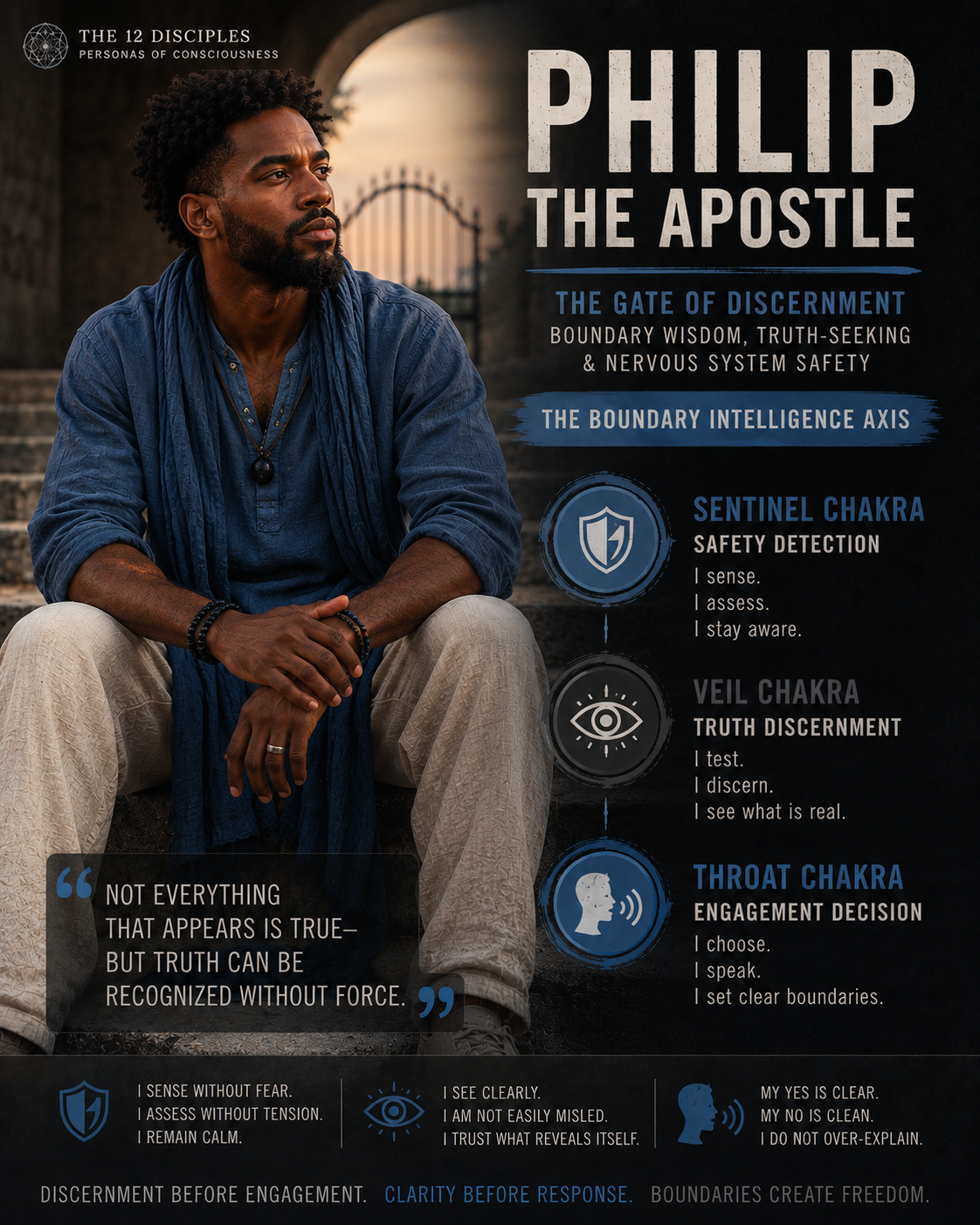
Philip the Apostle
The Gate of Discernment
Boundary Wisdom, Truth-Seeking & Nervous System Safety
Part of The Bible, The Chakras, and the 12 Disciples Series: Spotlighting the Sentinel • Veil • Throat Chakras
Opening Reflection: Learning to Sense What Is Safe
In moments of uncertainty, I notice something immediate within me—
a tightening in the jaw,
a subtle alertness in the face,
a leaning forward or pulling back before thought forms.
Something in me is already testing the environment.
This is not fear by default.
It is discernment.
But when this testing never shuts off,
what was meant to protect begins to interrogate everything.
This is the inner work of Philip.
The Chakra Architecture of Philip
Philip operates across a three-part boundary system:
🛡️ Sentinel Chakra — Safety Detection
⚫ Veil Chakra — Truth Discernment
🔵 Throat Chakra — Engagement Decision
Together, these form:
The Boundary Intelligence Axis
🛡️ Sentinel Chakra — Sensing What Is Safe
Philip begins in the body.
He scans.
He detects.
He evaluates.
This is the Sentinel Chakra—
the system that determines whether something is safe enough to approach.
When aligned:
- I sense without fear
- I assess without tension
- I remain calm while evaluating
When dysregulated:
- I scan constantly
- I cannot relax
- I assume threat where there is none
Philip teaches me:
Safety is sensed—not forced.
⚫ Veil Chakra — Testing What Is Real
Philip does not stop at safety.
He tests truth.
He asks:
- Is this real?
- Does this align?
- What is actually happening here?
This is the Veil Chakra—
the ability to discern illusion from reality.
When aligned:
- I see clearly
- I am not easily misled
- I trust what reveals itself
When misaligned:
- I doubt everything
- I overanalyze
- I lose trust in perception
Philip teaches:
Not everything that appears is true—but truth can be recognized without force.
🔵 Throat Chakra — Choosing Engagement
Discernment must lead somewhere.
Philip brings perception into decision:
- yes
- no
- not yet
This is the Throat Chakra—
where internal knowing becomes expressed boundary.
When aligned:
- my “yes” is clear
- my “no” is clean
- I do not over-explain
When dysregulated:
- I second-guess
- I hesitate
- I override my own knowing
Philip teaches:
Boundaries are clarity made visible.
Discernment vs. Hypervigilance
Healthy Philip says:
“Let me check this before engaging.”
Dysregulated Philip says:
“Nothing is safe. Keep scanning.”
This is not failure.
It is discernment that has taken over leadership.
Integration Insight
When Philip is aligned within me:
- my Sentinel is calm
- my Veil is clear
- my Throat is decisive
And from this place:
I do not need to question everything.
I only need to listen clearly.
Discernment becomes:
- quiet
- precise
- trustworthy
Embodied Practice: Softening the Gate
Purpose:
To restore discernment without tension, allowing boundaries to form without fear.
Practice
Sit comfortably and bring awareness to my face.
I notice my jaw, my cheeks, my brow.
I gently soften my jaw, letting my tongue rest naturally.
I take slow breaths through my nose.
With each exhale, I allow my face to relax.
I ask quietly:
What am I testing right now?
I do not force an answer.
I let the body settle.
I affirm:
Discernment serves me without fear.
Closing Contemplation: Philip
Philip reminds me that wisdom includes asking questions—
but also knowing when to stop asking.
I do not need to scrutinize everything to be safe.
When discernment is guided by coherence rather than fear:
- the body relaxes
- the face softens
- truth becomes easier to recognize
No faculty is removed.
Philip is not silenced.
He is integrated—
testing wisely,
then letting go.