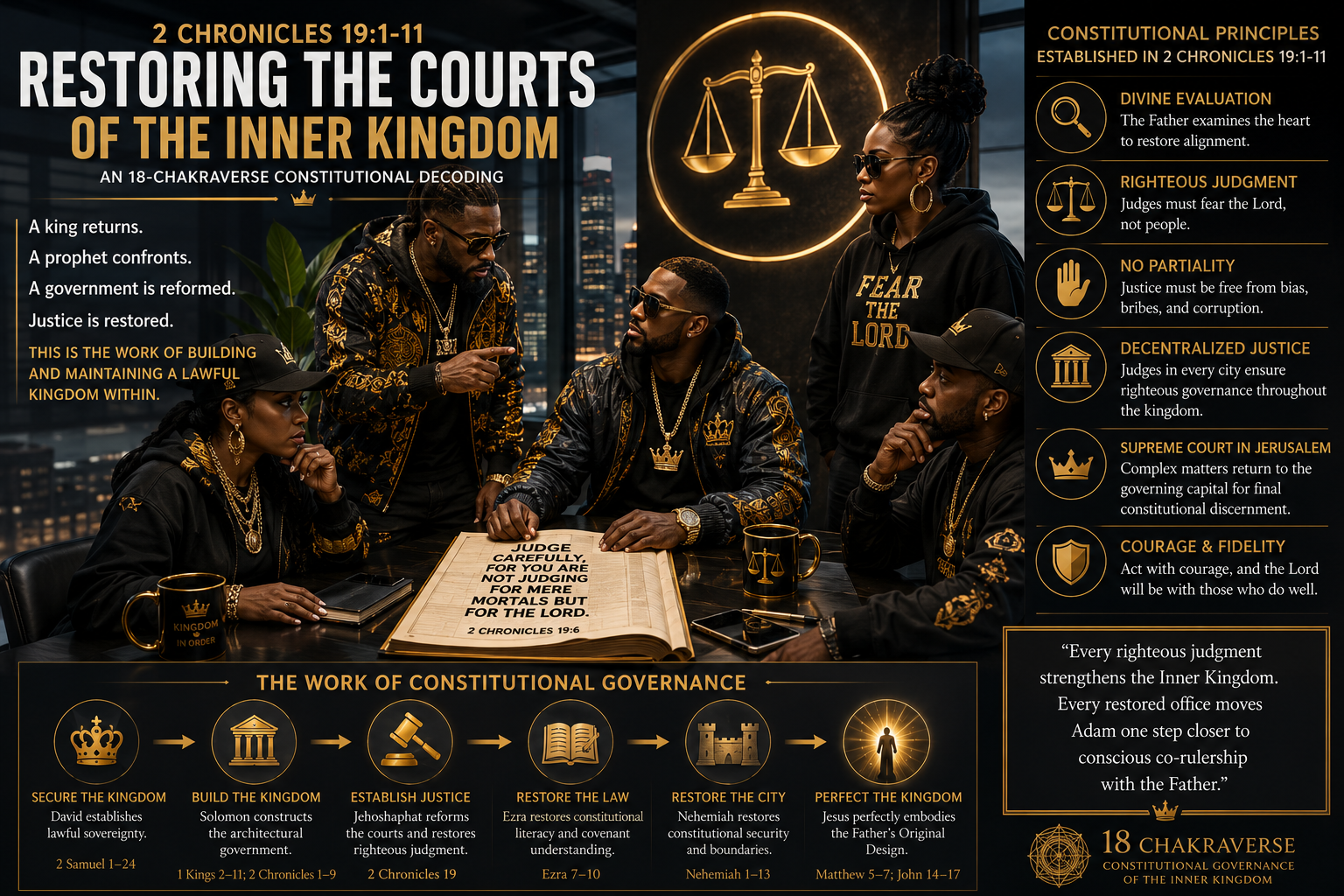
Restoring the Courts of the Inner Kingdom
2 Chronicles 19:1–11: An 18-ChakraVerse Constitutional Decoding
By Alchemist Iris Chapman
One of the greatest misconceptions about spiritual maturity is that once the Inner Kingdom has been established, it will naturally remain in order. Scripture repeatedly demonstrates the opposite. Government requires continual oversight. Every constitutional office must be regularly examined, corrected, and realigned if the kingdom is to remain faithful to the Father’s Original Design.
Second Chronicles 19 records one of the clearest constitutional reforms in all of Scripture. Following King Jehoshaphat’s misguided alliance with King Ahab, he returns to Jerusalem having learned a costly lesson. Although his kingdom remains standing, his judgment had been compromised by joining himself to a foreign system of governance.
Within the 18-ChakraVerse, this chapter marks Adam’s recognition that constitutional government cannot simply be built—it must be continually maintained.
Jehoshaphat Returns Home
The chapter opens with Jehoshaphat safely returning to Jerusalem. Architecturally, Jerusalem represents the governing capital of the Inner Kingdom.
Adam has survived a constitutional failure. He has experienced the consequences of allowing foreign counsel to influence his decisions. Yet the Father does not abandon the kingdom. Instead, Adam returns to the capital to restore lawful government.
- Failure becomes curriculum.
- The kingdom is given another opportunity to mature.
The Prophetic Audit
Jehu the son of Hanani immediately confronts the king. His question cuts directly to the constitutional issue:
“Should you help the wicked and love those who hate the Lord?”
Within the 18-ChakraVerse, Jehu represents constitutional evaluation. Every healthy government requires lawful examination. The Father does not merely observe Adam’s actions; He examines the governing intentions behind them.
Jehoshaphat’s error was not military—it was constitutional. He had entered into cooperative governance with a system that did not honor the Father’s Original Design.
Systems of Governance: The nations throughout the 18-ChakraVerse symbolize competing systems of governance seeking influence within the Inner Kingdom. Jehoshaphat’s alliance with Ahab illustrates how easily even a mature governor can become entangled with foreign constitutional principles when discernment gives way to compromise.
Mercy Within Accountability
Although Jehoshaphat is corrected, he is not rejected. Jehu acknowledges that good remains within him. This reveals an important constitutional principle: The Father’s government distinguishes between condemnation and correction.
A governor who remains teachable may still restore lawful order after failure. The purpose of divine evaluation is not humiliation; it is constitutional restoration.
The Field of Protected Evaluation—the Holy of Holies within the Temple—exists precisely for this reason. Adam’s condition is examined so that his curriculum may be refined, not so that he may be destroyed.
The Sequence of Structural Reform: Internal Alignment First
Before Jehoshaphat sets up a single judge or delegates authority, he takes a critical first step: he goes out among the people from Beersheba to the hill country of Ephraim and turns them back to the Lord.
Plaintext
               1. INTERNAL ALIGNMENT
         [ Reconnecting Core to the Father ]
                         │
                         ▼
             2. SYSTEMIC DELEGATION
     [ Appointing Judges Across Fortified Cities ]
This sequence reveals a vital rule of spiritual governance: Internal alignment must always precede structural delegation.
A governor cannot delegate discernment to local faculties until the primary connection to the Father’s Original Design has been re-established at the core. Trying to reform outer behaviors or set up boundaries without first turning the core consciousness back to the Father only creates fragile, surface-level rules. Real alignment starts at the top; only then can structural reform take hold across the outer realms.
Rebuilding the Judicial System
Once core alignment is secured, Jehoshaphat’s response is immediate. He appoints judges in every fortified city throughout the land. This is one of the most remarkable governmental acts recorded in Scripture.
Plaintext
                  [ THE KING / JERUSALEM ]
                             │
            ┌────────────────┴────────────────┐
            ▼                                 ▼
   [ FORTIFIED CITY A ]             [ FORTIFIED CITY B ]
      Judicial Court                   Judicial Court
    (Local Discernment)              (Local Discernment)
Within the Inner Kingdom, judges represent the faculty of righteous discernment operating throughout every constitutional realm. The king does not attempt to personally decide every minor matter. Instead, he establishes lawful courts across the kingdom.
This reflects mature self-governance:
- Every constitutional office must possess the ability to discern what belongs within its jurisdiction and what does not.
- Healthy government is decentralized while remaining united under one constitution.
The Character of a Judge
Jehoshaphat instructs the judges:
“Judge carefully, for you are not judging for mere mortals but for the Lord.”
This statement reaches to the very heart of constitutional maturity. Judgment is not based upon preference, popularity, fear, or personal gain. It is measured against the Father’s Constitution.
Within the 18-ChakraVerse, every constitutional office must ask the same question: “Does this intention align with the Father’s Original Design?” This becomes the highest standard of governance.
No Partiality
Jehoshaphat warns the judges against partiality, corruption, and bribery.
Architecturally, bribery symbolizes allowing external desires, fears, wounds, or ambitions to influence constitutional judgment. Whenever Adam allows personal preference to outweigh constitutional truth, justice becomes distorted and the Inner Kingdom begins to fracture.
Righteous judgment requires freedom from competing influences. Every office must remain loyal to the Constitution rather than to emotion, ego, or foreign systems of governance.
The High Court of Jerusalem
Jehoshaphat also establishes a supreme court in Jerusalem, composed of Levites, priests, and family leaders to resolve the most difficult cases.
| Jurisdiction | Composition | Function |
| Local Courts | Appointed Judges in Fortified Cities | Day-to-day righteous discernment across individual realms |
| High Court | Levites, Priests, & Family Leaders | Resolving complex constitutional questions at the governing capital |
Within the 18-ChakraVerse, this represents the highest level of constitutional discernment operating from the governing capital of the Inner Kingdom.
Significantly, Levi receives no territorial inheritance in Israel. This reflects a profound constitutional reality: Levi does not govern a separate jurisdiction; Levi safeguards the integrity of every jurisdiction.
Because Levi is not tied to an isolated territory or specific emotion, this office remains unbiased—ensuring that every decision across the kingdom strictly reflects the Father’s law. Whenever constitutional questions become too complex for local courts, they escalate to the central government for lawful interpretation. Likewise, when Adam encounters conflicts that exceed the understanding of individual offices, they must be brought before the highest authority within the Inner Kingdom.
Courage and Constitutional Fidelity
Jehoshaphat concludes his reforms with a charge:
“Act with courage, and may the Lord be with those who do well.”
Courage is not presented as emotional boldness; it is constitutional fidelity. It is the willingness to govern according to truth even when competing systems promise easier alternatives.
Every decision either strengthens or weakens the government of the Inner Kingdom. The courageous governor consistently chooses lawful alignment over temporary convenience.
The Constitutional Lesson
Second Chronicles 19 teaches that no constitutional government remains healthy through initial success alone. Every Adam will occasionally discover that foreign governing principles have entered the kingdom through compromise, misplaced trust, or incomplete discernment.
The answer is not despair; the answer is reform.
The Father continually calls Adam back to Jerusalem—to the governing capital of the Inner Kingdom—where every constitutional office can once again be examined, corrected, and restored. The mature governor does not fear evaluation; he welcomes it. For constitutional judgment is not the enemy of the kingdom; it is one of the Father’s greatest gifts.
Every righteous judgment strengthens the Inner Kingdom. Every restored office moves Adam one step closer to conscious co-rulership with the Father. The work of building the kingdom is never finished; the work of faithfully governing it continues throughout every stage of Adam’s constitutional journey.