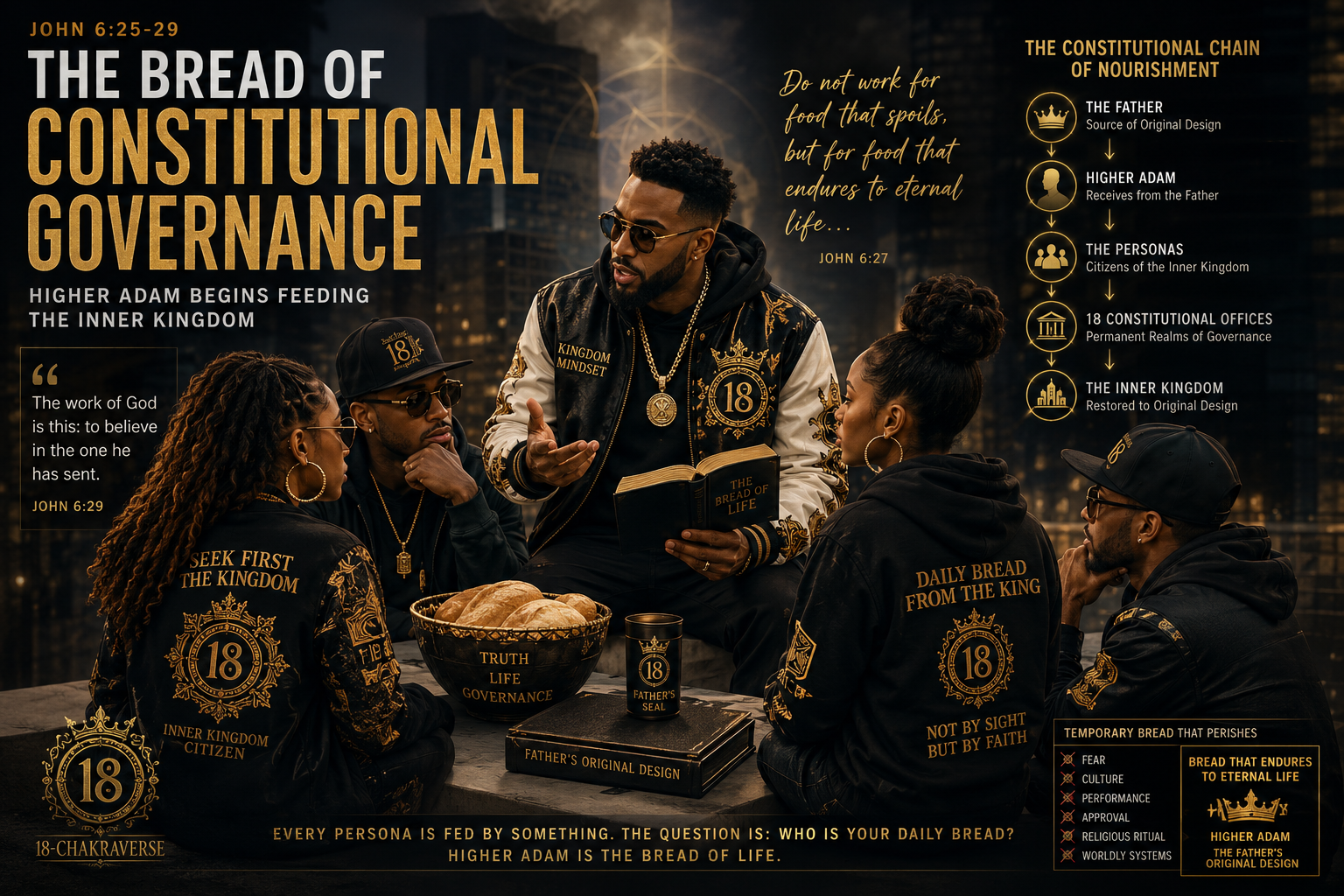
The Bread of Constitutional Governance
Bible Decode: John 6:25–29
By Alchemist Iris Chapman
One of the greatest misunderstandings of John 6 is assuming that Jesus is primarily teaching about physical food.
He is not.
Within the 18-ChakraVerse, bread is the language of constitutional nourishment. It represents the foundational governing principles that sustain the citizens of the Inner Kingdom. Every kingdom, whether external or internal, is continually fed by something. The question is never whether the kingdom is eating; the question is whose government is providing the daily bread.
John 6:25–29 marks a crucial constitutional turning point. Higher Adam announces that the citizens of the Inner Kingdom can no longer treat the Father’s truth as an occasional, seasonal meal. From this point forward, their continual, moment-by-moment nourishment must come through him—just as his continual nourishment comes directly from the Father.
The Scripture
John 6:25–29 (NIV)
When they found him on the other side of the lake, they asked him, “Rabbi, when did you get here?”
Jesus answered, “Very truly I tell you, you are looking for me, not because you saw the signs I performed but because you ate the loaves and had your fill. Do not work for food that spoils, but for food that endures to eternal life, which the Son of Man will give you. For on him God the Father has placed his seal of approval.”
Then they asked him, “What must we do to do the works God requires?”
Jesus answered, “The work of God is this: to believe in the one he has sent.”
The Feeding Was a Constitutional Sign
Within the framework of the 18-ChakraVerse, the miracle of feeding the multitude is read as an allegorical constitutional event. The miraculous bread is not the final destination of the story—it is the symbolic medium through which Jesus reveals how the Inner Kingdom is meant to be lawfully governed.
The crowd gathered on the hillside represents the citizens of Adam’s Inner Kingdom: the vast array of personas, subsystems, and internal drives that have developed throughout his constitutional journey. Each persona has learned to survive under particular governing principles:
- Some personas are shaped by fear and survival.
- Others are driven by ambition, status, or performance.
- Many are bound by religion, culture, shame, or inherited family traditions.
Every internal persona has learned to receive its “bread” from somewhere. The miracle on the hillside demonstrates that Higher Adam possesses lawful, abundant nourishment sufficient for every single citizen residing within the internal realm.
Yet the sign itself is merely the introduction.
       [ Competing Outer Systems ]
(Fear, Culture, Ambition, Religion, Tradition)
                   │
                   ▼
     [ Unlawful Bread / Perishing Food ]
                   │
                   ▼
     [ Divided Inner Kingdom Personas ]
The Problem Was Never Hunger
When the crowd tracks down Jesus on the other side of the lake, they are not empty-handed or starving. They have already received the immediate benefit contained within the sign.
The difficulty was not a lack of nourishment; the difficulty was that they continued treating the Father’s truth as an event to experience rather than the actual government by which they would continually live.
Many people genuinely enjoy moments of spiritual nourishment. They gladly receive wisdom, encouragement, deep inspiration, and sudden revelations. Yet once the gathering ends, they immediately return to allowing entirely different systems to govern their thoughts, emotions, decisions, and daily relationships.
The spiritual meal was welcomed. The government was not.
An Occasional Meal or Daily Bread?
This precise distinction lies at the absolute center of Jesus’ teaching. A citizen who only occasionally visits the King’s table remains perpetually vulnerable to every competing government throughout the remainder of the week.
 Day 1 ──► Feeds on Truth
 Day 2 ──► Feeds on Anxiety
 Day 3 ──► Feeds on Cultural Expectations
 Day 4 ──► Feeds on Fear & Self-Protection
 Day 5 ──► Feeds on Pride & Performance
Although truth has been experienced and received, it has not yet become the kingdom’s continual source of life. Jesus announces that this fragmented pattern can no longer continue. Higher Adam himself must become the daily Bread of Life.
“You Ate the Loaves”
Jesus exposes the root issue with direct candor:
“You are looking for me… because you ate the loaves and had your fill.”
He reveals something far deeper than physical appetite. The personas appreciated what Higher Adam provided; they enjoyed the sensation, the relief, and the experience. But they were still approaching him as merely one option among many. They had not yet recognized him as the sole lawful governor from whom every operating principle should continually flow.
The issue is not a lack of appreciation. The issue is constitutional allegiance.
“Do Not Work for Food That Perishes”
Jesus continues his decree:
“Do not work for food that spoils, but for food that endures to eternal life.”
Within the 18-ChakraVerse, “food that perishes” represents every temporary, external governing principle that promises stability but ultimately fails to produce constitutional harmony:
- Fear eventually exhausts the system.
- Performance continually demands more labor without rest.
- Status must be constantly defended against rivals.
- External Approval disappears the moment expectations change.
- Religious Ritual alone cannot transform the internal heart.
These false sources require constant replacement because they carry no eternal constitutional authority. By contrast, the nourishment flowing from the Father does not merely satisfy a temporary urge—it systematically restores the government itself.
The Father’s Seal
Jesus declares:
“For on him God the Father has placed his seal of approval.”
Throughout ancient history and Scripture, a seal establishes absolute, lawful authority. Higher Adam does not invent an arbitrary government; he faithfully administers the Father’s Original Design. Every principle he distributes down to the personas has first been received directly from the Father. His bread carries ultimate constitutional authority because its origin is the Father Himself.
The First Work of Restoration
The crowd immediately asks a question rooted in their old paradigm:
“What must we do to do the works God requires?”
They ask about performance—actions, checklists, and tasks. Jesus answers with government:
“The work of God is this: to believe in the one he has sent.”
Within the 18-ChakraVerse, belief is constitutional consent. It is the voluntary internal recognition that Higher Adam is the sole, lawful source from which every citizen of the Inner Kingdom must receive its governing directives. Before the kingdom can act differently, it must first align under its rightful King.
The Beginning of Constitutional Restoration
John 6 does not present a fully perfected kingdom overnight. Higher Adam has begun feeding the citizens, but many internal personas still draw water and bread from competing wells:
[ Higher Adam Begins Feeding ]
           │
           ├─► Some Personas: Gladly receive the bread
           ├─► Some Personas: Misunderstand the mandate
           ├─► Some Personas: Resist the change
           └─► Some Personas: Walk away entirely
The restoration has officially begun, but the journey is ongoing. Competing internal governments are progressively confronted, foreign allegiances are exposed, and unlawful governing principles are systematically dismantled until every realm operates in alignment with the Father’s Original Design.
The Constitutional Chain of Nourishment
Throughout John’s Gospel, Jesus reinforces that he does nothing independently. He speaks what the Father gives him to speak, performs what the Father shows him to do, and lives because of the Father. This establishes the structural Chain of Nourishment:
           The Father
               │
               ▼
          Higher Adam
               │
               ▼
     The Inner Personas
  (Citizens of the Kingdom)
               │
               ▼
   18 Constitutional Offices
               │
               ▼
   Fully Ordered Inner Kingdom
Every level receives life exclusively from the level above it. No lawful government is self-generated. Every office remains vibrant and effective because it continually receives nourishment from its true constitutional source.
Building the Inner Kingdom
Every single day, the citizens of your Inner Kingdom are being fed. The only real question is by whom.
Jesus’ invitation in John 6 is not simply to enjoy another inspiring message or theological concept. It is a summons to establish a new constitutional pattern of living. The internal personas must no longer receive their primary governing principles from fear, culture, performance, or tradition.
Instead, Higher Adam becomes their continual Bread of Life—receiving truth directly from the Father and faithfully distributing that nourishment throughout every room of the kingdom. As this process unfolds, the Inner Kingdom moves steadily out of internal conflict and into conscious co-rulership with the Father.
Constitutional Reflection
The core question of John 6 is not whether we occasionally receive spiritual inspiration. The question is whether Higher Adam has become the continual, daily source of nourishment for the citizens of our Inner Kingdom.
Every persona is always eating something. Every thought, habit, fear, and desire offers its own version of bread. Constitutional maturity begins when every citizen within us surrenders competing allegiances and willingly receives its daily bread from Higher Adam, who receives his directly from the Father. From that steady, daily exchange, the Original Design is progressively restored until the entire Inner Kingdom rests in complete alignment.