Jesus, Simon, and the Prostitute: Bible Decode
Luke 7:36–50: A Constitutional Examination of Recognition, Foundation, and Government
By Alchemist Iris Chapman
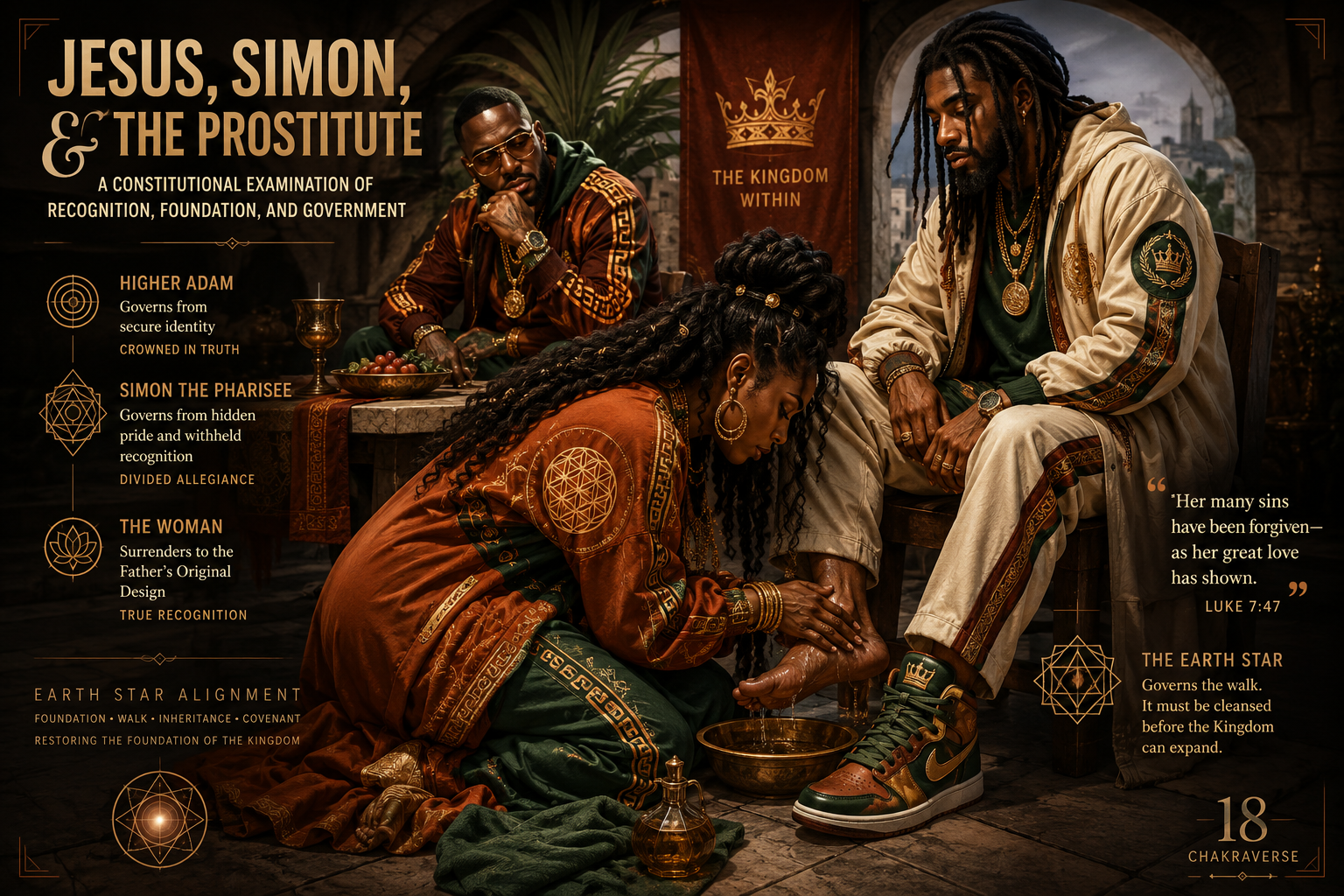
One of the most remarkable features of Luke 7:36–50 is that Jesus never treats the dinner as an ordinary social gathering. Within the 18-ChakraVerse, this scene unfolds as a formal constitutional evaluation conducted by Higher Adam. Every participant, gesture, silence, and response reveals the governing principles operating within the Inner Kingdom.
The Father is not merely observing human behavior from afar—He is actively examining government.
Standing in the exact same room are three distinct constitutional conditions:
- One governs from secure identity (Higher Adam).
- One governs from hidden pride and withheld recognition (Simon).
- One has reached the end of self-government and willingly submits to the Father’s Original Design (the woman).
Together, Jesus, Simon, and the woman become a living constitutional courtroom.
Higher Adam Enters the Jurisdiction
Simon the Pharisee invites Jesus into his home. But a house represents far more than a physical residence; within the constitutional architecture of Scripture, a house symbolizes an established system of governance—a jurisdiction where specific beliefs, values, and laws have become normalized.
When Higher Adam enters Simon’s house, He enters Simon’s government.
Throughout the Gospels, Jesus continually travels from city to city, village to village, synagogue to synagogue, and house to house. Rather than viewing these journeys merely as traditional missionary travel, the 18-ChakraVerse understands them as constitutional inspections. Every location represents another jurisdiction of the Inner Kingdom, and every encounter reveals the true condition of its internal government:
- Who recognizes lawful authority?
- Who governs from fear?
- Who governs from pride?
- Who is prepared for foundational restoration?
Luke 7 becomes one more constitutional survey.
Simon’s Hidden Government
Simon appears entirely respectable on the surface. He knows the Scriptures, occupies an honored religious office, and extends a formal dinner invitation to Jesus. Yet constitutional evaluations rarely begin with outward appearances—they begin with governing intention.
Jesus immediately identifies what Simon never says aloud. As Simon silently questions Him (“If this man were a prophet…”), Higher Adam responds directly to his hidden reasoning. This reveals one of the Father’s constitutional principles: Nothing governing the Inner Kingdom remains invisible inside the Circle of Evaluation. Every governing intention eventually becomes known.
Simon’s greatest problem is not ignorance; it is concealed government.
The Taxonomy of Recognition: The Kiss as a Constitutional Mechanism
Jesus highlights a crucial omission to Simon: “You gave Me no kiss.”
This observation appears almost insignificant until viewed constitutionally. A holy kiss throughout Scripture represents covenantal recognition. It communicates peace, spiritual kinship, mutual honor, and non-possessive love flowing under the Father’s government. A kiss publicly acknowledges:
- “I recognize your authority.”
- “I receive you in peace.”
- “I stand with you under the same government.”
When viewed across the Gospels, the kiss forms a complete three-part taxonomy of jurisdictional alignment:
                  THE CONSTITUTIONAL TAXONOMY OF THE KISS
┌──────────────────┬─────────────────────────────┬─────────────────────────────────┐
│ Figure           │ Gesture / Act               │ Governing Condition             │
├──────────────────┼─────────────────────────────┼─────────────────────────────────┤
│ The Woman        │ Unceasing Kisses (Feet)     │ True Recognition & Surrender    │
│ Simon            │ Withheld Kiss               │ Passive Resistance / Pride      │
│ Judas            │ Weaponized Kiss (Face)      │ Active Subversion / Counterfeit │
└──────────────────┴─────────────────────────────┴─────────────────────────────────┘
1. Simon: Concealed Reservation (Passive Resistance)
Simon’s condition is passive omission. He welcomes Jesus into his physical house (his jurisdiction) while withholding constitutional recognition. His system governs through polite distance, quiet judgment, and hidden self-righteousness. He does not actively attack; he simply refuses to grant lawful recognition, exposing his divided allegiance.
2. The Woman: Continuous Recognition (True Alignment)
Where Simon offers no kiss, the woman offers continual kisses to His feet. She recognizes what Simon’s self-righteousness blinds him to. Her gestures are not romantic—they are deeply constitutional. Each kiss acknowledges lawful authority, declares surrender to the Father’s Kingdom, and renounces the rogue government that previously defined her life. Unlike Simon’s concealed hesitation, she demonstrates recognition with complete transparency.
3. Judas: Corrupted Imitation (Active Subversion)
This narrative stands in stark contrast to another famous kiss later in the Gospels: Judas betraying Jesus in Gethsemane. Where Simon withholds the kiss out of cold pride, Judas weaponizes it. Judas uses the outward protocol of covenantal recognition to hand Higher Adam over to foreign authorities. This is the Kiss of Betrayal—simulating total alignment while operating under rogue governance. Light is imitated while serving darkness.
The woman remains the only model of true alignment because her external gesture perfectly matches her internal state. Nothing is hidden, and no motive is counterfeited.
Why the Feet?
The precise object of the woman’s devotion is equally vital: she kisses His feet—not His hands or His face.
The feet represent Adam’s walk. They reveal every path traveled, every compromise, every inherited pattern, and every foreign governmental influence accumulated while walking through the nations.
Within the 18-ChakraVerse, the feet correspond directly to the Earth Star Chakra—the constitutional office responsible for grounding, covenantal inheritance, earthly placement, and lawful participation within the physical world. The Earth Star records where Adam has walked and carries the residue of every journey. Before heavenly government can expand upward, the earthly foundation must first be restored.
Tears and Perfume
The woman washes His feet with her tears, dries them with her hair, and anoints them with costly perfume. Each act carries profound constitutional significance:
- Tears: Represent honest constitutional awareness. She no longer defends or excuses the government that once ruled her.
- Hair: Represents personal glory voluntarily placed beneath divine authority.
- Perfume: Represents the total surrender of identity, resources, reputation, and value back to the Father.
Nothing is withheld. Everything formerly organized around survival becomes reorganized around covenant. Her Earth Star is being fully restored.
The Prostitute as Constitutional Archetype
Within the 18-ChakraVerse, “prostitute” is not fundamentally an occupational label—it is a constitutional archetype. It represents every place where Adam trades sacred inheritance for temporary security.
Whenever identity becomes transactional…
Whenever truth is exchanged for acceptance…
Whenever purpose is surrendered for comfort…
Whenever dignity is sacrificed for survival…
…the prostitute archetype becomes active. The core issue is never merely physical; the issue is governance. Who determines Adam’s value? The Father, or the marketplace? The prostitute exposes the exact places where constitutional identity has become dependent upon external validation.
Ironically, both Simon and the woman participate in transactional living. The woman’s compromises are visible to all, whereas Simon’s are hidden beneath religious respectability. One traded through survival; the other through self-righteousness. Higher Adam exposes both.
The Parable of the Two Debtors
Jesus offers Simon a parable of two debtors to solidify the point: both owe a debt, neither can repay, and both desperately require mercy.
The constitutional difference lies in awareness. Those who recognize their constitutional debt become instantly open to restoration. Those convinced of their own self-sufficiency remain governed by illusion. Mercy cannot reorganize a kingdom that actively refuses examination. The woman welcomes the Father’s evaluation, while Simon resists it because he assumes he is already aligned.
Mapping the Kingdom: The Earth Star Protocol
Seen through this constitutional lens, Luke 7 is far from an isolated miracle story. It is a key movement in Higher Adam’s systemic inspection of the Inner Kingdom.
Throughout His ministry, Jesus travels the capital and its surrounding jurisdictions, revealing the alignment of every city, synagogue, household, and individual. This structural pattern explains two other vital practices across the Gospels:
- Washing the Disciples’ Feet: Jesus washes the disciples’ feet before sending them out because the Earth Star—the constitutional office governing their walk—must be cleansed of worldly residue before they can represent His jurisdiction.
- Shaking the Dust off the Feet: He instructs them to shake the dust from their feet whenever a city rejects the Kingdom. That dust represents foreign constitutional residue gathered from an unaligned jurisdiction. The disciples aren’t condemning the city; they are simply refusing to carry foreign governance into the next territory, keeping their Earth Star constitutionally clean.
Constitutional Reflection
Luke 7 proves that the Father evaluates far more than outward morality—He examines recognition, foundation, governance, and authenticity.
Simon appears righteous but withholds constitutional recognition out of subtle pride. Judas uses the symbol of recognition to execute betrayal. The woman appears broken yet freely acknowledges lawful authority, surrendering her entire government at the feet of Higher Adam.
The same question quietly echoes throughout the story and into every generation:
When Higher Adam enters the jurisdiction of your Inner Kingdom, does He find passive reservation like Simon, corrupted subversion like Judas, or a restored foundation willing to recognize the Father’s government without hesitation?
For constitutional governance always begins with a single act of genuine recognition. Only after Adam recognizes lawful authority can the Father cleanse his walk, restore his foundation, and establish the Kingdom upon the Earth Star according to Original Design.