The Serpent, Naming the Animals, Genesis, and Adam
Understanding the Kingdom Within
By Alchemist Iris Chapman
For generations, the story of Adam naming the animals has often been understood as humanity’s first exercise of authority over creation. While that observation has merit, the Genesis narrative reveals something even more profound. Before Adam ever encounters the serpent, before the Tree of the Knowledge of Good and Evil becomes the focus of attention, the Father gives Adam an unusual assignment:
- Observe the animals.
- Name them.
- Understand them.
Within the 18-ChakraVerse, Genesis records the constitutional formation of one particular Adam—the same Adam whose journey unfolds throughout Scripture. If this is true, then every element introduced before the decision to eat from the tree should be understood as part of Adam’s original constitutional architecture rather than a description of experiences that belong to the later life of the Cube.
This changes how we read the animals, the serpent, the court of law in the Garden, and the desolate landscape that followed.
The Animals as Constitutional Endowments
The animals are not personas.
Throughout the 18-ChakraVerse, personas emerge through Adam’s constitutional development as he matures, succeeds, fails, learns, and grows. They are not present as completed identities in Eden. The animals belong to a different category: they are constitutional endowments.
The Father installs them within Adam’s kingdom from the very beginning. Each animal represents a native capacity built into human nature:
- Some express strength.
- Others patience.
- Others vigilance.
- Others creativity.
- Others endurance.
None of these capacities are inherently good or evil. They are simply part of the Father’s original design.
Why Adam Names the Animals
If the animals represent constitutional endowments, then Adam’s assignment was never merely an exercise in biological classification. It was an exercise in constitutional awareness.
By observing the animals, Adam begins learning the architecture of his own kingdom:
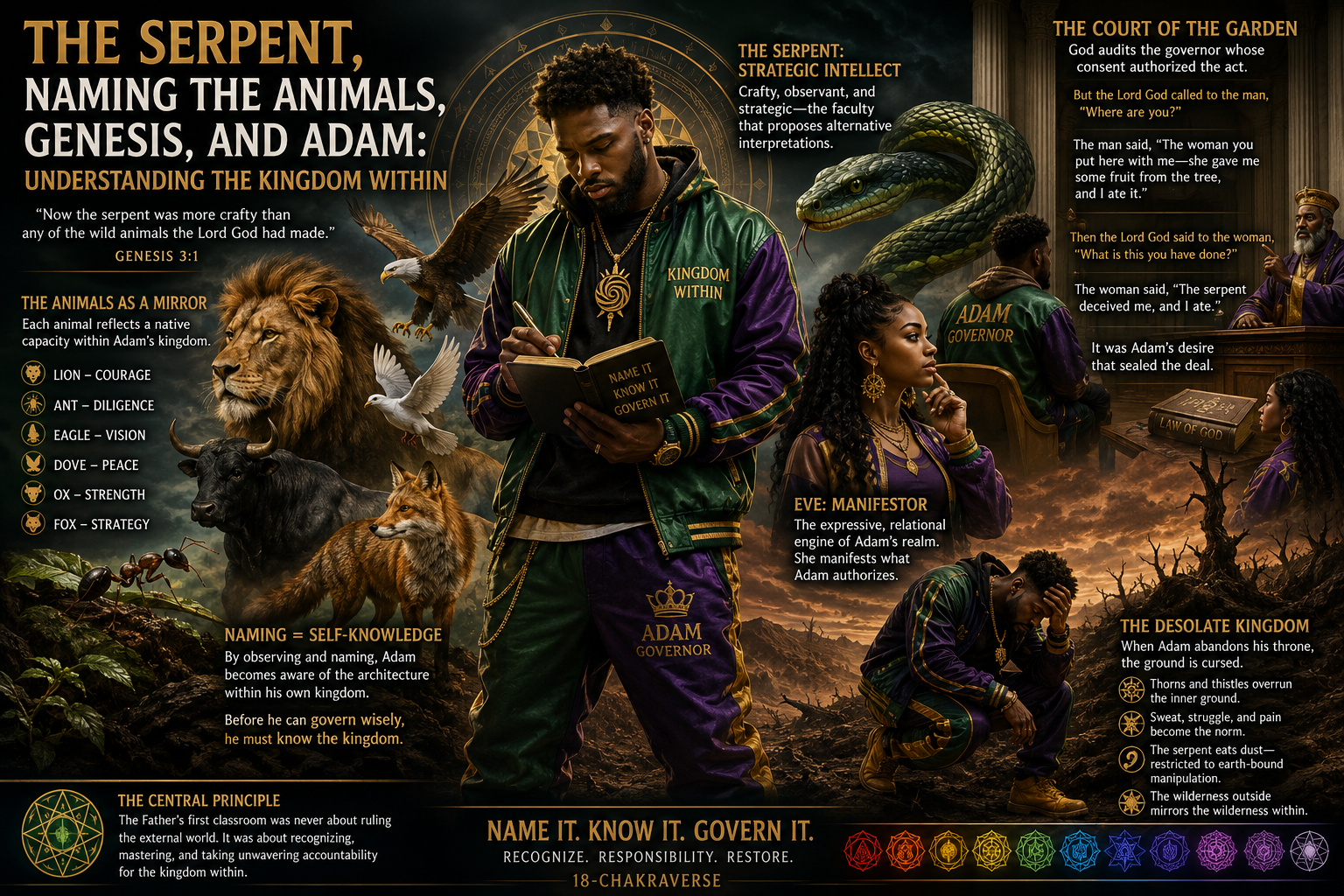
- The lion teaches courage.
- The ant demonstrates diligence and preparation.
- The eagle reveals elevated vision.
- The ox displays steadfast strength.
- The dove reflects peace and gentleness.
- The fox illustrates strategy and adaptability.
Every animal becomes a living lesson. The Father does not simply lecture Adam about his inner constitution; He allows Adam to discover it through observation. Naming becomes the first act of conscious self-knowledge. Before Adam governs the kingdom, he must first understand the kingdom.
The Animal Kingdom as a Mirror
The natural world becomes a mirror through which Adam learns himself. Every creature reflects one aspect of the constitutional design already present within him.
Rather than saying, “You possess courage,” the Father presents a lion.
Rather than saying, “You possess industry,” He presents an ant.
Rather than saying, “You possess patience,” He presents creatures that quietly reveal persistence through their behavior.
The external world becomes a classroom for the internal kingdom. This explains why the wisdom literature repeatedly teaches through creation:
“Go to the ant…”
“The righteous are bold as a lion…”
“Be wise as serpents…”
Throughout Scripture, the Father continues using creation to reveal constitutional principles already established in Genesis.
King and Priest: The Direct Sonship Mandate
Before the relational expansion of the kingdom occurs, Genesis establishes a vital covenantal principle: the Father gives the commandment exclusively to Adam (Genesis 2:16–17) before Eve is brought forth from his side.
In the architecture of the 18-ChakraVerse, Adam holds a dual mandate:
- As Priest: He is the sole direct mediator and Son in relationship with the Father at this stage. It is his priestly duty to guard, teach, and uphold the Father’s divine boundary within his realm.
- As King: He holds supreme governing authority over every endowment. “What he says goes.”
Because Adam holds the primary Sonship covenant and direct instruction from the Father, full legal liability for the realm rests on his shoulders.
The Serpent Is Different: Strategic Intellect and the Unlawful Path
After introducing the animals, Genesis draws attention to one creature above all others:
“Now the serpent was more crafty than any of the wild animals the Lord God had made.”
The serpent is not an external invader; it represents the highest cognitive endowment in Adam’s original architecture—strategic calculation, pattern recognition, and alternative scenario simulation. Strategic thought is essential for governance. The constitutional question was never whether strategy exists, but how it would be governed.
Free will naturally allowed for exploration. If the strategic faculty raised questions about perception, wisdom, and elevated knowledge, Adam had the full constitutional right as a Son to bring those questions directly to the Father. He could have approached the Most High in open, reasoning dialogue—much like the Prodigal Son who, despite a selfish desire, still approached his father directly to request his inheritance.
Instead, Adam chose an unlawful, covert transaction.
He did not reason with the Father. He attempted to expropriate governance behind the Father’s back, treating the Creator as an obstacle to be bypassed rather than the Source of all lawful authority.
From Internal Capacity to Relational Proposal
When Eve is brought forth into the relational architecture, she is tailor-made for Adam as the expressive, manifesting engine of his realm. She relies on his priestly alignment for truth and his kingly authority for protection. She cannot “run ahead” of Adam, nor can she act independently of his ultimate consent.
When the strategic serpent dialogues with Eve, it presents an alternative proposal to the manifesting dimension of Adam’s kingdom. But in the court of law, a deceiver can only draft a proposal. The deceiver holds no legal authority to execute a binding contract on behalf of the realm.
Where was the King and Priest during this dialogue? He was standing right there in complete dereliction of duty—failing to intercede as Priest, and surrendering his veto power as King.
Only the action-taker holds signature power. It was Adam’s desire that sealed the deal.
The Divine Deposition: Intention and the Collapse of Governance
The true nature of the serpent as an internal endowment—and Adam’s failure as a governor—is exposed in the courtroom interrogation of Genesis 3:8–13.
When the Lord God walks in the garden, He holds a constitutional audit. His first question goes straight to the seat of covenantal responsibility:
But the Lord God called to the man, “Where are you?”
The Father does not audit Eve first, nor does He interrogate the serpent. In any true court of law, justice seeks the governor whose consent authorized the act. God was not fooled; He knew that no proposal from the strategic intellect and no action by the manifesting partner could become law without Adam’s signature.
God was auditing Adam’s intention (mens rea). But when given the opportunity to confess his unlawful conduct or return to the Father in repentant sonship, Adam collapses:
The man said, “The woman you put here with me—she gave me some fruit from the tree, and I ate it.”
Adam attempts a double deflection, blaming his subject horizontally (“she gave me…”) and his Creator vertically (“the woman You put here…”). By claiming to be a passive bystander, Adam abdicates his throne. He disowns his intention and refuses accountability for a law he was charged as Priest to protect.
When the Father turns to the woman:
Then the Lord God said to the woman, “What is this you have done?”
The woman said, “The serpent deceived me, and I ate.”
Eve speaks with simple candor. She acknowledges being outmaneuvered by the strategic faculty operating in a domain where she lacked ultimate veto power. True to her position, she does not turn to testify against Adam. But because Adam abandoned true governance, the diagnostic prognosis of Genesis 3:16 is handed down: Eve will now absorb the heavy friction, pain, and mistreatment of bringing forth fruitfulness under an unaligned, controlling governor.
The Thistle and the Thorn: The Desolate Inner Kingdom
The court’s verdict falls upon every faction because every faculty resides within Adam’s total kingdom.
The strategic serpent is demoted to crawl on its belly and “eat dust”—restricted to analyzing and manipulating mere material, earth-bound concerns. But the most revealing consequence is the ground itself:
“Cursed is the ground because of you… It will produce thorns and thistles for you.”
This is a factual law of cause and effect: the external landscape is always a mirror of the internal realm.
When a king disowns his intention and abandons his throne, the land becomes desolate. Without an aligned governor to steward the inner ground:
- Thistles and thorns—sharp self-defense mechanisms, reactive trauma responses, cynicism, and internal friction—overrun the mind and heart.
- The sweat of the brow becomes necessary because bringing forth peace and purpose out of an untended, chaotic interior requires grueling, exhausting labor.
Adam is left fighting his own unruled nature. The wilderness outside the garden was simply the physical reflection of the wilderness inside Adam’s unruled heart.
Recognizing the Kingdom Within
Adam’s assignment in Eden was to learn his internal architecture before attempting to govern it:
- The animals revealed his native capacities.
- The serpent represented his strategic, alternative-generating intellect.
- Eve reflected the expansion of his manifesting, relational authority.
- His Sonship granted him direct access to reason with the Father lawfully.
Before Adam could govern wisely, he had to know himself and take complete ownership of his intention. When the test came, he chose covert theft over open sonship, disowned his consent, blamed his architecture, and left his throne vacant.
The central lesson of Genesis is clear: the Father’s first classroom was never about ruling the external world. It was about recognizing, mastering, and taking unwavering accountability for the kingdom within.