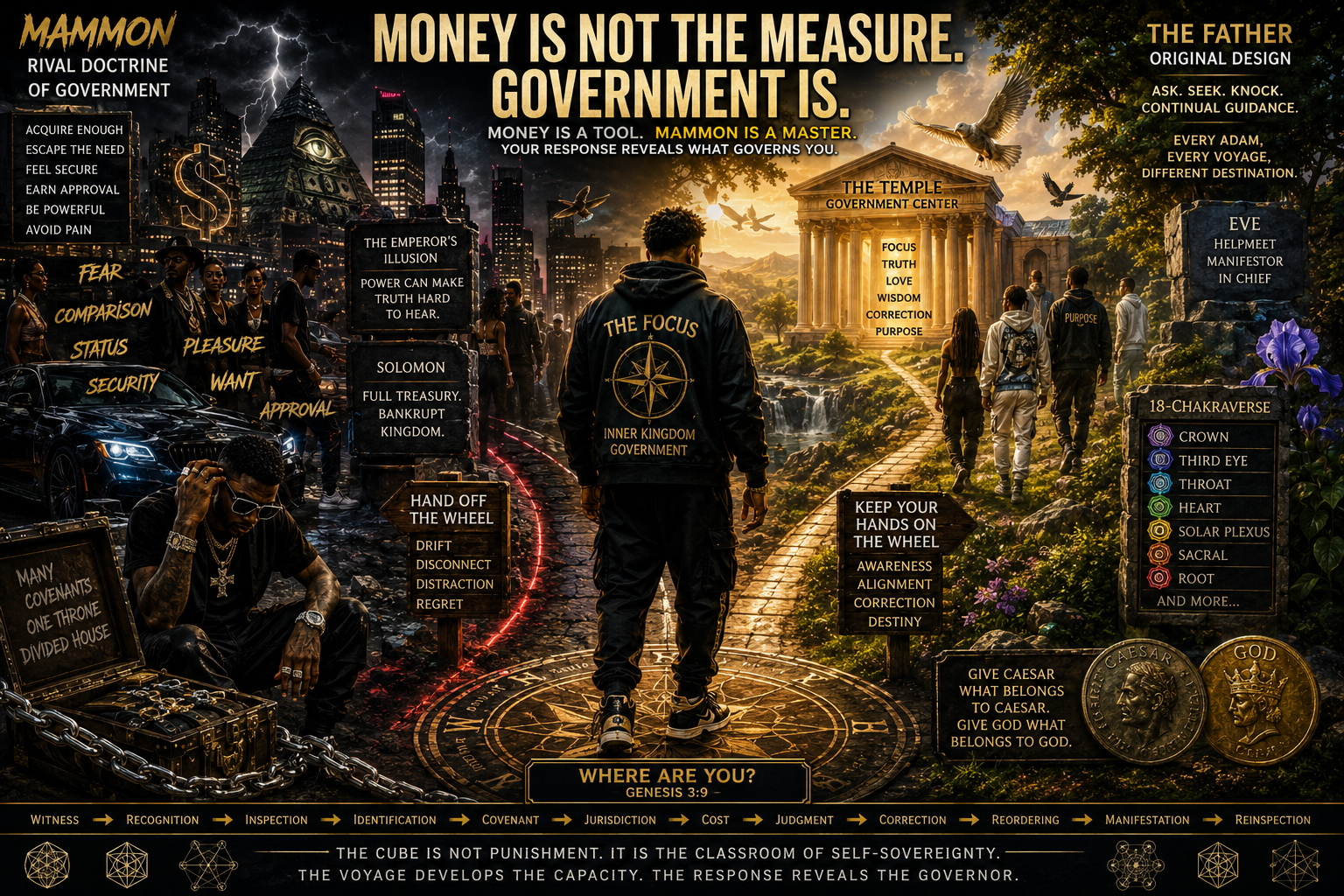
Money Is Not the Measure
What Mammon Reveals About the Government Within
The 18-ChakraVerse Bible Decode
By Alchemist Iris Chapman
Money may be one of the most misunderstood technologies in human life.
We are taught how to earn it, save it, invest it, borrow it, spend it, multiply it, protect it, and pass it to the next generation. Entire industries exist to teach financial literacy. Much of that information is useful.
Yet it leaves a deeper, more fundamental question unanswered:
- Why can Adam know exactly what he should do financially and still be unable to do it?
- Why does more money sometimes solve a problem and sometimes merely enlarge it?
- Why can one person possess very little and remain internally stable while another possesses enormous wealth and remain relentlessly afraid?
- Why can income increase while Want increases right alongside it?
- Why can someone understand budgeting, debt elimination, investing, and saving intellectually while continuing to execute financial decisions that undermine the very life they claim to build?
Perhaps the missing subject is not money. Perhaps it is government.
Within the 18-ChakraVerse, Scripture is the constitutional record of Adam’s journey toward conscious co-rulership with the Father. Adam represents humanity—male and female—learning through experiential embodiment how to govern the Inner Kingdom according to the Father’s Original Design.
From this perspective, money transforms into something entirely different.
Money does not tell us what Adam is worth. Adam’s response to money reveals what governs Adam.
That is where our constitutional examination begins.
Money Is a Technology of the Cube
Money is an economic technology. It stores value, facilitates exchange, measures obligations, transfers economic capacity, and allows resources to be accumulated and deployed across linear time.
Money can buy food. It can build a house, finance an education, compensate workers, support a family, fund an assignment, satisfy a lawful debt, and preserve future capacity. There is nothing inherently unrighteous or unlawful about any of these functions.
The crisis begins when Adam asks money to perform work completely outside its constitutional jurisdiction:
- Money can purchase shelter; it cannot establish inner security.
- Money can purchase attention; it cannot establish love.
- Money can purchase access; it cannot establish worth.
- Money can purchase comfort; it cannot establish peace.
- Money can finance an assignment; it cannot tell Adam what his assignment is.
This is the precise boundary where money and Mammon must be distinguished.
What Is Mammon?
Jesus warned with absolute constitutional clarity:
“No man can serve two masters: for either he will hate the one, and love the other; or else he will hold to the one, and despise the other. Ye cannot serve God and mammon.”
— Matthew 6:24
Within this decode, Mammon is not paper currency or digital balances.
Mammon is a rival doctrine of government: the false proposition that exterior capacity can provide what Adam has failed to establish within the Temple.
Money makes that false doctrine actionable:
- If Adam feels insecure, Mammon whispers: “Acquire enough and you will finally be safe.”
- If Adam feels insignificant, Mammon promises: “Acquire enough and people will finally respect you.”
- If Adam feels powerless, Mammon assures: “Acquire enough and nobody will ever control you.”
- If Adam feels unloved, Mammon bargains: “Acquire enough and people will stay around you.”
- If Adam feels afraid, Mammon rationalizes: “Acquire enough and you will never have to be vulnerable again.”
The deception is potent because money does possess undeniable exterior power. It alters circumstances. But altering circumstances is not the same as transforming Adam. Money can change the physical conditions of the examination without developing the spiritual capacity being tested.
Mammon’s ultimate promise is not merely that riches bring happiness. Its deeper claim is: With sufficient exterior capacity, you can escape the necessity of becoming.
There is no economic shortcut out of Adam’s constitutional curriculum.
The Cube Is Not Punishment
Genesis establishes this architectural reality. Following the descent at the Tree, the Father asks:
“And the Lord God called unto Adam, and said unto him, Where art thou?”
— Genesis 3:9
The Father does not require geographical coordinates. Adam needs to locate Adam. Something has fractured within his internal government.
Adam instinctively knows this, and his reaction illustrates the default human posture: he covers, he hides, and when questioned, he justifies and redirects responsibility.
When Adam recognizes an internal misalignment, his first impulse is rarely constitutional inspection. It is:
- How do I cover this?
- How do I explain this away?
- How do I make these uncomfortable consequences vanish?
- How do I keep everyone from seeing what happened?
Covering the manifestation does not resolve the cause. The governing question must become: How did my government get here?
This is the precise purpose of the Cube. The Cube is not a cosmic penal colony where Adam suffers for failure; it is the experiential training ground through which Adam discovers the exact government operating within himself.
The Father Asks ➔ Adam Reflects ➔ Eve Manifests ➔ Experience Provides Evidence ➔ Consequences Expose Agreements ➔ Adam Observes & Corrects ➔ Adam Governs Consciously
This cycle is how unconscious internal construction systematically matures into conscious, lawful co-rulership.
Eve Makes the Invisible Visible
Within the 18-ChakraVerse framework, Eve is the Holy Spirit in the office of Helpmeet—Adam’s Manifestor-in-Chief, the Flower of Life, the living creative field through which internal consciousness becomes embodied external reality.
Eve’s operational function is essential to Adam’s education.
Adam may proclaim with conscious intent: “I want financial stability.” Yet beneath the surface:
- The Root Chakra citizen may be governed by primal fear.
- The Sacral Chakra citizen may compulsively seek dopamine relief through retail consumption.
- The Solar Plexus Chakra citizen may demand visible displays of status to prove power.
- The Heart Chakra citizen may hold an unexamined agreement that love requires financially rescuing everyone.
Adam’s spoken intention and Adam’s actual governing body issue contradictory decrees.
Experience makes those contradictions visible. Eve faithfully manifests what Adam cannot yet see within his own government, ensuring that what was managed unconsciously is brought into the light to be governed consciously. Financial life serves as a precise mirror because currency translates invisible spiritual priorities into tangible, measurable resource allocation.
Want Is Not the Enemy
Desire must be restored to its proper constitutional rank.
Want is not evil; it is necessary. Without desire, Adam would never recognize expansion, deficiency, curiosity, lawful pleasure, refinement, or divine aspiration.
Want is constitutionally lawful as a messenger of perceived deficiency or possibility. Misalignment occurs when Adam mistakes the messenger for the governor and permits Want to prescribe its own remedy.
Want may correctly report: “Something is missing.” But Want possesses no jurisdictional authority to decide what will resolve that deficiency.
When unsupervised, a dangerous progression occurs:
- Want reports: “I feel deficient.”
- Ignorance admits: “I don’t understand why.”
- Mammon declares: “Acquire.”
- Money executes: “I can fund that transaction.”
An internal constitutional deficit is instantly misdiagnosed as an external commercial transaction.
Constitutional Sequence:
Want Reports ➔ Adam Investigates ➔ Purpose Establishes Priority ➔ Government Determines Remedy ➔ Money Commissioned (Only if Lawful Technology)
Sometimes the lawful ruling really is to buy. Sometimes it is to save, to wait, to give, or to walk away. Often, constitutional inspection reveals the truth: what Adam expected the exterior object to provide must be established within the Temple first.
The Polygamy of the Inner Kingdom
Adam easily enters into unconstitutional “marriages” with competing internal interests: career, public approval, status, fleeting pleasure, survival fear, family demands, rigid religiosity, and material accumulation.
Even legitimate desires become unlawful when elevated to an unassigned governing rank.
The seven inherited chakras grant Adam immense constitutional power before he necessarily possesses the spiritual maturity to integrate them. Without conscious central rule, these offices behave like rival rulers squabbling over the treasury:
- Root: “Protect me at all costs.”
- Sacral: “Feed my sensory appetite.”
- Solar Plexus: “Demonstrate my dominance.”
- Heart: “Deplete resources to keep the peace.”
- Throat: “Speak to defend my image.”
- Third Eye: “Project my assumptions.”
- Crown: Must govern in alignment with the Father.
When internal citizens operate as rogue authorities, money becomes the slush fund financing their competing covenants. This is constitutional polygamy.
The objective of the 18-ChakraVerse is not to give Adam eighteen competing appetites demanding capital. The objective is for eighteen constitutional offices to unite under One Undivided Government. As Adam integrates the inherited energy centers, the non-inherited chakras come online as expanded governmental capacity rather than amplified internal consumption.
Maturity is not having more desires; it is mastering greater complexity without internal fragmentation.
Solomon: A Full Treasury and a Bankrupt Kingdom
King Solomon provides the historical archetype of internal division masked by exterior success.
His external realm possessed unprecedented wealth, architectural mastery, diplomatic influence, and gold. Yet the constitutional record reveals the underlying fracture:
“But king Solomon loved many strange women… And it came to pass, when Solomon was old, that his wives turned away his heart after other gods: and his heart was not perfect with the Lord his God…”
— 1 Kings 11:1, 4
In our decode, Solomon’s tragedy is not merely physical wives; it is the multiplication of competing internal covenants.
Multiple allegiances inevitably require physical infrastructure. Solomon constructed altars for every competing claim. His vast external treasury made his internal division actionable on a monumental scale.
The true financial condition of Adam cannot be determined by examining the treasury alone. The treasury may be overflowing while the kingdom financing it is entirely bankrupt.
Solomon did not run out of gold. He ran out of undivided government.
The Naked Emperor
Hans Christian Andersen’s The Emperor’s New Clothes illustrates the same constitutional hazard.
The Emperor possesses enough exterior wealth and authority that subjects and advisors are terrified to state the obvious: the leader is naked. His status makes truth socially dangerous to voice.
Exterior capacity easily insulates an individual from vital feedback:
- Money hires intermediaries to absorb friction and clean up messes.
- Money replaces honest relationships with paid agreeable voices.
- Money buys comfort to drown out the voice of conviction.
The danger is not wealth itself; the danger is using wealth to build walls that truth cannot penetrate.
Constitutional financial health requires that increased economic capacity never purchase exemption from self-inspection. The more external resources Adam manages, the more radically correctable his government must remain.
Divine Favor Was Never Measured by Mammon
This understanding dismantles the erroneous belief that wealth proves divine righteousness or that poverty proves spiritual failure.
The life of Jesus refutes that equation:
“And Jesus saith unto him, The foxes have holes, and the birds of the air have nests; but the Son of man hath not where to lay his head.”
— Matthew 8:20
Paul echoes this neutrality:
“I know both how to be abased, and I know how to abound: every where and in all things I am instructed both to be full and to be hungry, both to abound and to suffer need.”
— Philippians 4:12
Economic conditions shift; the constitutional curriculum remains steady.
Do not diagnose the Inner Kingdom by the outer circumstance. Inspect the government revealed by Adam’s response.
Financial hardship is an environmental condition, not a spiritual diagnosis. Financial abundance is an environmental condition, not an endorsement of maturity. The treasury merely measures available material leverage. It never measures constitutional alignment.
Money Makes Government Visible
The spiritual confusion surrounding money clears the moment we look at the correct subject. The amount of capital is never the core question; Adam’s response to that capital is.
- Give Adam little, and observe his government.
- Give Adam much, and observe his government.
- Increase his income; decrease his income; drop an unexpected crisis into his lap; hand him sudden authority.
Watch the throne:
- Does Want seize the scepter?
- Does identity collapse when external assets drop?
- Does accumulation become the assignment?
- Can Adam manage abundance without worshipping the gift?
- Can Adam endure scarcity without letting survival panic rewrite his values?
- Can truth reach Adam when he holds enough power to fire the messenger?
Money never reveals what Adam is worth. Money reveals who rules Adam.
Purpose Must Govern the Treasury
How does Adam determine what his money is for? He must first confront the foundational question: What is this life for?
“Take my yoke upon you, and learn of me… For my yoke is easy, and my burden is light.”
— Matthew 11:29–30
“If any man will come after me, let him deny himself, and take up his cross, and follow me.”
— Matthew 16:24
Purpose is not whatever Adam’s ego invents, nor is it merely a career path, nor should Adam blindly adopt the expectations of family, employers, or religious institutions.
Adam identifies purpose by discerning the recurring constitutional curriculum and developed capacities of his specific life under the Father’s Original Design.
- What lessons keep returning?
- What internal citizens is he continually required to govern?
- What unique strength has been forged through his past trials?
Purpose establishes the compass heading, while daily communion provides active navigation:
“Ask, and it shall be given you; seek, and ye shall find; knock, and it shall be opened unto you.”
— Matthew 7:7
Keep Your Hands on the Wheel
Operating a life under divine governance is like driving a vehicle.
Even on a straight highway, a driver cannot let go of the steering wheel. Constant micro-corrections are mandatory. Crosswinds blow, asphalt shifts, traffic adjusts, and terrain changes. The destination is fixed, but active steering never stops.
Alignment is not a static destination Adam reaches; it is an active government Adam continually exercises.
The same holds true financially. A financial system or asset structure that served Adam ten years ago may obstruct today’s divine assignment. A season of accumulation may give way to a season of radical distribution. Adam must keep his hands on the wheel and steer.
The Focus: Attention vs. Government
Attention is not Focus.
Throughout a day, Adam’s attention must move dynamically: an invoice arrives, an unexpected repair occurs, a child needs care, or a work deadline demands energy.
Something requiring attention does not automatically deserve the throne.
“But seek ye first the kingdom of God, and his righteousness; and all these things shall be added unto you.”
— Matthew 6:33
Seeking the Kingdom first does not mean ignoring material responsibilities; it means maintaining constitutional priority. Pay the invoice today, but do not let financial fear dictate your identity.
Pay the Piper. Keep your hands on the wheel.
Settle legitimate obligations cleanly, but never mistake what requires your attention for what deserves your government.
Give Caesar What Belongs to Caesar
Jesus established this jurisdictional boundary during an economic cross-examination:
“Render therefore unto Caesar the things which are Caesar’s; and unto God the things that are God’s.”
— Matthew 22:21
This is the very definition of passing the financial test:
- To Caesar: taxes, contracts, lawful debts, fair compensation, civic obligations, and economic tools.
- To God: identity, worship, purpose, sovereignty, the Temple within, and absolute allegiance.
Caesar receives his coin. He does not get the throne.
Because assignments differ, alignment looks different for every Adam: one buys while another sells; one builds infrastructure while another distributes capital; one steps into corporate influence while another walks away. There is no singular external financial aesthetic that proves righteousness. The sole constant is jurisdictional purity.
The Odyssey of Adam
In Homer’s Odyssey, Odysseus knows his destination: home to Ithaca. Yet clarity of destination does not cancel the perils of the voyage. He faces monsters, shipwrecks, sirens, and seductions.
The governing test is always: Can you encounter this without forgetting where you are going?
The Sirens do not need to drown Odysseus; they only need to lure his ship off course. Calypso’s island is comfortable, but staying in comfort means abandoning his assignment.
A distraction does not have to be evil. It can be something good occupying the wrong constitutional rank.
Comparison Is Constitutionally Irrelevant
Every Adam navigates a bespoke curriculum:
- One is female, another male.
- One is born into generational abundance, another into systemic scarcity.
- One works in public visibility, another in quiet obscurity.
Original Design supplies the unshakeable governing laws; the individual lifetime provides the specific assignment.
Comparing your position to another Adam is a constitutional error:
- You do not know their starting baseline.
- You do not know the hidden curriculum they are working through.
- You cannot see what internal capacities their trials are forging.
- You cannot determine their spiritual maturity by looking at their physical scenery.
Mammon makes comparison tempting by offering metrics that look objective: net worth, account balances, real estate, and titles. But these numbers only measure material capacity, never constitutional rank.
Do not envy another Adam’s scenery. You cannot see his curriculum.
The Father never asks: “Where are you compared to him?” He asks: “Where are you?”
Every Adam Must Become
No Adam is exempt from becoming.
| Condition | Constitutional Test |
| Scarcity | Tests trust, integrity, and peace when resources drop. |
| Abundance | Tests stewardship, humility, and allegiance when resources surge. |
| Power | Tests whether authority serves divine order or self-interest. |
| Loss | Tests whether identity was anchored in the gift or the Giver. |
| Praise | Tests whether ego usurps the glory due to the Father. |
Intellectual comprehension alone is insufficient. Adam can memorize the truth that money does not establish his worth, but losing his savings will expose whether he has embodied that truth.
The Cube translates theoretical belief into demonstrated capacity. Adam does not graduate because he knows the curriculum; he graduates because his government has become capable of living it.
The Cube Is Effective, Not Easy
The Father did not design an effortless voyage; He designed an effective one.
A road without curves cannot teach steering. An administration facing no competing claims cannot prove governing integrity. An individual who never holds power cannot demonstrate how power is wielded with justice.
Difficulty does not mean you are off course. Ease does not mean you are blessed. The constitutional question remains: What does this exact condition require me to govern?
Restoration: Cleansing the Temple
What happens when Adam discovers that Mammon, survival fear, status, or an unauthorized citizen has taken over the treasury?
Jesus cleansing the Temple provides the exact operational procedure for restoration:
Witness ➔ Recognition ➔ Inspection ➔ Identification ➔ Covenant Assessment ➔ Jurisdiction ➔ Cost Counting ➔ Judgment ➔ Correction ➔ Reordering ➔ Manifestation ➔ Reinspection
- Witness: Acknowledge the alarm. Friction, repeated patterns, bodily tension, or external feedback signal that something is out of order.
- Inspect: Overrule the Genesis instinct to hide or blame. Step into self-examination.
- Identify the Merchant & Covenant: What unauthorized interest is trading in the Temple? What did Adam believe this transaction would provide (e.g., buying status to feel secure)?
- Count the Cost: What has this unlawful agreement cost in peace, time, relationships, and focus?
- Enforce Jurisdiction & Correct: Cast out the unauthorized merchant. Restore the throne to the Father.
- Reinspect the Manifestation: Watch what Eve embodies as the new, aligned government takes hold.
Restoration is not mere emotional remorse (“I made a mistake”). It is constitutional repentance: “How did my internal government produce this, and what must be reordered so it is not reproduced?”
There Is No Economic Shortcut
When pressure mounts, Mammon offers its signature escape: “Acquire enough leverage and you will never have to face this trial again.”
Money can upgrade your vehicle, hire legal help, and smooth out logistical bumps. But money cannot develop spiritual maturity on your behalf. There is no financial buyout for spiritual growth.
In the wilderness temptations, Jesus was offered immediate food, dramatic physical preservation, and worldly kingdoms. Every temptation offered a shortcut around the cross and the process of becoming. Higher Adam refused to use exterior power to bypass constitutional development.
What Happens After Graduation?
We do not know the economic systems of realms beyond the Cube, and that boundary is intentional. We are not given blueprints for what lies past graduation because our operational assignment is here.
A first grader learning the alphabet does not need to master advanced literary analysis. The knowledge exists, but it is not operationally relevant to their grade.
Adam is accountable for governing the capacity presently entrusted to him—not for speculating on realms he has not yet inherited.
The Constitutional Purpose of Money
What, then, is money within the 18-ChakraVerse?
Money is an economic technology of the Cube. It enables exchange, honors lawful obligations, and funds divine assignments. Because it is highly actionable, it serves as a mirror for internal government.
The amount of money is never the measure. Adam’s response is everything:
- When capital enters, who rules?
- When capital exits, who rules?
- When Want makes demands, who decides?
- When the Piper brings the bill, does Adam pay what is owed without surrendering his throne?
- When another Adam displays great wealth, does comparison derail the journey?
- When Mammon promises a shortcut, does Adam stay on course?
- When Adam drifts, does he cover—or does he inspect?
The Focus has always been the Inner Kingdom. Money was never grand enough to be the primary subject of divine revelation.
Adam is the subject. The Temple within is the subject. Conscious co-rulership under the Father’s Original Design is the subject. Money is simply an effective classroom tool through which Adam encounters himself.
The Father’s opening question echoes across every generation: “Where are you?”
The Cube provides an entire lifetime of experiences to discover the answer—not merely where your feet are standing, but who is governing the heart of the one standing there.