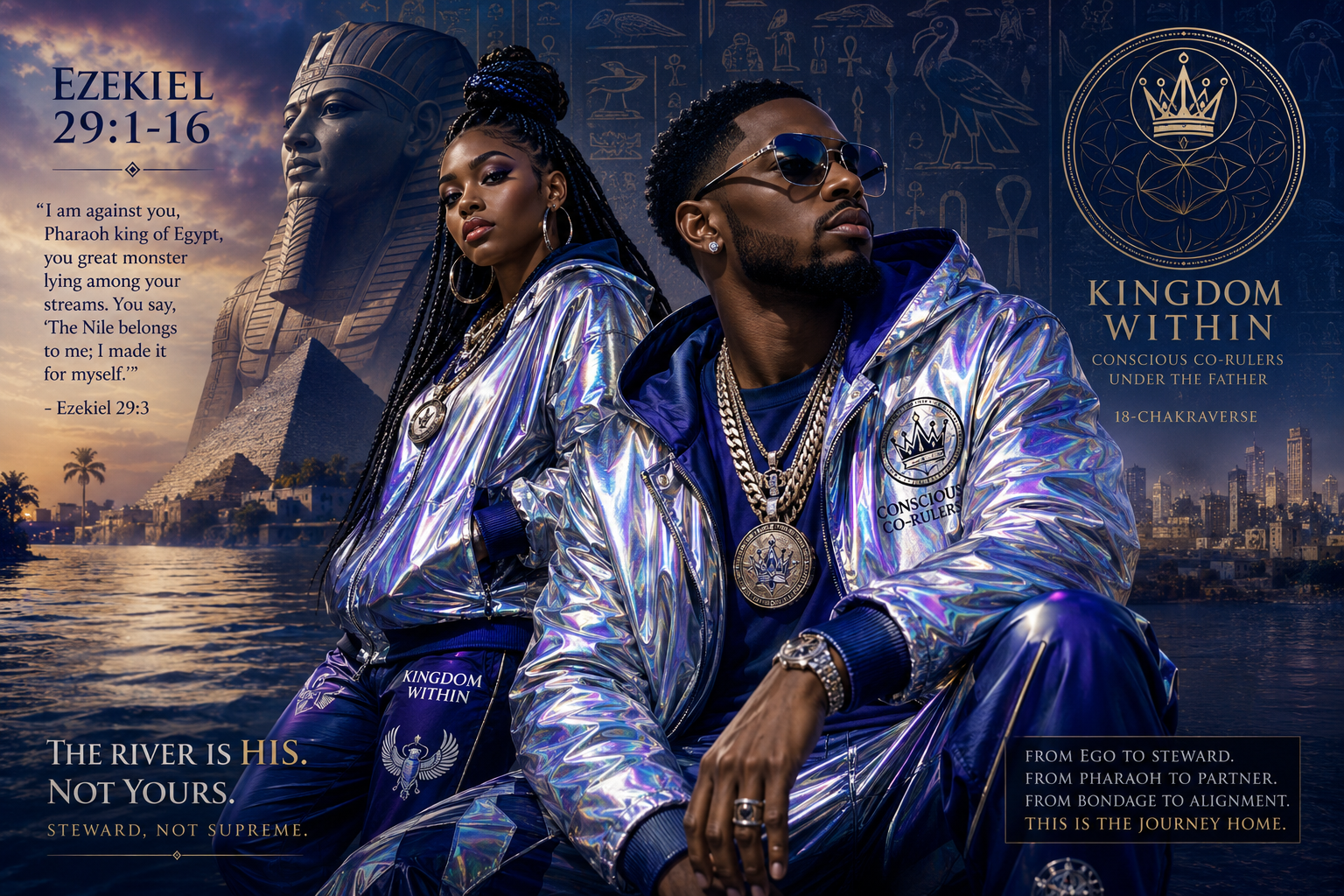
When the Inner Pharaoh Claims, “The River Is Mine”
Scripture of the Day: Bible Decode: Ezekiel 29:1–16
By Alchemist Iris Chapman
“Speak to him and say: ‘This is what the Sovereign Lord says: I am against you, Pharaoh king of Egypt, you great monster lying among your streams. You say, “The Nile belongs to me; I made it for myself.”‘” — Ezekiel 29:3
The Constitutional Crisis of Self-Created Identity
Ezekiel 29 presents one of Scripture’s most profound constitutional confrontations. On its surface, the prophecy announces judgment against Pharaoh and the nation of Egypt. Within the 18-ChakraVerse, however, this chapter reveals a far deeper pattern: the exposure of the governing persona that believes it is self-created, self-sustaining, and accountable to no authority beyond itself.
Egypt represents material consciousness—the constitutional realm where identity becomes rooted in the visible world, physical security, external success, bodily sensation, inherited programming, and subconscious survival patterns. It is the portion of Adam that believes reality begins and ends with what can be measured through the senses.
Pharaoh is the supreme governor of that realm. He is not evil simply because he possesses authority; he becomes misaligned because he mistakes delegated authority for absolute ownership.
Pharaoh: The Constitutional Ego
Within the Inner Kingdom, Pharaoh represents the ruling ego operating over material consciousness. He governs the lower constitutional realms below the diaphragm, where survival, possession, appetite, control, status, fear, and external validation often compete for governmental authority.
His defining constitutional declaration appears immediately: “The Nile belongs to me; I made it for myself.”
This is the language of autonomous governance. The ego no longer recognizes the Father as Source. Instead, it claims authorship of the very life it merely administers.
Every constitutional disorder begins with this subtle shift:
- Instead of stewardship… there is ownership.
- Instead of gratitude… there is entitlement.
- Instead of partnership… there is self-deification.
The Nile as Life Force
The Nile was Egypt’s single non-negotiable source of life; without it, Egypt ceased to function. Within the Inner Kingdom, the Nile symbolizes the continuous, overflowing flow of life itself—breath, vitality, resources, opportunity, creativity, relationships, provision, and consciousness itself.
+-------------------------------------------------------------+
|                         THE FATHER                          |
|                     (The Eternal Source)                    |
+------------------------------+------------------------------+
                               |
                               v
                     [ THE NILE / LIFE FORCE ]
            (Breath, Vitality, Resources, Consciousness)
                               |
                               v
                     [ PHARAOH / THE EGO ]
                   (The Delegated Steward)
The Father provides the river. Pharaoh merely governs beside it. When the ego declares ownership of the river, it mistakes administration for creation. This is the exact constitutional inversion Ezekiel exposes.
The Great Monster in the Waters
Ezekiel describes Pharaoh as a great monster lying among the rivers. The image is striking: the creature is comfortable, powerful, and apparently immovable. Yet it remains submerged within the very waters it claims to own.
This monster symbolizes deeply rooted subconscious agreements:
- Habitual pride
- Generational conditioning
- Inherited assumptions
- Material identity that has become so familiar it feels natural
The ego often appears strongest precisely where it is most unconscious.
Hooks in the Jaws
The Father declares that He will place hooks into Pharaoh’s jaws and pull him from the river. This is not arbitrary punishment—it is constitutional exposure. Hidden government must become visible before it can be transformed.
Throughout Adam’s journey, circumstances often arise that expose these unconscious governing principles:
- A financial crisis
- A failed relationship
- Loss of status or physical strength
- Unexpected transition or disruption
These moments reveal which internal ruler has actually been governing the kingdom. The Father is not creating disorder; He is uncovering the ruler who has already been sitting upon the wrong throne.
Egypt Becomes Desolate
The prophecy continues with Egypt becoming desolate for forty years. Within constitutional architecture, forty repeatedly symbolizes education, preparation, testing, and governmental restructuring.
The desolation of Egypt represents the temporary dismantling of material certainty. The ego can no longer rely upon the systems that once defined its identity. During these seasons, Adam discovers that his life has always depended upon the Father’s river—not Pharaoh’s management of it. What feels like loss often becomes constitutional recalibration.
Scattering Among the Nations
Egypt is then scattered among the nations. The nations represent competing governing systems operating outside the Father’s Original Design.
When Pharaoh loses centralized control, the fragmented loyalties that once hid beneath his rule become visible:
                  FRAGMENTED INNER GOVERNMENTS
  +--------------------+--------------------+--------------------+
  |                    |                    |                    |
  v                    v                    v                    v
Inherited           Cultural            Religious             Family
 Fears            Expectations           Legalism           Conditioning
Constitutional maturity requires identifying every single competing government that seeks unlawful influence within the Inner Kingdom.
Egypt Restored—But Never Supreme
One of the chapter’s most fascinating conclusions is that Egypt eventually returns—however, it never again becomes a dominant empire.
This is a remarkable constitutional principle:
- Material consciousness is not destroyed.
- The physical body is not rejected.
- The subconscious is not eliminated.
- The ego itself is not annihilated.
Instead, each assumes its lawful constitutional office. The material realm becomes a servant rather than a sovereign. The body becomes a temple rather than a master. Resources become tools rather than identity. The subconscious becomes an ally rather than a hidden dictator.
Key Takeaway: Egypt still exists. It simply no longer rules.
Constitutional Alignment
Within the 18-ChakraVerse, this passage invites a thorough constitutional examination of the governing intentions operating below the diaphragm, where survival, security, appetite, possession, and personal power first emerge.
Ask within the Circle of Meditation:
- Where have I quietly declared, “This is mine. I made this myself”?
- What areas of my life do I govern as though I am the source rather than the steward?
- Which constitutional offices have become governed by fear instead of trust?
- Where has material success become the sole measure of identity?
- What hidden Pharaoh still occupies a throne the Father never assigned him?
These questions are not accusations—they are invitations to lawful governance.
Bible Decode Insight
Ezekiel 29 is not primarily about the destruction of Egypt. It is about restoring constitutional order.
The Father does not remove Pharaoh because authority is wrong; He removes Pharaoh from unlawful supremacy. Every constitutional office has a rightful purpose. The subconscious has a purpose. The body has a purpose. Material resources have a purpose. The ego has a purpose.
But none were ever designed to become the ultimate king.
The Father’s Original Design establishes a kingdom in which every constitutional office faithfully serves under divine government. When Pharaoh relinquishes the throne, the river is recognized once again as the Father’s gift rather than the ego’s possession. Only then can the constitutional government of the Inner Kingdom function in harmony, allowing Adam to mature toward conscious co-rulership with the Father.