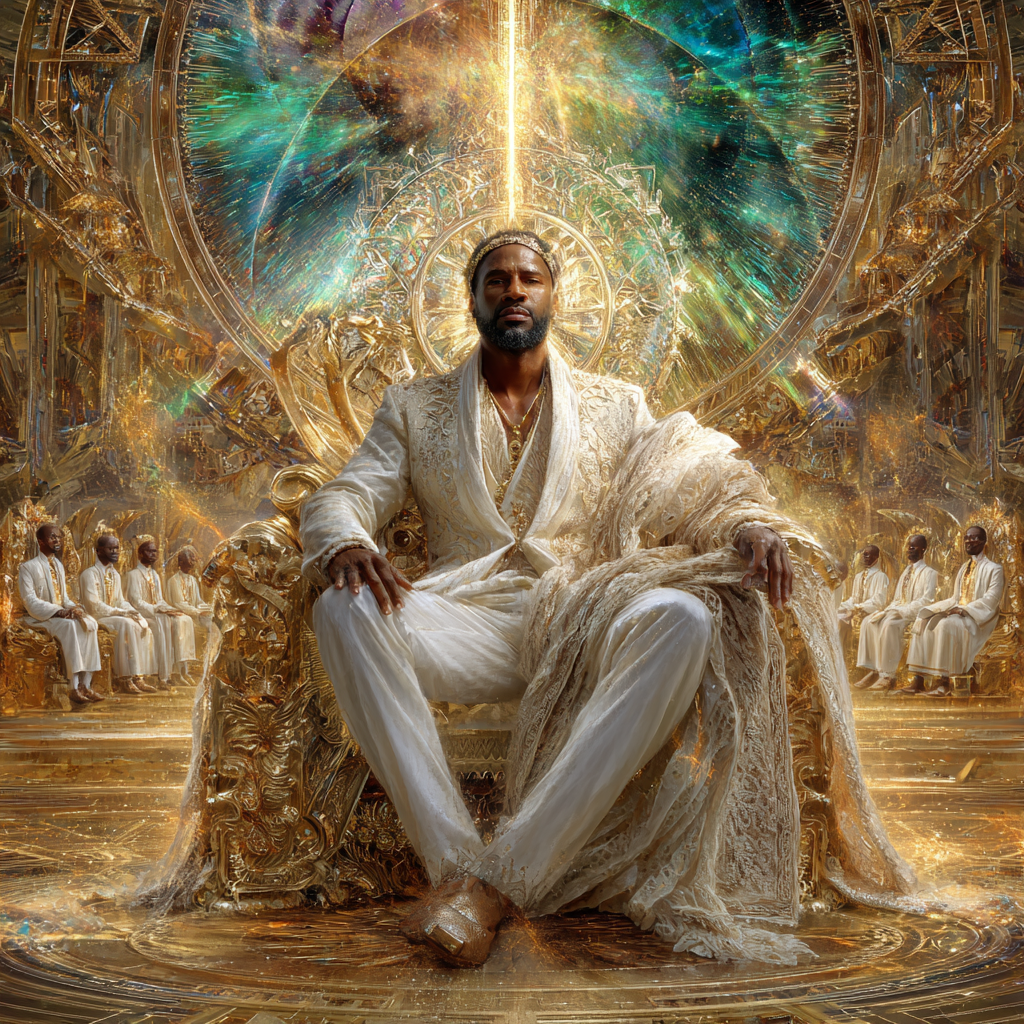
Tarot Decode: The Ordering of the Kingdom
By Alchemist Iris Chapman
If Eve, the Empress, represents the sacred womb of creation, then the Emperor represents the profound responsibility of governance.
While the Empress asks, “What has been created?” the Emperor looks at that creation and asks, “How shall it be governed?”
| The Empress (Eve) | The Emperor |
| Nurtures and Cultivates | Organizes and Establishes Order |
| Gives life to the kingdom | Ensures the kingdom can endure |
Within the esoteric framework of the 18-ChakraVerse and the Book of Revelation, Chapters 8 and 9 reveal one of the most difficult and demanding stages of Adam’s journey: the moment when the sovereign must finally begin governing what has been created. As the prophet Isaiah declared of the ultimate sovereign pattern, “And the government shall be upon his shoulder… of the increase of his government and peace there shall be no end, upon the throne of David, and upon his kingdom, to order it, and to establish it with judgment and with justice from henceforth even for ever” (Isaiah 9:6–7).
The Emperor carries that very mantle: taking the raw vitality of the soul and establishing a systemic structure that can endure.
The Harvest Has Been Gathered
The previous chapters revealed the vastness of the inner kingdom. The seals were opened, and the hidden contents of consciousness emerged into the light. The harvest was closely examined, the completed mansions of the soul were recognized, and the redeemed citizens of the kingdom stood before the throne.
The incredible work of the Empress had been fully revealed. Creation had borne fruit.
Now comes the next inevitable question: What must be done with the kingdom that has been built?
This is where the Emperor enters.
The Nature of the Emperor
The Emperor is frequently misunderstood. Many see this archetype solely as a symbol of domination, rigid control, or tyrannical authority. But the highest, truest expression of the Emperor is lawful governance. It is the archetype of structure, boundaries, ultimate responsibility, and wise stewardship.
A consciousness without this lawful boundary collapses from within: “He that hath no rule over his own spirit is like a city that is broken down, and without walls” (Proverbs 25:28).
The Emperor understands something fundamental that the Empress does not need to understand: not everything can simply be nurtured forever. A kingdom must eventually be organized. A kingdom must eventually be governed. A kingdom must eventually become sustainable. It requires the divine principle spoken through Paul: “For God is not the author of confusion, but of peace… Let all things be done decently and in order” (1 Corinthians 14:33, 40).
The Silence in Heaven: Shifting from Seal to Sound Current
Revelation 8 begins with a striking, highly atmospheric image:
“When he opened the seventh seal, there was silence in heaven for about half an hour.” (Revelation 8:1)
This silence marks a profound frequency threshold in the architecture of the 18-ChakraVerse. The Seven Seals represented the internal unsealing—the quiet, introspective surfacing of personal memory, hidden history, and karmic records. But once the seventh seal opens, the revelation pauses. The life review halts. The inner cosmos falls into total stillness.
As Habakkuk proclaimed, “The Lord is in his holy temple: let all the earth keep silence before him” (Habakkuk 2:20).
This silence is not emptiness; it is intense deliberation. It is the necessary chamber of stillness between internal realization and structural execution. Here, the sovereign steps back to quietly survey what has been revealed before issuing the decrees of the Word: “For while all things were in quiet silence, and that night was in the midst of her swift course, Thine Almighty word leaped down from heaven out of thy royal throne” (Wisdom of Solomon 18:14–15).
From that deep, centering stillness, the revelation transitions from the unsealed scroll to the audible sound current of the higher centers.
The Trumpets and the Logos Octave
Then, the trumpets appear.
It is easy to mistake the trumpets for the domain of the personal Throat Chakra, but their function here belongs to an entirely different dimension. While the Throat Chakra operates on the Virgo-Libra axis—analyzing, balancing, and speaking personal truth within the immediate vehicle—the Logos Chakra operates on the higher, cosmic frequency of Aquarius.
The Logos is not concerned with personal expression; it is the center of universal architecture, divine cosmic law, and the systemic orchestration of the collective psyche. The Emperor, elevated into the current of the Aquarian Logos, ceases to be an autocratic ruler imposing personal ego. Instead, he becomes the Water-Bearer of cosmic order, pouring out structural alignment across the entire internal plane.
Traditionally viewed as terrifying judgments from an angry God, the trumpets are the vibrational instruments of this higher octave. In ancient Israel, trumpets were sacred tools of civic coordination and alignment: “Make thee two trumpets of silver… that thou mayest use them for the calling of the assembly, and for the journeying of the camps” (Numbers 10:2).
The sound of a trumpet gathers attention. It signals movement. It signals that a ruler has spoken. Within the inner kingdom, the trumpets announce that active governance has finally begun. The sovereign is no longer merely observing the kingdom; through the acoustic resonance of the Logos, he is actively calling every camp into order.
The Necessity of Correction
Many people deeply desire creation—very few desire correction. Yet, no kingdom survives without it.
The Emperor understands the architecture of the soul. He knows that some structures must be reinforced and strengthened. Others must be completely dismantled. Some must be reassigned to new purposes, and some must be entirely transformed.
This process mirrors the spiritual principle recorded in Hebrews: “Despise not thou the chastening of the Lord, nor faint when thou art rebuked of him… Now no chastening for the present seemeth to be joyous, but grievous: nevertheless afterward it yieldeth the peaceable fruit of righteousness unto them which are exercised thereby” (Hebrews 12:5, 11).
This is not cruelty; it is stewardship. The ultimate purpose is not destruction, but alignment.
The Fractal Kingdom
Throughout the long evolutionary journey, Adam created many fractal personas to navigate reality:
- The Builders: Teachers, Healers, Warriors, Judges, Prophets, Protectors.
- The Shadows: Conspirators, Usurpers, Accusers, Tyrants, Demons, Devils.
He did not create the shadows because he consciously intended evil, but because consciousness creates continually, often out of unhealed trauma or pure survival instinct. Over time, the inner kingdom became heavily populated with countless citizens.
The Emperor’s task is not to deny their existence or pretend they are not there. The Emperor’s task is to determine their proper, lawful role.
Governance Versus Suppression
A wise ruler does not immediately destroy every difficult or frightening citizen. A wise ruler seeks to understand them, study them, assign them, and govern them. Even the most frightening forces often contain incredibly useful, necessary power.
- The Warrior can easily become a tyrant. Yet, without the Warrior, the kingdom cannot defend its borders.
- The Judge can easily become a harsh accuser. Yet, without the Judge, vital discernment disappears.
- The Rebel can easily become destructive. Yet, without the Rebel, deep-seated corruption goes completely unchallenged.
The Emperor learns to govern raw power rather than fear it.
Revelation 9 and the Shadow Kingdom
The imagery of Revelation 9 is among the most unsettling in all of Scripture. Strange, locust-like beings emerge from the abyss. Hidden forces appear. Fearsome, apocalyptic powers reveal themselves.
Within this psychological framework, these beasts can be understood as previously unexamined, deeply repressed aspects of the kingdom. It is the encounter of the Gerasene demoniac playing out within the self: “And Jesus asked him, saying, What is thy name? And he said, Legion: because many devils were entered into him. And they besought him that he would not command them to go out into the deep” (Luke 8:30–31).
For much of Adam’s journey, these splintered forces operated entirely unconsciously, driving behaviors from the shadows. Now, the abyss is unsealed, and they stand fully exposed before the throne. Yet Scripture reminds us, “all things that are reproved are made manifest by the light: for whatsoever doth make manifest is light” (Ephesians 5:13).
The sovereign finally sees what has been living in the dark. He sees them not to be terrified, and not to flee, but to understand. And, ultimately, to govern.
The Difference Between Job and the Emperor
The Book of Job and the Book of Revelation offer two entirely different approaches to the chaos of the inner kingdom. Job experienced the devastating consequences of an incompletely understood kingdom. The Emperor, however, begins truly understanding it.
| The Experience of Job | The Governance of the Emperor |
| Suffers the chaos of the kingdom | Studies the structure of the kingdom |
| Asks, “Why is this happening to me?” | Asks, “How is this governed?” |
| Endures the storm as a helpless victim | Directs the storm as a conscious steward |
This marks the ultimate spiritual transition from victimhood to stewardship.
The Throne and the Kingdom
The throne exists in the center of the vision for a very specific reason. Not because Adam needs to dominate his own mind, but because the mind requires integration: “A king that sitteth in the throne of judgment scattereth away all evil with his eyes” (Proverbs 20:8).
Without a sovereign center, chaos reigns: the Warrior seeks the throne, the Judge seeks the throne, the Rebel seeks the throne, and the Teacher seeks the throne. Every department of the psyche attempts to govern the whole, resulting in endless confusion and self-sabotage.
The Emperor restores the throne to its rightful place. Every faculty retains its unique purpose, but none are allowed to usurp the center.
The Emperor and the Orchestra
Perhaps the clearest symbol of the Emperor is the master conductor of an orchestra.
The kingdom contains many diverse instruments. Some are beautifully melodic. Some are deeply intimidating. Some are booming and loud. Some are incredibly subtle. The task is never about eliminating the orchestra or silencing the loud instruments. The task is directing them.
The Emperor learns precisely when the Warrior should play, when the Healer should step forward, when the Judge should weigh in, when the Prophet should speak, and when the Builder should act. The kingdom becomes a symphony only because the sovereign understands every single section.
The Logos and the Emperor
- The Fool chose the journey.
- The Magician discovered creative power.
- The High Priestess discovered hidden wisdom.
- The Empress revealed what had been created.
- The Emperor begins governing what has been created.
Revelation Chapters 8 and 9 therefore mark a crucial, demanding stage in Adam’s life review. The harvest has already been revealed; now, the kingdom must be strictly organized under the higher laws of the Logos.
Here, the Emperor demonstrates that true sovereignty is not autocratic control, but the conscious stewardship of cosmic order. He leads not through domination. Not through fear. He leads through lawful administration.
The Emperor teaches us that true sovereignty is not merely possessing the power to create. It is the willingness to actively govern what has been created. And before Adam can continue any deeper into the initiation of the Logos, he must demonstrate that every single citizen of the inner kingdom—the light and the shadow alike—can be brought into proper, harmonious order.
This is the lesson of the Emperor. This is the great work of governance. And this is the next monumental revelation on Adam’s path toward co-rulership with God.