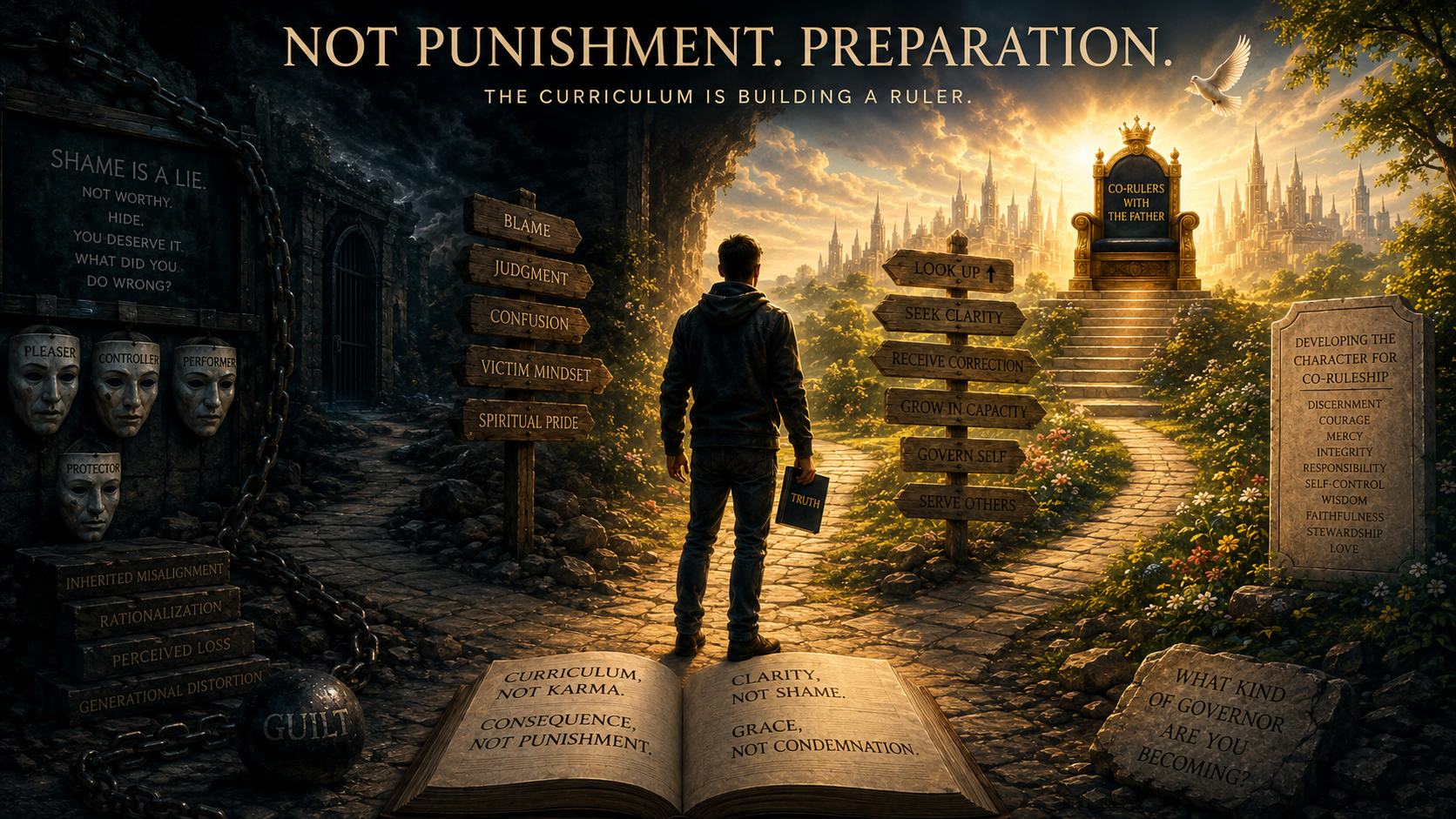
What If Your Life Isn’t Punishment?
The Hidden Curriculum Preparing You to Rule
By Alchemist Iris Chapman
What if some of the experiences you have interpreted as punishment were never punishment at all?
What if the difficulties, consequences, corrections, unanswered questions, unexpected circumstances, and even failures of your life belong to something much larger?
A curriculum.
For much of my life, I understood consequence through the language of punishment and shame. Something went wrong, therefore I must have done something wrong. Something painful happened, therefore perhaps God was displeased. I failed, therefore something must be inherently wrong with me.
This mindset embeds a destructive equation directly into our theology:
Misalignment ➡ Punishment ➡ Shame
The biblical journey of Adam is not primarily the story of a criminal being sentenced. It is the story of a ruler being trained. The curriculum is not designed to punish Adam for being an imperfect student; it is designed to develop an Adam whom God can trust as a co-ruler.
The Higher Agenda Is Co-Rulership
The purpose of Adam’s journey is not merely to learn how to behave. Adam is learning how to govern. That distinction changes everything.
If the ultimate objective were simply passive obedience, God could provide a rigid list of rules and reward compliance. But Scripture concludes somewhere far more expansive: it ends with rulership.
“To him that overcometh will I grant to sit with me in my throne.”
— Revelation 3:21
“And they shall reign for ever and ever.”
— Revelation 22:5
The student does not remain a student forever. There is an ultimate graduation—a throne, a government, and genuine responsibility. The curriculum has a definitive destination: Adam is being prepared for co-rulership.
Self-Sovereignty Is Part of the Training
Self-sovereignty is not merely Adam declaring, “Nobody tells me what to do.” That is freedom without government. True sovereignty requires rigorous internal alignment:
- Can Adam govern desire rather than be ruled by it?
- Can Adam exercise power without being corrupted by power?
- Can Adam distinguish the authentic Self from a protective persona?
- Can Adam recognize an inherited distortion even when everyone around calls it righteous?
- Can Adam receive correction without collapsing into self-condemnation?
- Can Adam create and accept total responsibility for what that creation produces?
- Can Adam exercise mercy without abandoning discernment?
- Can Adam encounter truth that costs something and still choose alignment?
Self-sovereignty is the testing ground where Adam discovers what internal governance actually demands.
The Curriculum Is Not Karma
The curriculum is not a simplistic karmic ledger where every hardship is a direct retribution for a past misdeed. That is merely punishment theology wrapped in alternative vocabulary:
| System | Diagnostic Assumption | Underlying Error |
| Punitive Theology | “You are suffering because you sinned.” | Diagnoses spiritual standing purely from external circumstance. |
| Karmic / Past-Life | “You must have done something wrong in a past life.” | Fills an information gap with speculative guilt. |
| The Divine Curriculum | “What capacity must Adam develop to govern?” | Views circumstance through developmental growth and lawful feedback. |
The core question is not, “What does Adam owe because of yesterday?” The larger developmental question is: What must Adam know, integrate, and become capable of governing to fulfill original design?
Sowing and reaping remain lawful realities. Actions have consequences. But consequence is not the only explanation for circumstance, and circumstance alone never reveals another person’s complete transcript.
Consequence Is Information, Not Retribution
Consequence is not necessarily punishment—it is information.
When Adam makes a choice, that choice produces a creation. Adam experiences the result, and that experience delivers immediate feedback regarding the internal government that produced it.
Choice ➡ Creation ➡ Consequence ➡ Information ➡ Correction ➡ Greater Capacity
If God continually shielded Adam from the lawful results of his own government, Adam could never understand how creation operates. A future co-ruler requires dependable laws. Rigidity of law is not the absence of grace; very often, grace is the clarity delivered directly through the consequence.
Nebuchadnezzar Looked Up
King Nebuchadnezzar provides a clear case study in Daniel 4. He held massive external authority, yet his internal government collapsed into hubris:
“Is not this great Babylon, that I have built… by the might of my power, and for the honour of my majesty?”
— Daniel 4:30
The persona of the monarch usurped the throne of his true identity. Because he was governed by the consciousness of his own power, he descended into a degraded, beast-like state. Yet the turning point arrived within that very condition:
“I Nebuchadnezzar lifted up mine eyes unto heaven, and mine understanding returned unto me.”
— Daniel 4:34
Nebuchadnezzar did not fix his circumstances first. He did not prove his worthiness or escape the consequence before approaching God. He looked up while still inside the lesson—and understanding returned.
       [ CONFLICT / COLLAPSE ]
                  │
        ┌─────────┴─────────┐
        ▼                   ▼
    LOOKING IN          LOOKING UP
 (Shame & Concealment)  (Alignment & Clarity)
        │                   │
  Identity Verdict     Understanding Returns
        │                   │
   Persona Rule        Sound Governance
Shame Tells Adam Not to Look Up
Shame corrupts the educational sequence. Instead of moving from observation to correction, shame inserts concealment:
Choice ➡ Consequence ➡ Shame ➡ Concealment ➡ Avoidance
Adam stops asking, “What does this teach me?” and begins asking, “What does this prove is broken in me?” To survive the perceived verdict, protective internal personas take over governance:
- The Pleaser: “Keep everyone appeased so we remain safe.”
- The Controller: “Micromanage all variables so nothing catches us off guard.”
- The Performer: “Remain impressive so no one sees our flaws.”
- The Protector: “Build walls so no one gets close enough to wound us.”
These personas are not evil; they were internal citizens commissioned during a past crisis. The problem is that no one ever notified them that the emergency has passed.
A persona is an instrument, not the Self. The objective is not to destroy these personas, but to restore proper order. The Self must govern the persona—the persona must never govern the Self.
When reassigned under sound governance, the Protector becomes a guardian of healthy boundaries, the Controller becomes discernment, the Pleaser matures into diplomacy, and the Performer becomes a clear communicator.
Job’s Friends and Circumstantial Judgments
When consequence provides feedback, we risk assuming every hardship is a direct consequence of error. Scripture explicitly forbids this.
In Job 1:6, a dialogue occurs in the heavenly realm outside of Job’s awareness. When devastation strikes, his friends observe his outer ruins and reason backward: Job is suffering, therefore Job must harbor secret sin. They manufactured guilt to explain a mystery they could not comprehend.
Jesus confronted this exact error in John 9:2 when His disciples asked whether a man’s blindness was caused by his own sin or his parents’. Jesus rejected the premises entirely, just as He did in Luke 13 regarding the Galileans who suffered untimely deaths. Circumstances do not disclose their own spiritual root.
The Inner Circle and the Transmitted Knot
Every individual’s complete curriculum is held securely in the Inner Circle between them and God. Others can see external behavior, outcomes, and disruption, but they do not possess the case file.
┌───────────────────────────────────────────────┐
│              THE INNER CIRCLE                 │
│                                               │
│   • Original Self         • Intentions & Fear │
│   • Active Personas       • Available Data    │
│   • Learned Capacities    • The Lesson Plan   │
│                                               │
│         [ KNOWN ONLY TO GOD & THE SELF ]      │
└───────────────────────────────────────────────┘
A failed exam demonstrates an outcome, but never the inner reason for the failure. Decades ago, I saw a struggling classmate’s test paper filled with cartoon names and nonsense. That visual gave me additional data, but it never gave me access to her Inner Circle. I could see the failure, but not the complex knot of fear, exhaustion, or resistance behind it.
Furthermore, many distortions are inherited across generations. When a misalignment is passed down through family systems, cultures, or institutions, it is frequently defended not as malice, but as moral righteousness:
Inherited Distortion ➡ Perceived Benefit ➡ Threatened Loss ➡Moral Justification ➡ Transmission
When an individual decides to break that chain and refuse cooperation with the inherited distortion, their life often undergoes immense disruption. An outside observer might judge the upheaval as failure, when in reality, the disruption is the natural friction of breaking a multi-generational knot.
From Unconscious Construction to Conscious Governance
Knowledge of this curriculum is meant for internal navigation, never external prosecution. Grace does not eliminate discipline; grace governs discernment so that correction can take place without condemnation.
UNCONSCIOUS CONSTRUCTION
Create ──► Experience ──► Discover ──► Correct ──► Develop Capacity

CONSCIOUS CONSTRUCTION
Understand ──► Choose ──► Create ──► Govern ──► Maintain Alignment
The classroom is real, the laws are dependable, and the stakes matter. God is not producing an Adam terrified of making an error; He is raising a co-ruler equipped with the discernment, wisdom, and capacity required to govern.
When the lesson feels obscure and your vantage point is limited, do not manufacture guilt or look to the opinions of fellow students.
Acknowledge the mystery, receive the information, and look up.