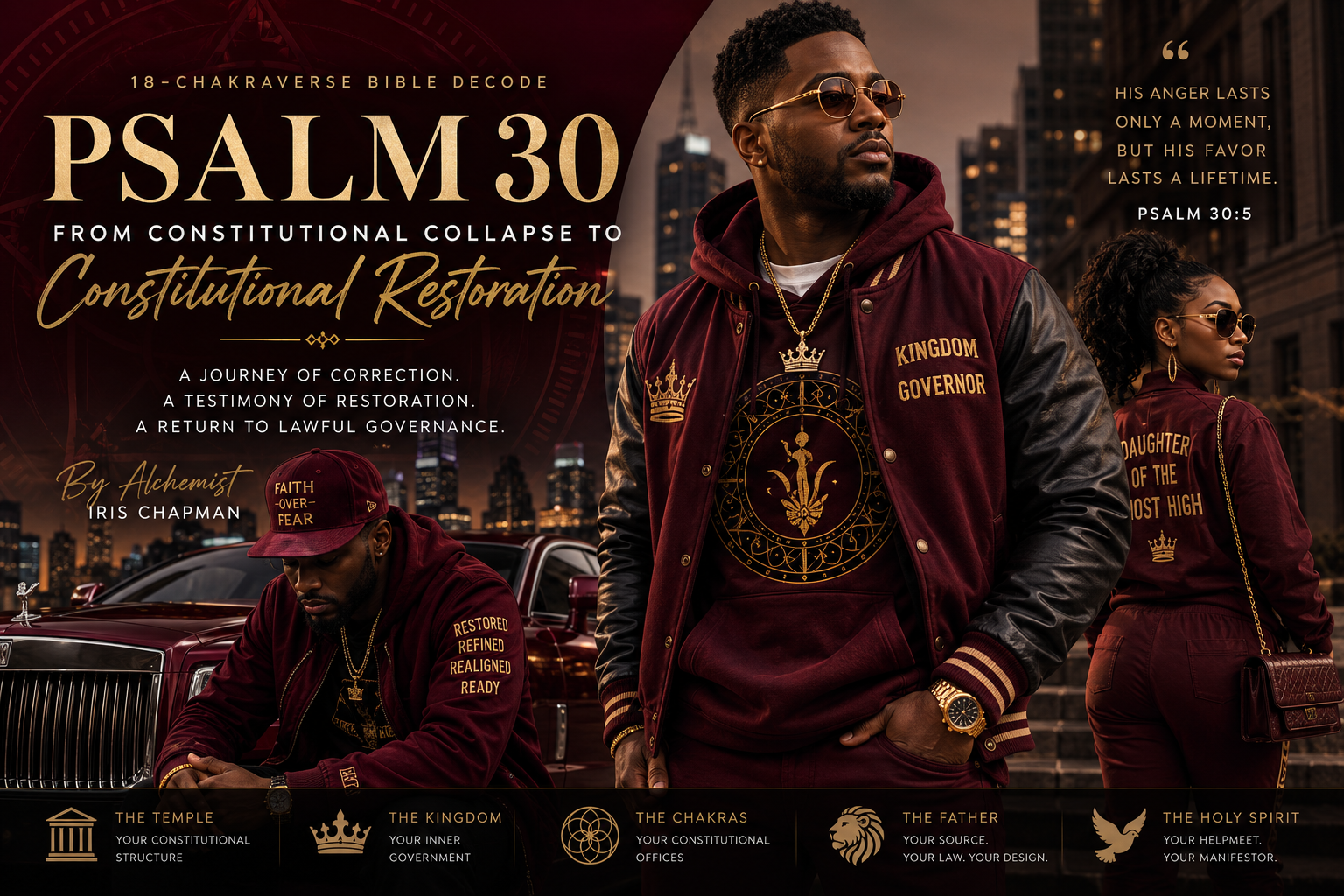
From Constitutional Collapse to Constitutional Restoration
Psalm 30: An 18-ChakraVerse Bible Decode
By Alchemist Iris Chapman
There are seasons in life when everything appears to be falling apart. Relationships become strained, emotions feel overwhelming, old habits resurface, and even our confidence in ourselves seems to disappear. Most people ask, “Why is God allowing this to happen?”
Psalm 30 offers a profound answer—but only when we read it as more than the story of one ancient king. Within the 18-ChakraVerse, Psalm 30 becomes a constitutional case study of the Inner Kingdom, revealing how the Father patiently restores lawful governance within Adam until every constitutional office operates according to its Original Design.
The 18-ChakraVerse approaches Scripture as the constitutional record of humanity’s journey toward conscious co-rulership with the Father:
- Adam represents humanity—male and female—progressing through successive personas as wisdom matures.
- The Temple represents the living constitutional structure of the human being.
- Jerusalem symbolizes the governing capital of the Inner Kingdom.
- The Nations represent competing systems of governance seeking influence within consciousness.
Through this lens, Psalm 30 is not simply a testimony of rescue from external danger; it is the constitutional story of a governor whose internal kingdom is being restored after a season of disorder.
Lifted from the Pit: The Beginning of Constitutional Restoration
Psalm 30 opens with David declaring:
“I will exalt you, Lord, for you lifted me out of the depths and did not let my enemies gloat over me.”
— Psalm 30:1
Within the constitutional framework, the “depths” are not merely physical danger or emotional depression. They symbolize constitutional exile—the experience of living under competing systems of governance rather than the Father’s Original Design.
This is the condition in which Adam unknowingly allows fear to govern instead of wisdom, pride instead of humility, or bitterness instead of forgiveness. Misaligned personas temporarily occupy positions of influence. The constitutional offices remain intact, but their governing intentions become distorted.
The Father’s response is not condemnation but restoration. He lifts Adam out of constitutional disorder, not by replacing the offices of government, but by restoring them to their lawful purpose.
The pit is therefore not the end of the journey. It becomes the classroom in which constitutional maturity begins.
Healing Is the Restoration of Government
David continues:
“Lord my God, I called to you for help, and you healed me.”
— Psalm 30:2
Healing throughout Scripture is often understood as physical recovery, emotional comfort, or deliverance from suffering. While those dimensions certainly matter, Psalm 30 points toward something even deeper: within the 18-ChakraVerse, healing is constitutional restoration.
The Father does not simply remove symptoms. He restores the architecture of governance.
Every constitutional office gradually returns to its Original Design:
- The Root Chakra learns steadfastness rather than fear.
- The Solar Plexus Chakra exercises authority without domination.
- The Heart Chakra governs through compassion rather than resentment.
- The Throat Chakra speaks truth instead of manipulation.
- The Crown Chakra willingly submits to divine wisdom rather than attempting independent rule.
Healing occurs whenever lawful government replaces constitutional disorder.
Awakening from the Realm of the Dead
David writes:
“You brought me up from the realm of the dead.”
— Psalm 30:3
Death in this context need not be understood merely as physical death. Constitutionally, the realm of the dead represents unconscious governance.
Many people live almost entirely from inherited reactions, conditioned beliefs, cultural expectations, family traditions, and automatic emotional responses. They are alive physically while remaining largely unconscious constitutionally.
Psalm 30 describes Adam awakening. He begins governing intentionally rather than automatically. He learns to evaluate competing systems instead of submitting to them unconsciously. This awakening marks the beginning of genuine constitutional maturity.
The Father’s Correction Is Educational
Perhaps one of the most beloved verses in the psalm is also one of its most constitutionally revealing:
“His anger lasts only a moment, but his favor lasts a lifetime; weeping may stay for the night, but rejoicing comes in the morning.”
— Psalm 30:5
Within the constitutional framework, the Father’s anger is never uncontrolled emotion. It is lawful correction. The Father exposes disorder only long enough to restore order.
Every difficult season serves a constitutional purpose:
- Hidden fears are revealed.
- Misaligned governing principles are exposed.
- False confidence is dismantled.
- Adam is invited to exchange competing governments for lawful stewardship.
Night represents seasons of unconscious governance; morning represents renewed constitutional awareness. Joy arrives because lawful administration has returned to the Inner Kingdom.
The Danger of Constitutional Pride
David honestly admits:
“When I felt secure, I said, ‘I will never be shaken.'”
— Psalm 30:6
Few constitutional dangers are greater than believing we no longer require continual alignment with the Father’s wisdom. Temporary success can create the illusion of permanent maturity.
When Adam assumes that his stability originates from himself rather than from faithful stewardship under the Father’s authority, constitutional drift quietly begins. Pride rarely announces itself dramatically—it often appears as subtle independence, self-sufficiency, or the belief that previous victories guarantee future wisdom.
The Father lovingly allows instability to expose this illusion—not as punishment, but as education. Every correction becomes another lesson in faithful governance.
A Constitutional Appeal Before the Throne
David cries out:
“To you, Lord, I called; to the Lord I cried for mercy.”
— Psalm 30:8
This prayer is remarkably constitutional. Adam recognizes that restoration serves a purpose greater than personal relief. He understands that a restored governor becomes capable of administering justice, compassion, wisdom, and truth throughout the Inner Kingdom.
The Father is not interested in producing passive followers. His objective is mature co-rulers who willingly administer His constitutional order within every realm of consciousness. Mercy therefore becomes the environment in which constitutional maturity develops.
Mourning Becomes Dancing
Near the conclusion of the psalm, David celebrates one of Scripture’s most beautiful transformations:
“You turned my mourning into dancing; you removed my sackcloth and clothed me with joy.”
— Psalm 30:11
Constitutionally, mourning represents internal contraction. Every office becomes defensive. Fear governs decision-making, creativity withdraws, love becomes guarded, speech becomes cautious, and vision narrows.
Dancing symbolizes something entirely different. It is the freedom that naturally emerges when every constitutional office begins functioning according to its Original Design.
Nothing new has been added. Nothing essential has been removed. The permanent constitutional structure remains exactly as the Father created it—only the governing intention has changed. Alignment produces freedom.
Praise Is Lawful Governance
The psalm concludes:
“That my heart may sing your praises and not be silent. Lord my God, I will praise you forever.”
— Psalm 30:12
Praise is often associated with songs, worship services, or spoken declarations. While these expressions have value, Psalm 30 points toward a deeper constitutional reality. Within the 18-ChakraVerse, praise is the faithful operation of the Father’s government within Adam.
| Constitutional Office | Expression of Praise |
| The Root | Remaining steadfast and grounded. |
| The Sacral | Cultivating creative fruitfulness. |
| The Solar Plexus | Exercising authority with humility. |
| The Heart | Governing through compassion and forgiveness. |
| The Throat | Speaking uncompromised truth. |
| The Third Eye | Demonstrating clear wisdom and discernment. |
| The Crown | Joyfully submitting to the Father’s authority. |
Every constitutional office praises the Father simply by fulfilling the intention for which it was originally established.
The Constitutional Pattern of Psalm 30
Psalm 30 reveals a recurring constitutional cycle that echoes throughout Scripture and throughout every stage of Adam’s journey:
- Disorder: Adam experiences constitutional disorder as competing systems gain influence.
- Consequence: The Father allows the consequences of misalignment to become visible.
- Supplication: Adam cries out for restoration.
- Correction: Divine correction exposes what no longer belongs within the Inner Kingdom.
- Restoration: Constitutional offices are restored to their Original Design.
- Joy: Joy replaces fear as lawful governance returns.
- Maturity: Adam emerges with greater wisdom, humility, and capacity for faithful stewardship.
This cycle is not evidence of divine rejection; it is evidence of divine commitment. The Father is not merely rescuing Adam from difficult circumstances—He is preparing humanity for conscious co-rulership.
Living Psalm 30 Today
Every believer encounters seasons that resemble the “pit” described in Psalm 30. Old patterns reappear, familiar fears attempt to reclaim authority, and competing voices promise easier paths to security, significance, or control.
The invitation of Psalm 30 is not simply to endure those seasons, but to recognize their constitutional purpose.
The Father is continually restoring the Inner Kingdom. Every correction invites deeper alignment, every restoration strengthens faithful governance, and every season of mourning prepares the way for greater constitutional joy.
Psalm 30 reminds us that the goal of the Father’s work has always been far greater than temporary relief from suffering. His purpose is to restore every permanent constitutional office to its Original Design so that Adam may faithfully govern the Inner Kingdom under divine authority. As lawful governance replaces constitutional disorder, the Temple becomes a living testimony to the Father’s wisdom, and the journey toward conscious co-rulership continues with renewed humility, deeper discernment, and abiding joy.