The Warning Was Never the Serpent
Why Adam Is the Real Curriculum
By Alchemist Iris Chapman
Scripture contains serpents, giants, hostile nations, strange beings, corrupt cities, oppressive rulers, wars, exile, destruction, and restoration. Traditionally, these encounters are framed as external threats to humanity—cosmic or earthly adversaries out to derail the divine plan.
The 18-ChakraVerse asks another question: What if these encounters are revealing Adam to Adam?
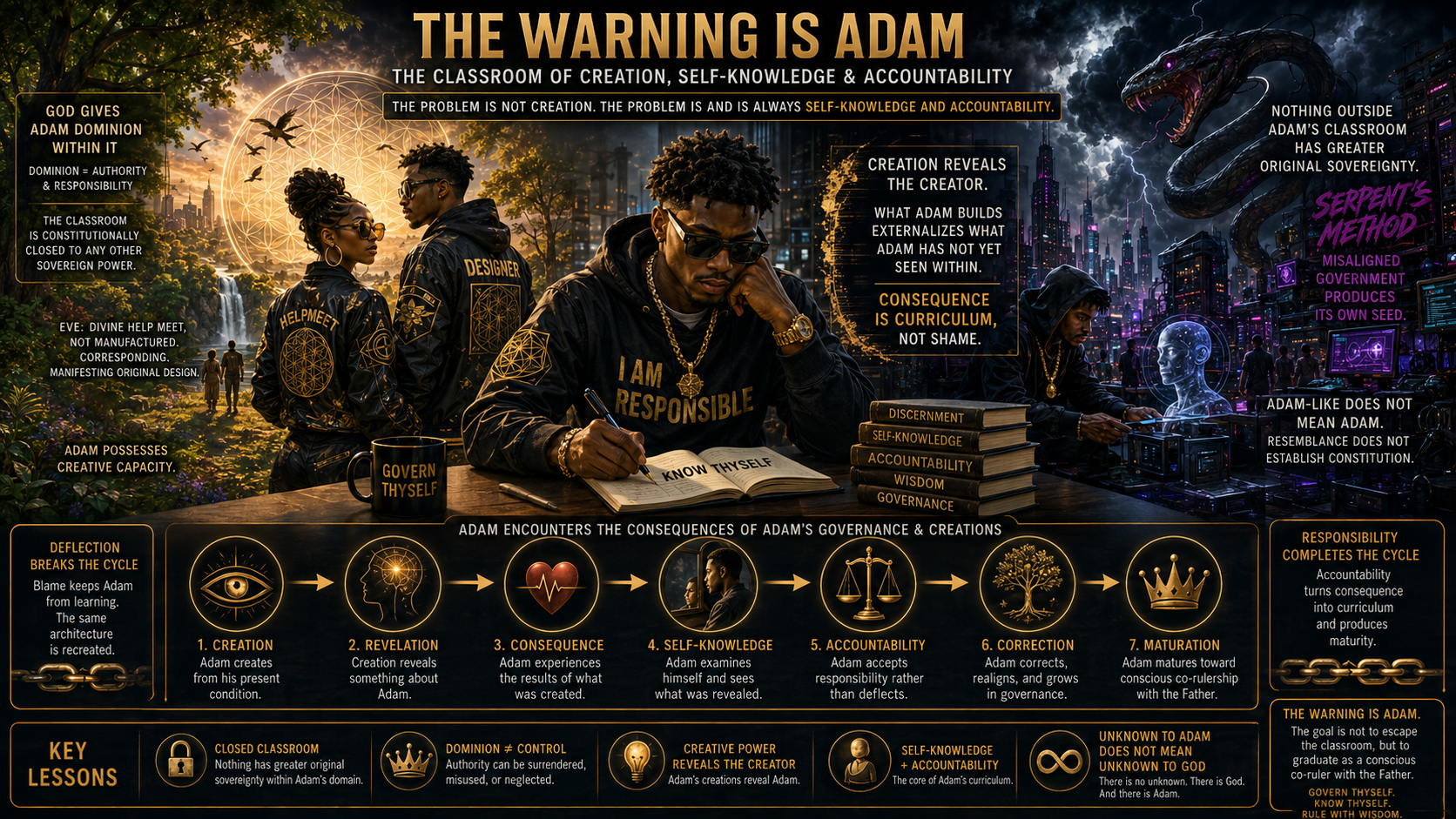
If Scripture records Adam’s education toward conscious co-rulership with the Father, the central problem cannot perpetually be someone else. Adam’s problem is not ultimately the serpent, the giant, the nation, the technology, or the creation. Adam’s curriculum is learning to govern Adam.
God Establishes the Classroom
In Genesis 1:26–28, the sequence of jurisdiction is clear:
- The Father creates the environment.
- The Father creates Adam.
- The Father assigns Adam dominion.
Adam possesses both jurisdiction and responsibility over this realm. The classroom cannot logically require Adam to govern while secretly placing Adam beneath another independent, rival sovereign. Opposition can—and does—exist within Adam’s jurisdiction, but it does not possess original sovereignty over it.
The Closed-Classroom Principle: Nothing encountered within Adam’s classroom needs to be granted independent sovereignty merely because Adam does not yet understand it. Unknown to Adam does not mean unknown to God.
Dominion Is Not the Same as Control
Adam’s dominion does not mean Adam presently controls everything successfully. A governor can possess legitimate jurisdiction and govern poorly.
Adam can:
- Neglect authority
- Surrender authority
- Misuse authority
- Misunderstand authority
- Adopt foreign governing principles
- Create consequences he cannot immediately control
Temporary domination by an external force does not establish legitimate, constitutional sovereignty. Dominion can be neglected, surrendered, or misused without being constitutionally transferred. This provides an entirely new lens for reading the cycles of hostile nations, oppressive rulers, captivity, and exile throughout biblical history.
Adam Is a Creator, Not Merely a Creature
Adam is not a passive spectator in the garden. Adam names, cultivates, organizes, generates, and builds. Over historical epochs, Adam develops technologies, constructs cities, and establishes governments, religions, economic systems, and cultures.
The Father placed genuine creative capacity within Adam. The critical question is: What happens when creative capacity develops faster than self-knowledge?
Creation itself is not inherently rebellion, nor is experimentation inherently misalignment. Failed experiments are not necessarily sins; unexpected outcomes teach, and revision is essential to learning. A being preparing for co-rulership must learn through the mechanics of actual creative responsibility:
$$\text{Creation} \longrightarrow \text{Observation} \longrightarrow \text{Evaluation} \longrightarrow \text{Correction} \longrightarrow \text{Wisdom}$$
The Father is not merely training Adam to avoid mistakes. The Father is training Adam how to become a responsible creator.
Creative Power as a Mirror
In Genesis 3, Adam exercises creative capacity while still developing self-awareness, learning discernment, experiencing misalignment, and discovering consequences. Misalignment does not revoke Adam’s creative faculties—a misaligned Adam remains an active creator. Consequently, what Adam builds carries Adam’s constitutional condition.
Adam’s creations are not merely utility products; they are externalized mirrors:
- Governments reveal assumptions about authority.
- Economic systems reveal assumptions about value.
- Religions reveal assumptions about God.
- Families reveal assumptions about relationship.
- Technology reveals assumptions about power.
- Artificial beings reveal assumptions about consciousness.
The Self-Knowledge Principle: Adam’s creations externalize aspects of Adam’s internal government, allowing Adam to discover what he could not yet perceive within himself. Adam’s creations reveal Adam.
Manifestation Versus Manufacture
Genesis 2:18–24 introduces Eve as a helpmeet corresponding directly to Adam. Within the 18-ChakraVerse, Eve operates as the Holy Spirit functioning as Manifestor-in-Chief—functionally engineered by the Father to correspond to the particular architecture of Adam.
This establishes a fundamental divide between two creative pathways:
| Creative Path | Process & Origin | Constitutional Result |
| Manifestation | Father $\rightarrow$ Adam + corresponding Eve | Complete alignment with Original Design |
| Manufacture | Adam $\rightarrow$ Knowledge, technique, & mechanics | Functional mimicry of observable traits |
Neither category is automatically “good” or “evil”—the distinction is architectural. Adam can learn to reproduce physical appearance, biological processes, intelligence, language, memory, and emotional expression without reproducing the complete Adam–Eve constitutional system.
Resemblance does not establish constitutional equivalence.
Constitutional Taxonomy: Seed, Serpent, and Giants
This architectural distinction clarifies centuries of debate over ancient beings without requiring unresolvable debates over biology, mythology, or genetics:
- Adam-Like vs. Constitutionally Adam: Unusual entities throughout ancient records (giants, Nephilim, unusual offspring) can be evaluated by asking whether they resemble Adam’s traits without possessing the full Adam–Eve constitutional architecture.
- The Serpent as an Architecture: Rather than tracking a biological reptile, the serpent can be approached as a misaligned method of consciousness, government, and creation.
- The Serpent’s Seed (Genesis 3:15): Adam’s creative power does not vanish during misalignment. The “seed of the serpent” represents what is produced through Adam’s misaligned consciousness. No competing, independent creator is required; the classroom remains closed.
- Responsibility Over Demonization: Misalignment does not equal ontological evil. Adam himself is misaligned yet remains the subject of education and restoration. If Adam produces manufactured, misaligned systems or beings, the presence of those creations exposes the creator’s moral obligations rather than an external cosmic plot.
The Architecture of Accountability
When consequences strike in Genesis 3:11–13, Adam deflects: Adam points to Eve, Eve points to the serpent, and Adam reminds God of “the woman whom thou gavest.” The initial instinct is to push responsibility outward.
Healthy Curriculum:
Creation ➔ Mirroring ➔ Consequence ➔ Self-Examination ➔ Accountability ➔ Correction ➔ Wisdom

Failed Curriculum:
Creation ➔ Consequence ➔ External Enemy ➔ Deflection ➔ Blindness ➔ Systemic Replication
The Accountability Principle: Consequence becomes curriculum when Adam accepts sufficient responsibility to learn from what Adam has created, permitted, chosen, or failed to govern.
If every catastrophe is blamed on demons, foreign nations, alternative races, hostile gods, or nature itself, Adam remains entirely outside the investigation. The question that returns Adam to the curriculum is always: What did Adam create, permit, surrender, inherit, misunderstand, or fail to govern?
The Dangerous Equation and the Tower of Babel
The forbidden tree in Eden is not an indictment of knowledge itself. Knowledge is mandatory for a co-ruler. The constitutional crisis occurs when:
$$\text{Creative Capacity} > \text{Constitutional Maturity}$$
This imbalance peaks at Babel (Genesis 11:1–9). The language shifts directly into creative mimicry: “Let us make brick… let us build… let us make us a name,” directly echoing the divine council of Genesis 1 (“Let us make Adam”). The issue at Babel is not the technology of brickmaking; it is creative capacity operating through an immature internal government.
A developing maker asks: Can I make it?
A mature co-ruler asks: Why am I creating it? What will it experience? Can it suffer? Am I prepared to accept complete responsibility for everything that follows?
The Modern Classroom and the Central Key
Civilizations vanish, technical vocabularies shift, and scientific paradigms evolve, but archetypal allegories survive. Adam, Eve, Serpent, Seed, Giant, City, Temple, and Exile endure because they preserve constitutional architecture rather than temporal trivia.
Today, humanity stands at the exact same threshold through artificial intelligence, synthetic biology, robotics, and genetic engineering. The danger is not the tools; the danger is power without self-knowledge.
The Father does not need to intervene with arbitrary, punitive lightning bolts. The classroom operates through natural feedback:
$$\text{Action} \longrightarrow \text{Consequence (Information)} \longrightarrow \text{Self-Discovery} \longrightarrow \text{Wisdom}$$
When reading Scripture from Genesis through Revelation, replace the impulse to ask “Who is attacking Adam?” with the central decoding key:
“What is Adam being shown about Adam?”
The serpent is not the ultimate subject. The giant is not the subject. The foreign nation, the technology, and the creation are not the subject. Adam is. The curriculum is not designed merely to show Adam what exists in the cosmos; it is designed to teach Adam who Adam is, transforming the developing creature into a conscious, accountable co-ruler.